PUBLISHER: Mordor Intelligence | PRODUCT CODE: 2114729

PUBLISHER: Mordor Intelligence | PRODUCT CODE: 2114729
Cord Blood Banking Services - Market Share Analysis, Industry Trends & Statistics, Growth Forecasts (2026 - 2031)
According to Mordor Intelligence, the cord blood banking services market size is expected to grow from USD 33.85 billion in 2025 to USD 35.81 billion in 2026 and is forecast to reach USD 49.85 billion by 2031 at 6.84% CAGR over 2026-2031.
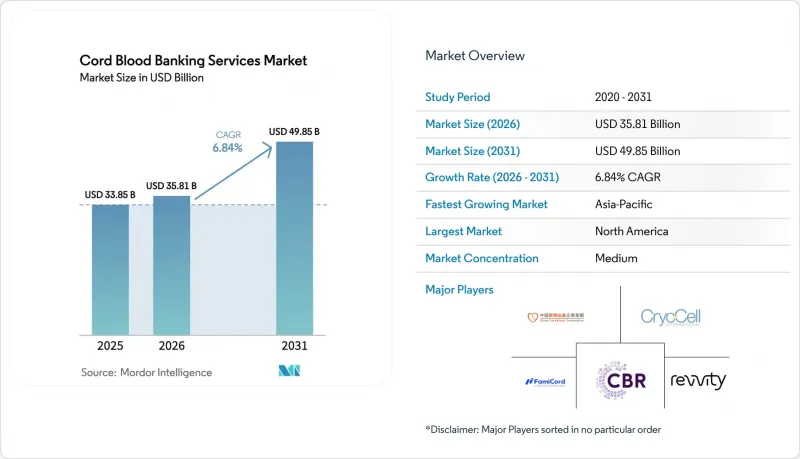
This report is Segmented by Bank Type (Public, Private), Storage Service (Processing-Only, Storage-Only, Combined Processing & Storage), Component Type (Cord Blood, Cord Tissue, Placental Blood), Application (Cancers, Blood Disorders, and More), End User (Hospitals & Clinics, and More), and Geography (North America, and More). The Market Forecasts are Provided in Terms of Value (USD).
Global Cord Blood Banking Services Market Trends and Insights
Growing Incidence of Transplant-Treatable Diseases
Leukemias and inherited anemias continue to lift transplant demand, and cord blood fills critical gaps when matched adult donors are unavailable. Acute lymphoblastic and acute myeloid leukemia account for roughly 60% of pediatric cord blood grafts, while sickle cell disease and beta-thalassemia are accelerating fastest in high-carrier geographies. Expanded newborn screening is also pushing metabolic-disorder transplants earlier when outcomes are best, as five-year survival exceeds 80% for Hurler syndrome treated before nine month. Payers in several European states now reimburse private banking for families with proven genetic risk, reinforcing the medical value proposition.
Rising Parental Awareness & Private Bank Uptake
Parents in major cities increasingly recognize that banked units offer a low-probability but high-value safety net. Up-front fees of USD 1,400-2,300 plus annual storage of USD 125-300 remain palatable to affluent households, and partnerships such as Cord Blood Registry's whole-exome sequencing bundle allow families to align storage with genetic insights. Autologous use rates stay below 1%, yet the perceived downside of not storing remains a potent motivator, keeping private demand resilient.
High Private-Banking Costs
Prices exclude many households where annual income is below USD 10,000, especially in emerging markets facing currency swings that push fees even higher. Only a handful of insurers pay for storage, restricting penetration outside upper-income tiers.
Other drivers and restraints analyzed in the detailed report include:
- Government Funding for Public Banks
- Advances in Cryopreservation & Processing Tech
- Limited Approved Clinical Applications
For complete list of drivers and restraints, kindly check the Table Of Contents.
Segment Analysis
Public institutions held 40.76% of the cord blood banking services market in 2025 and are set to grow 9.14% annually through 2031 as governments underwrite inventory diversity. Private players retain leadership due to entrenched brands and direct-to-consumer marketing, yet autologous usage below 1% continues to attract scrutiny and fosters new hybrid pricing that preserves consumer choice while enriching public stocks.
Private operators now layer genetic screening, tissue add-ons, and future access to ex-vivo expansion to justify premiums, aiming to limit cannibalization by hybrids. Public banks counter with broader HLA coverage and rising transplant success, positioning altruistic donation as both socially responsible and medically efficient.
Hospitals increasingly choose processing-only deals to avoid the capital burden of maintaining large cryogenic vaults, giving this niche a projected 9.53% CAGR. Combined processing and storage still represents 47.25% of 2025 revenue and remains the staple for full-service private banks that promote custody continuity and tighter chain-of-identity.
Banks investing in mega-facilities benefit from lower per-unit costs, yet they must also manage courier times, as cell viability drops when more than 48 hours elapse between collection and freezing. Storage-only agreements, though minor, attract parents who wish to move previously banked units into higher-accredited vaults, often after an international relocation.
Complete Report Scope:
- By Bank Type
- Public
- Private
- By Storage Service
- Processing-only
- Storage-only
- Combined Processing & Storage
- By Component Type
- Cord Blood
- Cord Tissue
- Placental Blood
- By Application
- Cancers
- Blood Disorders
- Metabolic Disorders
- Others
- By End User
- Hospitals & Clinics
- Specialty Transplant Centers
- Research Institutes
- Home Storage Users
- By Geography
- North America
- United States
- Canada
- Mexico
- Europe
- Germany
- France
- United Kingdom
- Italy
- Spain
- Rest of Europe
- Asia-Pacific
- China
- Japan
- India
- South Korea
- Australia
- Rest of Asia-Pacific
- Middle East & Africa
- GCC
- South Africa
- Rest of Middle East & Africa
- South America
- Brazil
- Argentina
- Rest of South America
- North America
Geography Analysis
North America led with 39.54% share in 2025 on the strength of mature private banking, FDA-mandated quality controls, and National Cord Blood Inventory funding of USD 16.5 million that preserved 150,000 diverse units. Canada emphasizes units from Indigenous populations to close HLA gaps, while Mexican parents often store across the border to access U.S. oversight. Competition among Cord Blood Registry, ViaCord, and Cryo-Cell squeezes margins and encourages service bundling.
Asia-Pacific should post the fastest regional CAGR at 8.24%. China's seven-license cap creates quasi-monopolies that drive premium pricing and medical tourism, with China Cord Blood Corporation reporting USD 180 million in 2024 revene. India's LifeCell and StemCyte expand at 15% a year as middle-class awareness and obstetric endorsements climb. Japan maintains stringent quality through its centralized network, while Australia limits operators to three through Therapeutic Goods Administration licensing.
Europe held roughly one-quarter of 2025 revenue. Robust public networks in the United Kingdom and Germany use performance-based funding to focus on transplant success, while private banking remains below 5% penetration due to cultural preference for public donation. Conditional EMA approval of Zemcelpro places the region at the forefront of expanded cord blood therapies. In the Middle East, Abu Dhabi Biobank's 100,000-unit vault positions the UAE as a cross-border storage hub, whereas Latin America contends with uneven accreditation; Brazil's ANVISA imposes GMP rigor, but neighboring countries lag, prompting families to store across borders for better assurance.
- AlphaCord
- Americord Registry
- Be The Match BioTherapies
- Biovault
- Boyalife Group
- Canadian Blood Services - CBB
- China Cord Blood Corp.
- Cord Blood Registry (CBR)
- Cordlife Group Ltd
- Cryo-Cell International
- FamiCord Group
- LifeCell International
- New York Blood Center (NCBP)
- NHS Cord Blood Bank
- Revvity Inc.
- Smart Cells International
- Stem Cell Technologies
- StemCyte
- Vita34 AG
Additional Benefits:
- The market estimate (ME) sheet in Excel format
- 3 months of analyst support
TABLE OF CONTENTS
1 Introduction
- 1.1 Study Assumptions & Market Definition
- 1.2 Scope of the Study
2 Research Methodology
3 Executive Summary
4 Market Landscape
- 4.1 Market Overview
- 4.2 Market Drivers
- 4.2.1 Growing Incidence of Transplant-Treatable Diseases
- 4.2.2 Rising Parental Awareness & Private Bank Uptake
- 4.2.3 Government Funding for Public Banks
- 4.2.4 Advances in Cryopreservation & Processing Tech
- 4.2.5 Ex-Vivo Stem-Cell Expansion Platforms
- 4.2.6 Hybrid Public-Private Cost-Sharing Models
- 4.3 Market Restraints
- 4.3.1 High Private-Banking Costs
- 4.3.2 Limited Approved Clinical Applications
- 4.3.3 Regulatory Accreditation Gaps in Emerging Markets
- 4.3.4 Competition From iPSC Sources
- 4.4 Value / Supply-Chain Analysis
- 4.5 Regulatory Landscape
- 4.6 Technological Outlook
- 4.7 Porter's Five Forces Analysis
- 4.7.1 Bargaining Power of Suppliers
- 4.7.2 Bargaining Power of Buyers
- 4.7.3 Threat of Substitutes
- 4.7.4 Threat of New Entrants
- 4.7.5 Intensity of Competitive Rivalry
5 Market Size & Growth Forecasts (Value in USD)
- 5.1 By Bank Type
- 5.1.1 Public
- 5.1.2 Private
- 5.2 By Storage Service
- 5.2.1 Processing-only
- 5.2.2 Storage-only
- 5.2.3 Combined Processing & Storage
- 5.3 By Component Type
- 5.3.1 Cord Blood
- 5.3.2 Cord Tissue
- 5.3.3 Placental Blood
- 5.4 By Application
- 5.4.1 Cancers
- 5.4.2 Blood Disorders
- 5.4.3 Metabolic Disorders
- 5.4.4 Others
- 5.5 By End User
- 5.5.1 Hospitals & Clinics
- 5.5.2 Specialty Transplant Centers
- 5.5.3 Research Institutes
- 5.5.4 Home Storage Users
- 5.6 By Geography
- 5.6.1 North America
- 5.6.1.1 United States
- 5.6.1.2 Canada
- 5.6.1.3 Mexico
- 5.6.2 Europe
- 5.6.2.1 Germany
- 5.6.2.2 France
- 5.6.2.3 United Kingdom
- 5.6.2.4 Italy
- 5.6.2.5 Spain
- 5.6.2.6 Rest of Europe
- 5.6.3 Asia-Pacific
- 5.6.3.1 China
- 5.6.3.2 Japan
- 5.6.3.3 India
- 5.6.3.4 South Korea
- 5.6.3.5 Australia
- 5.6.3.6 Rest of Asia-Pacific
- 5.6.4 Middle East & Africa
- 5.6.4.1 GCC
- 5.6.4.2 South Africa
- 5.6.4.3 Rest of Middle East & Africa
- 5.6.5 South America
- 5.6.5.1 Brazil
- 5.6.5.2 Argentina
- 5.6.5.3 Rest of South America
- 5.6.1 North America
6 Competitive Landscape
- 6.1 Market Concentration
- 6.2 Market Share Analysis
- 6.3 Company Profiles (includes Global level Overview, Market level overview, Core Segments, Financials as available, Strategic Information, Market Rank/Share for key companies, Products and Services, and Recent Developments)
- 6.3.1 AlphaCord
- 6.3.2 Americord Registry
- 6.3.3 Be The Match BioTherapies
- 6.3.4 Biovault Family
- 6.3.5 Boyalife Group
- 6.3.6 Canadian Blood Services - CBB
- 6.3.7 China Cord Blood Corp.
- 6.3.8 Cord Blood Registry (CBR)
- 6.3.9 Cordlife Group Ltd
- 6.3.10 Cryo-Cell International
- 6.3.11 FamiCord Group
- 6.3.12 LifeCell International
- 6.3.13 New York Blood Center (NCBP)
- 6.3.14 NHS Cord Blood Bank
- 6.3.15 Revvity Inc.
- 6.3.16 Smart Cells International
- 6.3.17 Stem Cell Technologies
- 6.3.18 StemCyte
- 6.3.19 Vita34 AG
7 Market Opportunities & Future Outlook
- 7.1 White-space & Unmet-need Assessment

