PUBLISHER: Mordor Intelligence | PRODUCT CODE: 2114736

PUBLISHER: Mordor Intelligence | PRODUCT CODE: 2114736
Patient-controlled Analgesia Pumps - Market Share Analysis, Industry Trends & Statistics, Growth Forecasts (2026 - 2031)
According to Mordor Intelligence, the patient controlled analgesic pumps market size is expected to grow from USD 491.57 million in 2025 to USD 518.66 million in 2026 and is forecast to reach USD 678.19 million by 2031 at 5.51% CAGR over 2026-2031.
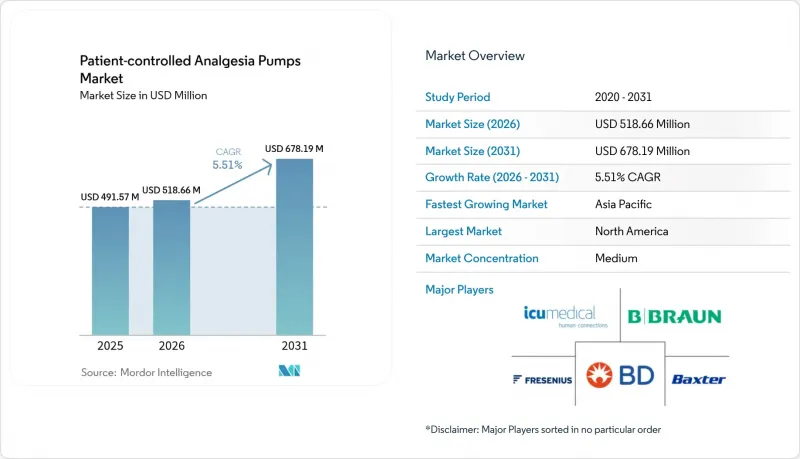
This report Segments the Industry Into by Product Type (Electronic PCA Pumps, and More), by Technology (Intravenous PCA, Epidural PCA, and More), by Application (Oncology, Diabetes-Related Pain, and More), by End Users (Hospital, Ambulatory Surgical Centers, and More), and by Geography. The Market Sizes and Forecasts are Provided in Terms of Value (USD).
Global Patient-controlled Analgesia Pumps Market Trends and Insights
Smart PCA Pumps With Advanced Safety Features
Smart pumps embed drug libraries and dose-error reduction systems that intercepted nearly 37,000 deviations in a single ICU study, underscoring their preventive value . Baxter's Novum IQ platform, cleared by the FDA in 2024, exemplifies the market shift toward bi-directional EHR interoperability that pre-populates pump settings and feeds actual delivery data back into clinical records . Evidence indicates that smart interoperability can reduce medication administration errors by 15.4%-90.5%. Consequently, healthcare systems weigh quantifiable safety outcomes over interface features when selecting vendors, reinforcing demand in the patient controlled analgesic pumps market.
Rising Prevalence Of Chronic Pain & Cancer
Cancer incidence is climbing in an aging world, driving long-term reliance on PCA modalities that preserve quality of life. Intrathecal pumps show high efficacy in refractory oncology pain. Diabetic peripheral neuropathy affects up to 40% of diabetics, with subcutaneous hydromorphone PCA titrating pain four times faster than oral opioids. These epidemiological forces create durable volume growth for the patient controlled analgesic pumps market.
Stringent Regulation & Frequent Recalls
Class I recalls covering 52,328 Nimbus pumps in 2024 illustrate the cost of non-compliance, with six injuries and one death reported . Warning letters to ICU Medical and Fresenius Kabi underscore rigorous oversight across design, manufacturing, and post-market surveillance. These events raise compliance spending and elongate development cycles, tempering near-term growth in the patient controlled analgesic pumps market.
Other drivers and restraints analyzed in the detailed report include:
- Growing Volume Of Surgical Procedures
- Growth Of Home & Ambulatory Pain Management
- EHR-Integrated Dose-Error Reduction Software
- Medication Errors From Poor Patient Education
- Cybersecurity Risks In Connected Pumps
For complete list of drivers and restraints, kindly check the Table Of Contents.
Segment Analysis
The patient controlled analgesic pumps market size for electronic pumps stood at USD 226.67 million in 2025, equal to 46.12% share, reaffirming provider preference for programmable accuracy. Smart logic maintains flow consistency despite ambient changes, a benefit absent in elastomeric systems. Improving battery life, color touchscreens, and network connectivity strengthen electronic incumbency. At the same time, wearable single-use devices, though representing a smaller baseline, are expanding at 6.14% CAGR. They cater to ambulatory and home scenarios where light weight and disposability trump advanced programmability. Mechanical elastomeric pumps remain fixtures in cost-sensitive settings, while implantable models serve refractory chronic pain. Accessories and disposables supply recurring revenue that offsets capital-equipment cyclicality, improving vendor resilience within the patient controlled analgesic pumps market.
Competitive strategies now hinge on broad product families that let facilities standardize on a single vendor. B. Braun's Perfusor PCA Syringe Pump couples KeyGuard narcotic security with weight-based dosing, illustrating incremental innovation. Meanwhile, startups emphasize wearable convenience, amplifying segment diversification. Collectively, these dynamics make product breadth and service wraparounds decisive factors for share capture across the patient controlled analgesic pumps market.
Intravenous systems generated 54.78% of patient controlled analgesic pumps market share in 2025, driven by broad surgical and critical care use. Clinicians value rapid onset and dose titration, attributes well documented in postoperative pain literature. Yet subcutaneous devices are scaling fastest at 6.65% CAGR, aided by lower infection risk and suitability for home use. Successful hydromorphone titration within 5.5 hours underscores clinical appeal. Epidural and transdermal approaches occupy specialized niches, supported by microneedle advances that promise non-invasive delivery. Vendors winning in this space focus on formulation science and patient comfort, steadily shifting technology mix within the patient controlled analgesic pumps market.
Complete Report Scope:
- By Product Type
- Electronic PCA Pumps
- Mechanical PCA Pumps
- Wearable / Single-use PCA Pumps
- Implantable / Intrathecal PCA Systems
- Pump Accessories & Disposables
- By Technology
- Intravenous PCA
- Epidural PCA
- Subcutaneous PCA
- Transdermal / Alternative Routes
- By Application
- Oncology
- Post-operative Pain
- Chronic Non-cancer Pain
- Diabetes-related Pain
- Pediatrics & Neonatology
- Palliative & End-of-life Care
- By End User
- Hospitals
- Ambulatory Surgical Centers
- Home-care Settings
- Pain Clinics & Specialty Centers
- By Geography
- North America
- United States
- Canada
- Mexico
- Europe
- Germany
- United Kingdom
- France
- Italy
- Spain
- Rest of Europe
- Asia-Pacific
- China
- Japan
- India
- Australia
- South Korea
- Rest of Asia-Pacific
- Middle East & Africa
- GCC
- South Africa
- Rest of Middle East & Africa
- South America
- Brazil
- Argentina
- Rest of South America
- North America
Geography Analysis
North America led the patient controlled analgesic pumps market with 42.08% revenue share in 2025, propelled by advanced health systems, clear reimbursement, and early smart-pump adoption. The NOPAIN Act encourages shift to non-opioid devices and home settings, feeding domestic uptake through at least 2027. Canada mirrors U.S. trends at smaller scale, while Mexico's ongoing hospital upgrades fuel mid-single-digit gains. These dynamics keep North America at the technological frontier of the patient controlled analgesic pumps market.
Asia-Pacific represents the fastest expansion at 7.29% CAGR to 2031. Rising surgical volumes, wider cancer screening, and escalating chronic disease rates underpin device demand. Terumo's Rika platform, with 98 U.S. installations as of August 2024, showcases Japanese engineering now targeting 20-25% share through multiphase rollout. China's public hospital modernization and India's private sector growth together anchor regional momentum. Yet diverse regulatory regimes require localized strategies, making strong distributor networks critical for capturing growth in the patient controlled analgesic pumps market.
Europe maintains material presence thanks to robust quality standards and social insurance coverage. Germany, France, and the United Kingdom serve as innovation hubs, whereas Southern and Eastern Europe trail in adoption pace. National health systems weigh cost-effectiveness heavily, setting a high bar for value demonstration. South America and Middle East & Africa contribute limited volume but hold long-term promise as infrastructure matures, creating a multi-speed map for the patient controlled analgesic pumps market.
- Baxter
- Beckton Dickinson
- ICU Medical
- Fresenius
- B. Braun
- Terumo
- Abbott Laboratories
- Micrel Medical Devices
- Medtronic
- Mindray
- Ace Medical Co., Ltd.
- JMS Co., Ltd.
- Nipro
- Avante Health Solutions
- Flextronics Medical (Viant)
- Epic Medical
- TandemLife (LivaNova)
- Insightra Medical
- Promedica Bioelectronics
- Woo Young Medical
Additional Benefits:
- The market estimate (ME) sheet in Excel format
- 3 months of analyst support
TABLE OF CONTENTS
1 Introduction
- 1.1 Study Assumptions & Market Definition
- 1.2 Scope of the Study
2 Research Methodology
3 Executive Summary
4 Market Landscape
- 4.1 Market Overview
- 4.2 Market Drivers
- 4.2.1 Smart PCA Pumps With Advanced Safety Features
- 4.2.2 Rising Prevalence Of Chronic Pain & Cancer
- 4.2.3 Growing Volume Of Surgical Procedures
- 4.2.4 Growth Of Home & Ambulatory Pain-Management
- 4.2.5 Ehr-Integrated Dose-Error Reduction Software
- 4.2.6 Wearable Single-Use Pca Devices
- 4.3 Market Restraints
- 4.3.1 Stringent Regulation & Frequent Recalls
- 4.3.2 Medication Errors From Poor Patient Education
- 4.3.3 Cyber-Security Risks In Connected Pumps
- 4.3.4 Semiconductor & Battery Supply Shortages
- 4.4 Value / Supply-Chain Analysis
- 4.5 Regulatory Landscape
- 4.6 Technological Outlook
- 4.7 Porters Five Forces Analysis
- 4.7.1 Threat of New Entrants
- 4.7.2 Bargaining Power of Buyers/Consumers
- 4.7.3 Bargaining Power of Suppliers
- 4.7.4 Threat of Substitute Products
- 4.7.5 Intensity of Competitive Rivalry
5 Market Size & Growth Forecasts (Value, USD million)
- 5.1 By Product Type
- 5.1.1 Electronic PCA Pumps
- 5.1.2 Mechanical PCA Pumps
- 5.1.3 Wearable / Single-use PCA Pumps
- 5.1.4 Implantable / Intrathecal PCA Systems
- 5.1.5 Pump Accessories & Disposables
- 5.2 By Technology
- 5.2.1 Intravenous PCA
- 5.2.2 Epidural PCA
- 5.2.3 Subcutaneous PCA
- 5.2.4 Transdermal / Alternative Routes
- 5.3 By Application
- 5.3.1 Oncology
- 5.3.2 Post-operative Pain
- 5.3.3 Chronic Non-cancer Pain
- 5.3.4 Diabetes-related Pain
- 5.3.5 Pediatrics & Neonatology
- 5.3.6 Palliative & End-of-life Care
- 5.4 By End User
- 5.4.1 Hospitals
- 5.4.2 Ambulatory Surgical Centers
- 5.4.3 Home-care Settings
- 5.4.4 Pain Clinics & Specialty Centers
- 5.5 By Geography
- 5.5.1 North America
- 5.5.1.1 United States
- 5.5.1.2 Canada
- 5.5.1.3 Mexico
- 5.5.2 Europe
- 5.5.2.1 Germany
- 5.5.2.2 United Kingdom
- 5.5.2.3 France
- 5.5.2.4 Italy
- 5.5.2.5 Spain
- 5.5.2.6 Rest of Europe
- 5.5.3 Asia-Pacific
- 5.5.3.1 China
- 5.5.3.2 Japan
- 5.5.3.3 India
- 5.5.3.4 Australia
- 5.5.3.5 South Korea
- 5.5.3.6 Rest of Asia-Pacific
- 5.5.4 Middle East & Africa
- 5.5.4.1 GCC
- 5.5.4.2 South Africa
- 5.5.4.3 Rest of Middle East & Africa
- 5.5.5 South America
- 5.5.5.1 Brazil
- 5.5.5.2 Argentina
- 5.5.5.3 Rest of South America
- 5.5.1 North America
6 Competitive Landscape
- 6.1 Market Concentration
- 6.2 Market Share Analysis
- 6.3 Company Profiles {(includes Global level Overview, Market level overview, Core Segments, Financials as available, Strategic Information, Market Rank/Share for key companies, Products & Services, and Recent Developments)}
- 6.3.1 Baxter International Inc.
- 6.3.2 Becton, Dickinson and Company (BD)
- 6.3.3 ICU Medical Inc. (Smiths Medical)
- 6.3.4 Fresenius SE & Co. KGaA
- 6.3.5 B. Braun SE
- 6.3.6 Terumo Corporation
- 6.3.7 Abbott Laboratories
- 6.3.8 Micrel Medical Devices
- 6.3.9 Medtronic plc
- 6.3.10 Mindray Medical International
- 6.3.11 Ace Medical Co., Ltd.
- 6.3.12 JMS Co., Ltd.
- 6.3.13 Nipro Corporation
- 6.3.14 Avante Health Solutions
- 6.3.15 Flextronics Medical (Viant)
- 6.3.16 Epic Medical
- 6.3.17 TandemLife (LivaNova)
- 6.3.18 Insightra Medical
- 6.3.19 Promedica Bioelectronics
- 6.3.20 Woo Young Medical
7 Market Opportunities & Future Outlook
- 7.1 White-space & Unmet-need Assessment

