PUBLISHER: Mordor Intelligence | PRODUCT CODE: 2114737

PUBLISHER: Mordor Intelligence | PRODUCT CODE: 2114737
Alexipharmic Drugs - Market Share Analysis, Industry Trends & Statistics, Growth Forecasts (2026 - 2031)
According to Mordor Intelligence, alexipharmic drugs market size in 2026 is estimated at USD 5.02 billion, growing from 2025 value of USD 4.76 billion with 2031 projections showing USD 6.55 billion, growing at 5.47% CAGR over 2026-2031.
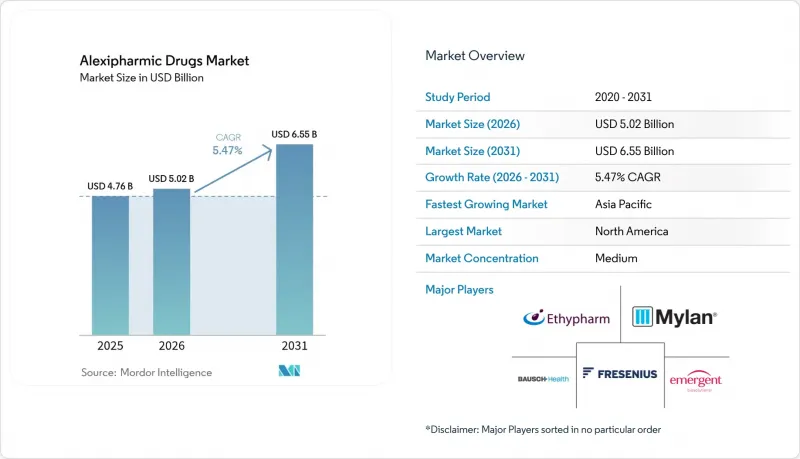
This report is Segmented by Drug Class (Opioid Antagonists, Benzodiazepine Antagonists, and More), Route of Administration (Parenteral, and More), Formulation (Solution, Auto-Injector, and More), Distribution Channel (Hospital Pharmacies, and More), and Geography (North America, Europe, Asia-Pacific, Middle East & Africa, South America). The Market Forecasts are Provided in Terms of Value (USD).
Global Alexipharmic Drugs Market Trends and Insights
Rising Dependence on Psychoactive & Narcotic Drugs
Synthetic opioids that exceed fentanyl potency now circulate in United States and European street markets, widening the overdose severity spectrum and prompting demand for higher-dose naloxone kits. Gaps in rapid detection technology amplify accidental exposure risks, pushing hospitals and first responders to maintain larger inventories. Distribution networks in Latin America and Southeast Asia are beginning to mirror North American consumption patterns, suggesting the upward trend in antidote volumes will persist. Pharmaceutical firms answer the need by co-developing concentrated formulations that overcome receptor saturation. Broader availability of test strips for new analogs is expected to support earlier intervention yet will not reduce naloxone demand in the short term.
Regulatory Backing for Medication-Assisted Treatment (MAT)
The 2024 FDA decision reclassifying Narcan nasal spray to over-the-counter status erased prescription barriers, allowing pharmacies, schools, and public venues to stock the antidote without clinician oversight. Medicare and Medicaid now reimburse naloxone with minimal copay in 42 states, embedding recurring purchase orders into public budgets. Europe follows similar cues with centralized EMA approvals that shorten lead times for new intranasal launches. These moves transform community harm-reduction initiatives from grant-funded pilots into permanent public health fixtures. As more countries embed naloxone coverage into national formularies, the alexipharmic market gains a predictable baseline of volume growth independent of broader economic cycles.
High Therapy & Hospitalization Costs
Out-of-pocket charges for a two-pack OTC naloxone carton average USD 44 in the United States, deterring purchase among uninsured households. Hospital buyers weigh antidote restocking against high-volume generics and may under-order products with uncertain turnover. Specialized cyanide antidotes can exceed USD 1,200 per adult dose, discouraging rural facilities from keeping full treatment courses. Insurance reimbursement disparities across states deepen gaps, leaving clusters of counties without 24-hour antidote access. Varying co-payment levels under Medicaid further fragment purchasing power, reducing the uniformity of demand and dampening the alexipharmic market CAGR.
Other drivers and restraints analyzed in the detailed report include:
- Escalating Synthetic-Opioid Fatalities in Lower-Income Regions
- Surge in Counterfeit-Drug Poisonings Triggering Naloxone Demand
- Rising Popularity of Abuse-Deterrent Opioid Formulations
For complete list of drivers and restraints, kindly check the Table Of Contents.
Segment Analysis
Opioid antagonists commanded 68.94% of 2025 revenue, underscoring the synthetic opioid emergency that dominates clinical headlines across developed economies. Naloxone's switch to OTC status multiplied consumer touchpoints, from gas stations to college campuses, cementing the segment's lead. Cyanide antidotes, while niche, exhibit the fastest 8.33% CAGR because industrial regulators now require on-site kits at electroplating plants and chemical warehouses. Benzodiazepine reversal agents show mid-single-digit growth tied to elective surgery volumes. Heavy-metal chelators gain episodically during environmental incidents yet contribute steady baseline turnover. Competitive profiles vary: opioid antagonists face generic entrants that suppress price, whereas cyanide antidotes benefit from patent-protected formulations, enabling premium margins.
Product expansion into multi-dose blister packs and child-resistant nasal applicators illustrates how packaging innovation supports broader user adoption across home, workplace, and first-responder settings. Manufacturers differentiate through shelf-life extensions and tamper-evident seals that satisfy stringent procurement criteria.
Parenteral formats represent 61.25% of 2025 sales because emergency departments prioritize intravenous onset that achieves peak plasma levels within minutes. Intranasal products, however, log a 7.55% CAGR as regulators approve self-administered sprays for layperson use, especially in public venues lacking clinical staff. Oral and sublingual deliveries address maintenance therapy rather than acute reversal and thus carve a smaller but steady niche.
Hospitals continue to demand vial stability under variable refrigeration conditions, prompting R&D into heat-tolerant formulations. Meanwhile, community health programs evaluate spray devices that provide audible click confirmation, reducing training complexity and error risk. Manufacturers that align dose strengths with emerging high-potency opioid threats gain formulary preference.
Complete Report Scope:
- By Drug Class
- Opioid Antagonists
- Benzodiazepine Antagonists
- Cyanide Antidotes
- Heavy-Metal Chelators
- Others
- By Route of Administration
- Parenteral
- Intranasal
- Oral & Sublingual
- By Formulation
- Solution
- Auto-Injector
- Nasal Spray
- Tablets & Capsules
- By Distribution Channel
- Hospital Pharmacies
- Retail & Community Pharmacies
- Other End Users
- By Geography
- North America
- United States
- Canada
- Mexico
- Europe
- Germany
- United Kingdom
- France
- Italy
- Spain
- Rest of Europe
- Asia-Pacific
- China
- Japan
- India
- Australia
- South Korea
- Rest of Asia-Pacific
- Middle East & Africa
- GCC
- South Africa
- Rest of Middle East & Africa
- South America
- Brazil
- Argentina
- Rest of South America
- North America
Geography Analysis
North America retains leadership with 38.92% of global sales in 2025. Federal investments such as BARDA's five-year naloxone framework agreement deliver predictable offtake that stabilizes factory capacity planning. Harm-reduction strategies embed antidotes into police cruisers and public libraries, expanding non-clinical utilization points. Overdose mortality eased 27% from 2023 to 2024, signaling effectiveness of widespread distribution, yet the persistence of nitazenes sustains bulk ordering. Canada's national plan funds free naloxone for high-risk prescriptions, and Mexico's new industrial safety code mandates cyanide antidote kits in gold-mining districts, contributing incremental upticks.
Asia Pacific posts the fastest 8.76% CAGR and is poised to surpass Europe by 2031. Industrial build-out raises cyanide exposure in metal finishing, prompting local labor ministries to enforce on-site antidote inventory. Japan approved diazepam nasal spray in 2024, signaling broader acceptance of non-injectables, while China's generics pipeline lowers price barriers for municipal emergency stockpiles. India's role as API powerhouse positions domestic firms to backfill global shortages and capture value through export-linked incentives. Emerging economies in Southeast Asia face counterfeit-drug influxes that increase community naloxone demands, steering humanitarian aid budgets toward antidote procurement.
Europe maintains steady mid-single-digit growth anchored by EMA's centralized procedure that eases cross-border circulation of new formulations. Post-Brexit recalibration diverted some volume from UK-centric hubs to continental warehouses, but also invited new entrants that leverage local fill-finish lines. Regional green-transition policies target reduction of cyanogenic emissions, indirectly boosting demand for detoxification agents during remediation projects. Abuse-deterrent opioid uptake is highest in Scandinavian markets, which could temper long-term naloxone volumes yet will take several years to materially influence totals.
- Emergent Bio Solutions
- Hikma Pharmaceuticals
- Pfizer
- Mylan N.V. (Viatris)
- Bausch Health
- Alkermes
- Amphastar Pharma
- Indivior
- Hikma (Ethypharm)
- Fresenius
- Mallinckrodt Pharmaceuticals
- SG Pharma
- Teva Pharma
- B. Braun
- Takeda (ANTIZOL)
- Merck
- Johnson & Johnson
- Novartis
- Glenmark Pharmaceuticals
- Cipla
- Dr. Reddy's
Additional Benefits:
- The market estimate (ME) sheet in Excel format
- 3 months of analyst support
TABLE OF CONTENTS
1 Introduction
- 1.1 Study Assumptions & Market Definition
- 1.2 Scope of the Study
2 Research Methodology
3 Executive Summary
4 Market Landscape
- 4.1 Market Overview
- 4.2 Market Drivers
- 4.2.1 Rising Dependence on Psychoactive & Narcotic Drugs
- 4.2.2 Regulatory Backing for Medication-Assisted Treatment (MAT)
- 4.2.3 Escalating Synthetic-Opioid Fatalities in Lower-Income Regions
- 4.2.4 Surge in Counterfeit-Drug Poisonings Triggering Naloxone Demand
- 4.2.5 Government-Funded Community Naloxone Programs
- 4.2.6 Venture Funding in Intranasal & Auto-Injector Delivery Tech
- 4.3 Market Restraints
- 4.3.1 High Therapy & Hospitalization Costs
- 4.3.2 Rising Popularity of Abuse-Deterrent Opioid Formulations
- 4.3.3 Stigma Limiting Patient Access & Prescription Fill Rates
- 4.3.4 Supply-Chain Shocks for Key Antidotes' APIs
- 4.4 Porter's Five Forces Analysis
- 4.4.1 Threat of New Entrants
- 4.4.2 Bargaining Power of Buyers
- 4.4.3 Bargaining Power of Suppliers
- 4.4.4 Threat of Substitutes
- 4.4.5 Competitive Rivalry
5 Market Size & Growth Forecasts (Value in USD)
- 5.1 By Drug Class
- 5.1.1 Opioid Antagonists
- 5.1.2 Benzodiazepine Antagonists
- 5.1.3 Cyanide Antidotes
- 5.1.4 Heavy-Metal Chelators
- 5.1.5 Others
- 5.2 By Route of Administration
- 5.2.1 Parenteral
- 5.2.2 Intranasal
- 5.2.3 Oral & Sublingual
- 5.3 By Formulation
- 5.3.1 Solution
- 5.3.2 Auto-Injector
- 5.3.3 Nasal Spray
- 5.3.4 Tablets & Capsules
- 5.4 By Distribution Channel
- 5.4.1 Hospital Pharmacies
- 5.4.2 Retail & Community Pharmacies
- 5.4.3 Other End Users
- 5.5 By Geography
- 5.5.1 North America
- 5.5.1.1 United States
- 5.5.1.2 Canada
- 5.5.1.3 Mexico
- 5.5.2 Europe
- 5.5.2.1 Germany
- 5.5.2.2 United Kingdom
- 5.5.2.3 France
- 5.5.2.4 Italy
- 5.5.2.5 Spain
- 5.5.2.6 Rest of Europe
- 5.5.3 Asia-Pacific
- 5.5.3.1 China
- 5.5.3.2 Japan
- 5.5.3.3 India
- 5.5.3.4 Australia
- 5.5.3.5 South Korea
- 5.5.3.6 Rest of Asia-Pacific
- 5.5.4 Middle East & Africa
- 5.5.4.1 GCC
- 5.5.4.2 South Africa
- 5.5.4.3 Rest of Middle East & Africa
- 5.5.5 South America
- 5.5.5.1 Brazil
- 5.5.5.2 Argentina
- 5.5.5.3 Rest of South America
- 5.5.1 North America
6 Competitive Landscape
- 6.1 Market Concentration
- 6.2 Market Share Analysis
- 6.3 Company Profiles (includes Global level Overview, Market-level Overview, Core Segments, Financials, Strategic Info, Market Rank/Share, Products & Services, Recent Developments)
- 6.3.1 Emergent BioSolutions
- 6.3.2 Hikma Pharmaceuticals
- 6.3.3 Pfizer Inc.
- 6.3.4 Mylan N.V. (Viatris)
- 6.3.5 Bausch Health Companies Inc.
- 6.3.6 Alkermes
- 6.3.7 Amphastar Pharma
- 6.3.8 Indivior PLC
- 6.3.9 Hikma (Ethypharm)
- 6.3.10 Fresenius Kabi
- 6.3.11 Mallinckrodt
- 6.3.12 SG Pharma
- 6.3.13 Teva Pharma
- 6.3.14 B. Braun Melsungen
- 6.3.15 Takeda (ANTIZOL)
- 6.3.16 Merck & Co.
- 6.3.17 Johnson & Johnson
- 6.3.18 Novartis (Sandoz)
- 6.3.19 Glenmark
- 6.3.20 Cipla
- 6.3.21 Dr. Reddy's
7 Market Opportunities & Future Outlook
- 7.1 White-space & Unmet-need Assessment

