PUBLISHER: Mordor Intelligence | PRODUCT CODE: 2114739

PUBLISHER: Mordor Intelligence | PRODUCT CODE: 2114739
Contrast Enhanced Ultrasound - Market Share Analysis, Industry Trends & Statistics, Growth Forecasts (2026 - 2031)
According to Mordor Intelligence, contrast enhanced ultrasound market size in 2026 is estimated at USD 2.34 billion, growing from 2025 value of USD 2.22 billion with 2031 projections showing USD 3.03 billion, growing at 5.31% CAGR over 2026-2031.
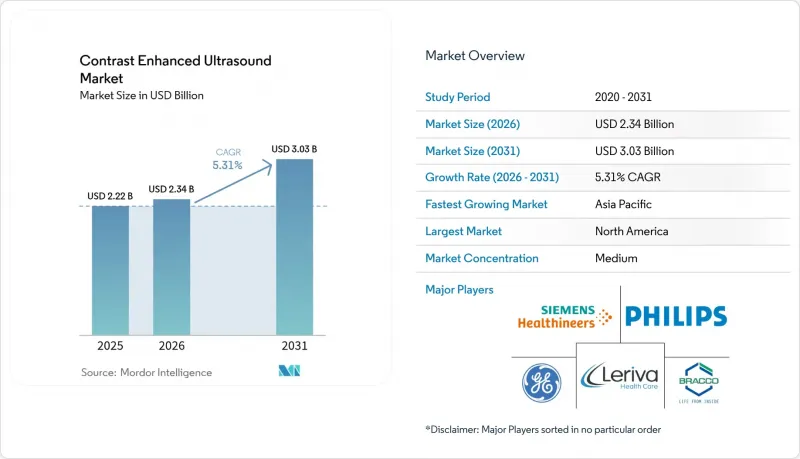
This report is Segmented by Product Type (Equipment, Contrast Agents), Technology (Non-Targeted and Targeted), Application (Cardiovascular Imaging, Hepatic & Biliary Imaging, and More), End User (Hospitals, Diagnostic Imaging Centers, and More), and Geography (North America, Europe, Asia-Pacific, Middle East & Africa, South America). The Market Forecasts are Provided in Terms of Value (USD).
Global Contrast Enhanced Ultrasound Market Trends and Insights
Rising Burden of Chronic Cardiovascular & Hepatic Diseases Necessitating Real-Time Perfusion Imaging
Steady growth in cardiac and liver pathologies heightens demand for dynamic perfusion assessment. CEUS delivers real-time visualization of microvascular flow that conventional B-mode ultrasound misses, achieving 86% sensitivity and 91.3% specificity for differentiating malignant from benign liver lesions in multi-center trials. These performance gains reduce secondary imaging and support earlier interventions, promoting wider procedural adoption across tertiary centers in North America and Europe.
Shift Toward Radiation-Free Imaging for Pediatric & Pregnant Populations
Concerns over ionizing radiation continue to steer clinicians toward ultrasound. CEUS provides diagnostic performance comparable with CT or MRI while eliminating radiation and nephrotoxicity risks. Severe adverse reactions occur in fewer than 0.01% of administrations, according to the Cleveland Clinic. Policy directives in Europe and updated pediatric guidelines in the United States further reinforce this transition, encouraging hospitals to embed CEUS pathways in routine pediatric liver and renal work-ups.
Limited Availability of CEUS-Trained Sonographers
A 2024 Journal of Diagnostic Medical Sonography survey found 42% of professionals cite inadequate training as the chief obstacle to CEUS deployment. Skill shortages lengthen exam scheduling and curb utilization, especially in smaller hospitals lacking structured mentorship. Large vendors now bundle e-learning modules with console purchases, yet adoption in emerging economies lags, constraining volume growth in regions that would benefit most from radiation-free imaging.
Other drivers and restraints analyzed in the detailed report include:
- Expansion of Point-of-Care Ultrasound Platforms in Emergency & Critical Care
- Growing Investments by Government and Private Organizations
- Stringent & Lengthy Regulatory Pathways for Novel Contrast Agents
For complete list of drivers and restraints, kindly check the Table Of Contents.
Segment Analysis
In 2025, equipment generated 61.42% of revenue within the contrast enhanced ultrasound market. Hospitals prize multi-purpose premium consoles for their versatility across abdominal, cardiac, and obstetric imaging. The contrast enhanced ultrasound market size for equipment is projected to climb steadily alongside replacement cycles in North America and Europe. Meanwhile, contrast agents are expanding at 10.74% CAGR thanks to broader procedure counts and the approval of safer sulfur-hexafluoride microbubbles. Bracco's Hexagon plant will remove historical supply bottlenecks and underpin double-digit shipment growth across Asia and Latin America. Innovation momentum is strongest in targeted agents that enable molecular imaging, an area attracting collaborative R&D between biotech firms and scanner OEMs.
Demand synergies are evident: every incremental console installation spurs recurring consumable sales, while new agents trigger software upgrades that differentiate vendors. Bundled service contracts that combine transducer warranties and agent purchasing agreements are creating stickier customer relationships. Emerging economies, however, still favor cost-effective mid-tier machines paired with generic microbubbles, hinting at a bifurcated purchasing landscape that challenges single-price global strategies.
Non-targeted CEUS held 88.07% of revenue in 2025, anchored by broad regulatory clearance and established clinical protocols. The contrast enhanced ultrasound market size for non-targeted exams continues to rise, driven by cardiology and abdominal imaging volumes. Yet targeted CEUS is gaining traction as academic centers validate ligand-specific microbubbles for oncology and inflammation.
The segment's 14.02% CAGR to 2031 reflects a pipeline of agents aimed at VEGF, integrins, and immune checkpoints. Early adopters in Europe are publishing encouraging results on drug-response monitoring, opening reimbursement discussions. Obstacles remain: longer regulatory reviews and interpretive complexity require tighter radiologist-clinician collaboration. Still, targeted imaging aligns with precision medicine trends, positioning the modality for outsized sampling in oncology trials and immune-therapy monitoring.
Complete Report Scope:
- By Product Type
- Equipment
- Contrast Agents
- By Technology
- Non-targeted CEUS
- Targeted CEUS
- By Application
- Cardiovascular Imaging
- Hepatic & Biliary Imaging
- Renal & Urological Imaging
- Obstetrics & Gynecology
- Oncology & Tumor Characterisation
- Others
- By End User
- Hospitals
- Diagnostic Imaging Centers
- Ambulatory Surgical Centers
- Academic & Research Institutes
- By Geography
- North America
- United States
- Canada
- Mexico
- Europe
- Germany
- United Kingdom
- France
- Italy
- Spain
- Rest of Europe
- Asia-Pacific
- China
- Japan
- India
- Australia
- South Korea
- Rest of Asia-Pacific
- Middle East & Africa
- GCC
- South Africa
- Rest of Middle East & Africa
- South America
- Brazil
- Argentina
- Rest of South America
- North America
Geography Analysis
North America commanded 36.88% revenue in 2025, supported by early FDA approvals and robust reimbursement. Numerous teaching hospitals lead CEUS guideline formulation, ensuring rapid diffusion into community practice. Canada's inclusion of CEUS in national hepatocellular carcinoma pathways further cements leadership. Europe ranks second, with Germany and the United Kingdom emphasizing radiation-dose mitigation; the European Federation of Societies for Ultrasound in Medicine and Biology's updated 2024 guidelines codify best practices and foster uniform quality across member states.
Asia delivers the highest growth at 9.41% CAGR. China's Healthy China 2030 plan prioritizes advanced imaging, funneling subsidies toward provincial hospitals that adopt CEUS. Japan's rapidly aging population drives cardiovascular and oncologic imaging, and local vendors introduce compact scanners tailored to clinic use. India remains nascent but exhibits strong potential as awareness grows and local distributors market competitively priced consoles.
Latin America and the Middle East & Africa trail in aggregate adoption, weighed by capital constraints and limited practitioner training. Multilateral development banks fund select pilot sites, hinting at gradual diffusion. Government partnerships with leading vendors could quicken momentum if bundled equipment-training packages lower entry barriers.
- Bracco
- Lantheus
- GE HealthCare Technologies Inc.
- Siemens Healthineers
- Koninklijke Philips
- Daiichi-Sankyo Co. Ltd.
- Canon
- Samsung Medison Co. Ltd.
- Esaote S.p.A.
- Mindray
- Hitachi Healthcare (Fujifilm)
- Guerbet SA
- Trivitron Healthcare
- Chison Medical Imaging Co. Ltd.
- Terason
- Sonoscape Medical Corp.
- Supersonic Imagine SA (Hologic)
- FUJIFILM VisualSonics Inc.
- Leriva Group
Additional Benefits:
- The market estimate (ME) sheet in Excel format
- 3 months of analyst support
TABLE OF CONTENTS
1 Introduction
- 1.1 Study Assumptions & Market Definition
- 1.2 Scope of the Study
2 Research Methodology
3 Executive Summary
4 Market Landscape
- 4.1 Market Overview
- 4.2 Market Drivers
- 4.2.1 Rising Burden of Chronic Cardiovascular & Hepatic Diseases Necessitating Real-Time Perfusion Imaging
- 4.2.2 Shift Toward Radiation-Free Imaging for Pediatric & Pregnant Populations
- 4.2.3 Expansion of Point-of-Care Ultrasound Platforms in Emergency & Critical Care
- 4.2.4 Growing Investments by Government and Private Organization
- 4.2.5 Rising Demand for Minimally Invasive Diagnostic Procedures
- 4.2.6 Technological Advancements in Microbubble Contrast Agents
- 4.3 Market Restraints
- 4.3.1 Limited Availability of CEUS-Trained Sonographers
- 4.3.2 Stringent & Lengthy Regulatory Pathways for Novel Contrast Agents
- 4.3.3 High Capital Costs of Premium CEUS-Enabled Ultrasound Systems
- 4.3.4 Adverse Reactions & Safety Concerns with Contrast Agents
- 4.4 Technological Outlook
- 4.5 Porter's Five Forces Analysis
- 4.5.1 Threat of New Entrants
- 4.5.2 Bargaining Power of Buyers
- 4.5.3 Bargaining Power of Suppliers
- 4.5.4 Threat of Substitutes
- 4.5.5 Intensity of Competitive Rivalry
5 Market Size & Growth Forecasts (Value in USD)
- 5.1 By Product Type
- 5.1.1 Equipment
- 5.1.2 Contrast Agents
- 5.2 By Technology
- 5.2.1 Non-targeted CEUS
- 5.2.2 Targeted CEUS
- 5.3 By Application
- 5.3.1 Cardiovascular Imaging
- 5.3.2 Hepatic & Biliary Imaging
- 5.3.3 Renal & Urological Imaging
- 5.3.4 Obstetrics & Gynecology
- 5.3.5 Oncology & Tumor Characterisation
- 5.3.6 Others
- 5.4 By End User
- 5.4.1 Hospitals
- 5.4.2 Diagnostic Imaging Centers
- 5.4.3 Ambulatory Surgical Centers
- 5.4.4 Academic & Research Institutes
- 5.5 By Geography
- 5.5.1 North America
- 5.5.1.1 United States
- 5.5.1.2 Canada
- 5.5.1.3 Mexico
- 5.5.2 Europe
- 5.5.2.1 Germany
- 5.5.2.2 United Kingdom
- 5.5.2.3 France
- 5.5.2.4 Italy
- 5.5.2.5 Spain
- 5.5.2.6 Rest of Europe
- 5.5.3 Asia-Pacific
- 5.5.3.1 China
- 5.5.3.2 Japan
- 5.5.3.3 India
- 5.5.3.4 Australia
- 5.5.3.5 South Korea
- 5.5.3.6 Rest of Asia-Pacific
- 5.5.4 Middle East & Africa
- 5.5.4.1 GCC
- 5.5.4.2 South Africa
- 5.5.4.3 Rest of Middle East & Africa
- 5.5.5 South America
- 5.5.5.1 Brazil
- 5.5.5.2 Argentina
- 5.5.5.3 Rest of South America
- 5.5.1 North America
6 Competitive Landscape
- 6.1 Market Concentration
- 6.2 Market Share Analysis
- 6.3 Company Profiles (includes Global level Overview, Market level overview, Core Segments, Financials as available, Strategic Information, Market Rank/Share for key companies, Products & Services, and Recent Developments)
- 6.3.1 Bracco Diagnostics Inc.
- 6.3.2 Lantheus Medical Imaging Inc.
- 6.3.3 GE HealthCare Technologies Inc.
- 6.3.4 Siemens Healthineers AG
- 6.3.5 Koninklijke Philips N.V.
- 6.3.6 Daiichi-Sankyo Co. Ltd.
- 6.3.7 Canon Medical Systems Corp.
- 6.3.8 Samsung Medison Co. Ltd.
- 6.3.9 Esaote S.p.A.
- 6.3.10 Shenzhen Mindray Bio-Medical Electronics Co. Ltd.
- 6.3.11 Hitachi Healthcare (Fujifilm)
- 6.3.12 Guerbet SA
- 6.3.13 Trivitron Healthcare Pvt. Ltd.
- 6.3.14 Chison Medical Imaging Co. Ltd.
- 6.3.15 Terason
- 6.3.16 Sonoscape Medical Corp.
- 6.3.17 Supersonic Imagine SA (Hologic)
- 6.3.18 FUJIFILM VisualSonics Inc.
- 6.3.19 Leriva Group
7 Market Opportunities & Future Outlook
- 7.1 White-space & Unmet-Need Assessment

