PUBLISHER: Mordor Intelligence | PRODUCT CODE: 2114740

PUBLISHER: Mordor Intelligence | PRODUCT CODE: 2114740
Laparoscopic Retrieval Bags - Market Share Analysis, Industry Trends & Statistics, Growth Forecasts (2026 - 2031)
According to Mordor Intelligence, the laparoscopic retrieval bags market size in 2026 is estimated at USD 559.8 million, growing from 2025 value of USD 520.45 million with 2031 projections showing USD 805.88 million, growing at 7.56% CAGR over 2026-2031.
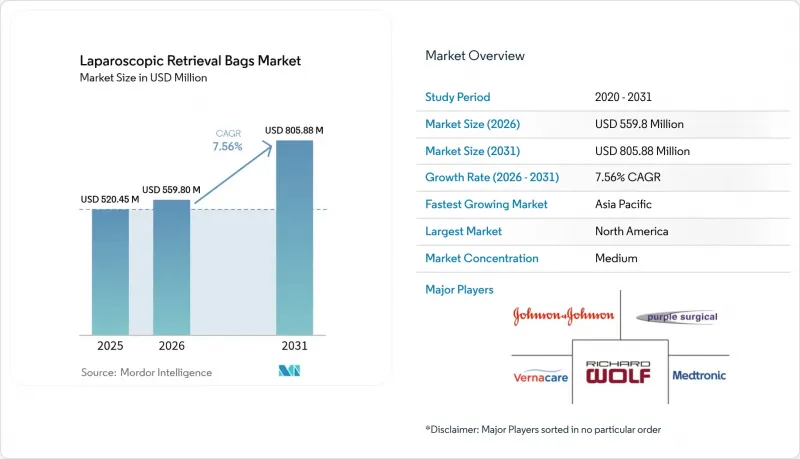
This report is Segmented by Type (Detachable Retrieval Bags, Non-Detachable Retrieval Bags), Technique (Manual Opening, Automatic Opening), Application (Gastrointestinal Surgeries, Gynecological Surgeries, Urological Surgeries, Other Applications), End User (Hospitals, and More), and Geography (North America, Europe, and More). The Market Forecasts are Provided in Terms of Value (USD).
Global Laparoscopic Retrieval Bags Market Trends and Insights
Rising Demand for Minimally-Invasive Surgery
Minimally invasive techniques now represent more than 80% of select surgical categories in leading health systems, shortening length of stay by up to 3 days and lowering complication risk. New imaging platforms such as the EVIS X1 endoscopy system cleared by the FDA in 2025 have raised image quality standards, reinforcing surgeon confidence in laparoscopy . Training curricula increasingly centre on advanced laparoscopic skills, creating a workforce predisposed to prefer these methods. Each minimally invasive case typically necessitates a sterile extraction bag, which directly lifts unit consumption. In value-based payment environments, faster recovery and fewer infections underpin further procedure migration to laparoscopy, accelerating demand across the laparoscopic retrieval bags market.
Growing Burden of Target Abdominal & Pelvic Diseases
Colorectal cancer interventions have climbed by 15% year on year in developed economies, while gallbladder, appendiceal, and gynaecological cases add to the cumulative surgical volume. In Japan alone, the medical device sector reached USD 40 billion in 2021 and is tracking a 5.5% CAGR to 2027, signalling substantial procedure throughput growth . Rising obesity and diabetes rates contribute to metabolic and urological surgeries that also rely on specimen retrieval during laparoscopy. Asia-Pacific records the steepest epidemiological transition, compelling hospitals to expand theatre capacity and stock greater quantities of single-use retrieval consumables to avoid sterilisation bottlenecks.
High Average Selling Price of Premium Retrieval Bags
Automatic deployment features command 40-60% price premiums compared with manual bags, sparking push-back from procurement teams running cost-containment initiatives. Value-based contracts obligate vendors to furnish outcome evidence that offsets incremental spend, damping discretionary upgrades. Competitive pricing from Asian manufacturers tightens margins, while hospital formularies standardise on a narrow band of lower-cost SKUs to exploit volume discounts. This environment may temper the premium segment within the laparoscopic retrieval bags market until proven clinical advantages outweigh cost concerns.
Other drivers and restraints analyzed in the detailed report include:
- Expansion of Ambulatory Surgery Centres Worldwide
- Technological Advances in Self-Opening Bag Mechanisms
- Environmental Scrutiny Over Single-Use Plastics in ORs
For complete list of drivers and restraints, kindly check the Table Of Contents.
Segment Analysis
Detachable designs captured 57.32% of laparoscopic retrieval bags market share in 2025, reflecting surgeon preference for specimen handling flexibility and compatibility with robot-assisted arms. This segment is forecast to post an 8.01% CAGR through 2031, outpacing the broader laparoscopic retrieval bags market. Innovation concentrates on secure fastening interfaces that withstand torque during extraction while enabling rapid separation once the bag reaches the umbilical port. Firms investing in robust latch geometries and radio-opaque markers facilitate fluoroscopic confirmation of complete removal, a feature valued in bariatric and oncological surgeries. Non-detachable bags occupy steady niches such as routine cholecystectomy where streamlined instrument counts matter more than modularity.
Continued miniaturisation of robotic wrists magnifies demand for slimline detachable bags that traverse 5 mm trocars without compromising specimen volume. Olympus's flexible inner shaft technology exemplifies how detachable sub-components can incorporate active cutting or cautery, enhancing procedural efficiency while keeping bag integrity intact. As hospitals standardise on robotic theatres, the detachable cohort is expected to widen its contribution to the laparoscopic retrieval bags market size.
Manual bags retained 61.88% of the laparoscopic retrieval bags market size in 2025 because of their familiar deployment and economical pricing, yet automatic formats post the sharpest growth at 8.07% CAGR. Manual devices benefit from simple mechanics and lower failure risk, making them the default in high-volume gallbladder or appendectomy programmes. Training curricula also reinforce comfort with traditional pull-string openings, sustaining share.
Automatic bags answer workflow variability concerns, particularly in robot-assisted suites where the surgeon operates from a console distant from the sterile field. Spring-triggered or SMA-driven rims guarantee mouth opening even at awkward angles, reducing need for ancillary grasper manipulation. Although higher cost deters deployment in budget-sensitive settings, university hospitals piloting standardised robotic pathways increasingly stipulate automatic bags for consistency. Patent activity from Boston Scientific on novel seal assemblies illustrates the competitive importance of reliability in auto-open categories. Broader availability of low-priced auto-open SKUs is expected to tilt incremental demand toward the segment over the forecast horizon.
Complete Report Scope:
- By Type
- Detachable Retrieval Bags
- Non-detachable Retrieval Bags
- By Technique
- Manual Opening
- Automatic Opening
- By Application
- Gastrointestinal Surgeries
- Gynecological Surgeries
- Urological Surgeries
- Other Applications
- By End User
- Hospitals
- Ambulatory Surgical Centres
- Specialty Clinics
- Others
- By Geography
- North America
- United States
- Canada
- Mexico
- Europe
- Germany
- United Kingdom
- France
- Italy
- Spain
- Rest of Europe
- Asia-Pacific
- China
- Japan
- India
- Australia
- South Korea
- Rest of Asia-Pacific
- Middle East and Africa
- GCC
- South Africa
- Rest of Middle East and Africa
- South America
- Brazil
- Argentina
- Rest of South America
- North America
Geography Analysis
North America posted 40.76% of global revenue in 2025, underpinned by high adoption of robotic-assisted surgery and favourable reimbursement that offsets premium consumable costs. FDA clarity on single-use device pathways accelerates time to market, and institutional review boards often require sterile retrieval for specimen integrity, supporting predictable purchasing volumes. Cross-selling across extensive device portfolios grants established vendors stable contracting leverage with group purchasing organisations.
Asia-Pacific leads growth at an 8.19% CAGR to 2031 thanks to aggressive capital expenditure on surgical infrastructure in China, India and Japan. The Japanese medical device market's 5.5% CAGR through 2027 reflects a demographic imperative for gastrointestinal and urological procedures among ageing citizens. China's climb toward a USD 210 billion device market by 2025 continues to open quota opportunities for international brands that localise production. India's updated medical device ethical marketing code encourages transparency, smoothing import approvals and catalysing adoption of high-quality retrieval consumables. Public-private partnership hospitals in tier-2 cities present untapped volume pockets, further enlarging the laparoscopic retrieval bags market.
Europe shows moderate expansion driven by stringent MDR compliance that rewards quality and safety. Sustainability goals spur trials of biodegradable polymers, creating a differentiating avenue for innovators. Fragmented reimbursement across member states pressures vendors to present clear health-economic data, but consistent clinical guidelines on minimally invasive cancer surgery preserve baseline demand. Middle East, Africa and South America combine emerging private hospital chains and government modernisation schemes to supply long-run upside, though currency volatility and procurement bureaucracy can temper near-term shipments.
- Johnson & Johnson
- Medtronic
- Applied Medical Resources
- B. Braun
- Genicon
- Richard Wolf
- Olympus
- Karl Storz SE
- Purple Surgical
- Conmed
- Teleflex
- Lagis Enterprise
- Grena
- Changzhou Wick Medical
- Unimicro Medical Systems
- Zhejiang Geyi Medical
- Vernacare
- The Cooper Companies
- LaproSurge
- Bariatric Solutions
Additional Benefits:
- The market estimate (ME) sheet in Excel format
- 3 months of analyst support
TABLE OF CONTENTS
1 Introduction
- 1.1 Study Assumptions & Market Definition
- 1.2 Scope of the Study
2 Research Methodology
3 Executive Summary
4 Market Landscape
- 4.1 Market Overview
- 4.2 Market Drivers
- 4.2.1 Rising demand for minimally-invasive surgery
- 4.2.2 Growing burden of target abdominal & pelvic diseases
- 4.2.3 Expansion of ambulatory surgery centres worldwide
- 4.2.4 Technological advances in self-opening bag mechanisms
- 4.2.5 Surge in regulations favouring single-use sterile devices
- 4.2.6 Development of biodegradable polymer retrieval bags
- 4.3 Market Restraints
- 4.3.1 High average selling price of premium retrieval bags
- 4.3.2 Availability of alternative specimen-removal techniques
- 4.3.3 Environmental scrutiny over single-use plastics in ORs
- 4.3.4 Limited compatibility with next-gen robotic trocars
- 4.4 Regulatory Landscape
- 4.5 Porter's Five Forces Analysis
- 4.5.1 Threat of New Entrants
- 4.5.2 Bargaining Power of Buyers
- 4.5.3 Bargaining Power of Suppliers
- 4.5.4 Threat of Substitutes
- 4.5.5 Intensity of Competitive Rivalry
5 Market Size & Growth Forecasts (Value, USD)
- 5.1 By Type
- 5.1.1 Detachable Retrieval Bags
- 5.1.2 Non-detachable Retrieval Bags
- 5.2 By Technique
- 5.2.1 Manual Opening
- 5.2.2 Automatic Opening
- 5.3 By Application
- 5.3.1 Gastrointestinal Surgeries
- 5.3.2 Gynecological Surgeries
- 5.3.3 Urological Surgeries
- 5.3.4 Other Applications
- 5.4 By End User
- 5.4.1 Hospitals
- 5.4.2 Ambulatory Surgical Centres
- 5.4.3 Specialty Clinics
- 5.4.4 Others
- 5.5 By Geography
- 5.5.1 North America
- 5.5.1.1 United States
- 5.5.1.2 Canada
- 5.5.1.3 Mexico
- 5.5.2 Europe
- 5.5.2.1 Germany
- 5.5.2.2 United Kingdom
- 5.5.2.3 France
- 5.5.2.4 Italy
- 5.5.2.5 Spain
- 5.5.2.6 Rest of Europe
- 5.5.3 Asia-Pacific
- 5.5.3.1 China
- 5.5.3.2 Japan
- 5.5.3.3 India
- 5.5.3.4 Australia
- 5.5.3.5 South Korea
- 5.5.3.6 Rest of Asia-Pacific
- 5.5.4 Middle East and Africa
- 5.5.4.1 GCC
- 5.5.4.2 South Africa
- 5.5.4.3 Rest of Middle East and Africa
- 5.5.5 South America
- 5.5.5.1 Brazil
- 5.5.5.2 Argentina
- 5.5.5.3 Rest of South America
- 5.5.1 North America
6 Competitive Landscape
- 6.1 Market Concentration
- 6.2 Market Share Analysis
- 6.3 Company Profiles (includes Global level Overview, Market level overview, Core Segments, Financials as available, Strategic Information, Market Rank/Share for key companies, Products & Services, and Recent Developments)
- 6.3.1 Johnson & Johnson (Ethicon)
- 6.3.2 Medtronic plc
- 6.3.3 Applied Medical Resources
- 6.3.4 B. Braun SE
- 6.3.5 GENICON
- 6.3.6 Richard Wolf GmbH
- 6.3.7 Olympus Corporation
- 6.3.8 Karl Storz SE
- 6.3.9 Purple Surgical
- 6.3.10 Conmed Corporation
- 6.3.11 Teleflex Incorporated
- 6.3.12 Lagis Enterprise
- 6.3.13 Grena Ltd.
- 6.3.14 Changzhou Wick Medical
- 6.3.15 Unimicro Medical Systems
- 6.3.16 Zhejiang Geyi Medical
- 6.3.17 Vernacare
- 6.3.18 CooperSurgical
- 6.3.19 LaproSurge
- 6.3.20 Bariatric Solutions
7 Market Opportunities & Future Outlook
- 7.1 White-space & Unmet-need Assessment

