PUBLISHER: Mordor Intelligence | PRODUCT CODE: 2114743

PUBLISHER: Mordor Intelligence | PRODUCT CODE: 2114743
Defoaming Coating Additive - Market Share Analysis, Industry Trends & Statistics, Growth Forecasts (2026 - 2031)
According to Mordor Intelligence, defoaming coating additive market size market size in 2026 is estimated at USD 2.12 billion, growing from 2025 value of USD 2.03 billion with 2031 projections showing USD 2.61 billion, growing at 4.32% CAGR over 2026-2031.
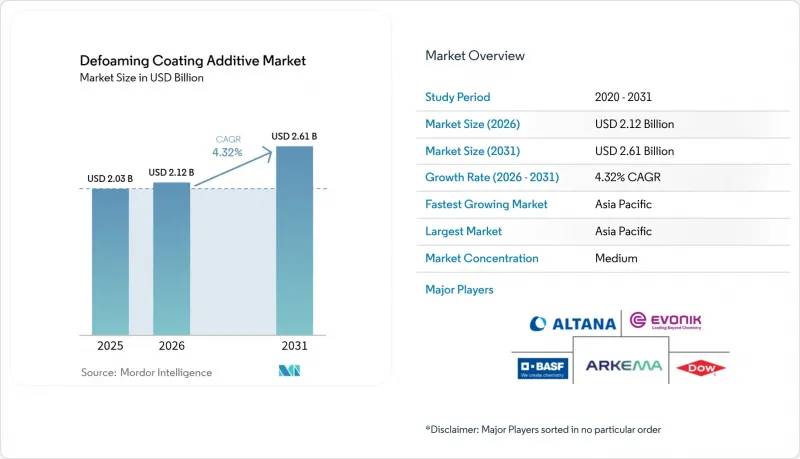
This report is Segmented by Product Type (Water-Based Systems and Solvent-Based Systems), End-User Industry (Building and Construction, Automotive and Transportation, Wood and Furniture, and Other End-User Industries), and Geography (Asia-Pacific, North America, Europe, South America, and Middle-East and Africa). The Market Forecasts are Provided in Terms of Value (USD).
Global Defoaming Coating Additive Market Trends and Insights
Growing Demand from Construction Coatings
Rapid urbanization and infrastructure renewal elevate foam-control requirements for architectural finishes worldwide. Spray-applied, high-build systems are now commonplace on commercial facades and civil structures, yet even micro-air entrapment compromises adhesion and long-term durability. The push toward low-VOC paints heightens the technical challenge because water-rich formulations entrain more air than solventborne predecessors. BASF boosted its Nanjing additives output in 2024 to supply water-compatible defoamers that reconcile these issues. Emerging economies, led by China, India, and Indonesia, continue to commission mass housing, transport corridors, and industrial parks, embedding sustained pull for high-efficiency defoamers able to maintain gloss uniformity on concrete, metal, and composite substrates.
Increasing Requirement in Automotive Coatings
Electric-vehicle platforms, lightweight substrates, and multi-layer paint stacks create fresh foam-control pain points. Modern primer-surfacer lines run at elevated line speeds, where improperly dispersed air causes crater, pinhole, and blister defects. Allnex's solventborne ADDITOL VXL 4951 N illustrates how the defoaming coating additive market now delivers narrow-range surface-tension control to avoid haze without silicone print-transfer risks. Battery housings, e-motor components, and electrode slurries present additional niches that require zero-silicone formulas for voltage-sensitive zones, nudging OEMs to lock in long-term supply contracts with additive vendors able to certify cleanliness.
Silicone-Oil Price Volatility
Slim supply chains, purity specifications and energy-intensive synthesis periodically lift silicone-oil costs, unsettling formulators who rely on the material as the cornerstone of high-efficiency defoamers. Coating makers operating on narrow margins, particularly in Southeast Asia, pivot toward lower-priced mineral-oil or polymer alternatives despite minor performance trade-offs. BYK's silicone-free BYK-1642 caters to this budget-centric cohort while giving additive suppliers a hedge against price spikes.
Other drivers and restraints analyzed in the detailed report include:
- Expansion of Wood and Furniture Production
- Surge in Digital Decor Printing Lines
- Stricter Food-Contact Migration Limits
For complete list of drivers and restraints, kindly check the Table Of Contents.
Segment Analysis
Water-based chemistries secured 59.74% of the defoaming coating additive market in 2025 and are forecast to advance at 5.18% CAGR through 2031 as formulators pursue VOC-compliant architectures. Silicone emulsions remain the workhorse class, combining rapid micro-bubble rupture with negligible surface-defect risk even at dosages below 0.2%. Meanwhile, the push for silicone-free labelling stimulates polymer microemulsions derived from vegetable oils. Allnex's bio-based ADDITOL VXW 4926 exemplifies this direction, offering equivalent dynamic surface-tension control without triggering substance-of-concern audits.
Solvent-based packages persist where extreme humidity resistance or high-temperature bake cycles make water a liability. Marine topcoats, chemical-plant linings, and specialty refinish fat lines still pick high-flashpoint carriers paired with silicone-polyacrylate defoamers that withstand 200 °C cure schedules. Powder-format defoamers, such as BYK-1693 SD, serve customers migrating to VOC-free zero-flow powder paints. These granules contain 54% bio-carbon, illustrate how the defoaming coating additive market blends sustainability and process convenience without sacrificing efficacy.
Complete Report Scope:
- Product Type
- Water-based Systems
- Silicone
- Emulsion
- Polymer
- Powder
- Others
- Solvent-based Systems
- Polymer
- Silicone
- Water-based Systems
- End-user Industry
- Building and Construction
- Automotive and Transportation
- Wood and Furniture
- Other End-user Industries (General Industrial and OEM, etc.)
- Geography
- Asia-Pacific
- China
- Japan
- India
- South Korea
- ASEAN Countries
- Rest of Asia-Pacific
- North America
- United States
- Canada
- Mexico
- Europe
- Germany
- United Kingdom
- France
- Italy
- Spain
- Russia
- NORDIC Countries
- Rest of Europe
- South America
- Brazil
- Argentina
- Rest of South America
- Middle-East and Africa
- Saudi Arabia
- South Africa
- Rest of Middle-East and Africa
- Asia-Pacific
Geography Analysis
Asia-Pacific captured 44.10% of the defoaming coating additive market in 2025 on the back of construction expansions and vehicle assembly clusters in China, India, and the ASEAN bloc. Regional CAGR of 5.03% reflects government-funded smart-city projects, new metro corridors, and aggressive EV production mandates. Multinational producers operate integrated Verbund sites and local joint ventures to curtail logistics costs and satisfy country-specific compliance audits.
Federal infrastructure modernization, battery-plant investments, and resilient housing demand keep coatings factories running near capacity in North America. Regulatory pressure against PFAS drives transfer from fluorinated defoamers to silicone or bio-based families, prompting formulators to fast-track new product qualifications. Europe maintains a similar regulatory tone, further complicated by REACH candidate-listing of additional cyclic silicones in 2025, spurring additive vendors to market PFAS-free, cyclic-siloxane-free lines.
South America, and Middle-East and Africa collectively account for a smaller yet rising slice of the defoaming coating additive market. Brazil's construction stimulus and Saudi Arabia's giga-projects draw in advanced waterborne coatings that cannot tolerate foam. Coating producers in these regions often license European technology, integrating defoamers sourced from global majors until local capacity matures. These dynamics translate into above-average growth trajectories, albeit from a comparatively low base.
- Allnex GMBH
- ALTANA
- Arkema
- Ashland
- BASF
- CLARIANT
- Dow
- Eastman Chemical Company
- Elementis PLC
- Elkem ASA
- Evonik Industries AG
- Momentive
- Munzing Corporation
- Shin-Etsu Chemical Co., Ltd.
- Solvay
- Wacker Chemie AG
Additional Benefits:
- The market estimate (ME) sheet in Excel format
- 3 months of analyst support
TABLE OF CONTENTS
1 Introduction
- 1.1 Study Assumptions and Market Definition
- 1.2 Scope of the Study
2 Research Methodology
3 Executive Summary
4 Market Landscape
- 4.1 Market Overview
- 4.2 Market Drivers
- 4.2.1 Growing Demand from Construction Coatings
- 4.2.2 Increasing Requirement in Automotive Coatings
- 4.2.3 Expansion of Wood and Furniture Production
- 4.2.4 Surge in Digital Decor Printing Lines
- 4.2.5 Rising Usage in Industrial Applications
- 4.3 Market Restraints
- 4.3.1 Silicone-Oil Price Volatility
- 4.3.2 Rise of UV-Powder Coatings
- 4.3.3 Stricter Food-Contact Migration Limits
- 4.4 Value Chain Analysis
- 4.5 Porter's Five Forces
- 4.5.1 Threat of New Entrants
- 4.5.2 Bargaining Power of Buyers
- 4.5.3 Bargaining Power of Suppliers
- 4.5.4 Threat of Substitute Products
- 4.5.5 Degree of Competition
5 Market Size and Growth Forecasts (Value)
- 5.1 Product Type
- 5.1.1 Water-based Systems
- 5.1.1.1 Silicone
- 5.1.1.2 Emulsion
- 5.1.1.3 Polymer
- 5.1.1.4 Powder
- 5.1.1.5 Others
- 5.1.2 Solvent-based Systems
- 5.1.2.1 Polymer
- 5.1.2.2 Silicone
- 5.1.1 Water-based Systems
- 5.2 End-user Industry
- 5.2.1 Building and Construction
- 5.2.2 Automotive and Transportation
- 5.2.3 Wood and Furniture
- 5.2.4 Other End-user Industries (General Industrial and OEM, etc.)
- 5.3 Geography
- 5.3.1 Asia-Pacific
- 5.3.1.1 China
- 5.3.1.2 Japan
- 5.3.1.3 India
- 5.3.1.4 South Korea
- 5.3.1.5 ASEAN Countries
- 5.3.1.6 Rest of Asia-Pacific
- 5.3.2 North America
- 5.3.2.1 United States
- 5.3.2.2 Canada
- 5.3.2.3 Mexico
- 5.3.3 Europe
- 5.3.3.1 Germany
- 5.3.3.2 United Kingdom
- 5.3.3.3 France
- 5.3.3.4 Italy
- 5.3.3.5 Spain
- 5.3.3.6 Russia
- 5.3.3.7 NORDIC Countries
- 5.3.3.8 Rest of Europe
- 5.3.4 South America
- 5.3.4.1 Brazil
- 5.3.4.2 Argentina
- 5.3.4.3 Rest of South America
- 5.3.5 Middle-East and Africa
- 5.3.5.1 Saudi Arabia
- 5.3.5.2 South Africa
- 5.3.5.3 Rest of Middle-East and Africa
- 5.3.1 Asia-Pacific
6 Competitive Landscape
- 6.1 Market Concentration
- 6.2 Strategic Moves
- 6.3 Market Share(%)/Ranking Analysis
- 6.4 Company Profiles (includes Global level Overview, Market level overview, Core Segments, Financials as available, Strategic Information, Market Rank/Share for key companies, Products and Services, and Recent Developments)
- 6.4.1 Allnex GMBH
- 6.4.2 ALTANA
- 6.4.3 Arkema
- 6.4.4 Ashland
- 6.4.5 BASF
- 6.4.6 CLARIANT
- 6.4.7 Dow
- 6.4.8 Eastman Chemical Company
- 6.4.9 Elementis PLC
- 6.4.10 Elkem ASA
- 6.4.11 Evonik Industries AG
- 6.4.12 Momentive
- 6.4.13 Munzing Corporation
- 6.4.14 Shin-Etsu Chemical Co., Ltd.
- 6.4.15 Solvay
- 6.4.16 Wacker Chemie AG
7 Market Opportunities and Future Outlook
- 7.1 White-space and unmet-need assessment

