PUBLISHER: Mordor Intelligence | PRODUCT CODE: 2114744

PUBLISHER: Mordor Intelligence | PRODUCT CODE: 2114744
Foam Glass - Market Share Analysis, Industry Trends & Statistics, Growth Forecasts (2026 - 2031)
According to Mordor Intelligence, foam glass market size in 2026 is estimated at USD 2.96 billion, growing from 2025 value of USD 2.82 billion with 2031 projections showing USD 3.77 billion, growing at 4.97% CAGR over 2026-2031.
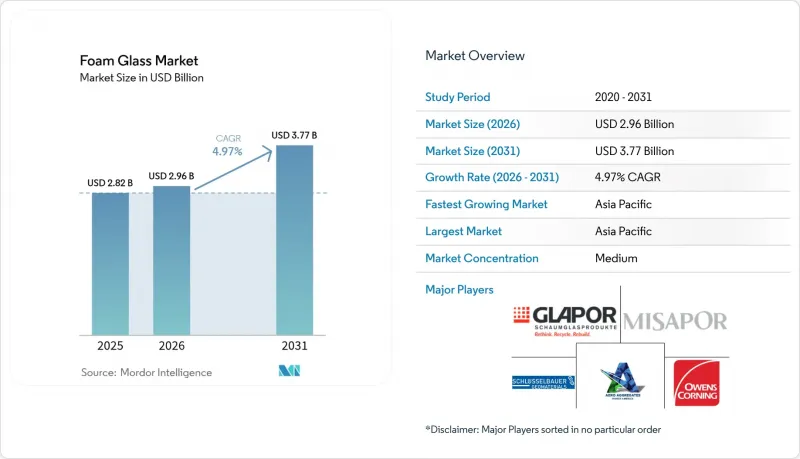
This report is Segmented by Type (Open Cell, Closed Cell, Hybrid Cell), Manufacturing Process (Continuous Foaming, Batch Foaming, and More), Application (Building and Construction, Infrastructure and Civil Engineering, and More), End-User Industry (Residential, Commercial, Industrial), and Geography (Asia-Pacific, North America, Europe, and More). The Market Forecasts are Provided in Terms of Value (USD).
Global Foam Glass Market Trends and Insights
Rapid Adoption of Foam Glass as Lightweight Fill in Transportation Infrastructure
Highway agencies are validating foam glass aggregates as a structural solution in soft-soil projects. The Federal Highway Administration documented load reductions of up to 75% in bridge abutments compared with traditional stone fill. Lower loads cut foundation costs and improve seismic tolerance, while the material's drainage and thermal properties curb frost heave. Field trials in Norway reported two winter seasons without frost penetration, removing the need for extra frost-protection layers. These results reposition foam glass from an insulation material to an engineered lightweight fill.
Rising Energy-Efficiency Regulations Boosting Demand for High-Performance Insulation
Revised codes in the European Union and North America prioritize whole-building energy outcomes, prompting architects to select materials with reliable thermal performance over decades. FIW studies show foam glass retains conductivity within design limits for 50 years. Its non-organic matrix resists moisture, microbial growth, and degradation that undermine polymeric foams. Cold-climate regions rely on a -269 °C to +482 °C operating window to specify a single insulation solution across temperature zones.
High Capital-Investment Requirement for Production Lines
Building a modern foam glass plant demands USD 50-100 million for high-temperature furnaces, foaming systems, and emission controls. Emerging markets struggle to marshal patient capital and specialist engineering talent, delaying local supply. Minimum efficient capacity often exceeds domestic demand, reinforcing reliance on imports and sustaining moderate industry consolidation.
Other drivers and restraints analyzed in the detailed report include:
- Industrial Uptake for Chemically Inert Insulation in LNG and Cryogenic Storage
- 3-D Printed Foam-Glass Components for Modular Construction
- Price Competition from Cheaper Polymeric Foams and Mineral Wool
For complete list of drivers and restraints, kindly check the Table Of Contents.
Segment Analysis
Closed-cell products held 61.35% of the foam glass market share in 2025, reflecting strong adoption in industrial process pipework and below-grade building envelopes where vapor resistance is critical. The segment benefits from compressive strengths above 4 MPa, supporting load-bearing applications across LNG tanks and cold-storage floors. Hybrid-cell materials, blending closed and open pores, are slated to grow at 5.69% CAGR as formulators optimize densities for both structural and acoustic performance.
Open-cell variants remain niche but gain traction in architectural elements that prioritize sound absorption and breathability. Indoor air quality certifications now reference vapor-permeable insulation, creating pull for open-cell slabs in schools and healthcare projects. Manufacturers integrating over 60% recycled glass content satisfy green building credits and meet circular-economy targets.
Continuous foaming deployed in tunnel furnaces accounted for 62.60% of the foam glass market size in 2025, leveraging decades of incremental efficiency gains. The approach excels at long runs of standard boards and blocks. Additive manufacturing, however, is poised to expand at 5.78% CAGR as it unlocks complex geometries for modular facades and bespoke industrial parts.
Batch foaming remains relevant where density control overrides scale, such as in fireproof pipe supports. Recent cold-expansion methods cut energy use below 1 kWh/kg, narrowing the cost gap with polymers while shrinking the emissions footprint.
Complete Report Scope:
- By Type
- Open Cell
- Closed Cell
- Hybrid Cell
- By Manufacturing Process
- Continuous Foaming
- Batch Foaming
- Additive Manufacturing (3-D Printing)
- By Application
- Building and Construction
- Infrastructure and Civil Engineering
- Industrial and Chemical Processing
- Cryogenic and LNG
- Agriculture and Water Treatment
- Other Applications (Roofing Granules, Landscaping)
- By End-user Industry
- Residential
- Commercial
- Industrial
- By Geography
- Asia-Pacific
- China
- Japan
- India
- South Korea
- ASEAN Countries
- Rest of Asia-Pacific
- North America
- United States
- Canada
- Mexico
- Europe
- Germany
- United Kingdom
- France
- Italy
- Spain
- Russia
- NORDIC Countries
- Rest of Europe
- South America
- Brazil
- Argentina
- Rest of South America
- Middle East and Africa
- Saudi Arabia
- South Africa
- Rest of Middle East and Africa
- Asia-Pacific
Geography Analysis
Asia-Pacific generated 38.95% of global revenue in 2025 and is advancing at a 5.44% CAGR. Chinese industrial policy supporting energy-efficient manufacturing underpins widespread adoption in petrochemical clusters along the Yangtze. Japan's materials sector is trialing additive manufacturing to supply high-precision foamed inserts for seismic isolation. South Korea's shipyards specify closed-cell blocks in LNG carriers, reinforcing regional leadership.
North America forms a mature demand base anchored by stringent envelope codes. Federal and state investments in bridge resilience have opened a new route for lightweight aggregates. Canada's cold climate positions foam glass as a single-material solution from foundations to rooftop mechanical rooms.
Europe benefits from a dense recycling network that supplies high-quality cullet at competitive prices. Germany and Switzerland host major producers that export to neighboring construction and process-industry hubs. Nordic experiences in permafrost highways furnish performance data that global designers now cite.
- AeroAggregates of North America, LLC
- Anhui Huichang New Material Co. Ltd
- Foamit Group
- Glapor Werk Mitterteich GmbH
- Glavel Inc
- JSC Gomelsteklo
- Misapor
- Ningbo Yoyo Foam Glass Co., Ltd.
- Owens Corning
- PINOSKLO cellular glass
- REFAGLASS sro
- SCHLUSSELBAUER Geomaterials GmbH
- Styro Insulations Mat. Ind. LLC.
- Tianjin Huali Thermal Insulation Building Material Co., Ltd.
- Uusioaines Oy - Foamit
- Veriso GmbH & Co. KG
- ZHEJIANG ZHENSHEN INSULATION TECHNOLOGY CORP.LTD.
Additional Benefits:
- The market estimate (ME) sheet in Excel format
- 3 months of analyst support
TABLE OF CONTENTS
1 Introduction
- 1.1 Study Assumptions and Market Definition
- 1.2 Scope of the Study
2 Research Methodology
3 Executive Summary
4 Market Landscape
- 4.1 Market Overview
- 4.2 Market Drivers
- 4.2.1 Rapid adoption of foam glass as lightweight fill in transportation infrastructure
- 4.2.2 Rising energy-efficiency regulations boosting demand for high-performance insulation
- 4.2.3 Industrial uptake for chemically inert insulation in LNG and cryogenic storage
- 4.2.4 Recycling-mandate driven supply growth of cullet for foam-glass production
- 4.2.5 3-D printed foam-glass components for modular construction
- 4.3 Market Restraints
- 4.3.1 High capital-investment requirement for production lines
- 4.3.2 Price competition from cheaper polymeric foams and mineral wool
- 4.3.3 Limited design flexibility for aesthetic architectural use
- 4.4 Value Chain Analysis
- 4.5 Porter's Five Forces
- 4.5.1 Bargaining Power of Suppliers
- 4.5.2 Bargaining Power of Buyers
- 4.5.3 Threat of New Entrants
- 4.5.4 Threat of Substitutes
- 4.5.5 Degree of Competition
5 Market Size and Growth Forecasts (Value)
- 5.1 By Type
- 5.1.1 Open Cell
- 5.1.2 Closed Cell
- 5.1.3 Hybrid Cell
- 5.2 By Manufacturing Process
- 5.2.1 Continuous Foaming
- 5.2.2 Batch Foaming
- 5.2.3 Additive Manufacturing (3-D Printing)
- 5.3 By Application
- 5.3.1 Building and Construction
- 5.3.2 Infrastructure and Civil Engineering
- 5.3.3 Industrial and Chemical Processing
- 5.3.4 Cryogenic and LNG
- 5.3.5 Agriculture and Water Treatment
- 5.3.6 Other Applications (Roofing Granules, Landscaping)
- 5.4 By End-user Industry
- 5.4.1 Residential
- 5.4.2 Commercial
- 5.4.3 Industrial
- 5.5 By Geography
- 5.5.1 Asia-Pacific
- 5.5.1.1 China
- 5.5.1.2 Japan
- 5.5.1.3 India
- 5.5.1.4 South Korea
- 5.5.1.5 ASEAN Countries
- 5.5.1.6 Rest of Asia-Pacific
- 5.5.2 North America
- 5.5.2.1 United States
- 5.5.2.2 Canada
- 5.5.2.3 Mexico
- 5.5.3 Europe
- 5.5.3.1 Germany
- 5.5.3.2 United Kingdom
- 5.5.3.3 France
- 5.5.3.4 Italy
- 5.5.3.5 Spain
- 5.5.3.6 Russia
- 5.5.3.7 NORDIC Countries
- 5.5.3.8 Rest of Europe
- 5.5.4 South America
- 5.5.4.1 Brazil
- 5.5.4.2 Argentina
- 5.5.4.3 Rest of South America
- 5.5.5 Middle East and Africa
- 5.5.5.1 Saudi Arabia
- 5.5.5.2 South Africa
- 5.5.5.3 Rest of Middle East and Africa
- 5.5.1 Asia-Pacific
6 Competitive Landscape
- 6.1 Market Concentration
- 6.2 Strategic Moves
- 6.3 Market Share(%)/Ranking Analysis
- 6.4 Company Profiles (includes Global level Overview, Market level overview, Core Segments, Financials as available, Strategic Information, Market Rank/Share for key companies, Products and Services, and Recent Developments)
- 6.4.1 AeroAggregates of North America, LLC
- 6.4.2 Anhui Huichang New Material Co. Ltd
- 6.4.3 Foamit Group
- 6.4.4 Glapor Werk Mitterteich GmbH
- 6.4.5 Glavel Inc
- 6.4.6 JSC Gomelsteklo
- 6.4.7 Misapor
- 6.4.8 Ningbo Yoyo Foam Glass Co., Ltd.
- 6.4.9 Owens Corning
- 6.4.10 PINOSKLO cellular glass
- 6.4.11 REFAGLASS sro
- 6.4.12 SCHLUSSELBAUER Geomaterials GmbH
- 6.4.13 Styro Insulations Mat. Ind. LLC.
- 6.4.14 Tianjin Huali Thermal Insulation Building Material Co., Ltd.
- 6.4.15 Uusioaines Oy - Foamit
- 6.4.16 Veriso GmbH & Co. KG
- 6.4.17 ZHEJIANG ZHENSHEN INSULATION TECHNOLOGY CORP.LTD.
7 Market Opportunities and Future Outlook
- 7.1 White-space and Unmet-Need Assessment

