PUBLISHER: Mordor Intelligence | PRODUCT CODE: 2114747

PUBLISHER: Mordor Intelligence | PRODUCT CODE: 2114747
Cytotoxic Drugs - Market Share Analysis, Industry Trends & Statistics, Growth Forecasts (2026 - 2031)
According to Mordor Intelligence, the cytotoxic drugs market size in 2026 is estimated at USD 16.21 billion, growing from 2025 value of USD 15.38 billion with 2031 projections showing USD 21.06 billion, growing at 5.37% CAGR over 2026-2031.
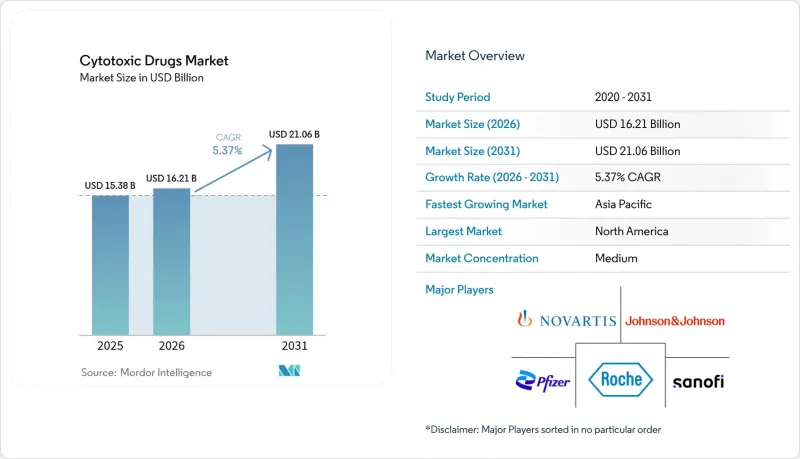
This report is Segmented by Route of Administration (Parenteral and Oral), Drug Type (Alkylating Agents, Antitumor Antibiotics, Antimetabolites, and More), Application (Breast Cancer, Prostate Cancer, Lung Cancer, and More), Distribution Channel (Hospital Pharmacies, Online Pharmacies, and More), and Geography (North America, Europe, and More). The Market Forecasts are Provided in Terms of Value (USD).
Global Cytotoxic Drugs Market Trends and Insights
Rising Cancer Incidence & Earlier Diagnosis
The number of newly diagnosed cancer cases crossed 2.04 million in the United States for the first time in 2025, reinforcing a large treatment pool for cytotoxic agents. Improved imaging, AI-enabled screening, and aging demographics bring malignancies to clinical attention at stages where cytotoxics remain standard of care. Emerging nations roll out population-wide screening that uncovers earlier-stage tumors and unlocks demand for cost-effective chemotherapy. These factors collectively raise treatment volumes and extend therapy durations, strengthening baseline growth for the cytotoxic drugs market.
Expanding Reimbursement For Chemotherapy Regimens
Medicare's 2025 introduction of a USD 2,000 annual cap on patient out-of-pocket drug costs slashes financial barriers for multi-agent chemotherapy. Private insurers increasingly mirror this ceiling, smoothing access to high-dose and combination protocols that previously strained household budgets. Similar reforms appear in China, where the national medical insurance list now includes recently approved cytotoxics, while European payers sustain comprehensive oncology packages. The resulting reimbursement expansion translates into higher treatment adherence, broader use of supportive care drugs, and faster uptake of newly launched cytotoxics.
Severe Adverse-Effect Profile Limits Dosage Adherence
Toxicity-driven discontinuation persists, with dropout rates ranging from 27% to 53% in colorectal cancer treatments. Shortages of cornerstone agents such as cisplatin in 2023 amplified reliance on alternative drugs and spotlighted the narrow therapeutic margins of many chemotherapies. Although supportive care and pharmacist-led adherence programs mitigate some challenges, the core toxicity profile constrains broader application and affects real-world outcomes.
Other drivers and restraints analyzed in the detailed report include:
- Pipeline Approvals Of Next-Gen Cytotoxic Formulations
- Surging Demand Across Low- And Middle-Income Countries
- Shift Of R&D Budgets Toward Targeted & Immuno-Oncology Drugs
For complete list of drivers and restraints, kindly check the Table Of Contents.
Segment Analysis
Parenteral drugs dominated with 68.87% market share in 2025, anchored by clinician confidence in controlled dosing for acute and combination regimens. Oral cytotoxics, however, record the segment's quickest expansion at 8.79% CAGR through 2031 as patient-centric care models pivot toward home administration. The cytotoxic drugs market size for oral treatments is projected to outgrow hospital-exclusive volumes when improved bioavailability formulations reach widespread reimbursement. Advances such as sustained-release tablets reduce peak plasma toxicity while maintaining efficacy, driving oncologists to integrate oral options into long-term combination plans.
Convenience bolsters adherence when pharmacists monitor dosing schedules through telehealth platforms that flag missed pills and manage side effects. Injectables remain critical in induction and salvage protocols where rapid cytoreduction is essential, yet broader patient acceptance of tablets and capsules shifts revenue momentum toward oral formats. As e-prescription ecosystems mature, online pharmacy distribution further accelerates uptake of at-home regimens, creating fresh competitive angles for formulation innovators.
Alkylating agents commanded 30.10% share in 2025 owing to their broad mechanistic reach and longstanding physician familiarity. The cytotoxic drugs market share attributed to this class underscores its entrenched role in foundation regimens for hematologic and solid tumors. Antimetabolites, featuring refined toxicity and combination potential, outpace all other types at a 7.02% CAGR. AI-enabled drug repurposing identifies synergistic antimetabolite partners that enhance outcomes in resistant cancers.
Development pipelines increasingly leverage ADCs that carry topoisomerase inhibitors and plant alkaloid derivatives into antigen-expressing tumors, breathing new commercial life into underutilized payloads. FDA endorsement of treosulfan demonstrates regulators' confidence in optimized alkylators even as antimetabolites seize growth momentum. The interplay of incremental innovation and novel conjugation strategies reshapes competitive dynamics across the drug-type spectrum.
Complete Report Scope:
- By Route of Administration
- Parenteral
- Oral
- By Drug Type
- Alkylating Agents
- Antitumor Antibiotics
- Antimetabolites
- Plant Alkaloids
- Topoisomerase Inhibitors
- Others
- By Application
- Breast Cancer
- Prostate Cancer
- Lung Cancer
- Pancreatic Cancer
- Colorectal Cancer
- Others
- By Distribution Channel
- Hospital Pharmacies
- Retail Pharmacies & Drug Stores
- Online Pharmacies
- Other Distribution Channels
- Geography
- North America
- United States
- Canada
- Mexico
- Europe
- Germany
- United Kingdom
- France
- Italy
- Spain
- Rest of Europe
- Asia-Pacific
- China
- Japan
- India
- South Korea
- Australia
- Rest of Asia-Pacific
- Middle East and Africa
- GCC
- South Africa
- Rest of Middle East and Africa
- South America
- Brazil
- Argentina
- Rest of South America
- North America
Geography Analysis
North America led revenue with 42.15% share in 2025, propelled by comprehensive insurance coverage and robust clinical trial activity. Medicare's cost-sharing cap beginning in 2025 widens the addressable patient base for multi-agent cycles and supports higher therapy adherence. Venture investment and favorable orphan-drug incentives keep the United States at the forefront of ADC and oral formulation breakthroughs. Canada adds analytical depth through machine-learning incidence forecasts that allow provincial health authorities to budget accurately for chemotherapy inventories.
Asia-Pacific registers a vigorous 10.07% CAGR and now anchors global manufacturing scaleouts that lower finished-dose costs. China's NMPA clearance of 228 drugs in 2024, with 37% classified as antineoplastics, signals regulatory momentum supporting domestic innovators. India's localization drive exemplified by NexCAR19 and large API parks, Japan's conditional nods for isatuximab in multiple myeloma, and Korea's bioconjugate trials collectively form a vibrant ecosystem that accelerates both clinical adoption and export potential.
Europe maintains balanced progress through harmonized EMA procedures that give companies a single pathway to 27 markets. The agency's approval of Roche's Alecensa as adjuvant therapy highlights precision oncology leadership in integrating cytotoxic payloads into early disease settings. Contract development giants such as Lonza expand Swiss conjugation suites to serve escalating ADC demand. Public healthcare frameworks secure broad patient access yet heighten price scrutiny, pressing suppliers to justify incremental benefits.
Middle East and Africa plus South America are smaller in absolute terms yet register double-digit upticks where multilateral health initiatives lift chemotherapy availability. Infrastructure projects, such as oncology centers co-funded by Gulf sovereign wealth funds, facilitate region-specific supply networks. The Access to Oncology Medicines Coalition channels technical assistance and pooled procurement tools that shorten supply timelines, solidifying emerging-market contributions to the cytotoxic drugs market.
- Baxter
- Cipla
- Eli Lilly and Company
- Fresenius
- Johnson & Johnson
- Viatris
- Novartis
- Pfizer
- Sun Pharmaceuticals Industries
- Teva Pharmaceutical Industries
- Sanofi
- Roche
- AstraZeneca
- Merck
- Amgen
- Lonza Group (HPAPI CDMO)
- Dr. Reddy's Laboratories
- Hikma Pharmaceuticals
- Intas Pharmaceuticals
- Alvogen
Additional Benefits:
- The market estimate (ME) sheet in Excel format
- 3 months of analyst support
TABLE OF CONTENTS
1 Introduction
- 1.1 Study Assumptions & Market Definition
- 1.2 Scope of the Study
2 Research Methodology
3 Executive Summary
4 Market Landscape
- 4.1 Market Overview
- 4.2 Market Drivers
- 4.2.1 Rising Cancer Incidence & Earlier Diagnosis
- 4.2.2 Expanding Reimbursement For Chemotherapy Regimens
- 4.2.3 Pipeline Approvals Of Next-Gen Cytotoxic Formulations
- 4.2.4 Surging Demand Across Low- And Middle-Income Countries
- 4.2.5 AI-Driven Drug-Repurposing Accelerating Cytotoxic Combos
- 4.2.6 ADC (Antibody-Drug Conjugate) Payload Demand For Cytotoxics
- 4.3 Market Restraints
- 4.3.1 Severe Adverse-Effect Profile Limits Dosage Adherence
- 4.3.2 High Cost Of HPAPI Containment & Compliance (USP-800, EMA)
- 4.3.3 Shift Of R&D Budgets Toward Targeted & Immuno-Oncology Drugs
- 4.3.4 Environmental Regulations On Cytotoxic Effluent Disposal
- 4.4 Supply-Chain Analysis
- 4.5 Porter's Five Forces
- 4.5.1 Threat of New Entrants
- 4.5.2 Bargaining Power of Buyers
- 4.5.3 Bargaining Power of Suppliers
- 4.5.4 Threat of Substitutes
- 4.5.5 Intensity of Competitive Rivalry
5 Market Size & Growth Forecasts (Value, USD)
- 5.1 By Route of Administration
- 5.1.1 Parenteral
- 5.1.2 Oral
- 5.2 By Drug Type
- 5.2.1 Alkylating Agents
- 5.2.2 Antitumor Antibiotics
- 5.2.3 Antimetabolites
- 5.2.4 Plant Alkaloids
- 5.2.5 Topoisomerase Inhibitors
- 5.2.6 Others
- 5.3 By Application
- 5.3.1 Breast Cancer
- 5.3.2 Prostate Cancer
- 5.3.3 Lung Cancer
- 5.3.4 Pancreatic Cancer
- 5.3.5 Colorectal Cancer
- 5.3.6 Others
- 5.4 By Distribution Channel
- 5.4.1 Hospital Pharmacies
- 5.4.2 Retail Pharmacies & Drug Stores
- 5.4.3 Online Pharmacies
- 5.4.4 Other Distribution Channels
- 5.5 Geography
- 5.5.1 North America
- 5.5.1.1 United States
- 5.5.1.2 Canada
- 5.5.1.3 Mexico
- 5.5.2 Europe
- 5.5.2.1 Germany
- 5.5.2.2 United Kingdom
- 5.5.2.3 France
- 5.5.2.4 Italy
- 5.5.2.5 Spain
- 5.5.2.6 Rest of Europe
- 5.5.3 Asia-Pacific
- 5.5.3.1 China
- 5.5.3.2 Japan
- 5.5.3.3 India
- 5.5.3.4 South Korea
- 5.5.3.5 Australia
- 5.5.3.6 Rest of Asia-Pacific
- 5.5.4 Middle East and Africa
- 5.5.4.1 GCC
- 5.5.4.2 South Africa
- 5.5.4.3 Rest of Middle East and Africa
- 5.5.5 South America
- 5.5.5.1 Brazil
- 5.5.5.2 Argentina
- 5.5.5.3 Rest of South America
- 5.5.1 North America
6 Competitive Landscape
- 6.1 Market Concentration
- 6.2 Market Share Analysis
- 6.3 Company Profiles (includes Global level Overview, Market level overview, Core Business Segments, Financials, Headcount, Key Information, Market Rank, Market Share, Products and Services, and analysis of Recent Developments)
- 6.3.1 Baxter International Inc.
- 6.3.2 Cipla Ltd
- 6.3.3 Eli Lilly and Company
- 6.3.4 Fresenius Kabi AG
- 6.3.5 Johnson & Johnson
- 6.3.6 Viatris Inc
- 6.3.7 Novartis AG
- 6.3.8 Pfizer Inc.
- 6.3.9 Sun Pharmaceutical Industries
- 6.3.10 Teva Pharmaceutical Industries
- 6.3.11 Sanofi SA
- 6.3.12 Roche Holding AG
- 6.3.13 AstraZeneca PLC
- 6.3.14 Merck & Co., Inc.
- 6.3.15 Amgen Inc.
- 6.3.16 Lonza Group (HPAPI CDMO)
- 6.3.17 Dr. Reddy's Laboratories
- 6.3.18 Hikma Pharmaceuticals
- 6.3.19 Intas Pharmaceuticals
- 6.3.20 Alvogen
7 Market Opportunities & Future Outlook
- 7.1 White-space & unmet-need assessment

