PUBLISHER: Mordor Intelligence | PRODUCT CODE: 2114748

PUBLISHER: Mordor Intelligence | PRODUCT CODE: 2114748
Tubular Membrane - Market Share Analysis, Industry Trends & Statistics, Growth Forecasts (2026 - 2031)
According to Mordor Intelligence, tubular membrane market size in 2026 is estimated at USD 1.5 billion, growing from 2025 value of USD 1.42 billion with 2031 projections showing USD 1.94 billion, growing at 5.31% CAGR over 2026-2031.
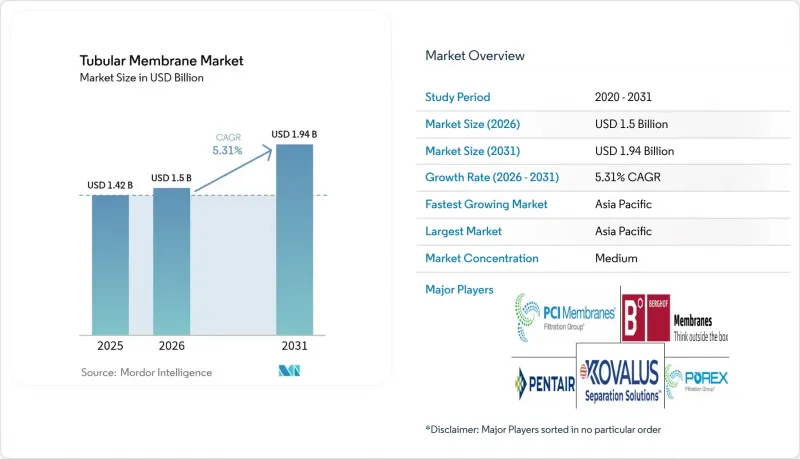
This report is Segmented by Application (Membrane Bioreactors, Reverse Osmosis Pretreatment, and More), End-User Industry (Food and Beverage, Chemical and Petrochemicals, and More), Membrane Material (PVDF, Sulfone-Based, PTFE, and More), and Geography (Asia-Pacific, North America, Europe, South America, and Middle-East and Africa). The Market Forecasts are Provided in Terms of Value (USD).
Global Tubular Membrane Market Trends and Insights
Rising Adoption of Membrane Bioreactors
Cities increasingly view MBRs as a dual answer to regulatory compliance and potable-reuse ambitions. California's net-energy-positive staged anaerobic fluidized bed-MBR at Silicon Valley Clean Water cuts biosolids production by 90% and demonstrates energy self-sufficiency, anchoring procurement decisions among U.S. utilities. Similar pilots in Singapore, Beijing and Milan validate robust pathogen removal under high mixed-liquor suspended solids, underpinning global uptake. The compact footprint eases siting in dense metros, while high solids tolerance allows treatment plants to intensify capacity without land expansion. Consequently, capital programs in North America and East Asia now incorporate tubular MBRs as default for new works or major retrofits, reinforcing growth in the tubular membrane market.
Industrial Demand for High-Strength Effluent Treatment
Chemical facilities moving toward circular-water strategies favor tubular membranes because they withstand solvent spikes, high salinity and abrasive particulates better than flat-sheet or hollow-fiber analogs. Recent 20 g/L-salinity MBR trials reported 97% COD abatement and near-complete BOD removal, validating performance in brine and produced-water settings. Pharmaceutical formulators shifting to continuous processing generate concentrated wastes that demand mechanically robust modules capable of 24/7 operation at elevated trans-membrane pressures. In mining, ceramic tubular units deliver long runtimes in acid mine drainage service, cutting chemical dosing and downtime. These industrial use cases collectively fuel incremental consumption within the tubular membrane market.
Competition from Hollow-Fiber, Flat-Sheet and Other Alternatives
Hollow-fiber MBRs deliver higher packing density and lower installed costs per square meter, steering price-sensitive municipal tenders toward these designs in regions with ample land. Flat-sheet cassettes provide easy access for visual inspection, a key benefit for operators lacking advanced maintenance tooling. Graphene-oxide laminates boasting 6-66 L cm-2 MPa-1 water permeability threaten to leapfrog all polymeric systems on energy performance. Meanwhile, photocatalytic self-cleaning coatings under development could narrow the fouling-resistance advantage historically enjoyed by tubular modules. These headwinds temper adoption in segments where high-solids resilience is not critical.
Other drivers and restraints analyzed in the detailed report include:
- Stricter Global Discharge and Water-Reuse Regulations
- Tubular Forward-Osmosis Modules Enable Low-Energy Concentration
- High CAPEX for Small and Decentralized Facilities
For complete list of drivers and restraints, kindly check the Table Of Contents.
Segment Analysis
Membrane bioreactors controlled 44.92% of the tubular membrane market in 2025, underpinned by their capacity to treat high mixed-liquor concentrations without secondary clarification. This dominance reflects the integration benefits of merging biological oxidation with physical separation, lowering overall plant footprints and enabling fast retrofits within existing clarifier basins. The segment leverages modular skid layouts that simplify expansion as flows rise, a consideration for utilities facing population growth and industrial-park hookups. Energy intensity continues to decline as fine-bubble aeration and intermittent operation routines gain traction, further cementing the business case for MBR installations across the tubular membrane market.
Reverse-osmosis pretreatment, while smaller, is projected to post a 5.82% CAGR to 2031 as desalination operators adopt multi-barrier flowsheets to protect high-pressure RO stages from fouling. Tubular membranes' ability to handle turbid feed waters laced with oil, grease and biopolymers that overwhelm micro-sand filters positions them as a resilient first-stage screen. Dairy clean-in-place recovery, leachate polishing and landfill condensate management remain niche but steady outlets, benefitting from the tubes' mechanical strength and ease of chemical cleaning. Together, these diversified applications broaden revenue streams and mitigate cyclicality within the tubular membrane market.
Complete Report Scope:
- By Application
- Membrane Bioreactors (MBR)
- Reverse Osmosis (RO) Pretreatment
- Other Applications (Dairy CIP, Leachate, etc.)
- By Membrane Material
- Polyvinylidene Fluoride (PVDF)
- Sulfone-based (Polyether sulfone (PES) / Polysulfone (PSU))
- Polytetrafluoroethylene (PTFE) / Expanded PTFE
- Polypropylene
- Ceramic
- Other Membrane Materials (Polyacrylonitrile (PAN), etc.)
- By End-user Industry
- Food and Beverage
- Chemical and Petrochemicals
- Pharmaceutical
- Energy and Power
- Other Industries (Mining, Pulp and Paper, etc.)
- By Geography
- Asia-Pacific
- China
- Japan
- India
- South Korea
- ASEAN Countries
- Rest of Asia-Pacific
- North America
- United States
- Canada
- Mexico
- Europe
- Germany
- United Kingdom
- France
- Italy
- Spain
- Russia
- NORDIC Countries
- Rest of Europe
- South America
- Brazil
- Argentina
- Rest of South America
- Middle East and Africa
- Saudi Arabia
- South Africa
- Rest of Middle East and Africa
- Asia-Pacific
Geography Analysis
Asia-Pacific dominated the tubular membrane market with 42.60% revenue share in 2025, buoyed by large-scale municipal rollouts in China and India's zero-liquid-discharge mandates for bulk chemicals and textiles. China's Yangtze River protection law pushes advanced treatment retrofits at thousands of industrial clusters, while provincial subsidies accelerate capital recovery for MBR retrofits. India's 2025 reuse targets compel overnight adoption of integrated membrane trains that guarantee consistent permeate below 10 mg/L BOD. Japanese vendors leverage decades of Johkasou decentralized expertise to export containerized tubular packages across Southeast Asia, and South Korean pharma expansions add demand for ultrapure-water systems.
North America forms the second-largest regional bloc, underpinned by mature replacement cycles and regulatory tightening. The U.S. Infrastructure Investment and Jobs Act allocates billions for lead-service-line replacements and advanced treatment upgrades, and many utilities piggy-back these programs with MBR conversions to meet nutrient caps. Canadian provinces channel climate-resilience funds toward decentralized schemes in indigenous territories, favoring small MBRs and tubular fouling-resistant skids. Mexico's industrial corridor along the Gulf coast embraces tubular pretreatment to minimize downstream RO fouling at its rapidly expanding petrochemical complexes.
Europe faces a pivotal material-compliance shift. PFAS curbs under REACH accelerate ceramic adoption and favor sulfone, polyetherimide and modified PP chemistries in new bids. Germany's carbon-neutral-water initiative funds pilot hybrid membrane-ozone plants, while Iberia channels drought-mitigation money toward water-reuse schemes anchored by tubular ultrafiltration. Nordic utilities pioneer low-energy FO-MBR hybrids supported by green-hydrogen producers, illustrating how cross-sector integration underpins incremental demand in the regional tubular membrane market.
- Applied membranes, inc.
- Berghof Membrane Technology GmbH (BMT)
- Duraflow LLC
- Dynatec Systems Inc.
- Graver Technologies
- Kovalus Separation Solutions
- Kubota Corporation
- Lenntech B.V.
- Memsift Innovations
- PCI Membranes
- Pentair
- Porex
- Sihyflux
- SpinTek
- TORAY INDUSTRIES, INC.
Additional Benefits:
- The market estimate (ME) sheet in Excel format
- 3 months of analyst support
TABLE OF CONTENTS
1 Introduction
- 1.1 Study Assumptions and Market Definition
- 1.2 Scope of the Study
2 Research Methodology
3 Executive Summary
4 Market Landscape
- 4.1 Market Overview
- 4.2 Market Drivers
- 4.2.1 Rising Adoption of Membrane Bioreactors (MBR) In Municipal Wastewater
- 4.2.2 Industrial Demand for High-Strength Effluent Treatment
- 4.2.3 Stringent Global Discharge and Water-Reuse Regulations
- 4.2.4 Tubular Forward-Osmosis (TFO) Modules Enable Low-Energy Concentration
- 4.2.5 Biomimetic Aquaporin-Based Tubular Membranes Unlock Niche Separation
- 4.3 Market Restraints
- 4.3.1 Competition from Hollow-Fiber, Flat-Sheet and Other Alternatives
- 4.3.2 High CAPEX for Small and Decentralised Facilities
- 4.3.3 PFAS-Linked PVDF Restrictions
- 4.4 Value Chain Analysis
- 4.5 Porter's Five Forces
- 4.5.1 Threat of New Entrants
- 4.5.2 Bargaining Power of Buyers
- 4.5.3 Bargaining Power of Suppliers
- 4.5.4 Threat of Substitutes
- 4.5.5 Degree of Competition
5 Market Size and Growth Forecasts (Value)
- 5.1 By Application
- 5.1.1 Membrane Bioreactors (MBR)
- 5.1.2 Reverse Osmosis (RO) Pretreatment
- 5.1.3 Other Applications (Dairy CIP, Leachate, etc.)
- 5.2 By Membrane Material
- 5.2.1 Polyvinylidene Fluoride (PVDF)
- 5.2.2 Sulfone-based (Polyether sulfone (PES) / Polysulfone (PSU))
- 5.2.3 Polytetrafluoroethylene (PTFE) / Expanded PTFE
- 5.2.4 Polypropylene
- 5.2.5 Ceramic
- 5.2.6 Other Membrane Materials (Polyacrylonitrile (PAN), etc.)
- 5.3 By End-user Industry
- 5.3.1 Food and Beverage
- 5.3.2 Chemical and Petrochemicals
- 5.3.3 Pharmaceutical
- 5.3.4 Energy and Power
- 5.3.5 Other Industries (Mining, Pulp and Paper, etc.)
- 5.4 By Geography
- 5.4.1 Asia-Pacific
- 5.4.1.1 China
- 5.4.1.2 Japan
- 5.4.1.3 India
- 5.4.1.4 South Korea
- 5.4.1.5 ASEAN Countries
- 5.4.1.6 Rest of Asia-Pacific
- 5.4.2 North America
- 5.4.2.1 United States
- 5.4.2.2 Canada
- 5.4.2.3 Mexico
- 5.4.3 Europe
- 5.4.3.1 Germany
- 5.4.3.2 United Kingdom
- 5.4.3.3 France
- 5.4.3.4 Italy
- 5.4.3.5 Spain
- 5.4.3.6 Russia
- 5.4.3.7 NORDIC Countries
- 5.4.3.8 Rest of Europe
- 5.4.4 South America
- 5.4.4.1 Brazil
- 5.4.4.2 Argentina
- 5.4.4.3 Rest of South America
- 5.4.5 Middle East and Africa
- 5.4.5.1 Saudi Arabia
- 5.4.5.2 South Africa
- 5.4.5.3 Rest of Middle East and Africa
- 5.4.1 Asia-Pacific
6 Competitive Landscape
- 6.1 Market Concentration
- 6.2 Strategic Moves
- 6.3 Market Share(%)/Ranking Analysis
- 6.4 Company Profiles (includes Global level Overview, Market level overview, Core Segments, Financials as available, Strategic Information, Market Rank/Share for key companies, Products and Services, and Recent Developments)
- 6.4.1 Applied membranes, inc.
- 6.4.2 Berghof Membrane Technology GmbH (BMT)
- 6.4.3 Duraflow LLC
- 6.4.4 Dynatec Systems Inc.
- 6.4.5 Graver Technologies
- 6.4.6 Kovalus Separation Solutions
- 6.4.7 Kubota Corporation
- 6.4.8 Lenntech B.V.
- 6.4.9 Memsift Innovations
- 6.4.10 PCI Membranes
- 6.4.11 Pentair
- 6.4.12 Porex
- 6.4.13 Sihyflux
- 6.4.14 SpinTek
- 6.4.15 TORAY INDUSTRIES, INC.
7 Market Opportunities and Future Outlook

