PUBLISHER: Mordor Intelligence | PRODUCT CODE: 2114758

PUBLISHER: Mordor Intelligence | PRODUCT CODE: 2114758
Wavefront Aberrometer - Market Share Analysis, Industry Trends & Statistics, Growth Forecasts (2026 - 2031)
According to Mordor Intelligence, the wavefront aberrometer market size is expected to grow from USD 52.55 million in 2025 to USD 55.2 million in 2026 and is forecast to reach USD 70.64 million by 2031 at 5.05% CAGR over 2026-2031.
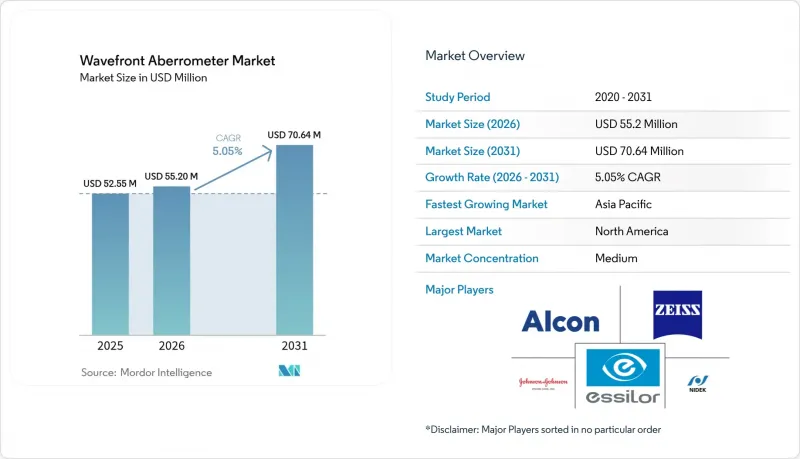
This report is Segmented by Product Type (Table-Top Stand-Alone Systems, Integrated Topography-Aberrometer Systems, and More), Application (Myopia, Hyperopia, Astigmatism, and More), End User (Hospitals, Ophthalmology Clinics, and More), and Geography (North America, Europe, Asia-Pacific, Middle East and Africa, South America). The Market Forecasts are Provided in Terms of Value (USD).
Global Wavefront Aberrometer Market Trends and Insights
Growing Global Prevalence of Uncorrected Refractive Errors
Half of the world population may be myopic by 2030, with Asia-Pacific carrying the greatest burden. Governments respond by funding early-screening drives where portable devices such as handheld aberrometers identify refractive errors in schools and rural clinics. AI modules now deliver 88% sensitivity and 94% specificity in flagging abnormal wavefront profiles, trimming chair-time, and widening access. Population-level productivity gains further justify public investment, enlarging the wavefront aberrometer market. Vendors that bundle cloud analytics with low-footprint hardware gain an edge in mass-screening contracts.
Surge in Adoption of Wavefront-Guided LASIK and Premium Cataract Procedures
Wavefront-guided refractive surgery routinely delivers 20/40 vision or better in 99.7% of patients, outperforming conventional techniques. Patient willingness to pay for quality upgrades boosts demand for high-accuracy diagnostics. FDA clearance of Bausch + Lomb's TENEO laser in late 2023 renewed competitive intensity, spotlighting systems that seamlessly integrate aberrometry, eye tracking, and topography. In the wavefront aberrometer market, this translates into higher per-procedure throughput because real-time wavefront data speeds lens-power confirmation. Premium IOL packages, often paid out-of-pocket, thus finance device upgrades despite tighter insurer reimbursements.
High Capital Investment and Per-Procedure Costs
Integrated topography-aberrometers list above USD 200,000, while consumables add USD 50-100 per measurement. Small clinics in cost-sensitive regions struggle to justify these outlays, delaying refresh cycles even as technology leaps ahead. Leasing and pay-per-use models mitigate the hurdle, but margin compression remains real, especially after a 2.93% Medicare cut in 2025. Until device prices fall or reimbursement improves, spending restraint will temper the wavefront aberrometer market trajectory.
Other drivers and restraints analyzed in the detailed report include:
- Advancements in AI-Powered, Topography-Integrated Aberrometers
- Rising Use of Intra-Operative Aberrometry to Optimize IOL Choice
- Shortage of Skilled Ophthalmic Technicians Trained in Wavefront Diagnostics
For complete list of drivers and restraints, kindly check the Table Of Contents.
Segment Analysis
Integrated topography-aberrometer systems accounted for 41.08% of the wavefront aberrometer market in 2025, reflecting clinician preference for single-platform corneal mapping and wavefront measurement. These units bundle Placido-disc topography with Hartmann-Shack sensors, letting surgeons refine ablation profiles and IOL power selections without switching devices. Table-top standalone systems still serve high-volume refractive practices where workflow efficiency outweighs multi-modality. Intra-operative aberrometers, although currently smaller in revenue, register a 7.02% CAGR because premium cataract surgeons require live feedback. The handheld sub-segment remains nascent but attracts telehealth programs and military medicine, particularly since forthcoming devices promise sub-USD 15,000 entry pricing that broadens the wavefront aberrometer industry customer base.
In competitive terms, integrated platforms now compete on software depth more than optical hardware. Firms adding biomechanics analytics or predictive AI secure premium price points. Meanwhile, modular architectures let clinics begin with diagnostics and later bolt on surgical guidance tools, easing capital budgeting. As cloud processing offloads computation, lightweight consoles could democratize advanced aberrometry across secondary-tier hospitals, raising the ceiling for the wavefront aberrometer market.
Complete Report Scope:
- By Product Type
- Table-Top Stand-Alone Systems
- Integrated Topography-Aberrometer Systems
- Intra-Operative Aberrometers
- Hand-Held / Portable Aberrometers
- By Application
- Myopia
- Hyperopia
- Astigmatism
- Presbyopia
- Keratoconus & Ectasia
- Others
- By End User
- Hospitals
- Ophthalmology Clinics
- Ambulatory Surgery Centres
- Academic & Research Institutes
- By Geography
- North America
- United States
- Canada
- Mexico
- Europe
- Germany
- United Kingdom
- France
- Italy
- Spain
- Rest of Europe
- Asia-Pacific
- China
- Japan
- India
- Australia
- South Korea
- Rest of Asia-Pacific
- Middle East & Africa
- GCC
- South Africa
- Rest of Middle East & Africa
- South America
- Brazil
- Argentina
- Rest of South America
- North America
Geography Analysis
North America retained 35.40% of global revenue in 2025, or nearly USD 18.6 million of the wavefront aberrometer market size, thanks to entrenched reimbursement codes and high patient willingness to pay for premium IOLs. The region's regulatory clarity, illustrated by smooth FDA clearance pathways for new excimer lasers, supports continual product refresh. Headwinds include Medicare's 2025 rate cut, which pressures smaller practices to seek leasing over outright purchase. Consolidation among corporate practice groups may offset some strain by pooling capital for fleet upgrades.
Asia-Pacific posts the fastest regional expansion at 8.78% CAGR, adding USD 7.05 million incremental revenue by 2031. China's streamlined National Medical Products Administration timelines and the Boao Lecheng fast-track zone slash approval lags, letting overseas-cleared aberrometers reach market early. India's fresh device-marketing code, coupled with rising private-equity investment in eye-care chains, unlocks buying power. Japan and South Korea, already technologically advanced, lead AI module adoption, reinforcing the premium tier of the wavefront aberrometer market.
Europe shows mature yet steady demand, buoyed by evidence-based practice standards and national health insurance that reimburse functional improvements for cataract and refractive patients. EssilorLuxottica's regional roll-up of clinics and Heidelberg Engineering assets deepens integration between diagnostics and therapy, potentially moving procurement toward closed-platform ecosystems . Emerging regions Middle East & Africa plus South America offer upside as private hospitals upgrade imaging suites; however, currency volatility and limited reimbursement temper near-term scale.
- Alcon
- Carl Zeiss
- Johnson & Johnson
- EssilorLuxottica
- Nidek
- SCHWIND eye-tech-solutions
- Topcon
- Tracey Technologies
- Luneau Technology
- Marco
- Bausch + Lomb
- Optikon
- Canon Medical
- Vmax Vision
- WaveLight
- i-Optics
- AceVision Group
- Haag-Streit
- Heidelberg Engineering
- Ophtec
Additional Benefits:
- The market estimate (ME) sheet in Excel format
- 3 months of analyst support
TABLE OF CONTENTS
1 Introduction
- 1.1 Study Assumptions & Market Definition
- 1.2 Scope of the Study
2 Research Methodology
3 Executive Summary
4 Market Landscape
- 4.1 Market Overview
- 4.2 Market Drivers
- 4.2.1 Growing Global Prevalence of Uncorrected Refractive Errors
- 4.2.2 Surge In Adoption of Wavefront-Guided LASIK And Premium Cataract Procedures
- 4.2.3 Advancements in AI-Powered, Topography-Integrated Aberrometers
- 4.2.4 Rising Use of Intra-Operative Aberrometry to Optimize Intraocular Lens (IOL)
- 4.2.5 Expansion of Portable Aberrometer Solutions Enabling Remote Diagnostics
- 4.2.6 Increased Demand for Precise Ocular Calibration In AR/VR Headsets
- 4.3 Market Restraints
- 4.3.1 High Capital Investment and Per-Procedure Costs
- 4.3.2 Shortage of Skilled Ophthalmic Technicians Trained in Wavefront Diagnostics
- 4.3.3 Reimbursement Ambiguity Surrounding Intra-Operative Aberrometry Codes
- 4.3.4 Lack of Standardized Data Formats Impedes Seamless Integration
- 4.4 Porter's Five Forces Analysis
- 4.4.1 Threat of New Entrants
- 4.4.2 Bargaining Power of Buyers
- 4.4.3 Bargaining Power of Suppliers
- 4.4.4 Threat of Substitutes
- 4.4.5 Competitive Rivalry
5 Market Size & Growth Forecasts (Value in USD)
- 5.1 By Product Type
- 5.1.1 Table-Top Stand-Alone Systems
- 5.1.2 Integrated Topography-Aberrometer Systems
- 5.1.3 Intra-Operative Aberrometers
- 5.1.4 Hand-Held / Portable Aberrometers
- 5.2 By Application
- 5.2.1 Myopia
- 5.2.2 Hyperopia
- 5.2.3 Astigmatism
- 5.2.4 Presbyopia
- 5.2.5 Keratoconus & Ectasia
- 5.2.6 Others
- 5.3 By End User
- 5.3.1 Hospitals
- 5.3.2 Ophthalmology Clinics
- 5.3.3 Ambulatory Surgery Centres
- 5.3.4 Academic & Research Institutes
- 5.4 By Geography
- 5.4.1 North America
- 5.4.1.1 United States
- 5.4.1.2 Canada
- 5.4.1.3 Mexico
- 5.4.2 Europe
- 5.4.2.1 Germany
- 5.4.2.2 United Kingdom
- 5.4.2.3 France
- 5.4.2.4 Italy
- 5.4.2.5 Spain
- 5.4.2.6 Rest of Europe
- 5.4.3 Asia-Pacific
- 5.4.3.1 China
- 5.4.3.2 Japan
- 5.4.3.3 India
- 5.4.3.4 Australia
- 5.4.3.5 South Korea
- 5.4.3.6 Rest of Asia-Pacific
- 5.4.4 Middle East & Africa
- 5.4.4.1 GCC
- 5.4.4.2 South Africa
- 5.4.4.3 Rest of Middle East & Africa
- 5.4.5 South America
- 5.4.5.1 Brazil
- 5.4.5.2 Argentina
- 5.4.5.3 Rest of South America
- 5.4.1 North America
6 Competitive Landscape
- 6.1 Market Concentration
- 6.2 Market Share Analysis
- 6.3 Company Profiles (includes Global level Overview, Market level overview, Core Segments, Financials as available, Strategic Information, Market Rank/Share for key companies, Products & Services, and Recent Developments)
- 6.3.1 Alcon
- 6.3.2 Carl Zeiss Meditec
- 6.3.3 Johnson & Johnson Vision
- 6.3.4 EssilorLuxottica
- 6.3.5 NIDEK
- 6.3.6 SCHWIND eye-tech-solutions
- 6.3.7 Topcon
- 6.3.8 Tracey Technologies
- 6.3.9 Luneau Technology
- 6.3.10 Marco
- 6.3.11 Bausch + Lomb
- 6.3.12 Optikon
- 6.3.13 Canon Medical
- 6.3.14 Vmax Vision
- 6.3.15 WaveLight
- 6.3.16 i-Optics
- 6.3.17 AceVision Group
- 6.3.18 Haag-Streit
- 6.3.19 Heidelberg Engineering
- 6.3.20 Ophtec
7 Market Opportunities & Future Outlook
- 7.1 White-space & Unmet-need Assessment

