PUBLISHER: Mordor Intelligence | PRODUCT CODE: 2114761

PUBLISHER: Mordor Intelligence | PRODUCT CODE: 2114761
Fluorosilicone - Market Share Analysis, Industry Trends & Statistics, Growth Forecasts (2026 - 2031)
According to Mordor Intelligence, the fluorosilicone market size is expected to grow from 31.15 kilotons in 2025 to 32.63 kilotons in 2026 and is forecast to reach 41.12 kilotons by 2031 at 4.74% CAGR over 2026-2031.
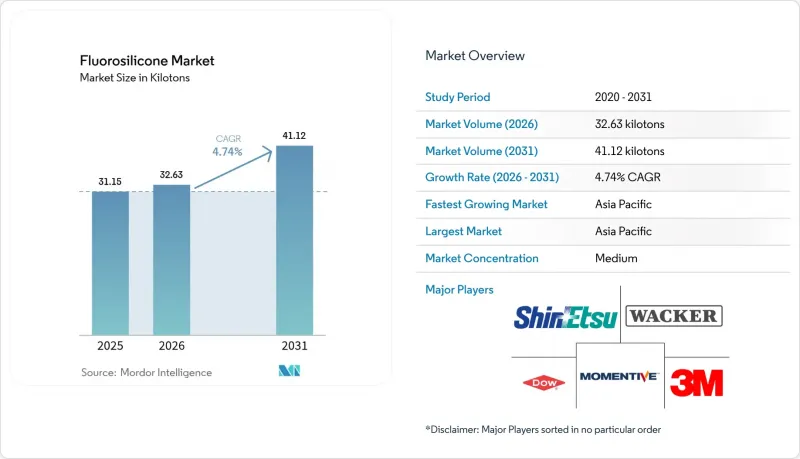
This report Segments the Industry by Product Type (Elastomer, Adhesives and Sealants, and More), End-User Industry (Oil and Gas, Automotive, and More), and Geography (Asia-Pacific, North America, and More). The Market Forecasts are Provided in Terms of Volume (Tons).
Global Fluorosilicone Market Trends and Insights
Growing Demand from Aerospace & Defence Fuel/Hydraulic Systems
Modern aircraft fuel circuits run hotter than 177 °C and cycle between synthetic bio-jet blends, hydraulic fluids, and anti-icing additives. Standard silicones fracture or swell, but trifluoropropyl-substituted chains in fluorosilicone stay elastic down to -73 °C, avoiding brittle failure at altitude. Leading seal suppliers now qualify fluorosilicone O-rings under MIL-DTL-25988 to satisfy rapid pressure cycling without fatigue. Weight-saving trends intensify the switch because thinner seals rely on superior chemical tenacity to preserve lifetime reliability.
Rising Utilisation from Offshore Oil and Gas Fields
Ultra-deep wells exceed 22,000 psi and approach 450 °F. Completion strings and FPSO fluid swivels face sour gas, high brine salinity, and rapid gas decompression. Fluorosilicone keeps modulus and volume change within API-spec limits where HNBR and perfluoroelastomer grades either crack or lose strength. Longer mean time between intervention lowers lifting costs, so operators specify fluorosilicone on packers, blow-out preventer seals, and downhole sensors for harsh-gas reservoirs.
Availability of Cost-Competitive Alternatives
Advanced EPDM, HNBR, and VMQ compounds now reach fuel-resistance levels once exclusive to fluorosilicone, offering up to 70% material savings for moderate-temperature duties. The switch is fastest in mass-market automotive and appliance seals where total exposure temperatures seldom surpass 180 °C. However, in environments with simultaneous exposure to aggressive aromatics and large thermal swings, competing elastomers still fall short.
Other drivers and restraints analyzed in the detailed report include:
- Adoption in High-Temperature Automotive Turbo & Bio-Fuel Lines
- Emergence of Flexible Electronics and EV Battery Applications
- Fluoromonomer Price Volatility & Supply Bottlenecks
For complete list of drivers and restraints, kindly check the Table Of Contents.
Segment Analysis
Elastomers generated the largest slice of the fluorosilicone market in 2025, capturing 46.55% of volume. They dominate because high-consistency rubber and liquid silicone rubber formats suit press-molding, extrusion, and injection lines used by hose, gasket, and O-ring producers. Lubricants, greases, and dielectric fluids sit in a smaller but faster pool, expected to post a 7.55% CAGR through 2031 as battery-electric cooling circuits scale up. In mass production, liquid grades cut cycle times while holding tight tolerances, and two-part room-temperature-vulcanizing chemistries simplify on-line gasketing. Specialty coatings and antifoams stay niche yet profitable, sold to pharmaceutical and food processors that need chemically inert, non-tainting agents.
A wider formulation window allows suppliers to tailor hardness, resilience, and swelling limits to each customer specification. That flexibility preserves elastomer prominence even as volumes shift among industries. Meanwhile, the lubricant sub-segment rides the jump in direct-immersion battery cooling, where low electrical conductivity matters. Adoption also spreads in semiconductor vacuum pumps unable to tolerate hydrocarbon backstreaming. Across these uses the fluorosilicone market size for lubricants could move from lab scale to commercial tonnage by 2030.
Complete Report Scope:
- By Product Type
- Elastomer
- Adhesives and Sealants
- Antifoams
- Coating
- Other Product Types (Lubricants, etc.)
- By End-user Industry
- Oil and Gas
- Automotive
- Aerospace and Defence
- Other End-user Industries (Industrial OEM, etc.)
- By Geography
- Asia-Pacific
- China
- India
- Japan
- South Korea
- Rest of Asia-Pacific
- North America
- United States
- Canada
- Mexico
- Europe
- Germany
- United Kingdom
- France
- Italy
- Rest of Europe
- South America
- Brazil
- Argentina
- Rest of South America
- Middle East and Africa
- Saudi Arabia
- South Africa
- Rest of Middle East and Africa
- Asia-Pacific
Geography Analysis
Asia-Pacific controlled 38.55% of global shipments in 2025 and is poised to record a 6.55% CAGR to 2031. China remains the central node, thanks to high-volume automotive turbocharger production, rapid expansion in 300 mm semiconductor fabs, and state programs that target domestic supply chains for specialty chemicals. Indigenous chemists are trialling fluorosilicone foams for oil-water separation, a step that underlines the region's innovation depth. Japan leverages precision process know-how to turn out ultra-clean grades for space and defence instruments, while South Korea's chaebol structure benefited after KCC Corporation absorbed Momentive, cementing in-house supply security.
North America maintains the second-largest consumption bloc, supported by its aviation, space, and defence sectors, plus shale and offshore operators that prefer premium materials. The fluorosilicone market size in the region is anchored by FAA and DoD certifications, which lock in long replacement cycles. Automotive demand is stable rather than stellar, hampered by cost-down targets, yet the shift to battery-electric trucks creates new thermal-interface and dielectric-fluid opportunities. Canadian oil sands push service temperatures high enough to justify fluorosilicone over FKM, extending regional demand into energy.
Europe faces the most intricate regulatory climate. Draft PFAS restrictions under REACH tighten reporting and substitution requirements, but carve-out exemptions exist for aerospace, medical, and critical energy infrastructure. German OEMs continue to fit fluorosilicone hoses on bio-fuel-capable engines, and French nuclear facilities keep using radiation-hard grades. Nordic countries explore recycled silicone loops that break down polymer chains into reusable monomers, a pathway for circularity that could stabilise long-term supply. Overall, European consumption grows slowly yet shifts toward sustainable, low-fluoro content designs, a niche that local producers are well placed to serve.
- 3M
- Dow
- Eagle Elastomer Inc.
- DLR Elastomer Engineering Ltd
- Marco Rubber & Plastics
- Momentive Performance Materials (KCC Corporation)
- Parker Hannifin Corp
- Shandong Huaxia Shenzhou New Material Co., Ltd.
- Shin-Etsu Silicones of America, Inc.
- Trelleborg Group
- Wacker Chemie AG
- Zhejiang Huanxin Fluoro Material Co. Ltd.
Additional Benefits:
- The market estimate (ME) sheet in Excel format
- 3 months of analyst support
TABLE OF CONTENTS
1 Introduction
- 1.1 Study Assumptions
- 1.2 Scope of the Study
2 Research Methodology
3 Executive Summary
4 Market Landscape
- 4.1 Market Overview
- 4.2 Market Drivers
- 4.2.1 Growing demand from aerospace & defence fuel/ hydraulic systems
- 4.2.2 Rising utilisation from the oil and gas industry
- 4.2.3 Adoption in high-temperature automotive turbo & bio-fuel lines
- 4.2.4 Emergence of flexible electronics and electric vehicle battery applications
- 4.2.5 Commercialisation of bio-sourced fluorinated siloxane monomer
- 4.3 Market Restraints
- 4.3.1 Availability of cost-competitive alternatives
- 4.3.2 Fluoromonomer price volatility & supply bottlenecks
- 4.3.3 Environemntal concerns related to fluorine compounds
- 4.4 Value Chain Analysis
- 4.5 Porter's Five Forces
- 4.5.1 Bargaining Power of Suppliers
- 4.5.2 Bargaining Power of Buyers
- 4.5.3 Threat of New Entrants
- 4.5.4 Threat of Substitutes
- 4.5.5 Degree of Competition
5 Market Size & Growth Forecasts (Volume)
- 5.1 By Product Type
- 5.1.1 Elastomer
- 5.1.2 Adhesives and Sealants
- 5.1.3 Antifoams
- 5.1.4 Coating
- 5.1.5 Other Product Types (Lubricants, etc.)
- 5.2 By End-user Industry
- 5.2.1 Oil and Gas
- 5.2.2 Automotive
- 5.2.3 Aerospace and Defence
- 5.2.4 Other End-user Industries (Industrial OEM, etc.)
- 5.3 By Geography
- 5.3.1 Asia-Pacific
- 5.3.1.1 China
- 5.3.1.2 India
- 5.3.1.3 Japan
- 5.3.1.4 South Korea
- 5.3.1.5 Rest of Asia-Pacific
- 5.3.2 North America
- 5.3.2.1 United States
- 5.3.2.2 Canada
- 5.3.2.3 Mexico
- 5.3.3 Europe
- 5.3.3.1 Germany
- 5.3.3.2 United Kingdom
- 5.3.3.3 France
- 5.3.3.4 Italy
- 5.3.3.5 Rest of Europe
- 5.3.4 South America
- 5.3.4.1 Brazil
- 5.3.4.2 Argentina
- 5.3.4.3 Rest of South America
- 5.3.5 Middle East and Africa
- 5.3.5.1 Saudi Arabia
- 5.3.5.2 South Africa
- 5.3.5.3 Rest of Middle East and Africa
- 5.3.1 Asia-Pacific
6 Competitive Landscape
- 6.1 Market Concentration
- 6.2 Strategic Moves
- 6.3 Market Share(%)/Ranking Analysis
- 6.4 Company Profiles {(includes Global level Overview, Market level overview, Core Segments, Financials as available, Strategic Information, Market Rank/Share for key companies, Products & Services, and Recent Developments)}
- 6.4.1 3M
- 6.4.2 Dow
- 6.4.3 Eagle Elastomer Inc.
- 6.4.4 DLR Elastomer Engineering Ltd
- 6.4.5 Marco Rubber & Plastics
- 6.4.6 Momentive Performance Materials (KCC Corporation)
- 6.4.7 Parker Hannifin Corp
- 6.4.8 Shandong Huaxia Shenzhou New Material Co., Ltd.
- 6.4.9 Shin-Etsu Silicones of America, Inc.
- 6.4.10 Trelleborg Group
- 6.4.11 Wacker Chemie AG
- 6.4.12 Zhejiang Huanxin Fluoro Material Co. Ltd.
7 Market Opportunities & Future Outlook
- 7.1 White-space & Unmet-need Assessment

