PUBLISHER: Mordor Intelligence | PRODUCT CODE: 2114765

PUBLISHER: Mordor Intelligence | PRODUCT CODE: 2114765
United States Precision Farming Software - Market Share Analysis, Industry Trends & Statistics, Growth Forecasts (2026 - 2031)
According to Mordor Intelligence, the United States precision farming software market size was valued at USD 2.89 billion in 2025 and estimated to grow from USD 3.16 billion in 2026 to reach USD 4.92 billion by 2031, at a CAGR of 9.28% during the forecast period (2026-2031).
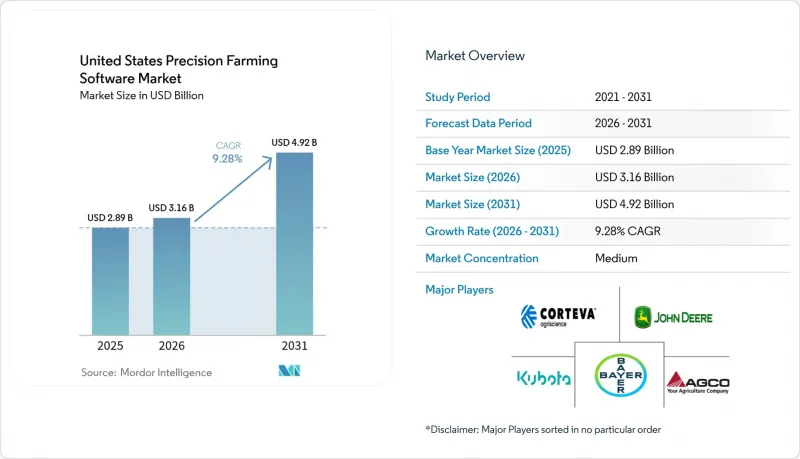
This report is Segmented by Application (Crop Management, Financial Management, and More), by Deployment Type (Local/Web-Based and Cloud-Based), by Farm Size (Small, Medium, and Large), and by End-User (Row-Crop Growers, and More). The Market Forecasts are Provided in Terms of Value (USD).
United States Precision Farming Software Market Trends and Insights
Farm-Labor Scarcity and Rising Average Farm Size
Consolidation into larger holdings amplifies these pressures because covering wider acreages intensifies demand for software that synchronizes field operations, labor scheduling, and inventory flows. Medium-scale farms are the most responsive, posting 12.2% CAGR adoption as they strive to match the efficiency of larger peers. Consequently, the United States precision farming software market increasingly targets features that reduce idle equipment time, streamline input allocation, and substitute scarce human labor. These dynamics position workflow automation and fleet coordination modules as core upgrade priorities over the next two planning cycles.
Federal Cost-Share Programs for Digital Tools
Application volume surged to 156,485 in fiscal 2024, signaling unmet demand that is likely to expand program breadth. These incentives stimulate early upgrades to cloud-based packages that capture granular field data needed for compliance reporting. Although funding does not fully cover backlog demand, its continuity reassures lenders and stimulates longer-term financing for integrated platforms. Consequently, the United States precision farming software market experiences a virtuous cycle wherein cost-share capital catalyzes private investment in sensors, connectivity, and subscription services.
High Upfront Cost and Unclear Short-Term Payback
Iowa surveys show 74% of growers label precision technologies expensive, even while acknowledging efficiency benefits, indicating hesitancy to invest absent guaranteed returns. Fragmented hardware ecosystems often force multiple, uncoordinated purchases that lengthen payback periods. Although large farms (>2,000 acres) shoulder these costs more easily and now hold 63% market share, smaller holdings still delay upgrades unless subsidies defray capital expense.
Other drivers and restraints analyzed in the detailed report include:
- Expanding Cloud Connectivity in Rural Broadband
- AI-Driven Agronomy Improving ROI Visibility
- Data Ownership and Privacy Concerns
For complete list of drivers and restraints, kindly check the Table Of Contents.
Segment Analysis
Crop management solutions controlled 45.35% of the United States precision farming software market share in 2025, underscoring their status as the operating hub for seeding, fertilization, and harvest decisions. The United States precision farming software market size attributed to crop management is projected to expand alongside advanced imaging, sensor fusion, and rate-variable application features. Adding financial and compliance modules converts point solutions into holistic suites that appeal to diversified operations.
Weather-tracking applications, rising at a 11.35% CAGR, exploit high-resolution radar and machine-learning models that predict micro-climate shifts affecting planting windows. Their success illustrates the shift to microservices architecture, where specialized functions bolt onto an overarching platform via open APIs.
Cloud offerings accounted for 60.25% of the United States precision farming software market in 2025 because of remote access, automatic updates, and lower upfront hardware outlays. The United States precision farming software market size for cloud deployments is primed for an 11.02% CAGR as rural fiber installations alleviate coverage gaps. Early adopters cite seamless multi-device collaboration, enabling agronomists, equipment operators, and accountants to share one data source as the principal advantage.
Offline-sync capabilities still matter in fringe signal zones, so hybrid configurations combining cloud cores with edge gateways remain popular. Providers differentiate by embedding cybersecurity protocols and contract clauses that guarantee data portability on termination, easing vendor-lock fears. As machine telemetry volumes escalate, pay-per-use storage and compute models will further shift costs from capital to operating expenditure, sustaining cloud momentum within the United States precision farming software market.
Complete Report Scope:
- By Application
- Crop Management
- Financial Management
- Farm Inventory Management
- Personnel Management
- Weather Tracking and Forecasting
- Other Applications
- By Deployment Type
- Local/Web-based
- Cloud-based
- By Farm Size
- Small (Less than 500 acres)
- Medium (500 to 2,000 acres)
- Large (More than 2,000 acres)
- By End-User
- Row-crop Growers
- Specialty-crop Growers
- Livestock and Mixed Operations
List of Companies Covered in this Report:
- Deere & Company
- Corteva Agriscience
- AGCO Corporation
- Topcon Corporation
- IBM Corporation
- Kubota Corporation
- Bayer AG
- Ag Leader Technology
- Farmers Edge Inc. (Fairfax Financial Holdings)
- Raven Industries, Inc.(CNH Industrial N.V)
- CropX Inc
- Iteris Inc. (Almaviva S.p.A.)
- Planet Labs PBC
- Farmers Business Network, Inc.
- Conservis Corp. (Rabobank and TELUS Agriculture)
Additional Benefits:
- The market estimate (ME) sheet in Excel format
- 3 months of analyst support
TABLE OF CONTENTS
1 Introduction
- 1.1 Study Assumptions and Market Definition
- 1.2 Scope of the Study
2 Research Methodology
3 Executive Summary
4 Market Landscape
- 4.1 Market Overview
- 4.2 Market Drivers
- 4.2.1 Farm-labor scarcity and rising average farm size
- 4.2.2 Federal cost-share programs for digital tools
- 4.2.3 Expanding cloud connectivity in rural broadband
- 4.2.4 AI-driven agronomy improving ROI visibility
- 4.2.5 Carbon-credit revenue models for data-rich farms
- 4.2.6 OEM-software vendor JV activity
- 4.3 Market Restraints
- 4.3.1 High upfront cost and unclear short-term payback
- 4.3.2 Data ownership and privacy concerns
- 4.3.3 Integration complexity across heterogeneous machinery
- 4.3.4 Digital-skills gap among ageing farm operators
- 4.4 Regulatory Landscape
- 4.5 Technological Outlook
- 4.6 Porter's Five Forces Analysis
- 4.6.1 Bargaining Power of Suppliers
- 4.6.2 Bargaining Power of Buyers
- 4.6.3 Threat of New Entrants
- 4.6.4 Threat of Substitutes
- 4.6.5 Intensity of Competitive Rivalry
5 Market Size and Growth Forecasts (Value)
- 5.1 By Application
- 5.1.1 Crop Management
- 5.1.2 Financial Management
- 5.1.3 Farm Inventory Management
- 5.1.4 Personnel Management
- 5.1.5 Weather Tracking and Forecasting
- 5.1.6 Other Applications
- 5.2 By Deployment Type
- 5.2.1 Local/Web-based
- 5.2.2 Cloud-based
- 5.3 By Farm Size
- 5.3.1 Small (Less than 500 acres)
- 5.3.2 Medium (500 to 2,000 acres)
- 5.3.3 Large (More than 2,000 acres)
- 5.4 By End-User
- 5.4.1 Row-crop Growers
- 5.4.2 Specialty-crop Growers
- 5.4.3 Livestock and Mixed Operations
6 Competitive Landscape
- 6.1 Market Concentration
- 6.2 Strategic Moves
- 6.3 Market Share Analysis
- 6.4 Company Profiles (Includes Global Level Overview, Market Level Overview, Core Segments, Financials as Available, Strategic Information, Market Rank/Share for Key Companies, Products and Services, and Recent Developments)
- 6.4.1 Deere & Company
- 6.4.2 Corteva Agriscience
- 6.4.3 AGCO Corporation
- 6.4.4 Topcon Corporation
- 6.4.5 IBM Corporation
- 6.4.6 Kubota Corporation
- 6.4.7 Bayer AG
- 6.4.8 Ag Leader Technology
- 6.4.9 Farmers Edge Inc. (Fairfax Financial Holdings)
- 6.4.10 Raven Industries, Inc.(CNH Industrial N.V)
- 6.4.11 CropX Inc
- 6.4.12 Iteris Inc. (Almaviva S.p.A.)
- 6.4.13 Planet Labs PBC
- 6.4.14 Farmers Business Network, Inc.
- 6.4.15 Conservis Corp. (Rabobank and TELUS Agriculture)
7 Market Opportunities and Future Outlook

