PUBLISHER: Mordor Intelligence | PRODUCT CODE: 2114766

PUBLISHER: Mordor Intelligence | PRODUCT CODE: 2114766
Face And Ear Bow - Market Share Analysis, Industry Trends & Statistics, Growth Forecasts (2026 - 2031)
According to Mordor Intelligence, the face and ear bow market size was valued at USD 286.88 million in 2025 and estimated to grow from USD 304.03 million in 2026 to reach USD 406.58 million by 2031, at a CAGR of 5.98% during the forecast period (2026-2031).
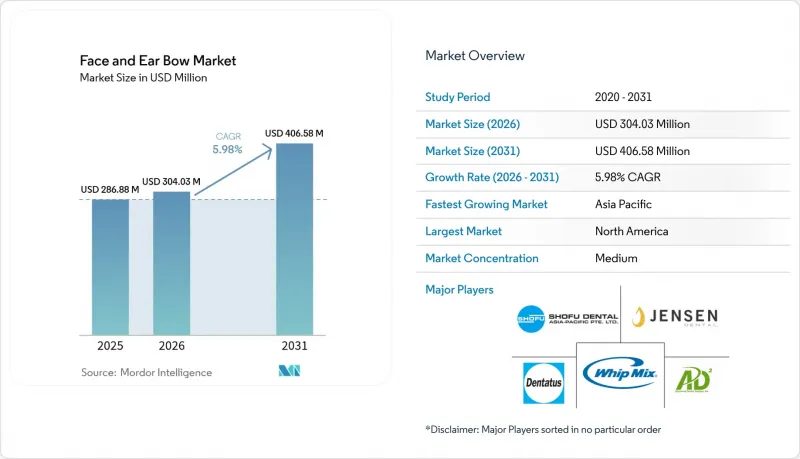
This report is Segmented by Product Type (Kinematic (Hinge-Axis) Facebows, Arbitrary Facebows, Ear-Bows, and More), Material (Aluminum Alloys, Stainless Steel, and More), Application (Orthodontics & Occlusal Analysis, and More), End User (Dental Laboratories, Dental Clinics, and More), and Geography (North America, Europe, and More). The Market Forecasts are Provided in Terms of Value (USD).
Global Face And Ear Bow Market Trends and Insights
Rising Prosthodontic Procedures Among Ageing Population
Rapid population ageing in most high-income nations is enlarging the pool of edentulous or partially dentate patients who require complex full-arch rehabilitations. Accurate transfer of the hinge-axis relationship with a facebow materially raises implant success, masticatory efficiency, and long-term comfort. Public health agendas now frame oral function as central to healthy ageing, prompting insurers and policymakers to promote early restorative interventions. Academic curricula consequently reinforce facebow skills, while manufacturers roll out lighter frames and simplified clamps to serve geriatric ergonomics. Taken together, these forces transform the face and ear bow market by embedding precision recording into routine senior care.
Digital/Virtual Facebows Enable Chair-Side CAD-CAM
Virtual facebow systems integrate optical jaw-tracking sensors with intraoral scanners to generate 4D articulator positions in real time. The workflow merges directly into CAD platforms, eliminating mechanical indexing errors and cutting appointment counts by nearly 40%. Dentists report streamlined lab communication, faster remakes, and higher first-fit rates, especially when treating bilateral free-end saddles. Software updates push automatic condylar path simulation that aids TMJ diagnostics, further widening clinical uptake. Early adopters in Europe and the United States have driven a visible shift in purchasing decisions, anchoring digital options as the premium tier of the face and ear bow market.
Limited Reimbursement for Dental Prosthetics
Most public and private payers classify prosthodontics as elective, leaving patients to cover the bulk of procedure costs. Out-of-pocket expenditure dampens demand for premium accessories, including titanium facebow kits or full digital solutions. In Europe, benefit caps and long waiting lists steer many seniors toward basic dentures without detailed jaw-relation transfer. Some insurers pilot outcome-based bundles that could eventually reimburse precision mounting when linked to reduced remake rates, yet momentum remains slow. Consequently, pricing pressure restrains full penetration of advanced systems within the face and ear bow market.
Other drivers and restraints analyzed in the detailed report include:
- Surge in Cosmetic & Orthodontic Corrections
- 3-D Printed Custom Facebow Parts Lower Costs
- Evidence Questioning Routine Facebow Need
For complete list of drivers and restraints, kindly check the Table Of Contents.
Segment Analysis
In 2025, Arbitrary Facebows controlled the largest slice of the face and ear bow market share at 45.12%. Digital/Virtual Facebows, though smaller in starting base, are forecast to post a compelling 12.24% CAGR to 2031, outpacing every other device class. The rising preference mirrors clinics' shift toward single-visit prosthetics and cloud-linked lab services. Meanwhile, Kinematic Facebows sustain a core presence in postgraduate programs and research centers, whereas Ear-Bows cater to orthognathic surgery where temporal bone references are essential.
Investments in motion-capture optics and AI-driven landmark detection have narrowed the cost gap between digital and mechanical alternatives, encouraging practitioners to trade up. Manufacturers bundle cloud licenses, articulator models, and online training to simplify onboarding. Accessories, including fork pans and orbital indicators, increasingly come in recyclable resin variants compatible with office printers, extending lifecycle value. As these trends coalesce, the face and ear bow market continues to pivot toward data-rich virtual instrumentation without entirely displacing reliable mechanical baselines.
Aluminum Alloys accounted for 37.10% revenue in 2025 and continue to anchor entry-level kits through ease of machining and familiar handling. Titanium components, although costlier, are projected to log a 9.28% CAGR, attracting high-end clinics seeking superior corrosion resistance and reduced patient allergenicity. Stainless Steel retains a foothold in budget-sensitive regions, while reinforced engineering plastics gain share in disposable accessories such as bite forks.
The face and ear bow market size for titanium assemblies is expected to widen as additive manufacturing cuts scrap rates and supports hollow-frame geometries that lower chairside fatigue. Cross-compatibility standards introduced by major articulator vendors encourage modular upgrades, allowing practices to add titanium forks to existing aluminum frames. Continuing education courses now highlight the biomechanical benefits of lightweight, high-yield alloys, raising practitioner comfort and futureproofing purchase decisions within the face and ear bow industry.
Complete Report Scope:
- By Product Type
- Kinematic (Hinge-axis) Facebows
- Arbitrary Facebows
- Digital / Virtual Facebows
- Ear-Bows
- Accessories
- By Material
- Aluminum Alloys
- Stainless Steel
- Titanium
- Engineering Plastics & Composites
- By Application
- Prosthodontics
- Orthodontics & Occlusal Analysis
- Maxillofacial & Implant Surgery
- By End User
- Dental Laboratories
- Dental Clinics
- Hospitals & Surgical Centers
- Geography
- North America
- United States
- Canada
- Mexico
- Europe
- Germany
- United Kingdom
- France
- Italy
- Spain
- Rest of Europe
- Asia-Pacific
- China
- Japan
- India
- South Korea
- Australia
- Rest of Asia-Pacific
- Middle East and Africa
- GCC
- South Africa
- Rest of Middle East and Africa
- South America
- Brazil
- Argentina
- Rest of South America
- North America
Geography Analysis
North America retained leadership with 34.40% of global revenue in 2025 thanks to mature insurance coverage for implant dentistry and deep penetration of chair-side CAD-CAM systems. Clinics across the United States and Canada continue migrating to virtual registries because large group practices favor standardized, evidence-based protocols that reduce remakes. Regional research grants foster prototypes that pair jaw-tracking sensors with AI occlusal simulators, sustaining technology leadership and brand loyalty in the face and ear bow market.
Europe follows a similar path, although adoption varies among national health systems. Germany, France, and the Nordics show high per-capita expenditure, whereas Southern Europe remains price-sensitive and leans on aluminum or stainless-steel kits. Tightened Medical Device Regulation (MDR) rules in 2025 push suppliers to invest in post-market surveillance, improving reliability across the face and ear bow industry. Cross-border dental tourism into Hungary, Croatia, and Spain supports volume growth as cost-competitive clinics advertise full-arch packages that include virtual articulation.
Asia-Pacific is the fastest-growing territory, expected to post an 8.51% CAGR. Healthcare modernization programs in China and India expand public dental insurance coverage, while private hospitals in Thailand and South Korea capitalize on inbound medical travel. The face and ear bow market size in the region widens further as local manufacturers offer 3-D printed accessories that comply with global standards but at lower price points. Government-led oral-health campaigns heighten functional-rehabilitation awareness among middle-income populations, channeling steady demand for precise jaw registration services.
- Solventum Corporation
- Dentsply Sirona
- KaVo Kerr (Envista)
- Amann Girrbach
- Whip Mix Corp.
- Panadent
- Jensen Dental
- Dentatus
- Shofu Inc.
- Ivoclar Vivadent
- Hager & Werken
- Advance Dental Designs
- Bio-Art Equipamentos
- Denar (Whip Mix)
- Sam Dental Articulators
- CoriDent
- Dentflex
- Zhermack
- Artex (Amann Girrbach)
- Whipmix Store
Additional Benefits:
- The market estimate (ME) sheet in Excel format
- 3 months of analyst support
TABLE OF CONTENTS
1 Introduction
- 1.1 Study Assumptions & Market Definition
- 1.2 Scope of the Study
2 Research Methodology
3 Executive Summary
4 Market Landscape
- 4.1 Market Overview
- 4.2 Market Drivers
- 4.2.1 Rising Prosthodontic Procedures Among Ageing Population
- 4.2.2 Surge In Cosmetic & Orthodontic Corrections
- 4.2.3 Increasing Oral-Hygiene Awareness Campaigns
- 4.2.4 Digital/Virtual Facebows Enable Chair-Side CAD-CAM
- 4.2.5 Dental-Tourism Driven Procedure Volumes
- 4.2.6 3-D Printed Custom Facebow Parts Lower Costs
- 4.3 Market Restraints
- 4.3.1 High Device & Accessory Pricing
- 4.3.2 Limited Reimbursement For Dental Prosthetics
- 4.3.3 Evidence Questioning Routine Facebow Need
- 4.3.4 AI Occlusion-Mapping Scanners As Substitutes
- 4.4 Porter's Five Forces
- 4.4.1 Threat of New Entrants
- 4.4.2 Bargaining Power of Buyers
- 4.4.3 Bargaining Power of Suppliers
- 4.4.4 Threat of Substitutes
- 4.4.5 Intensity of Rivalry
5 Market Size & Growth Forecasts (Value, USD)
- 5.1 By Product Type
- 5.1.1 Kinematic (Hinge-axis) Facebows
- 5.1.2 Arbitrary Facebows
- 5.1.3 Digital / Virtual Facebows
- 5.1.4 Ear-Bows
- 5.1.5 Accessories
- 5.2 By Material
- 5.2.1 Aluminum Alloys
- 5.2.2 Stainless Steel
- 5.2.3 Titanium
- 5.2.4 Engineering Plastics & Composites
- 5.3 By Application
- 5.3.1 Prosthodontics
- 5.3.2 Orthodontics & Occlusal Analysis
- 5.3.3 Maxillofacial & Implant Surgery
- 5.4 By End User
- 5.4.1 Dental Laboratories
- 5.4.2 Dental Clinics
- 5.4.3 Hospitals & Surgical Centers
- 5.5 Geography
- 5.5.1 North America
- 5.5.1.1 United States
- 5.5.1.2 Canada
- 5.5.1.3 Mexico
- 5.5.2 Europe
- 5.5.2.1 Germany
- 5.5.2.2 United Kingdom
- 5.5.2.3 France
- 5.5.2.4 Italy
- 5.5.2.5 Spain
- 5.5.2.6 Rest of Europe
- 5.5.3 Asia-Pacific
- 5.5.3.1 China
- 5.5.3.2 Japan
- 5.5.3.3 India
- 5.5.3.4 South Korea
- 5.5.3.5 Australia
- 5.5.3.6 Rest of Asia-Pacific
- 5.5.4 Middle East and Africa
- 5.5.4.1 GCC
- 5.5.4.2 South Africa
- 5.5.4.3 Rest of Middle East and Africa
- 5.5.5 South America
- 5.5.5.1 Brazil
- 5.5.5.2 Argentina
- 5.5.5.3 Rest of South America
- 5.5.1 North America
6 Competitive Landscape
- 6.1 Market Concentration
- 6.2 Market Share Analysis
- 6.3 Company Profiles (includes Global level Overview, Market level overview, Core Segments, Financials as available, Strategic Information, Market Rank/Share for key companies, Products & Services, and Recent Developments)
- 6.3.1 Solventum Corporation
- 6.3.2 Dentsply Sirona
- 6.3.3 KaVo Kerr (Envista)
- 6.3.4 Amann Girrbach
- 6.3.5 Whip Mix Corp.
- 6.3.6 Panadent Corporation
- 6.3.7 Jensen Dental
- 6.3.8 Dentatus
- 6.3.9 Shofu Inc.
- 6.3.10 Ivoclar Vivadent
- 6.3.11 Hager & Werken
- 6.3.12 Advance Dental Designs
- 6.3.13 Bio-Art Equipamentos
- 6.3.14 Denar (Whip Mix)
- 6.3.15 Sam Dental Articulators
- 6.3.16 CoriDent
- 6.3.17 Dentflex
- 6.3.18 Zhermack
- 6.3.19 Artex (Amann Girrbach)
- 6.3.20 Whipmix Store
7 Market Opportunities & Future Outlook
- 7.1 White-space & Unmet-Need Assessment

