PUBLISHER: Mordor Intelligence | PRODUCT CODE: 2114770

PUBLISHER: Mordor Intelligence | PRODUCT CODE: 2114770
Medical Nonwoven Disposables - Market Share Analysis, Industry Trends & Statistics, Growth Forecasts (2026 - 2031)
According to Mordor Intelligence, medical nonwoven disposables market size market size in 2026 is estimated at USD 30.39 billion, growing from 2025 value of USD 28.92 billion with 2031 projections showing USD 38.98 billion, growing at 5.09% CAGR over 2026-2031.
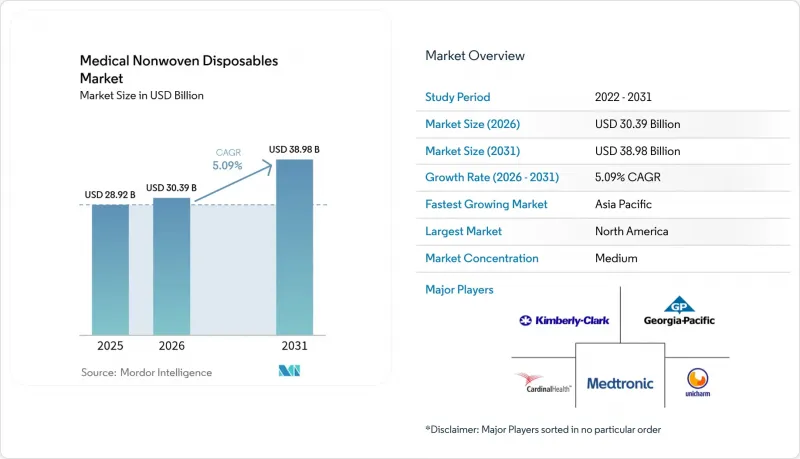
This report is Segmented by Product (Incontinence Products, and More), Material (Polypropylene Spunbond, and More), End-User (Hospitals & Clinics, and More), Distribution Channel (Hospital Pharmacies, Retail Pharmacies, Online Pharmacies), and Geography (North America, Europe, Asia-Pacific, Middle East & Africa, South America). The Market Forecasts are Provided in Terms of Value (USD).
Global Medical Nonwoven Disposables Market Trends and Insights
Increasing Global Geriatric Population
People aged 60 and older already exceed 310 million in China alone, a figure that is driving long-term demand for adult absorbent products and advanced wound dressings . Chronic wound prevalence rises sharply with age, compelling both hospitals and home-health services to maintain higher inventories of breathable, skin-friendly nonwoven dressings. Long-term care facilities are expanding worldwide, and each bed translates directly into recurring demand for disposable bedding protectors and underpads. Clinical studies link aging to higher rates of frailty, malnutrition, and device-related infections, further reinforcing institutional reliance on sterile single-use drapes and gowns. Together these demographic pressures create a predictable, multi-year baseline for the medical nonwovens disposables market.
Rising Incidence of Hospital-Acquired Infections
Healthcare-associated infections cost U.S. hospitals USD 35.7-45 billion every year, with analysts estimating that 70% of cases can be prevented through better barrier materials and workflow controls. Hospital procurement teams therefore prioritize nonwovens that incorporate fluid-impervious layers and embedded antimicrobial chemistries. Audit-and-feedback programs increasingly measure compliance at the material level, reinforcing the link between product choice and reimbursement. Advanced gauze dressings infused with silver ions or cationic additives have demonstrated significant reductions in surgical-site infection rates, validating premium pricing for such solutions. Regulators in Europe and the United States now require performance data on microbial strike-through resistance, accelerating replacement of legacy cotton packs with engineered composites. The result is steady, price-supported uptake of higher-margin antimicrobial nonwoven SKUs.
Environmental Concerns Over Polypropylene-Based Waste
Life-cycle studies undertaken during the COVID-19 pandemic recorded steep increases in nonwoven waste volumes, highlighting landfill pressure and carbon footprints associated with single-use PPE. Regulators in the European Union and the state of California now explore extended-producer-responsibility schemes that could raise compliance costs for disposable products. Hospitals in urban centers have started piloting closed-loop collection for sterilizable textile alternatives, potentially eroding demand for low-value SMS gowns. Brands counter by introducing polylactic-acid (PLA) spunbond that degrades 95% within 90 days under commercial composting conditions, yet price premiums and limited sterilization data inhibit rapid substitution. Unless cost parity is achieved, sustainability will remain a headwind that modestly tempers the long-run CAGR of the medical nonwovens disposables market.
Other drivers and restraints analyzed in the detailed report include:
- Expanding Surgical Volumes in Emerging Economies
- Stringent Infection-Control Guidelines in Outpatient Settings
- Surging Adoption of Antimicrobial-Impregnated Spun-Melt Nonwovens
- Government Subsidies for Domestic PPE Manufacturing
- Shift Toward Reusable Robotic and Laparoscopic Procedures
For complete list of drivers and restraints, kindly check the Table Of Contents.
Segment Analysis
The incontinence segment held 42.21% of the medical nonwovens disposables market share in 2025. Consistent consumer uptake of adult briefs, underpads, and gender-specific liners underscores how stigma reduction campaigns and discreet product designs convert latent need into active purchasing. Manufacturers have boosted fluff-free core absorption and skin-contact softness, attributes that attract long-term-care operators and retail buyers alike. Disposable adult underwear volumes are rising in supermarkets and e-commerce channels, aided by plus-size SKUs that fit waistlines up to 95 inches.
Advanced wound dressings are the fastest-growing product cluster with a 5.68% CAGR as electrospun nanofiber scaffolds mimic extracellular matrix and foster moist-healing environments. Self-adhesive bioresorbable patches that integrate antibacterial agents and controlled-release growth factors shorten dressing change intervals, easing nursing workloads and lowering infection risk. Surgical packs remain a bedrock category, with procedure count growth offsetting modest pack optimization initiatives. Collectively, these trends ensure the medical nonwovens disposables market size continues to benefit from both volume-driven staples and value-added specialized dressings.
Polypropylene spunbond represented 47.62% of the 2025 medical nonwovens disposables market size due to its favorable cost-to-performance ratio and straightforward compliance path. SMS and SMMS laminates blend spunbond strength with melt-blown filtration to meet high-stress surgical applications, and capacity additions in the United States and Vietnam are calibrated for healthcare volumes. Melt-blown webs maintain critical importance for N95-class respirators, with governments stockpiling media to hedge against future respiratory outbreaks.
Biopolymer and natural-fiber substrates posted the highest growth at 5.55% CAGR. PLA fibers from corn starch or sugarcane deliver hypoallergenic performance and moisture wicking for next-generation feminine hygiene pads. Start-ups leverage agricultural waste streams such as pineapple leaf and bagasse to spin biodegradable pulps into absorbent cores, a development that reduces fossil-carbon content while supporting rural economies. Although volumes remain small, price premiums have started to narrow as line speeds climb, setting the stage for broader adoption over the forecast period.
Complete Report Scope:
- By Product
- Incontinence Products
- Adult Diapers
- Feminine Hygiene Pads
- Infant Diapers
- Surgical Non-woven Products
- Surgical Gowns
- Surgical Drapes & Packs
- Face Masks, Caps & Shoe Covers
- Advanced Wound Dressings
- Personal Protective Equipment (PPE)
- Incontinence Products
- By Material
- Polypropylene Spunbond
- Melt-blown
- SMS/SMMS Composites
- Air-laid Pulp
- Biodegradable/Biopolymer Nonwovens
- By End-user
- Hospitals & Clinics
- Ambulatory Surgical Centres
- Long-term Care Facilities
- Home-healthcare Settings
- By Distribution Channel
- Hospital Pharmacies
- Retail Pharmacies
- Online Pharmacies
- By Geography
- North America
- United States
- Canada
- Mexico
- Europe
- Germany
- United Kingdom
- France
- Italy
- Spain
- Rest of Europe
- Asia-Pacific
- China
- Japan
- India
- Australia
- South Korea
- Rest of Asia-Pacific
- Middle East & Africa
- GCC
- South Africa
- Rest of Middle East & Africa
- South America
- Brazil
- Argentina
- Rest of South America
- North America
Geography Analysis
North America contributed 39.83% to 2025 revenue thanks to advanced infection-control standards, high procedure intensity, and federal incentives that channel PPE contracts to domestic mills. U.S. manufacturers committed over USD 290 million to new lines after federal demand forecasts guaranteed order visibility, though domestic unit costs remain above Asian benchmarks. Canada focuses on provincial stockpiles for pandemic resilience, further supporting regional utilization of premium nonwovens.
Asia-Pacific is forecast to post the fastest 6.42% CAGR through 2031 as governments expand universal health coverage and build surgical infrastructure. China commands significant export volume in wound dressings and packs, leveraging economies of scale and improving quality systems to hold global share. India, Indonesia, and Vietnam combine low labor costs with rising local consumption, prompting multinationals to establish joint ventures for closer-to-market production. Japan and South Korea sustain demand for high-specification drapes in robotic surgery, underpinning value growth.
Europe registers steady expansion on the back of stringent environmental mandates that stimulate early adoption of biodegradable spunbond fabrics. Extended-producer-responsibility rules set phased recycling targets for medical disposables, nudging procurement toward certified compostable gowns in Nordic hospitals. Eastern European facilities absorb niche contract manufacturing as Western EU converters focus on sustainable specialty lines.
The Middle East & Africa and South America together account for a modest but rising contribution to the medical nonwovens disposables market. Investment in flagship hospitals and national health-insurance schemes in Saudi Arabia, the United Arab Emirates, Brazil, and Chile create demand for disposable procedure packs, even though macro-economic volatility sometimes delays public tenders.
- Ahlstrom-Munksjo
- Asahi Kasei Corp.
- Berry Global
- Cardinal Health
- First Quality Enterprises
- Freudenberg SE
- Georgia-Pacific
- Kimberly-Clark Corp.
- Unicharm Corp.
- Cypress Medical
- Medtronic
- MRK Healthcare
- Molnlycke Health Care
- Ontex NV
- Domtar Corp.
- TWE Group
- PFNonwovens a.s.
- Suominen Corp.
- Toray Industries
- Hogy Medical Co. Ltd.
- Medline Industries
Additional Benefits:
- The market estimate (ME) sheet in Excel format
- 3 months of analyst support
TABLE OF CONTENTS
1 Introduction
- 1.1 Study Assumptions & Market Definition
- 1.2 Scope of the Study
2 Research Methodology
3 Executive Summary
4 Market Landscape
- 4.1 Market Overview
- 4.2 Market Drivers
- 4.2.1 Increasing Global Geriatric Population
- 4.2.2 Rising Incidence Of Hospital-Acquired Infections
- 4.2.3 Expanding Surgical Volumes In Emerging Economies
- 4.2.4 Stringent Infection-Control Guidelines In Outpatient Settings
- 4.2.5 Surging Adoption Of Antimicrobial-Impregnated Spun-Melt Nonwovens
- 4.2.6 Government Subsidies For Domestic Ppe & Medical Textile Manufacturing
- 4.3 Market Restraints
- 4.3.1 Environmental Concerns Over Polypropylene-Based Waste
- 4.3.2 Shift Toward Reusable Robotic & Laparoscopic Procedures
- 4.3.3 Volatility In Polypropylene Resin Pricing Due To Capacity Rationalisation
- 4.3.4 Slow Clinical Acceptance Of Biopolymer Nonwovens Owing To Cost
- 4.4 Value / Supply-Chain Analysis
- 4.5 Regulatory Landscape
- 4.6 Technological Outlook
- 4.7 Porter's Five Forces Analysis
- 4.7.1 Threat of New Entrants
- 4.7.2 Bargaining Power of Buyers
- 4.7.3 Bargaining Power of Suppliers
- 4.7.4 Threat of Substitute Products
- 4.7.5 Intensity of Competitive Rivalry
5 Market Size & Growth Forecasts (Value - USD)
- 5.1 By Product
- 5.1.1 Incontinence Products
- 5.1.1.1 Adult Diapers
- 5.1.1.2 Feminine Hygiene Pads
- 5.1.1.3 Infant Diapers
- 5.1.2 Surgical Non-woven Products
- 5.1.2.1 Surgical Gowns
- 5.1.2.2 Surgical Drapes & Packs
- 5.1.2.3 Face Masks, Caps & Shoe Covers
- 5.1.3 Advanced Wound Dressings
- 5.1.4 Personal Protective Equipment (PPE)
- 5.1.1 Incontinence Products
- 5.2 By Material
- 5.2.1 Polypropylene Spunbond
- 5.2.2 Melt-blown
- 5.2.3 SMS/SMMS Composites
- 5.2.4 Air-laid Pulp
- 5.2.5 Biodegradable/Biopolymer Nonwovens
- 5.3 By End-user
- 5.3.1 Hospitals & Clinics
- 5.3.2 Ambulatory Surgical Centres
- 5.3.3 Long-term Care Facilities
- 5.3.4 Home-healthcare Settings
- 5.4 By Distribution Channel
- 5.4.1 Hospital Pharmacies
- 5.4.2 Retail Pharmacies
- 5.4.3 Online Pharmacies
- 5.5 By Geography
- 5.5.1 North America
- 5.5.1.1 United States
- 5.5.1.2 Canada
- 5.5.1.3 Mexico
- 5.5.2 Europe
- 5.5.2.1 Germany
- 5.5.2.2 United Kingdom
- 5.5.2.3 France
- 5.5.2.4 Italy
- 5.5.2.5 Spain
- 5.5.2.6 Rest of Europe
- 5.5.3 Asia-Pacific
- 5.5.3.1 China
- 5.5.3.2 Japan
- 5.5.3.3 India
- 5.5.3.4 Australia
- 5.5.3.5 South Korea
- 5.5.3.6 Rest of Asia-Pacific
- 5.5.4 Middle East & Africa
- 5.5.4.1 GCC
- 5.5.4.2 South Africa
- 5.5.4.3 Rest of Middle East & Africa
- 5.5.5 South America
- 5.5.5.1 Brazil
- 5.5.5.2 Argentina
- 5.5.5.3 Rest of South America
- 5.5.1 North America
6 Competitive Landscape
- 6.1 Market Concentration
- 6.2 Market Share Analysis
- 6.3 Company Profiles (includes Global level Overview, Market level overview, Core Segments, Financials as available, Strategic Information, Market Rank/Share, Products & Services, Recent Developments)
- 6.3.1 Ahlstrom-Munksjo
- 6.3.2 Asahi Kasei Corp.
- 6.3.3 Berry Global Inc.
- 6.3.4 Cardinal Health Inc.
- 6.3.5 First Quality Enterprises Inc.
- 6.3.6 Freudenberg SE
- 6.3.7 Georgia-Pacific LLC
- 6.3.8 Kimberly-Clark Corp.
- 6.3.9 Unicharm Corp.
- 6.3.10 Cypress Medical
- 6.3.11 Medtronic plc
- 6.3.12 MRK Healthcare
- 6.3.13 Molnlycke Health Care
- 6.3.14 Ontex NV
- 6.3.15 Domtar Corp.
- 6.3.16 TWE Group
- 6.3.17 PFNonwovens a.s.
- 6.3.18 Suominen Corp.
- 6.3.19 Toray Industries Inc.
- 6.3.20 Hogy Medical Co. Ltd.
- 6.3.21 Medline Industries LP
7 Market Opportunities & Future Outlook
- 7.1 White-space & Unmet-need Assessment

