PUBLISHER: Mordor Intelligence | PRODUCT CODE: 2114772

PUBLISHER: Mordor Intelligence | PRODUCT CODE: 2114772
Transdermal Skin Patches - Market Share Analysis, Industry Trends & Statistics, Growth Forecasts (2026 - 2031)
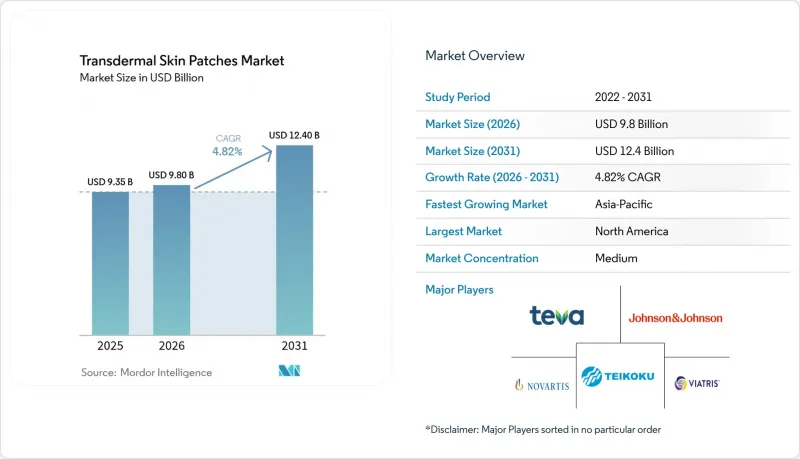
According to Mordor Intelligence, the transdermal skin patches market size was valued at USD 9.35 billion in 2025 and estimated to grow from USD 9.8 billion in 2026 to reach USD 12.4 billion by 2031, at a CAGR of 4.82% during the forecast period (2026-2031).
Global Transdermal Skin Patches Market Trends and Insights
Patent Cliff-Driven Switch to Novel Delivery Formats
Pharmaceutical companies face USD 200 billion worth of patent expirations between 2025-2030, prompting reformulations that extend exclusivity while improving patient adherence. This pivot is pronounced in chronic pain and neurological therapies where patches circumvent hepatic first-pass metabolism, enabling lower dosing with steadier plasma levels. FDA guidance released in June 2024 clarified "Essential Drug Delivery Outputs," reducing regulatory uncertainty and cutting pre-approval timelines by up to 12 months. Companies therefore treat transdermal delivery as both a life-cycle management tool and a compliance-boosting strategy for lifestyle medications.
Rapid Rise of Self-Administered Chronic-Care Therapies
Rising global prevalence of diabetes, hypertension, and hormone-related conditions elevates demand for home-based treatment that minimizes clinic visits. Transdermal insulin systems achieved 35% higher patient-satisfaction scores than subcutaneous injections in recent trials. APAC markets adopt patches quickly due to aging populations and rural care gaps, while elderly cohorts worldwide value the simple "apply-and-go" format that aids cognitive decline-related adherence issues.
High Development Cost vs. Oral Generics
Novel transdermal patches can cost USD 50 million to bring to market compared with USD 5-10 million for oral generics, largely due to specialized manufacturing and bioequivalence studies. In low-income settings, payers emphasize volume over innovation, challenging patch adoption despite clinical benefits. Combination-product regulations further raise costs with added device-testing requirements, squeezing smaller entrants.
Other drivers and restraints analyzed in the detailed report include:
- Rapid Rise of Self-Administered Chronic-Care Therapies
- Reimbursement Expansion for Smoking-Cessation Aids
- Skin-Sensitivity Litigation Risks
For complete list of drivers and restraints, kindly check the Table Of Contents.
Segment Analysis
Drug-in-adhesive systems held 46.62% of the transdermal skin patches market share in 2025, reflecting process maturity, proven safety, and cost efficiency. Yet microneedle-assisted formats show the highest forecast CAGR at 4.88%, propelled by their ability to deliver peptides, vaccines, and even GLP-1 agonists with bioavailability above 50%. Reservoir and matrix patches maintain niche roles in controlled-release analgesia and generic pain management, respectively.
Microneedle advances resonate with pharmaceutical pipelines that now feature larger biologic molecules. Start-ups such as Anodyne Nanotech report room-temperature-stable patches that bypass cold-chain costs, opening emerging-market opportunities. As clinical data accumulate, the technology is expected to reallocate a portion of the transdermal skin patches market size away from injections, particularly in chronic metabolic and autoimmune care.
Smoking-cessation patches continue to dominate with 64.01% share in 2025, anchored by public-health funding and strong clinical evidence. However, neurological disorders register the fastest growth at 5.14% CAGR on the back of steady-state drug delivery advantages for Parkinson's and ADHD therapies. Hormone-replacement and pain-management segments remain stable, while cardiovascular and contraception patches serve targeted populations.
Continuous dermal release mitigates peak-trough fluctuations critical in central-nervous-system treatment. Rotigotine and methylphenidate patches exemplify the model, demonstrating improved motor control and attentional stability, respectively. Payers increasingly recognize reduced hospitalization and enhanced quality-of-life outcomes, bolstering formulary inclusion.
Complete Report Scope:
- By Release Technology (Value)
- Drug-in-adhesive
- Reservoir
- Matrix
- Microneedle-assisted
- Others
- By Therapeutic Area (Value)
- Smoking Cessation
- Hormone Replacement Therapy
- Pain Management
- Neurological Disorders
- Cardiovascular Disorders
- Contraception
- Others
- By Adhesive Technology (Value)
- Acrylate Adhesives
- Silicone Adhesives
- Hydrogel Adhesives
- Other Adhesives
- By Distribution Channel (Value)
- Hospital Pharmacies
- Retail Pharmacies
- Online Pharmacies
- Others
- By Geography (Value)
- North America
- United States
- Canada
- Mexico
- Europe
- Germany
- United Kingdom
- France
- Italy
- Spain
- Rest of Europe
- Asia-Pacific
- China
- India
- Japan
- South Korea
- Australia
- Rest of Asia-Pacific
- South America
- Brazil
- Argentina
- Rest of South America
- Middle East and Africa
- GCC
- South Africa
- Rest of Middle East and Africa
- North America
Geography Analysis
North America led the transdermal skin patches market with 38.77% share in 2025, lifted by broad reimbursement for nicotine therapy, favorable IP protection, and streamlined FDA combination-product pathways. Medicare's inclusion of patches for vasomotor symptom management in 2025 further widens uptake, while domestic manufacturing expansions, such as LGM Pharma's USD 6 million facility upgrade, bolster supply resilience. U.S. demographic aging also raises demand for patch-based pain and hormone therapies requiring minimal dexterity.
Europe follows with mature yet regulation-dense adoption. Implementation of MDR raises compliance costs, yet the European Medicines Agency's 2024 Q&A clarifies device-drug integration requirements, reducing ambiguity. Hormone-replacement patches enjoy strong traction, though recent estradiol shortages underline the need for regional manufacturing redundancy. Additionally, smoking-cessation reimbursement across leading EU economies sustains steady volume despite fierce generic competition.
Asia-Pacific represents the fastest-growing region, advancing at 5.06% CAGR through 2031. Aging populations in China and Japan, coupled with rising diabetes prevalence, create fertile ground for patch adoption. Regulatory harmonization across ASEAN, alongside local production investments, lowers market-entry barriers. China's menopausal-therapy market illustrates the opportunity; clinicians increasingly recommend patches over oral estrogen due to lower thrombotic risk. Expanding e-commerce ecosystems also address rural accessibility challenges, propelling online patch sales.
- 3M
- Abbott Laboratories
- Johnson & Johnson
- Novartis
- Teva Pharmaceutical Industries
- Hisamitsu Pharmaceutical
- GlaxoSmithKline
- Bayer
- Viatris
- LTS Lohmann Therapie-Systeme
- Nitto Denko
- Corium LLC
- Agile Therapeutics Inc.
- UCB
- Luye Pharma Group Ltd.
- Zydus Lifesciences Ltd.
- Sparsha Pharma International Pvt Ltd
- Tapemark Inc.
- AdhexPharma
Additional Benefits:
- The market estimate (ME) sheet in Excel format
- 3 months of analyst support
TABLE OF CONTENTS
1 Introduction
- 1.1 Study Assumptions & Market Definition
- 1.2 Scope of the Study
2 Research Methodology
3 Executive Summary
4 Market Landscape
- 4.1 Market Overview
- 4.2 Market Drivers
- 4.2.1 Patent cliff-driven switch to novel delivery formats
- 4.2.2 Rapid rise of self-administered chronic-care therapies
- 4.2.3 Reimbursement expansion for smoking-cessation aids
- 4.2.4 Micro-needle/ionic-poration hybrids entering clinical phase III
- 4.2.5 AI-enabled adhesive design lowering skin-irritation rates
- 4.3 Market Restraints
- 4.3.1 High development cost vs. oral generics
- 4.3.2 Skin-sensitivity litigation risks
- 4.3.3 Regulatory ambiguity on combination-device pathway (U.S. & EU)
- 4.4 Value / Supply-Chain Analysis
- 4.5 Regulatory Landscape
- 4.6 Technological Outlook
- 4.7 Porter's Five Forces
- 4.7.1 Threat of New Entrants
- 4.7.2 Bargaining Power of Suppliers
- 4.7.3 Bargaining Power of Buyers
- 4.7.4 Threat of Substitutes
- 4.7.5 Competitive Rivalry
5 Market Size & Growth Forecasts
- 5.1 By Release Technology (Value)
- 5.1.1 Drug-in-adhesive
- 5.1.2 Reservoir
- 5.1.3 Matrix
- 5.1.4 Microneedle-assisted
- 5.1.5 Others
- 5.2 By Therapeutic Area (Value)
- 5.2.1 Smoking Cessation
- 5.2.2 Hormone Replacement Therapy
- 5.2.3 Pain Management
- 5.2.4 Neurological Disorders
- 5.2.5 Cardiovascular Disorders
- 5.2.6 Contraception
- 5.2.7 Others
- 5.3 By Adhesive Technology (Value)
- 5.3.1 Acrylate Adhesives
- 5.3.2 Silicone Adhesives
- 5.3.3 Hydrogel Adhesives
- 5.3.4 Other Adhesives
- 5.4 By Distribution Channel (Value)
- 5.4.1 Hospital Pharmacies
- 5.4.2 Retail Pharmacies
- 5.4.3 Online Pharmacies
- 5.4.4 Others
- 5.5 By Geography (Value)
- 5.5.1 North America
- 5.5.1.1 United States
- 5.5.1.2 Canada
- 5.5.1.3 Mexico
- 5.5.2 Europe
- 5.5.2.1 Germany
- 5.5.2.2 United Kingdom
- 5.5.2.3 France
- 5.5.2.4 Italy
- 5.5.2.5 Spain
- 5.5.2.6 Rest of Europe
- 5.5.3 Asia-Pacific
- 5.5.3.1 China
- 5.5.3.2 India
- 5.5.3.3 Japan
- 5.5.3.4 South Korea
- 5.5.3.5 Australia
- 5.5.3.6 Rest of Asia-Pacific
- 5.5.4 South America
- 5.5.4.1 Brazil
- 5.5.4.2 Argentina
- 5.5.4.3 Rest of South America
- 5.5.5 Middle East and Africa
- 5.5.5.1 GCC
- 5.5.5.2 South Africa
- 5.5.5.3 Rest of Middle East and Africa
- 5.5.1 North America
6 Competitive Landscape
- 6.1 Market Concentration
- 6.2 Market Share Analysis
- 6.3 Company Profiles (includes Global level Overview, Market level overview, Core Segments, Financials as available, Strategic Information, Market Rank/Share for key companies, Products & Services, and Recent Developments)
- 6.3.1 3M Company
- 6.3.2 Abbott Laboratories
- 6.3.3 Johnson & Johnson Services Inc.
- 6.3.4 Novartis International AG
- 6.3.5 Teva Pharmaceutical Industries Ltd.
- 6.3.6 Hisamitsu Pharmaceutical Co. Inc.
- 6.3.7 GlaxoSmithKline plc
- 6.3.8 Bayer AG
- 6.3.9 Viatris Inc.
- 6.3.10 LTS Lohmann Therapie-Systeme AG
- 6.3.11 Nitto Denko Corporation
- 6.3.12 Corium LLC
- 6.3.13 Agile Therapeutics Inc.
- 6.3.14 UCB S.A.
- 6.3.15 Luye Pharma Group Ltd.
- 6.3.16 Zydus Lifesciences Ltd.
- 6.3.17 Sparsha Pharma International Pvt Ltd
- 6.3.18 Tapemark Inc.
- 6.3.19 AdhexPharma
7 Market Opportunities & Future Outlook
- 7.1 White-space & Unmet-need Assessment

