PUBLISHER: Mordor Intelligence | PRODUCT CODE: 2114774

PUBLISHER: Mordor Intelligence | PRODUCT CODE: 2114774
Tracheostomy Products - Market Share Analysis, Industry Trends & Statistics, Growth Forecasts (2026 - 2031)
According to Mordor Intelligence, the tracheostomy products market size was valued at USD 226.43 million in 2025 and estimated to grow from USD 236.03 million in 2026 to reach USD 290.48 million by 2031, at a CAGR of 4.24% during the forecast period (2026-2031).
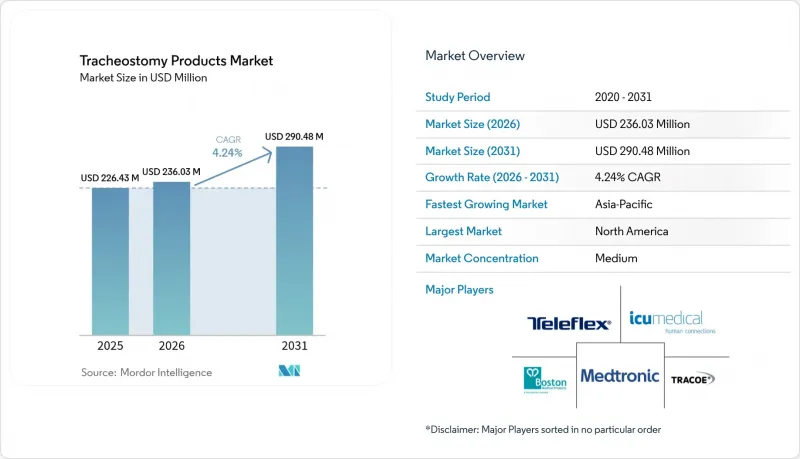
This report Segments the Industry Into by Product Type (Tracheostomy Tubes, and More), by Material (Polyvinyl Chloride, Silicone, and More), Procedure Type (Surgical Tracheostomy, and More), Indication (Prolonged Mechanical Ventilation, Obstructive Sleep Apnoea, and More), by End User (Hospitals, and More), and Geography. The Market Sizes and Forecasts are Provided in Terms of Value (USD).
Global Tracheostomy Products Market Trends and Insights
Rising Prevalence of Chronic Respiratory Diseases
Global chronic respiratory disease cases climbed to 454.56 million in 2024, enlarging the candidate pool for tracheostomy procedures . Post-COVID patients now present longer stenotic segments and cartilage damage, making percutaneous tracheostomy favorable for complex airway rehabilitation. Research on biodegradable stents and drug-eluting tubes broadens treatment choices, encouraging hospitals to invest in higher-priced, complication-mitigating platforms. Device makers that integrate antimicrobial coatings and real-time flow monitoring record stronger adoption because clinicians aim to lower ventilator-associated pneumonia rates while easing prolonged mechanical ventilation transitions. The net effect is a measurable lift in procedural volumes and a preference for advanced kits that optimize decannulation outcomes.
Aging Population and ICU Admissions
Patients aged 50-69 have overtaken older cohorts to form the largest tracheostomy demographic, driven by higher survival in critical-care settings and wider eligibility for elective airway management. Predictive analytics embedded in electronic health records guide clinicians on timing, prompting the purchase of percutaneous systems compatible with bedside ultrasound guidance. With middle-aged survivors returning for repeat evaluations, the tracheostomy products market sees demand for tubes that offer comfort, phonation accessories, and embedded sensors for home monitoring. Vendors that position portfolios around ICU workflow efficiency stand to capture higher replacement sales and service contracts.
High Procedure and Device Cost
Tracheostomy kits, postoperative consumables, and specialized staffing together elevate the total cost of ownership, straining budgets in low-resource hospitals. Value-based purchasing now obliges suppliers to furnish pharmacoeconomic models that link premium silicone or silver tubes with shorter ICU stays. Distributors counter price pushback by offering lease-to-own bundles and training packages that spread capital outlays. Emerging-market tenders still favor base-grade PVC tubes, tempering uptake of connected devices despite clinical upside. Cost pressure consequently nudges vendors to streamline component counts, adopt regional manufacturing, and expand portfolio tiers to protect volume share.
Other drivers and restraints analyzed in the detailed report include:
- Favorable Reimbursement in Mature Markets
- Shift Toward Home-Based Weaning Programs
- Device-Associated Infection Risk
For complete list of drivers and restraints, kindly check the Table Of Contents.
Segment Analysis
The tracheostomy products market size attributed to tubes reached USD 112.66 million in 2025, equal to 49.74% of global revenue. Despite ongoing commoditization, tubes retain primacy because every airway procedure needs a well-fitted cannula. Tube makers defend share through incremental gains such as Medtronic's tapered cuff that cuts leakage by 99% and reduces lateral wall pressure by 18.6%. Ventilation accessories-filters, speaking valves, and humidification chambers-are the fastest climbers at a 4.74% CAGR through 2031 as hospitals seek holistic infection-control bundles. Connected accessories that log airflow metrics integrate seamlessly into electronic records, positioning suppliers for service-based revenue.
Accessory growth also mirrors home-care expansion, where families favor turnkey kits that simplify suction, dressing changes, and emergency management. Smart accessories transmit alerts to telehealth hubs, helping clinicians fine-tune weaning protocols. This evolution from stand-alone cannulas to full airway ecosystems raises switching barriers and promotes multi-product procurement contracts. The tracheostomy products industry thus sees new cross-selling potential, with disposables providing stable recurring income that offsets longer replacement cycles for base tubes.
PVC and polyurethane retained 51.88% market share in 2025 owing to low unit cost and entrenched tooling. Nevertheless, silicone grew at 4.67% CAGR, propelled by reduced hypersensitivity reactions and improved airflow characteristics under high-frequency ventilation modes. The tracheostomy products market benefits when ICUs adopt silicone for complex cases, raising average selling prices and stimulating premium R&D. Hybrid constructions that sandwich silicone liners within PVC shells balance cost with performance and ease regulatory pathways, enabling mid-tier offerings.
Silver and stainless steel tubes continue to serve reconstructive or head-neck oncology needs where durability and antimicrobial traits matter. Emerging biodegradable polymers such as PLGA and PLA attract research funding, offering temporary airway scaffolds that circumvent long-term complications. Nanoparticle-infused coatings disrupt biofilm while preserving lumen patency, yet scale-up challenges linger. Raw material shortages during the pandemic exposed reliance on Asia-centric silicone supply, prompting dual-sourcing and local compounding investments to secure continuity and reassure hospital buyers about delivery timeframes.
Complete Report Scope:
- By Product Type
- Tracheostomy Tubes
- Tracheostomy Ventilation Accessories
- Tracheostomy Cleaning & Care Kits
- Other Product Types
- By Material
- PVC & Polyurethane
- Silicone
- Metal (Silver / Stainless Steel)
- Biodegradable Polymers & Others
- By Procedure Type
- Surgical / Open Tracheostomy
- Percutaneous Dilatational Tracheostomy (PDT)
- Hybrid / Endoscopic-assisted
- By Indication
- Prolonged Mechanical Ventilation
- Head & Neck Cancer / Tumours
- Obstructive Sleep Apnoea
- Trauma & Emergency Airway
- Neuromuscular & Degenerative Disorders
- Congenital / Other Conditions
- By End User
- Hospitals
- Ambulatory / Day-care Centres
- Home-care Settings
- By Geography
- North America
- United States
- Canada
- Mexico
- Europe
- Germany
- United Kingdom
- France
- Italy
- Spain
- Rest of Europe
- Asia-Pacific
- China
- Japan
- India
- Australia
- South Korea
- Rest of Asia-Pacific
- Middle East & Africa
- GCC
- South Africa
- Rest of Middle East & Africa
- South America
- Brazil
- Argentina
- Rest of South America
- North America
Geography Analysis
North America controlled 42.02% of global revenue in 2025, underpinned by expansive ICU capacity, stringent product-safety oversight, and Medicare payment updates that reward connected respiratory devices. U.S. adoption of percutaneous kits accelerated when professional societies published bedside ultrasound guidelines, and post-acute reimbursement now endorses telemonitored decannulation programs. Canada mirrors this trend through universal coverage, promoting standardized tube bundles that reduce cross-province procurement complexity.
European Union markets collectively provide a robust margin environment thanks to the Medical Device Regulation framework that harmonizes clinical evidence demands and sustains premium pricing for silicone and silver tubes. Germany and France spearhead percutaneous technique uptake due to universal ICU ultrasound access, while Italy and Spain embrace home-based weaning to offset constrained bed capacity. Brexit pushed the United Kingdom to refine its own regulatory files, yet NHS initiatives still favor AI-enabled monitoring tools that document readmission avoidance.
Asia-Pacific registers the fastest 5.20% CAGR as demographic aging, chronic pulmonary disease prevalence, and government healthcare expansion converge. China's investment in tertiary ICUs and respiratory therapist programs widens the addressable installation base for smart tracheostomy platforms. Japan's mature health insurance covers high-end silicone tubes, encouraging local production partnerships. India and Southeast Asian nations stimulate price-sensitive segments, prompting hybrid PVC-silicone offerings and incremental adoption of low-cost percutaneous sets. Australia and South Korea, with advanced e-health records, pilot validation studies for IoT-based cuff pressure telemetry, shaping next-generation product specifications across the tracheostomy products market.
- Medtronic
- Smiths Group
- Teleflex
- Boston Medical Center
- TRACOE medical
- Cook Group
- Fuji Systems
- Fisher & Paykel Healthcare
- Troge Medical
- Pulmodyne
- Atos Medical AB
- Intersurgical
- Ambu
- Coloplast (Servona)
- Becton Dickinson (CareFusion)
- ICU Medical
- Mercury Medical
- Passy-Muir Inc.
- SunMed LLC
- Boston Scientific
Additional Benefits:
- The market estimate (ME) sheet in Excel format
- 3 months of analyst support
TABLE OF CONTENTS
1 Introduction
- 1.1 Study Assumptions & Market Definition
- 1.2 Scope of the Study
2 Research Methodology
3 Executive Summary
4 Market Landscape
- 4.1 Market Overview
- 4.2 Market Drivers
- 4.2.1 Rising prevalence of chronic respiratory diseases
- 4.2.2 Ageing population & ICU admissions
- 4.2.3 Favourable reimbursement in mature markets
- 4.2.4 Shift toward home-based weaning programmes
- 4.2.5 Wider adoption of minimally-invasive percutaneous tracheostomy techniques in intensive-care units
- 4.2.6 Continuous technological improvements in tubes
- 4.3 Market Restraints
- 4.3.1 High procedure & device cost
- 4.3.2 Device-associated infection risk
- 4.3.3 Shortage of trained decannulation teams
- 4.3.4 Supply-chain fragility for silicone & silver
- 4.4 Value / Supply-Chain Analysis
- 4.5 Regulatory Landscape
- 4.6 Technological Outlook
- 4.7 Porter's Five Forces Analysis
- 4.7.1 Threat of New Entrants
- 4.7.2 Bargaining Power of Buyers
- 4.7.3 Bargaining Power of Suppliers
- 4.7.4 Threat of Substitutes
- 4.7.5 Intensity of Competitive Rivalry
5 Market Size & Growth Forecasts (Value/Volume)
- 5.1 By Product Type
- 5.1.1 Tracheostomy Tubes
- 5.1.2 Tracheostomy Ventilation Accessories
- 5.1.3 Tracheostomy Cleaning & Care Kits
- 5.1.4 Other Product Types
- 5.2 By Material
- 5.2.1 PVC & Polyurethane
- 5.2.2 Silicone
- 5.2.3 Metal (Silver / Stainless Steel)
- 5.2.4 Biodegradable Polymers & Others
- 5.3 By Procedure Type
- 5.3.1 Surgical / Open Tracheostomy
- 5.3.2 Percutaneous Dilatational Tracheostomy (PDT)
- 5.3.3 Hybrid / Endoscopic-assisted
- 5.4 By Indication
- 5.4.1 Prolonged Mechanical Ventilation
- 5.4.2 Head & Neck Cancer / Tumours
- 5.4.3 Obstructive Sleep Apnoea
- 5.4.4 Trauma & Emergency Airway
- 5.4.5 Neuromuscular & Degenerative Disorders
- 5.4.6 Congenital / Other Conditions
- 5.5 By End User
- 5.5.1 Hospitals
- 5.5.2 Ambulatory / Day-care Centres
- 5.5.3 Home-care Settings
- 5.6 By Geography
- 5.6.1 North America
- 5.6.1.1 United States
- 5.6.1.2 Canada
- 5.6.1.3 Mexico
- 5.6.2 Europe
- 5.6.2.1 Germany
- 5.6.2.2 United Kingdom
- 5.6.2.3 France
- 5.6.2.4 Italy
- 5.6.2.5 Spain
- 5.6.2.6 Rest of Europe
- 5.6.3 Asia-Pacific
- 5.6.3.1 China
- 5.6.3.2 Japan
- 5.6.3.3 India
- 5.6.3.4 Australia
- 5.6.3.5 South Korea
- 5.6.3.6 Rest of Asia-Pacific
- 5.6.4 Middle East & Africa
- 5.6.4.1 GCC
- 5.6.4.2 South Africa
- 5.6.4.3 Rest of Middle East & Africa
- 5.6.5 South America
- 5.6.5.1 Brazil
- 5.6.5.2 Argentina
- 5.6.5.3 Rest of South America
- 5.6.1 North America
6 Competitive Landscape
- 6.1 Market Concentration
- 6.2 Market Share Analysis
- 6.3 Company Profiles (includes Global level Overview, Market level overview, Core Segments, Financials as available, Strategic Information, Market Rank/Share, Products & Services, Recent Developments)
- 6.3.1 Medtronic PLC
- 6.3.2 Smiths Group PLC
- 6.3.3 Teleflex Incorporated
- 6.3.4 Boston Medical Products Inc.
- 6.3.5 TRACOE medical GmbH
- 6.3.6 Cook Group
- 6.3.7 Fuji Systems Corporation
- 6.3.8 Fisher & Paykel Healthcare Ltd
- 6.3.9 Troge Medical GmbH
- 6.3.10 Pulmodyne
- 6.3.11 Atos Medical AB
- 6.3.12 Intersurgical Ltd
- 6.3.13 Ambu A/S
- 6.3.14 Coloplast (Servona)
- 6.3.15 Becton Dickinson (CareFusion)
- 6.3.16 ICU Medical Inc.
- 6.3.17 Mercury Medical
- 6.3.18 Passy-Muir Inc.
- 6.3.19 SunMed LLC
- 6.3.20 Boston Scientific Corp.
7 Market Opportunities & Future Outlook
- 7.1 White-space & Unmet-Need Assessment

