PUBLISHER: Mordor Intelligence | PRODUCT CODE: 2114775

PUBLISHER: Mordor Intelligence | PRODUCT CODE: 2114775
Battlefield Management Systems - Market Share Analysis, Industry Trends & Statistics, Growth Forecasts (2026 - 2031)
According to Mordor Intelligence, the battlefield management systems (BMS) market size was valued at USD 11.93 billion in 2025 and estimated to grow from USD 12.45 billion in 2026 to reach USD 15.38 billion by 2031, at a CAGR of 4.32% during the forecast period (2026-2031).
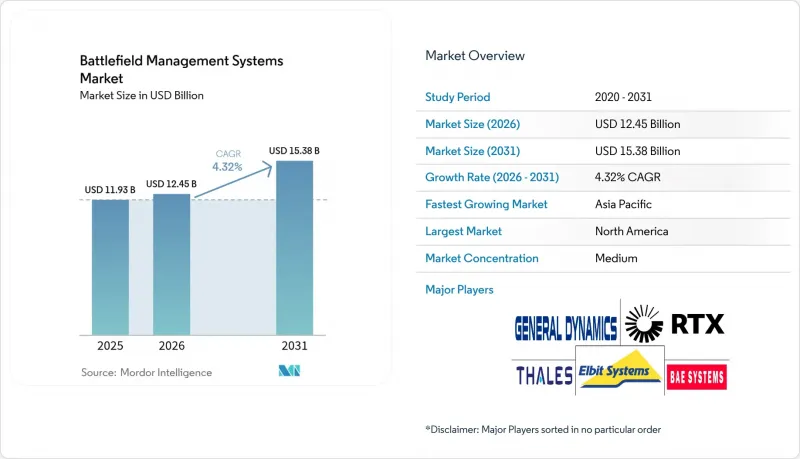
This report is Segmented by System (Navigation, Communication and Networking, and More), Component (Hardware, Software, and Services), Platform (Armored Vehicles, Aircraft, and More), Installation Type (Vehicle-Mounted, and More), End User (Army, Navy, and More), and Geography (North America, Asia-Pacific and More). The Market Forecasts are Provided in Terms of Value (USD).
Global Battlefield Management Systems Market Trends and Insights
Digital transformation enables real-time decision superiority
Defense ministries are channeling record budgets into data-centric warfare programs that elevate the BMS market. The US FY 2025 budget assigns USD 21.1 billion to C4I systems, reflecting the shift toward information dominance. Ukraine's Delta platform demonstrates how drone feeds, satellite imagery, and AI video analysis converge into a unified battlespace picture. Comparable initiatives across NATO and the Asia-Pacific are pressuring legacy forces to migrate toward software-defined architectures. As the Canadian Armed Forces Digital Campaign Plan underscored, organizational change can prove more challenging than technology integration. Therefore, the BMS market hinges on aligning culture, doctrine, and technology around sub-second data flows.
Network-centric warfare drives interoperability mandates
Modern battle networks rely on secure data links integrating land, air, maritime, space, and cyber assets. NATO assessments highlight capability gaps that have accelerated Joint All-Domain Command and Control frameworks. The UK's Morpheus and TRINITY programs illustrate the complexity of migrating to quantum-secure, AI-enabled networks. China's April 2024 creation of the Information Support Force confirms that great-power competitors prioritize network-centric formations. Intensive exercises in the Indo-Pacific underscore how coalition partners must share data without exposing vulnerabilities. These trends propel the BMS market toward universal interoperability requirements.
Cybersecurity escalation strains budgets and schedules
The Defense Industrial Base Cybersecurity Strategy 2024 mandates tighter controls across supply chains. Cybersecurity Maturity Model Certification 2.0 requires contractors to fund continuous monitoring, which inflates program costs. Adversaries target data integrity, prompting the US Navy to field decentralized certificate-key servers that operate in disrupted networks. New export controls on AI model weights add compliance burdens for allied projects. As a result, acquisition timelines stretch, moderating BMS market growth.
Other drivers and restraints analyzed in the detailed report include:
- Open standards revolution tackles vendor lock-in
- Augmented-reality soldier applications reshape dismounted operations
- Legacy system integration complexity inflates customization costs
For complete list of drivers and restraints, kindly check the Table Of Contents.
Segment Analysis
The BMS market size for communication and networking systems is expanding at an 8.34% CAGR by 2031 as militaries prioritize seamless data exchange. Command and control retains the largest slice with 31.78% revenue in 2025, reflecting enduring centralized decision authority. Navigation subsystems are upgrading with assured positioning, navigation, and timing to counter GPS denial. Weapon system integration is shifting to software-defined payloads that accelerate engagement cycles. Memoranda such as the Nokia-blackened agreement illustrate how 5G and defense expertise merge to deploy tactical meshes. The US Air Force's prototypes for Indo-Pacific Command confirm that resilient comms networks underpin multi-domain operations. As mesh architectures standardize, the BMS market deepens coalition interoperability.
Communications growth draws new entrants that leverage open APIs and virtualized network functions. Link 16 augmentation with mesh topologies sustains connectivity when satellites or line-of-sight radios fail. Governments direct funds toward spectrum agility and anti-jamming, reinforcing long-term communication investment. Meanwhile, command and control vendors adapt by embedding AI decision aides and cloud-native microservices. The widening capability gap between software-defined networks and legacy stovepipes underscores why the BMS market will continue rewarding agile communicators.
Hardware delivered 50.62% of the BMS market revenue in 2025, led by rugged computers, radios, and sensors that withstand extreme environments. Yet software is outpacing at an 8.84% CAGR, propelled by mapping, predictive logistics, and digital-twin applications. Services-including integration, cyber hardening, and training-benefit from rising complexity and mission-specific customization requirements. Anduril's collaboration with Meta on mixed-reality interfaces exemplifies how software innovation redefines human-machine interaction. The Army's Digital Transformation Challenge drew 64 submissions, revealing industry focus on open data models and DevSecOps pipelines. The Battlefield Management Systems market favors suppliers who separate hardware refresh rates from software upgrade cycles as update velocity increases.
Communication devices evolve into multi-waveform, software-defined radios that host waveform apps on common hardware. Imaging systems integrate augmented reality overlays to display sensor feeds and tactical data simultaneously. Meanwhile, service providers cultivate advanced simulation environments that model entire theaters of operation. Investors, therefore, view the BMS market as shifting toward subscription-like software and service revenue streams layered atop durable hardware baselines.
Complete Report Scope:
- By System
- Navigation Systems
- Communication and Networking Systems
- Command and Control Systems
- Weapon Systems
- By Component
- Hardware
- Communication Devices
- Imaging and Display Devices
- Computing and Data Servers
- Software
- Logistics Management Software
- Mapping and Navigation Applications
- Services
- Integration and Maintenance
- Training and Simulation
- Hardware
- By Platform
- Armored Fighting Vehicles
- Soldier (Dismounted) Systems
- Command Headquarters
- Unmanned Systems
- Naval Vessels
- Aircraft
- By Installation Type
- Vehicle-Mounted
- Hand-held and Wearable
- Stationary Command Centers
- By End User
- Army
- Air Force
- Navy
- Homeland Security and Special Forces
- By Geography
- North America
- United States
- Canada
- Europe
- United Kingdom
- Germany
- France
- Russia
- Rest of Europe
- Asia-Pacific
- China
- India
- Japan
- South Korea
- Rest of Asia-Pacific
- South America
- Brazil
- Rest of South America
- Middle East and Africa
- Middle East
- Saudi Arabia
- United Arab Emirates
- Israel
- Rest of Middle East
- Africa
- South Africa
- Rest of Africa
- Middle East
- North America
Geography Analysis
Asia-Pacific generated 29.05% of the BMS market revenue in 2025, driven by China's formation of the Information Support Force and India's edge-AI partnerships that embed indigenous technology into C4ISR programs. The US Indo-Pacific Command's emphasis on technology integration and intensive joint exercises accelerates regional demand for interoperable systems. Japan's invitation for India to join the Global Combat Air Program further binds regional supply chains to open-architecture mandates.
The Middle East and Africa are forecast to post the fastest growth at 9.23% CAGR, catalyzed by surging military expenditures that reached USD 693 billion in 2024. Saudi Arabia's partnerships with L3Harris for EO/IR payloads and Lockheed Martin for integrated missile defense systems exemplify regional appetite for advanced command suites. The US-UAE defense agreement opens new avenues for joint technology development and transfer.
North America maintains a robust demand through sustained US Department of Defense investment. The FY 2025 allocation of USD 21.1 billion for C4I keeps the Battlefield Management Systems market dynamic. European modernization centers on NATO interoperability, with the European Defence Fund's 2025 call financing autonomous triage systems and secure distribution networks. NATO gap assessments in AI-enabled C4ISR infrastructure amplify funding for cross-border projects. Collectively, these regional dynamics ensure steady global revenue streams, even as open standards ease technology sharing among allies.
- ASELSAN A.S.
- BAE Systems plc
- RTX Corporation
- Elbit Systems Ltd.
- General Dynamics Corporation
- Indra Sistemas S.A.
- Kongsberg Gruppen ASA
- L3Harris Technologies, Inc.
- Rheinmetall AG
- Leonardo DRS Inc. (Leonardo S.p.A)
- Saab AB
- Thales Group
- Northrop Grumman Corporation
- Bharat Electronics Limited
- Ultra Electronics Holdings plc
- Systematic A/S
- Curtiss-Wright Corporation
- HENSOLDT AG
Additional Benefits:
- The market estimate (ME) sheet in Excel format
- 3 months of analyst support
TABLE OF CONTENTS
1 INTRODUCTION
- 1.1 Study Assumptions and Market Definition
- 1.2 Scope of the Study
2 RESEARCH METHODOLOGY
3 EXECUTIVE SUMMARY
4 MARKET LANDSCAPE
- 4.1 Market Overview
- 4.2 Market Drivers
- 4.2.1 Accelerating digital-transformation programs
- 4.2.2 Adoption of network-centric warfare doctrines
- 4.2.3 Shift to open, software-defined standards
- 4.2.4 Soldier-worn augmented-reality BMS apps
- 4.2.5 AI/ML-powered analytics and cloud-edge computing
- 4.2.6 Proliferation of unmanned and autonomous platforms
- 4.3 Market Restraints
- 4.3.1 Escalating cybersecurity and electronic-warfare threats driving costly hardening
- 4.3.2 Complex integration with heterogeneous legacy platforms and data formats
- 4.3.3 Export controls on advanced computing items and AI model weights
- 4.3.4 Organizational and cultural barriers that slow digital-transformation adoption
- 4.4 Value Chain Analysis
- 4.5 Regulatory and Technological Outlook
- 4.6 Porter's Five Forces Analysis
- 4.6.1 Bargaining Power of Buyers/Consumers
- 4.6.2 Bargaining Power of Suppliers
- 4.6.3 Threat of New Entrants
- 4.6.4 Threat of Substitute Products
- 4.6.5 Intensity of Competitive Rivalry
5 MARKET SIZE AND GROWTH FORECASTS (VALUE)
- 5.1 By System
- 5.1.1 Navigation Systems
- 5.1.2 Communication and Networking Systems
- 5.1.3 Command and Control Systems
- 5.1.4 Weapon Systems
- 5.2 By Component
- 5.2.1 Hardware
- 5.2.1.1 Communication Devices
- 5.2.1.2 Imaging and Display Devices
- 5.2.1.3 Computing and Data Servers
- 5.2.2 Software
- 5.2.2.1 Logistics Management Software
- 5.2.2.2 Mapping and Navigation Applications
- 5.2.3 Services
- 5.2.3.1 Integration and Maintenance
- 5.2.3.2 Training and Simulation
- 5.2.1 Hardware
- 5.3 By Platform
- 5.3.1 Armored Fighting Vehicles
- 5.3.2 Soldier (Dismounted) Systems
- 5.3.3 Command Headquarters
- 5.3.4 Unmanned Systems
- 5.3.5 Naval Vessels
- 5.3.6 Aircraft
- 5.4 By Installation Type
- 5.4.1 Vehicle-Mounted
- 5.4.2 Hand-held and Wearable
- 5.4.3 Stationary Command Centers
- 5.5 By End User
- 5.5.1 Army
- 5.5.2 Air Force
- 5.5.3 Navy
- 5.5.4 Homeland Security and Special Forces
- 5.6 By Geography
- 5.6.1 North America
- 5.6.1.1 United States
- 5.6.1.2 Canada
- 5.6.2 Europe
- 5.6.2.1 United Kingdom
- 5.6.2.2 Germany
- 5.6.2.3 France
- 5.6.2.4 Russia
- 5.6.2.5 Rest of Europe
- 5.6.3 Asia-Pacific
- 5.6.3.1 China
- 5.6.3.2 India
- 5.6.3.3 Japan
- 5.6.3.4 South Korea
- 5.6.3.5 Rest of Asia-Pacific
- 5.6.4 South America
- 5.6.4.1 Brazil
- 5.6.4.2 Rest of South America
- 5.6.5 Middle East and Africa
- 5.6.5.1 Middle East
- 5.6.5.1.1 Saudi Arabia
- 5.6.5.1.2 United Arab Emirates
- 5.6.5.1.3 Israel
- 5.6.5.1.4 Rest of Middle East
- 5.6.5.2 Africa
- 5.6.5.2.1 South Africa
- 5.6.5.2.2 Rest of Africa
- 5.6.5.1 Middle East
- 5.6.1 North America
6 COMPETITIVE LANDSCAPE
- 6.1 Market Concentration
- 6.2 Strategic Moves
- 6.3 Market Share Analysis
- 6.4 Company Profiles (includes Global-level Overview, Market-level Overview, Core Segments, Financials as available, Strategic Information, Market Rank/Share for key companies, Products and Services, and Recent Developments)
- 6.4.1 ASELSAN A.S.
- 6.4.2 BAE Systems plc
- 6.4.3 RTX Corporation
- 6.4.4 Elbit Systems Ltd.
- 6.4.5 General Dynamics Corporation
- 6.4.6 Indra Sistemas S.A.
- 6.4.7 Kongsberg Gruppen ASA
- 6.4.8 L3Harris Technologies, Inc.
- 6.4.9 Rheinmetall AG
- 6.4.10 Leonardo DRS Inc. (Leonardo S.p.A)
- 6.4.11 Saab AB
- 6.4.12 Thales Group
- 6.4.13 Northrop Grumman Corporation
- 6.4.14 Bharat Electronics Limited
- 6.4.15 Ultra Electronics Holdings plc
- 6.4.16 Systematic A/S
- 6.4.17 Curtiss-Wright Corporation
- 6.4.18 HENSOLDT AG
7 MARKET OPPORTUNITIES AND FUTURE OUTLOOK
- 7.1 White-space and Unmet-need Assessment

