PUBLISHER: Mordor Intelligence | PRODUCT CODE: 2114781

PUBLISHER: Mordor Intelligence | PRODUCT CODE: 2114781
Enzyme Replacement Therapy - Market Share Analysis, Industry Trends & Statistics, Growth Forecasts (2026 - 2031)
According to Mordor Intelligence, the enzyme replacement therapy market size is expected to grow from USD 16.01 billion in 2025 to USD 17.45 billion in 2026 and is forecast to reach USD 26.83 billion by 2031 at 8.99% CAGR over 2026-2031.
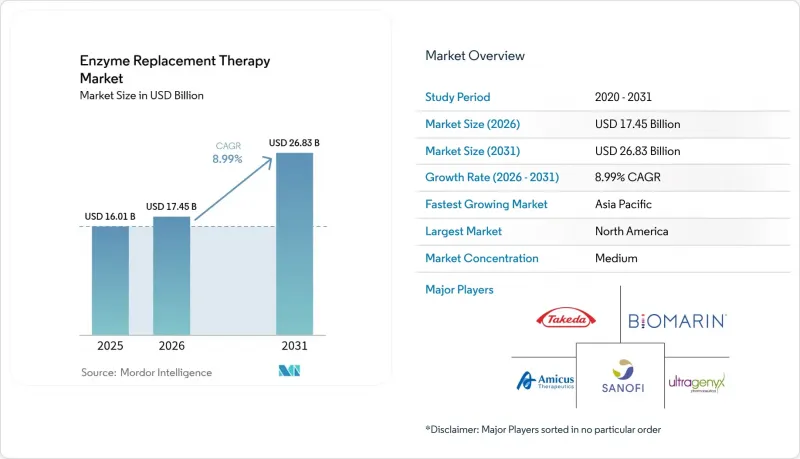
This report is Segmented by Enzyme Type (Imiglucerase, and More), Application (Gaucher Disease (Type I, II, III), and More), Route of Administration (Intravenous Infusion and Sub-Cutaneous), by Formulation (Standard Recombinant Enzyme, and More), by End User (Infusion Centers, and More), Geography (North America, Europe, and More). The Market Forecasts are Provided in Terms of Value (USD).
Global Enzyme Replacement Therapy Market Trends and Insights
Growing Rare Disease Prevalence
Newborn genomic programs in China identified lysosomal storage disorders in 1 of every 1,512 births, revealing sizable undiagnosed cohorts and spurring sustained uptake across the enzyme replacement therapy market. Earlier diagnoses let clinicians intervene before irreversible organ damage, which lowers lifetime costs relative to late stage symptom management. Payers increasingly treat early therapy as preventive spending, realigning rare-disease budgets. As more jurisdictions adopt similar programs, the global patient pool expands and accelerates demand predictability. Early identification also facilitates long-term outcome tracking, a pre-requisite for value-based contracts that many insurers now favor.
Government Incentives and Funding
The US FDA granted six Rare Pediatric Disease Designations to M6P Therapeutics in 2024, illustrating how expedited review routes shorten development timelines for enzyme candidates. Europe's proposal for an Orphan Genomic Therapies Fund seeks to underwrite both innovation and equitable access. Direct subsidies now target manufacturing capacity, responding to chronic shortages and boosting confidence in supply security. These policies lessen capital risk for biopharma sponsors and speed commercial launches, raising competitive intensity inside the enzyme replacement therapy market. Multinational firms leverage grants to scale regional plants, lowering landed costs and improving patient reach.
High Treatment Costs
Annual outlays of USD 200,000-300,000 per patient in the United States continue to squeeze payer budgets, complicating broad adoption across emerging economies with smaller health-care spends. Surveyed insurers quote a median "fair" price of USD 256,000 for chronic enzyme therapies, a figure that scarcely aligns with public budget ceilings. European reimbursement still ranges widely-from 27% in Poland to 88% in Denmark-creating unequal access that fragments demand and tempers revenue visibility. While outcome-based contracts mitigate risk, they require sophisticated data streams that many health systems lack, slowing uptake.
Other drivers and restraints analyzed in the detailed report include:
- Expansion of Newborn Screening Programs
- Shift Toward Patient-Centric Delivery
- Immunogenicity Concerns
For complete list of drivers and restraints, kindly check the Table Of Contents.
Segment Analysis
Imiglucerase held 38.05% of enzyme replacement therapy market share in 2025, underscoring its entrenched role in Gaucher disease management over three decades. However, avalglucosidase alfa is forecast to grow at 11.12% CAGR, propelled by enhanced lysosomal targeting in Pompe disease protocols. The enzyme replacement therapy market size for next-generation agents is projected to expand rapidly as manufacturers migrate toward pegylated or glycoengineered constructs that promise longer half-life, lower immunogenicity, and reduced infusion frequency.
Competitive pressure mounts as agalsidase alfa, taliglucerase alfa, and velaglucerase alfa vie for differentiated positioning through alternative production systems and supply stability. Pegunigalsidase alfa's phase-3 readouts show sustained plasma exposure, hinting at a paradigm shift for Fabry disease care. Manufacturers investing in yeast or plant-cell bioreactors cut upstream costs and diversify sourcing, lowering the risk of shortages that once punctuated the enzyme replacement therapy industry.
Gaucher protocols generated 42.87% of the enzyme replacement therapy market size in 2025, courtesy of multiple approved assets and well-established dosing algorithms. Pompe disease tails closely, with an 11.02% CAGR expected through 2031 as cipaglucosidase alfa plus miglustat outperforms monotherapy benchmarks. Meanwhile, Fabry disease therapies maintain momentum through earlier diagnosis and guideline-driven initiation.
Emerging gene therapies, such as FLT201, are already trimming biomarker burdens and could squeeze enzyme uptake over the long term. Prenatal experimentation, as seen in UCSF's PEARL trial, may rewrite intervention windows altogether. Application-specific recommendations from European consensus groups now standardize monitoring intervals, supporting payer confidence and indirectly buoying the enzyme replacement therapy market.
Complete Report Scope:
- By Enzyme Type
- Imiglucerase
- Agalsidase Alfa
- Agalsidase Beta
- Velaglucerase Alfa
- Taliglucerase Alfa
- Alglucosidase Alfa
- Avalglucosidase Alfa
- Galsulfase
- Idursulfase
- Other Enzymes
- By Application
- Gaucher Disease (Type I, II, III)
- Pompe Disease (Infantile & Late-Onset)
- Fabry Disease
- MPS I (Hurler Syndrome)
- MPS II (Hunter Syndrome)
- MPS IV (Morquio Syndrome)
- Other Applications
- By Route of Administration
- Intravenous Infusion
- Sub-Cutaneous
- By Formulation
- Standard Recombinant Enzyme
- PEGylated / Fusion Proteins
- Gene-Activated Next-Generation Enzymes
- By End User
- Hospitals & Specialty Clinics
- Home Healthcare Settings
- Infusion Centers
- Geography
- North America
- United States
- Canada
- Mexico
- Europe
- Germany
- United Kingdom
- France
- Italy
- Spain
- Rest of Europe
- Asia-Pacific
- China
- Japan
- India
- Australia
- South Korea
- Rest of Asia-Pacific
- Middle East & Africa
- GCC
- South Africa
- Rest of Middle East & Africa
- South America
- Brazil
- Argentina
- Rest of South America
- North America
Geography Analysis
North America retained 38.10% share in 2025 and continues to benefit from well-funded insurance schemes and an FDA that accelerates rare-disease approvals such as Lenmeldy for metachromatic leukodystrophy. Outcome-based contracts have gained traction, tying annual outlays to biomarker improvements and hospitalization reductions. Manufacturers leverage specialty-pharmacy networks to execute same-day deliveries, enhancing adherence and reducing wastage. The enzyme replacement therapy market size across the United States and Canada also reflects broad newborn screening mandates, which funnel newly diagnosed infants into therapy earlier.
Europe presents a mixed access picture. Denmark reimburses up to 88% of costs, yet Poland covers just 27%, producing uneven uptake that tempers aggregate revenue. Centralized approvals via the European Medicines Agency simplify filings, as seen with Xenpozyme for Niemann-Pick disease, but post-approval price negotiations can stretch for years. Cross-border treatment travel rises where domestic funding lags, adding logistical complexity to supply planning. Still, coordinated treatment guidelines for mucopolysaccharidoses support convergence in clinical practice and underpin moderate growth.
Asia-Pacific is the enzyme replacement therapy market's fastest-growing arena at a 10.08% CAGR, lifted by aggressive newborn screening, rising household incomes, and localized production hubs. China's genomic panels uncovered higher-than-expected lysosomal incidence rates, prompting municipal funding programs that subsidize first-year treatments. Japan's approvals for pabinafusp alfa (MPS II) and aceneuramic acid (GNE myopathy) reflect regulator openness to cutting-edge modalities. Contract manufacturers across South Korea and Singapore scale up enzyme capacity, while India leverages cost leadership to serve domestic and export demand. Collectively these initiatives lift the enzyme replacement therapy industry's revenue baseline across the region.
- Sanofi
- Takeda Pharmaceuticals
- Biomarin Pharmaceutical
- Amicus Therapeutics
- Ultragenyx Pharmaceutical Inc.
- Spark Therapeutics
- JCR Pharmaceuticals Co. Ltd.
- Protalix BioTherapeutics
- Chiesi Farmaceutici
- GC Pharma (Green Cross Corp.)
- ISU Abxis
- Denali Therapeutics
- CANbridge Pharmaceuticals Inc.
- Pharming Group N.V.
- SOBI (Orphan Biovitrum)
- Avacta Group plc
- Orchard Therapeutics
- EUSA Pharma
- Idorsia Pharmaceuticals
Additional Benefits:
- The market estimate (ME) sheet in Excel format
- 3 months of analyst support
TABLE OF CONTENTS
1 Introduction
- 1.1 Study Assumptions & Market Definition
- 1.2 Scope of the Study
2 Research Methodology
3 Executive Summary
4 Market Landscape
- 4.1 Market Overview
- 4.2 Market Drivers
- 4.2.1 Growing Rare Disease Prevalence
- 4.2.2 Government Incentives and Funding
- 4.2.3 Expansion of Newborn Screening Programs
- 4.2.4 Shift Toward Patient-Centric Delivery
- 4.2.5 Technological Advancements in Enzyme Engineering
- 4.2.6 Innovative Reimbursement Models
- 4.3 Market Restraints
- 4.3.1 High Treatment Costs
- 4.3.2 Immunogenicity Concerns
- 4.3.3 Competition From Emerging Therapies
- 4.3.4 Supply Chain Challenges
- 4.4 Regulatory Landscape
- 4.5 Porter's Five Forces Analysis
- 4.5.1 Threat of New Entrants
- 4.5.2 Bargaining Power of Buyers
- 4.5.3 Bargaining Power of Suppliers
- 4.5.4 Threat of Substitutes
- 4.5.5 Competitive Rivalry
5 Market Size & Growth Forecasts (Value, USD)
- 5.1 By Enzyme Type
- 5.1.1 Imiglucerase
- 5.1.2 Agalsidase Alfa
- 5.1.3 Agalsidase Beta
- 5.1.4 Velaglucerase Alfa
- 5.1.5 Taliglucerase Alfa
- 5.1.6 Alglucosidase Alfa
- 5.1.7 Avalglucosidase Alfa
- 5.1.8 Galsulfase
- 5.1.9 Idursulfase
- 5.1.10 Other Enzymes
- 5.2 By Application
- 5.2.1 Gaucher Disease (Type I, II, III)
- 5.2.2 Pompe Disease (Infantile & Late-Onset)
- 5.2.3 Fabry Disease
- 5.2.4 MPS I (Hurler Syndrome)
- 5.2.5 MPS II (Hunter Syndrome)
- 5.2.6 MPS IV (Morquio Syndrome)
- 5.2.7 Other Applications
- 5.3 By Route of Administration
- 5.3.1 Intravenous Infusion
- 5.3.2 Sub-Cutaneous
- 5.4 By Formulation
- 5.4.1 Standard Recombinant Enzyme
- 5.4.2 PEGylated / Fusion Proteins
- 5.4.3 Gene-Activated Next-Generation Enzymes
- 5.5 By End User
- 5.5.1 Hospitals & Specialty Clinics
- 5.5.2 Home Healthcare Settings
- 5.5.3 Infusion Centers
- 5.6 Geography
- 5.6.1 North America
- 5.6.1.1 United States
- 5.6.1.2 Canada
- 5.6.1.3 Mexico
- 5.6.2 Europe
- 5.6.2.1 Germany
- 5.6.2.2 United Kingdom
- 5.6.2.3 France
- 5.6.2.4 Italy
- 5.6.2.5 Spain
- 5.6.2.6 Rest of Europe
- 5.6.3 Asia-Pacific
- 5.6.3.1 China
- 5.6.3.2 Japan
- 5.6.3.3 India
- 5.6.3.4 Australia
- 5.6.3.5 South Korea
- 5.6.3.6 Rest of Asia-Pacific
- 5.6.4 Middle East & Africa
- 5.6.4.1 GCC
- 5.6.4.2 South Africa
- 5.6.4.3 Rest of Middle East & Africa
- 5.6.5 South America
- 5.6.5.1 Brazil
- 5.6.5.2 Argentina
- 5.6.5.3 Rest of South America
- 5.6.1 North America
6 Competitive Landscape
- 6.1 Market Concentration
- 6.2 Market Share Analysis
- 6.3 Company Profiles (includes Global level Overview, Market level overview, Core Business Segments, Financials, Headcount, Key Information, Market Rank, Market Share, Products and Services, and analysis of Recent Developments)
- 6.3.1 Sanofi (Genzyme)
- 6.3.2 Takeda Pharmaceutical Co. Ltd
- 6.3.3 BioMarin Pharmaceutical Inc.
- 6.3.4 Amicus Therapeutics
- 6.3.5 Ultragenyx Pharmaceutical Inc.
- 6.3.6 Spark Therapeutics
- 6.3.7 JCR Pharmaceuticals Co. Ltd.
- 6.3.8 Protalix Biotherapeutics
- 6.3.9 Chiesi Farmaceutici S.p.A.
- 6.3.10 GC Pharma (Green Cross Corp.)
- 6.3.11 ISU Abxis
- 6.3.12 Denali Therapeutics
- 6.3.13 CANbridge Pharmaceuticals Inc.
- 6.3.14 Pharming Group N.V.
- 6.3.15 SOBI (Orphan Biovitrum)
- 6.3.16 Avacta Group plc
- 6.3.17 Orchard Therapeutics
- 6.3.18 EUSA Pharma
- 6.3.19 Idorsia Pharmaceuticals
7 Market Opportunities & Future Outlook
- 7.1 White-Space & Unmet-Need Assessment

