PUBLISHER: Mordor Intelligence | PRODUCT CODE: 2114784

PUBLISHER: Mordor Intelligence | PRODUCT CODE: 2114784
Vertebroplasty And Kyphoplasty - Market Share Analysis, Industry Trends & Statistics, Growth Forecasts (2026 - 2031)
According to Mordor Intelligence, the vertebroplasty & kyphoplasty market size is expected to grow from USD 940 million in 2025 to USD 991.32 million in 2026 and is forecast to reach USD 1.29 billion by 2031 at 5.46% CAGR over 2026-2031.
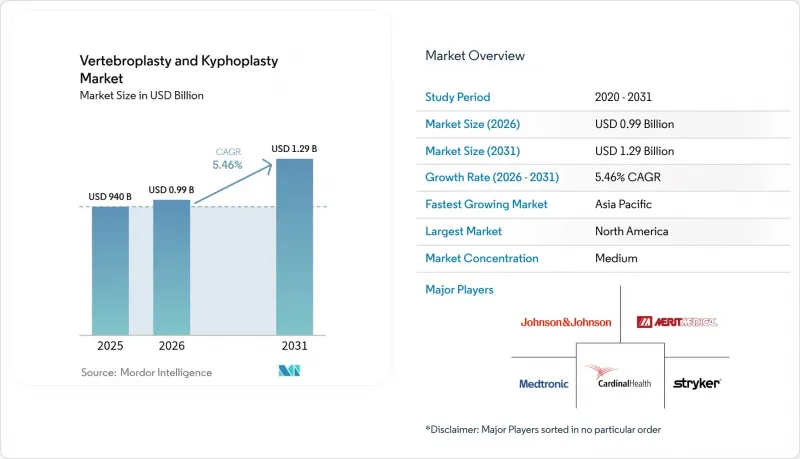
This report is Segmented by Product Type (Vertebroplasty Devices and More), Bone-Cement Material (PMMA, CPS, and Other Materials), Application (Osteoporotic Vertebral Compression Fractures and More), Surgical Approach (Transpedicular and More), End-User (Hospitals and More), and Geography (North America, Europe, Asia-Pacific, and More). The Market Forecasts are Provided in Terms of Value (USD).
Global Vertebroplasty And Kyphoplasty Market Trends and Insights
Growing Osteoporosis Prevalence
More than 1.4 million vertebral compression fractures occur every year, and osteoporosis affects 10-30% of women over 40 in Asia-Pacific, driving steady case growth for vertebral augmentation procedures. Nearly 23% of patients with single osteoporotic fractures develop severe sagittal misalignment after conservative treatment, prompting early surgical intervention. The economic drag is evident, as Brazil spent over BRL 288.9 million on osteoporosis care for the elderly during 2008-2010, underscoring cost pressures that favor definitive procedures that restore mobility.
Expanding Geriatric Demographic
One-fifth of people older than 70 experience osteoporotic vertebral compression fractures, with one-third developing chronic pain that often requires augmentation. Japan's policy focus on healthy life expectancy elevates demand for rapid fracture repair that permits early ambulation and lowers downstream disability costs. Balloon kyphoplasty can enable standing and walking within hours, helping health systems manage the mobility gap in aging societies.
Stringent FDA & EU-MDR Approval Timelines
Manufacturers now face EU-MDR transition deadlines that extend to 2027-2028 for Class III and certain Class IIb devices, lengthening certification cycles and raising compliance costs. In the US, ongoing post-market surveillance requirements following past cement leakage concerns add data-generation burdens that can slow first-to-market advantage.
Other drivers and restraints analyzed in the detailed report include:
- Preference for Minimally Invasive Day-Care Spine Surgeries
- Early-Intervention Guidelines Favoring Vertebral Augmentation
- Inconsistent Reimbursement for Vertebral Augmentation
For complete list of drivers and restraints, kindly check the Table Of Contents.
Segment Analysis
Kyphoplasty devices held 67.62% of the vertebroplasty & kyphoplasty market share in 2025 and are projected to rise at a 5.57% CAGR. The approach restores vertebral height before cement injection, cutting leakage risk and delivering visual-analog-scale pain reductions from 7.7 to 2.2. In comparison, vertebroplasty remains essential for acute stabilization but grows more slowly. The vertebroplasty & kyphoplasty market size for kyphoplasty devices is expected to move from USD 0.64 billion in 2025 to about USD 0.88 billion by 2031 at the stated CAGR, maintaining its dominant contribution to overall revenues. Stryker's SpineJack, capable of 1,000 N expansion force, and next-gen unipedicular balloons exemplify how engineering upgrades reinforce clinical preference.
The competitive focus now shifts toward hybrid implants that combine the structural benefits of kyphoplasty with vertebroplasty-style cement flows. Early clinical readouts from autonomous puncture systems suggest that procedural speed and accuracy can improve further, supporting sustained demand for premium device platforms. Emerging players demonstrate that well-targeted design tweaks can still carve share despite the presence of large incumbents.
PMMA retained 71.74% of the vertebroplasty & kyphoplasty market share in 2025 and is tracking a 5.51% CAGR. The growth of PMMA-based products reflects their broad familiarity and mechanical reliability. Recent formulations fine-tune polymerization temperature and viscosity to reduce extrusion while preserving strength.
At the same time, bioactive cements are carving a noticeable niche. Strontium-substituted hydroxyapatite promotes osseointegration, and PMMA-CPC hybrids blend load-bearing prowess with controlled resorption. Though starting from a small base, the "Other Materials" category is expected to post a higher CAGR than PMMA, aided by surgeon demand for biologically friendly agents that bond with cancellous bone.
Complete Report Scope:
- By Product Type
- Vertebroplasty Devices
- Kyphoplasty Devices
- By Bone-Cement Material
- Polymethylmethacrylate (PMMA)
- Calcium Phosphate Cement (CPC)
- Other Materials
- By Application
- Osteoporotic Vertebral Compression Fractures
- Spinal Metastases
- Other Applications
- By Surgical Approach
- Transpedicular
- Extrapedicular
- By End-User
- Hospitals
- Ambulatory Surgical Centres (ASCs)
- Other End-Users
- By Geography
- North America
- United States
- Canada
- Mexico
- Europe
- Germany
- United Kingdom
- France
- Italy
- Spain
- Rest of Europe
- Asia-Pacific
- China
- India
- Japan
- Australia
- South Korea
- Rest of Asia-Pacific
- Middle East and Africa
- GCC
- South Africa
- Rest of Middle East and Africa
- South America
- Brazil
- Argentina
- Rest of South America
- North America
Geography Analysis
North America remains the largest territory, supported by Medicare reimbursement that averages USD 1,200-1,500 per case and clinical familiarity built over two decades of data. The region advances at a 4.97% CAGR as demographic aging continues and AI-assisted navigation gains clinical acceptance.
Asia-Pacific, posting the fastest 6.56% CAGR, benefits from high osteoporosis prevalence-52.8% in women and 18.7% in men undergoing spine surgery in China, paired with rising healthcare expenditure. Government campaigns that emphasize active aging and swift fracture repair underpin procedure uptake.
Europe delivers a 5.21% CAGR, buoyed by aging populations and quality-of-life evidence that reinforces adoption, although EU-MDR compliance costs temper rapid product launches. Middle East & Africa and South America trail but still expand above 6% as tertiary centers adopt modern augmentation protocols and local device distributors build channel depth.
- ATEC Spine
- Beckton Dickinson
- BIOPSYBELL S.R.L.
- Cardinal Health
- G21 S.r.l.
- Globus Medical
- IZI Medical Products
- Johnson & Johnson
- Joimax
- Lindare Medical Ltd
- Medtronic
- Merit Medical Systems
- Shanghai Kinetic Medical Limited Co., Ltd.
- Spinal Elements, Inc.
- Spondylos
- Stryker
- Tecres S.p.A.
- Teknimed SA
- Zavation Medical Products, LLC
- Zimmer Biomet
Additional Benefits:
- The market estimate (ME) sheet in Excel format
- 3 months of analyst support
TABLE OF CONTENTS
1 Introduction
- 1.1 Study Assumptions & Market Definition
- 1.2 Scope of the Study
2 Research Methodology
3 Executive Summary
4 Market Landscape
- 4.1 Market Overview
- 4.2 Market Drivers
- 4.2.1 Growing osteoporosis prevalence
- 4.2.2 Expanding geriatric demographic
- 4.2.3 Preference for minimally-invasive day-care spine surgeries
- 4.2.4 Early-intervention clinical guidelines recommending vertebroplasty/kyphoplasty for acute osteoporotic fractures
- 4.2.5 AI-driven navigation & robotic alignment in vertebral augmentation
- 4.2.6 Bioactive, radiopaque & biodegradable bone-cement innovations
- 4.3 Market Restraints
- 4.3.1 Stringent FDA & EU-MDR approval timelines
- 4.3.2 Inconsistent reimbursement for vertebral augmentation
- 4.3.3 Procedure-related adverse events
- 4.3.4 PMMA monomer supply-chain volatility
- 4.4 Supply Chain Analysis
- 4.5 Regulatory Landscape
- 4.6 Technological Outlook
- 4.7 Porter's Five Forces Analysis
- 4.7.1 Threat of New Entrants
- 4.7.2 Bargaining Power of Buyers
- 4.7.3 Bargaining Power of Suppliers
- 4.7.4 Threat of Substitutes
- 4.7.5 Competitive Rivalry
5 Market Size & Growth Forecasts (Value)
- 5.1 By Product Type
- 5.1.1 Vertebroplasty Devices
- 5.1.2 Kyphoplasty Devices
- 5.2 By Bone-Cement Material
- 5.2.1 Polymethylmethacrylate (PMMA)
- 5.2.2 Calcium Phosphate Cement (CPC)
- 5.2.3 Other Materials
- 5.3 By Application
- 5.3.1 Osteoporotic Vertebral Compression Fractures
- 5.3.2 Spinal Metastases
- 5.3.3 Other Applications
- 5.4 By Surgical Approach
- 5.4.1 Transpedicular
- 5.4.2 Extrapedicular
- 5.5 By End-User
- 5.5.1 Hospitals
- 5.5.2 Ambulatory Surgical Centres (ASCs)
- 5.5.3 Other End-Users
- 5.6 By Geography
- 5.6.1 North America
- 5.6.1.1 United States
- 5.6.1.2 Canada
- 5.6.1.3 Mexico
- 5.6.2 Europe
- 5.6.2.1 Germany
- 5.6.2.2 United Kingdom
- 5.6.2.3 France
- 5.6.2.4 Italy
- 5.6.2.5 Spain
- 5.6.2.6 Rest of Europe
- 5.6.3 Asia-Pacific
- 5.6.3.1 China
- 5.6.3.2 India
- 5.6.3.3 Japan
- 5.6.3.4 Australia
- 5.6.3.5 South Korea
- 5.6.3.6 Rest of Asia-Pacific
- 5.6.4 Middle East and Africa
- 5.6.4.1 GCC
- 5.6.4.2 South Africa
- 5.6.4.3 Rest of Middle East and Africa
- 5.6.5 South America
- 5.6.5.1 Brazil
- 5.6.5.2 Argentina
- 5.6.5.3 Rest of South America
- 5.6.1 North America
6 Competitive Landscape
- 6.1 Market Concentration
- 6.2 Competitive Benchmarking
- 6.3 Market Share Analysis
- 6.4 Company Profiles (includes Global level Overview, Market level overview, Core Segments, Financials as available, Strategic Information, Market Rank/Share for key companies, Products & Services, and Recent Developments)
- 6.4.1 Alphatec Holdings, Inc.
- 6.4.2 Becton, Dickinson and Company
- 6.4.3 BIOPSYBELL S.R.L.
- 6.4.4 Cardinal Health, Inc.
- 6.4.5 G21 S.r.l.
- 6.4.6 Globus Medical, Inc.
- 6.4.7 IZI Medical Products
- 6.4.8 Johnson & Johnson Services, Inc.
- 6.4.9 joimax GmbH
- 6.4.10 Lindare Medical Ltd
- 6.4.11 Medtronic plc
- 6.4.12 Merit Medical Systems, Inc.
- 6.4.13 Shanghai Kinetic Medical Limited Co., Ltd.
- 6.4.14 Spinal Elements, Inc.
- 6.4.15 Spondylos
- 6.4.16 Stryker Corporation
- 6.4.17 Tecres S.p.A.
- 6.4.18 Teknimed SA
- 6.4.19 Zavation Medical Products, LLC
- 6.4.20 Zimmer Biomet Holdings, Inc.
7 Market Opportunities & Future Outlook
- 7.1 White-space & Unmet-Need Assessment

