PUBLISHER: Mordor Intelligence | PRODUCT CODE: 2114797

PUBLISHER: Mordor Intelligence | PRODUCT CODE: 2114797
Ureteral Stent - Market Share Analysis, Industry Trends & Statistics, Growth Forecasts (2026 - 2031)
According to Mordor Intelligence, the ureteral stents market size was valued at USD 624.35 million in 2025 and estimated to grow from USD 662.5 million in 2026 to reach USD 891.07 million by 2031, at a CAGR of 6.11% during the forecast period (2026-2031).
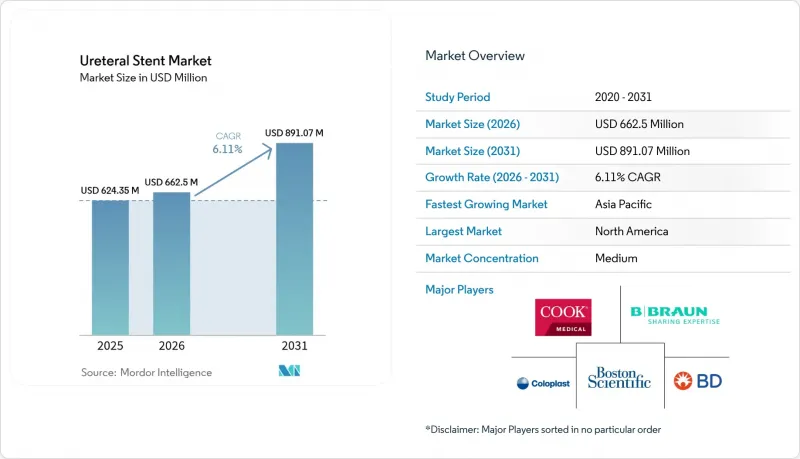
This report is Segmented by Product Type (Double Pigtail, Open-Ended, Close Ended and More), Material (Polyurethane, Silicon and More), Coating/Technology (Hydrophilic-Coated, Drug-Eluting and More), Application (Kidney Stones, Kidney Transplant and More), End User (Hospitals, Ambulatory Surgical Centers and More) and Geography. The Market Forecasts are Provided in Terms of Value (USD).
Global Ureteral Stent Market Trends and Insights
Rising Burden of Urological Disorders
Kidney-stone disease now affects 9.25% of US adults, with the sharpest gains in women under 60-a demographic shift prompting gender-specific stent design refinement.Obesity-linked metabolic changes accelerate stone formation in younger populations, creating a sustained pipeline of preventive stenting procedures. Chronic kidney disease correlates strongly with retained devices; 30.6% of patients with forgotten stents develop CKD versus 8.3% when timely removal occurs, nudging clinicians toward long-dwell, biocompatible options. These epidemiological realities underpin steady procedural growth and motivate manufacturers to deliver designs that maintain drainage while minimizing encrustation over extended durations.
Ageing Population-Linked Urological Surgeries Surge
Roughly 14.53% of older adults now experience renal stones, yet octogenarian treatment outcomes match younger cohorts, validating ureteroscopy coupled with stenting for frail patients. Initial stone-free rates reach 88% and rise to 97% after ancillary therapy, while complications remain near 9%, reinforcing preference for biodegradable stents that negate second interventions. Frailty assessments show a 1.731-fold greater kidney-stone risk, encouraging preventive drainage strategies for vulnerable seniors. Geriatric urology programs are standardizing anesthesia and recovery protocols to accommodate reduced physiological reserves, positioning temporary, dissolvable implants as a default option.
Infection & Encrustation Risks
Encrustation afflicts 80.8% of forgotten stents and drives a 40.2% UTI incidence, while risk escalates from 18.33% at 5 weeks to 75% beyond 12 weeks, underscoring the need for timely exchange or resorbable options. Prolonged pre-operative dwell exceeding two months multiplies post-ureteroscopy infection risk nearly fourfold. Even visually clean devices may harbor internal crystalline blockage, necessitating emergency intervention and prompting R&D toward antimicrobial coatings that disrupt biofilm formation.
Other drivers and restraints analyzed in the detailed report include:
- Increasing Research and Development for Material & Coating Innovations
- Increased Adoption and Launch of Biodegradable/Bioresorbable Stents
- Patient Discomfort / Stent-Related Symptoms
For complete list of drivers and restraints, kindly check the Table Of Contents.
Segment Analysis
Double pigtail devices retained 39.02% ureteral stents market share in 2025 because clinicians appreciate their reliable drainage and straightforward placement. Yet biodegradable alternatives are growing 10.04% annually as hospitals focus on single-procedure care pathways that boost throughput and patient satisfaction. Open-ended and closed-ended configurations remain niche, reserved for anatomically complex cases or strictures needing directional flow control. Metallic stents serve malignant obstruction needs, with the Allium system delivering 59.5% functional survival and a 22-month median patency despite notable migration.
Biodegradable innovations address core drawbacks of traditional products. PLA/PGA blends withstand early postoperative forces before dissolving into CO2 and water, limiting chronic irritation. Hybrid constructs combine self-expanding metal frames with resorbable coverings to unite long-term radial force with eventual lumen restoration. Patient-specific 3-D-printed geometries reduce migration by matching ureteral curvature, aligning with the ureteral stents market trend toward customized therapy at scale.
Polyurethane held 41.85% of the ureteral stents market size in 2025 thanks to decades of clinical familiarity and balanced flexibility. However, biodegradable materials exhibit an 10.48% CAGR because payers reward avoidance of second procedures. Silicone continues to dominate extended indwelling cases, valued for smoothness and low encrustation propensity, yet supply-chain shortages of medical-grade grades prompt diversification toward liquid-silicone-rubber variants produced closer to point of care.
Composite designs integrate radiopaque fillers within biodegradable matrices, ensuring visibility without permanent residue. Metal-polymer hybrids exploit nitinol's elasticity while providing resorbable luminal scaffolding. As ASTM F2579-18 standardization streamlines FDA review, manufacturers accelerate launches, reinforcing a structural change in the ureteral stents market where temporary function replaces permanent implantation.
Complete Report Scope:
- By Product Type
- Double Pigtail
- Open-Ended
- Closed-Ended
- Multiloop
- Biodegradable/Bioresorbable
- Metallic
- By Material
- Polyurethane
- Silicone
- Metal (Nitinol/Stainless)
- Biodegradable Polymers (PLA/PGA)
- Hybrid/Composite
- By Coating / Technology
- Hydrophilic-Coated
- Drug-Eluting
- Anti-Encrustation Nano-coated
- Radiopaque / Imaging-Enhanced
- By Application
- Kidney Stones (Urolithiasis)
- Kidney Transplant
- Urinary Tract Infection / Obstruction
- Tumors / Malignancies
- Post-Ureteroscopy / Post-Surgery
- By End User
- Hospitals
- Ambulatory Surgical Centers
- Specialty Urology Clinics
- Home-Care Settings
- By Geography
- North America
- United States
- Canada
- Mexico
- Europe
- Germany
- United Kingdom
- France
- Italy
- Spain
- Rest of Europe
- Asia-Pacific
- China
- Japan
- India
- Australia
- South Korea
- Rest of Asia-Pacific
- Middle East and Africa
- GCC
- South Africa
- Rest of Middle East and Africa
- South America
- Brazil
- Argentina
- Rest of South America
- North America
Geography Analysis
North America held 36.85% ureteral stents market share in 2025, powered by robust reimbursement, established procedural pathways, and early adoption of designs such as the RELIEF stent for reflux prevention. Kidney-stone incidence at 9.25% fuels volume, while ASC penetration improves throughput and patient convenience. Regional supply-chain resilience remains top-of-mind after pandemic-era shortages exposed vulnerabilities in medical-grade silicone sourcing.
Asia-Pacific registers the fastest 7.92% CAGR, reflecting healthcare modernization, aging societies in Japan and South Korea, and expanding insurance coverage throughout China and India. Regulatory harmonization across ASEAN lowers approval barriers, and domestic manufacturing plants shorten lead times, making advanced stents accessible to price-sensitive markets. Telemedicine adoption aids post-procedure follow-up across wide geographies, mitigating rural access gaps.
Europe grows steadily under universal healthcare but navigates a complex regulatory landscape that can slow novel-device rollouts. EMA scrutiny of biodegradable-by-product safety imposes rigorous, expensive trials, though academic-center collaborations support evidence generation. Cost-effectiveness remains pivotal; thus, technologies showing tangible savings-such as eliminating removal procedures-gain faster traction. Brexit-related logistics disruption persists, yet established supplier relationships deliver stability.
- Allium Medical
- Beckton Dickinson
- B. Braun
- Boston Scientific
- Coloplast
- Cook Group
- Olympus
- Teleflex
- UROMED Kurt Drews KG
- Taewoong Medical
- Advin Health Care
- Zhejiang ChuangXiang Medical Technology
- Pnn Medical A/S
- Merit Medical Systems
- Stryker
- Plasti-Med
- Micro-tech
- ROCAMED
- HydrUStent Lda
Additional Benefits:
- The market estimate (ME) sheet in Excel format
- 3 months of analyst support
TABLE OF CONTENTS
1 Introduction
- 1.1 Study Assumptions and Market Definition
- 1.2 Scope of the Study
2 Research Methodology
3 Executive Summary
4 Market Landscape
- 4.1 Market Overview
- 4.2 Market Drivers
- 4.2.1 Rising Burden Of Urological Disorders
- 4.2.2 Ageing Population-Linked Urological Surgeries Surge
- 4.2.3 Increasing Research and Development for Material & Coating Innovations
- 4.2.4 Increased Adoption and Launch Of Biodegradable/Bioresorbable Stents
- 4.2.5 AI-Guided Sizing & Placement Reducing Revision Rates
- 4.2.6 Day-Care Ureteroscopy Growth In ASCs
- 4.3 Market Restraints
- 4.3.1 Infection & Encrustation Risks
- 4.3.2 Patient Discomfort / Stent-Related Symptoms
- 4.3.3 Supply-Chain Shortage Of Medical-Grade Silicones
- 4.3.4 Regulatory Scrutiny On Biodegradable By-Products
- 4.4 Value / Supply-Chain Analysis
- 4.5 Regulatory Landscape
- 4.6 Technology Outlook
- 4.7 Porter's Five Forces Analysis
- 4.7.1 Bargaining Power of Suppliers
- 4.7.2 Bargaining Power of Buyers
- 4.7.3 Threat of New Entrants
- 4.7.4 Threat of Substitutes
- 4.7.5 Intensity of Competitive Rivalry
5 Market Size and Growth Forecasts (Value-USD)
- 5.1 By Product Type
- 5.1.1 Double Pigtail
- 5.1.2 Open-Ended
- 5.1.3 Closed-Ended
- 5.1.4 Multiloop
- 5.1.5 Biodegradable/Bioresorbable
- 5.1.6 Metallic
- 5.2 By Material
- 5.2.1 Polyurethane
- 5.2.2 Silicone
- 5.2.3 Metal (Nitinol/Stainless)
- 5.2.4 Biodegradable Polymers (PLA/PGA)
- 5.2.5 Hybrid/Composite
- 5.3 By Coating / Technology
- 5.3.1 Hydrophilic-Coated
- 5.3.2 Drug-Eluting
- 5.3.3 Anti-Encrustation Nano-coated
- 5.3.4 Radiopaque / Imaging-Enhanced
- 5.4 By Application
- 5.4.1 Kidney Stones (Urolithiasis)
- 5.4.2 Kidney Transplant
- 5.4.3 Urinary Tract Infection / Obstruction
- 5.4.4 Tumors / Malignancies
- 5.4.5 Post-Ureteroscopy / Post-Surgery
- 5.5 By End User
- 5.5.1 Hospitals
- 5.5.2 Ambulatory Surgical Centers
- 5.5.3 Specialty Urology Clinics
- 5.5.4 Home-Care Settings
- 5.6 By Geography
- 5.6.1 North America
- 5.6.1.1 United States
- 5.6.1.2 Canada
- 5.6.1.3 Mexico
- 5.6.2 Europe
- 5.6.2.1 Germany
- 5.6.2.2 United Kingdom
- 5.6.2.3 France
- 5.6.2.4 Italy
- 5.6.2.5 Spain
- 5.6.2.6 Rest of Europe
- 5.6.3 Asia-Pacific
- 5.6.3.1 China
- 5.6.3.2 Japan
- 5.6.3.3 India
- 5.6.3.4 Australia
- 5.6.3.5 South Korea
- 5.6.3.6 Rest of Asia-Pacific
- 5.6.4 Middle East and Africa
- 5.6.4.1 GCC
- 5.6.4.2 South Africa
- 5.6.4.3 Rest of Middle East and Africa
- 5.6.5 South America
- 5.6.5.1 Brazil
- 5.6.5.2 Argentina
- 5.6.5.3 Rest of South America
- 5.6.1 North America
6 Competitive Landscape
- 6.1 Market Concentration
- 6.2 Market Share Analysis
- 6.3 Company profiles (includes Global level Overview, Market level overview, Core Segments, Financials as available, Strategic Information, Market Rank/Share for key companies, Products and Services, and Recent Developments)
- 6.3.1 Allium Medical
- 6.3.2 Becton, Dickinson and Company
- 6.3.3 B. Braun Melsungen AG
- 6.3.4 Boston Scientific Corporation
- 6.3.5 Coloplast A/S
- 6.3.6 Cook Medical LLC
- 6.3.7 Olympus Corporation
- 6.3.8 Teleflex Incorporated
- 6.3.9 UROMED Kurt Drews KG
- 6.3.10 Taewoong Medical Co., Ltd.
- 6.3.11 Advin Health Care
- 6.3.12 Zhejiang ChuangXiang Medical Technology
- 6.3.13 Pnn Medical A/S
- 6.3.14 Merit Medical Systems
- 6.3.15 Stryker Corporation
- 6.3.16 Plasti-Med
- 6.3.17 Micro-Tech (Nanjing) Co., Ltd.
- 6.3.18 ROCAMED
- 6.3.19 HydrUStent Lda
7 Market Opportunities and Future Outlook
- 7.1 White-Space and Unmet-Need Assessment

