PUBLISHER: Mordor Intelligence | PRODUCT CODE: 2114799

PUBLISHER: Mordor Intelligence | PRODUCT CODE: 2114799
Cell Therapy - Market Share Analysis, Industry Trends & Statistics, Growth Forecasts (2026 - 2031)
According to Mordor Intelligence, the cell therapy market size is expected to increase from USD 5.58 billion in 2025 to USD 6.55 billion in 2026 and reach USD 14.56 billion by 2031, growing at a CAGR of 17.32% over 2026-2031.
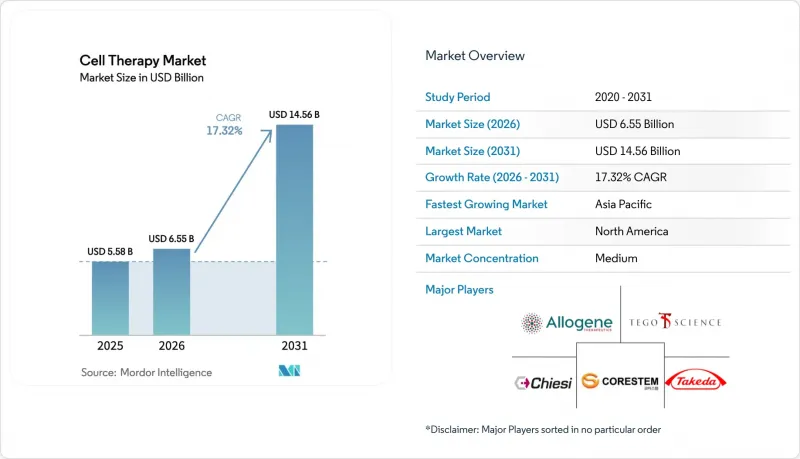
This report is Segmented by Therapy Type (Autologous Cell Therapy and Allogeneic Cell Therapy), by Cell Type (Stem Cell Therapy and More), Application (Oncology, Cardiovascular and More), End User (Hospitals & Clinics, Specialized Cell- & Gene-Therapy Centers, and More), and Geography (North America, Europe, Asia-Pacific, and More). The Market Forecasts are Provided in Terms of Value (USD).
Global Cell Therapy Market Trends and Insights
Rising Approvals and Commercial Launches of Autologous CAR-T Therapies
The United States Food and Drug Administration (FDA) and the European Medicines Agency (EMA) approved nine new CAR-T indications between 2024 and 2025, reducing median review time from 14 months to 9 months . Novartis reported USD 680 million in 2025 revenue for Kymriah, reflecting 28% growth following label expansion to follicular lymphoma. European conditional approvals for three autologous T-cell receptor therapies in 2025 were the first for solid tumors, unlocking a USD 2.1 billion addressable segment by 2028. United States commercial payers linked 30-50% of reimbursement to six-month complete response rates across five CAR-T products in 2024, lowering upfront risk for hospitals. Japan's regenerative-medicine fast-track designation halved review times for candidates with Phase 2 data showing >=40% objective responses.
Build-Out of Global CDMO Capacity for Allogeneic Pipelines
CDMOs installed 180,000 liters of allogeneic capacity from 2024 to 2025, including Lonza's 50,000-liter Portsmouth facility and Charles River's 40,000-liter Leiden site. Off-the-shelf platforms now generate a therapy batch within 48 hours, down from 4-6 weeks for autologous processes, and the cost-of-goods dropped from USD 350,000 to USD 75,000 per dose. Allogene Therapeutics' ALPHA2 candidate delivered 67% complete remission in large B-cell lymphoma and targets a U.S. biologics license filing by mid-2026. Vertex and CRISPR Therapeutics committed USD 420 million to a Swiss base-edited T-cell plant, aiming for 100,000 annual doses by 2028. Samsung Biologics' USD 300 million Incheon facility secured four regional contracts, signaling Asia-Pacific supply-chain localization.
Other drivers and restraints analyzed in the detailed report include:
- Expansion of National Reimbursement Pathways
- AI-Optimized Closed Bioreactor Systems Cutting COGs Greater Than 40%
- High Cost-of-Goods for Personalized Autologous Batches
- Viral-Vector and Plasmid Supply-Chain Bottlenecks
For complete list of drivers and restraints, kindly check the Table Of Contents.
Segment Analysis
Autologous products held 91.3% of the cell therapy market share in 2025, supported by mature CAR-T franchises and established reimbursement pathways. However, the allogeneic segment is advancing at a 17.34% CAGR through 2031 as off-the-shelf availability removes the 4-6 week manufacturing wait, lowers cost-of-goods to USD 75,000, and streamlines logistics.
Investor confidence intensified in 2025 when Vertex and CRISPR Therapeutics backed a Swiss plant designed for 100,000 doses annually, underscoring the scalability edge of allogeneic platforms. Regulatory flexibility, such as FDA acceptance of non-viral transfection, has shortened timelines, while outcomes-based contracting is tightening margins for autologous players. Allogeneic candidates, therefore, position the cell therapy market for cost-efficient penetration into less-affluent geographies without sacrificing margin integrity.
Immune-cell therapies dominated 56.1% revenue in 2025, largely from CAR-T and tumor-infiltrating lymphocyte programs endorsed by strong oncology data. Stem-cell platforms are expanding at an 18.32% CAGR as mesenchymal and induced pluripotent stem-cell (iPSC) candidates demonstrate efficacy in cardiovascular and neurological disorders.
Mesoblast's Phase 3 heart-failure trial cut major adverse events by 34%, while Takeda's iPSC cardiomyocytes are enrolling ischemic patients with the first readout expected in 2026. Breakthroughs in scaffold and 3D-printing technologies are further elevating stem-cell momentum, positioning them as the cell therapy market's diversification engine beyond hematologic malignancies.
Complete Report Scope:
- By Therapy Type
- Autologous Cell Therapy
- Allogeneic Cell Therapy
- By Cell Type
- Stem Cell Therapy
- Hematopoietic Stem Cells
- Mesenchymal Stem Cells
- Induced Pluripotent Stem Cells
- Immune Cell Therapy
- T-Cell Therapy (incl. CAR-T, TCR-T)
- NK-Cell Therapy
- Dendritic Cell Therapy
- Fibroblast & Chondrocyte-based Therapies
- Stem Cell Therapy
- By Application
- Oncology
- Autoimmune Disorders
- Cardiovascular Diseases
- Orthopedic & Musculoskeletal
- Neurological Disorders
- Wound Healing & Dermatology
- Ophthalmology
- By End User
- Hospitals & Clinics
- Specialized Cell- & Gene-Therapy Centers
- Academic & Research Institutes
- Contract Manufacturing & CRO Facilities
- By Geography
- North America
- United States
- Canada
- Mexico
- Europe
- Germany
- United Kingdom
- France
- Italy
- Spain
- Rest of Europe
- Asia-Pacific
- China
- Japan
- India
- South Korea
- Australia
- Rest of APAC
- Middle East & Africa
- GCC
- South Africa
- Rest of Middle East & Africa
- South America
- Brazil
- Argentina
- Rest of South America
- North America
Geography Analysis
North America recorded a 54.2% share in 2025, with NTAP covering USD 80,000-200,000 per case and five commercial insurers shifting 30-50% payment to outcome-based models. Approvals rose to nine indications for CAR-T therapy between 2024-2025, and Yescarta revenue grew 22% to USD 2.1 billion. High apheresis-suite utilization at 85% created 6-8-week waits, underscoring capacity constraints.
Europe held a 28% share as Germany's NUB pathway accelerated billing for three allogeneic therapies, while NICE guidance released GBP 120 million in U.K. funding. Conditional approvals for T-cell receptors targeting solid tumors opened a USD 2.1 billion European opportunity. However, QALY thresholds introduced in 2024 require an average of 35% discounts, tempering revenue expansion.
Asia-Pacific registered the fastest 17.89% CAGR; China's first domestic CAR-T approval, Carvykti, addressed 2,500 multiple-myeloma patients in year one. Japan's conditional reimbursement route accepted Phase 2 data with a mandatory seven-year follow-up. South Korea reimbursed two local CAR-Ts at 40% lower prices, serving 1,200 patients in 2025. Supply-chain localization via Samsung Biologics and growing CDMO capacity are consolidating the region as the cell therapy market's next growth engine.
- Novartis
- Gilead Sciences
- Bristol-Myers Squibb
- Johnson & Johnson (Janssen Biotech)
- Legend Biotech Corporation
- Fate Therapeutics Inc.
- Bluebird Bio
- Allogene Therapeutics
- Sangamo Therapeutics
- CRISPR Therapeutics AG
- Mesoblast Limited
- Vericel
- Glycostem Therapeutics BV
- Celyad Oncology SA
- Iovance Biotherapeutics Inc.
- CARsgen Therapeutics Holdings
- JW Therapeutics Co. Ltd.
- Takeda Pharmaceuticals
- Astellas Pharma
- Vertex Pharmaceuticals Inc.
- Sanofi
- Century Therapeutics Inc.
- Be The Match BioTherapies
- Lonza Group
- Charles River
Additional Benefits:
- The market estimate (ME) sheet in Excel format
- 3 months of analyst support
TABLE OF CONTENTS
1 Introduction
- 1.1 Study Assumptions & Market Definition
- 1.2 Scope of the Study
2 Research Methodology
3 Executive Summary
4 Market Landscape
- 4.1 Market Overview
- 4.2 Market Drivers
- 4.2.1 Rising Approvals & Commercial Launches of Autologous CAR-T Therapies
- 4.2.2 Build-out of Global CDMO Capacity for Allogeneic Pipelines
- 4.2.3 Expansion of National Reimbursement Pathways (e.g., Germany NUB, U.S. NTAP)
- 4.2.4 Indication Expansion Beyond Oncology into Autoimmune & Cardiovascular Diseases
- 4.2.5 AI-optimised Closed Bioreactor Systems Cutting COGs Above 40 %
- 4.2.6 Integration of 3-D Bioprinted Scaffolds Enabling Combination Implants
- 4.3 Market Restraints
- 4.3.1 High Cost-of-goods for Personalized Autologous Batches
- 4.3.2 Viral-vector & Plasmid Supply-chain Bottlenecks
- 4.3.3 Long-term Genomic-Integrity Data Gaps Post-editing
- 4.3.4 ESG Scrutiny of Donor-tissue Sourcing & Cryogenic-shipping Sustainability
- 4.4 Value Supply-Chain Analysis
- 4.5 Regulatory Landscape
- 4.6 Technological Outlook
- 4.7 Porter's Five Forces
- 4.7.1 Threat of New Entrants
- 4.7.2 Bargaining Power of Suppliers
- 4.7.3 Bargaining Power of Buyers
- 4.7.4 Threat of Substitutes
- 4.7.5 Competitive Rivalry
5 Market Size & Growth Forecasts
- 5.1 By Therapy Type
- 5.1.1 Autologous Cell Therapy
- 5.1.2 Allogeneic Cell Therapy
- 5.2 By Cell Type
- 5.2.1 Stem Cell Therapy
- 5.2.1.1 Hematopoietic Stem Cells
- 5.2.1.2 Mesenchymal Stem Cells
- 5.2.1.3 Induced Pluripotent Stem Cells
- 5.2.2 Immune Cell Therapy
- 5.2.2.1 T-Cell Therapy (incl. CAR-T, TCR-T)
- 5.2.2.2 NK-Cell Therapy
- 5.2.2.3 Dendritic Cell Therapy
- 5.2.3 Fibroblast & Chondrocyte-based Therapies
- 5.2.1 Stem Cell Therapy
- 5.3 By Application
- 5.3.1 Oncology
- 5.3.2 Autoimmune Disorders
- 5.3.3 Cardiovascular Diseases
- 5.3.4 Orthopedic & Musculoskeletal
- 5.3.5 Neurological Disorders
- 5.3.6 Wound Healing & Dermatology
- 5.3.7 Ophthalmology
- 5.4 By End User
- 5.4.1 Hospitals & Clinics
- 5.4.2 Specialized Cell- & Gene-Therapy Centers
- 5.4.3 Academic & Research Institutes
- 5.4.4 Contract Manufacturing & CRO Facilities
- 5.5 By Geography
- 5.5.1 North America
- 5.5.1.1 United States
- 5.5.1.2 Canada
- 5.5.1.3 Mexico
- 5.5.2 Europe
- 5.5.2.1 Germany
- 5.5.2.2 United Kingdom
- 5.5.2.3 France
- 5.5.2.4 Italy
- 5.5.2.5 Spain
- 5.5.2.6 Rest of Europe
- 5.5.3 Asia-Pacific
- 5.5.3.1 China
- 5.5.3.2 Japan
- 5.5.3.3 India
- 5.5.3.4 South Korea
- 5.5.3.5 Australia
- 5.5.3.6 Rest of APAC
- 5.5.4 Middle East & Africa
- 5.5.4.1 GCC
- 5.5.4.2 South Africa
- 5.5.4.3 Rest of Middle East & Africa
- 5.5.5 South America
- 5.5.5.1 Brazil
- 5.5.5.2 Argentina
- 5.5.5.3 Rest of South America
- 5.5.1 North America
6 Competitive Landscape
- 6.1 Market Concentration
- 6.2 Market Share Analysis
- 6.3 Company Profiles (includes Global level Overview, Market level overview, Core Segments, Financials as available, Strategic Information, Market Rank/Share for key companies, Products & Services, and Recent Developments)
- 6.3.1 Novartis AG
- 6.3.2 Gilead Sciences Inc. (Kite Pharma)
- 6.3.3 Bristol Myers Squibb Company
- 6.3.4 Johnson & Johnson (Janssen Biotech)
- 6.3.5 Legend Biotech Corporation
- 6.3.6 Fate Therapeutics Inc.
- 6.3.7 Bluebird Bio Inc.
- 6.3.8 Allogene Therapeutics Inc.
- 6.3.9 Sangamo Therapeutics Inc.
- 6.3.10 CRISPR Therapeutics AG
- 6.3.11 Mesoblast Limited
- 6.3.12 Vericel Corporation
- 6.3.13 Glycostem Therapeutics BV
- 6.3.14 Celyad Oncology SA
- 6.3.15 Iovance Biotherapeutics Inc.
- 6.3.16 CARsgen Therapeutics Holdings
- 6.3.17 JW Therapeutics Co. Ltd.
- 6.3.18 Takeda Pharmaceutical Company Ltd.
- 6.3.19 Astellas Pharma Inc.
- 6.3.20 Vertex Pharmaceuticals Inc.
- 6.3.21 Sanofi S.A.
- 6.3.22 Century Therapeutics Inc.
- 6.3.23 Be The Match BioTherapies
- 6.3.24 Lonza Group AG
- 6.3.25 Charles River Laboratories International Inc.
7 Market Opportunities & Future Outlook
- 7.1 White-space & Unmet-Need Assessment

