PUBLISHER: Mordor Intelligence | PRODUCT CODE: 2114802

PUBLISHER: Mordor Intelligence | PRODUCT CODE: 2114802
Autonomous BVLOS Drone - Market Share Analysis, Industry Trends & Statistics, Growth Forecasts (2026 - 2031)
According to Mordor Intelligence, autonomous BVLOS drone market size in 2026 is estimated at USD 1.69 billion, growing from 2025 value of USD 1.36 billion with 2031 projections showing USD 4.97 billion, growing at 24.10% CAGR over 2026-2031.
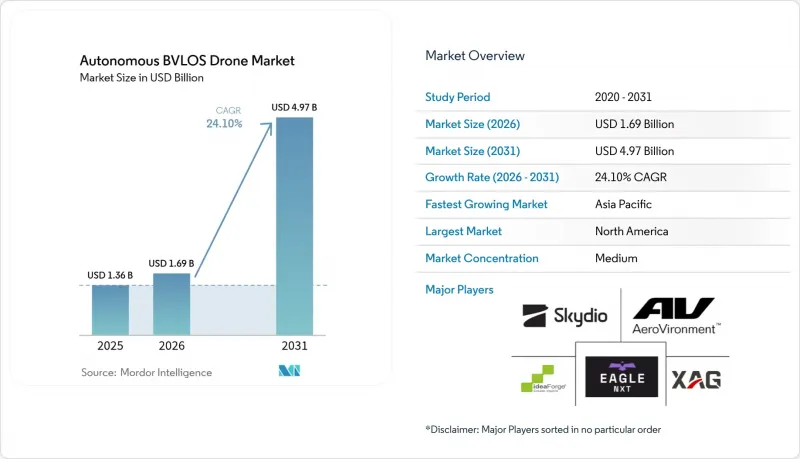
This report is Segmented by Platform Type (Multirotor, Fixed-Wing, and Hybrid), Range (Short, Medium, and Long), Size (Nano, Micro, Small, Medium, and Large), End-Use Industry (Energy and Utilities, Logistics and Delivery, Agriculture and Forestry, Construction and Infrastructure, and More), and Geography (North America, Europe, and More). The Market Forecasts are Provided in Terms of Value (USD).
Global Autonomous BVLOS Drone Market Trends and Insights
Regulatory Progress Enabling Routine BVLOS Waivers and Standards
The new Part 108 Notice of Proposed Rulemaking released by the FAA in August 2025 introduces a rule-based path that replaces individual waivers, specifying mandatory detect-and-avoid equipment and standardized reporting, streamlining approval cycles. EASA mirrors this shift through its July 2024 Easy Access Rules update, which embeds BVLOS requirements into Standard Scenario STS-02 and harmonizes oversight across member states. Transport Canada reinforces North American alignment by finalizing an expanded BVLOS framework for drones up to 150 kg, effective November 2025, opening national airspace for routine long-range flights. As regulators converge on standard safety baselines, the autonomous BVLOS drone market gains predictable certification pathways that reduce time-to-deployment for commercial fleets. The improved clarity spurs investment in fleet expansion, integrated software platforms, and pilot training programs that anchor long-term revenue growth.
Advances in Detect-and-Avoid and Unmanned Traffic Management Technologies
Collision-avoidance innovation is moving from prototype to production. Optical, acoustic, and radar sensor fusion enables reliable non-cooperative traffic detection beyond 2 km. At the same time, lightweight Automatic Dependent Surveillance-Light (ADS-L) transponders provide affordable electronic conspicuity for general aviation users. Parallel progress in UTM networks means real-time traffic data can feed onboard navigation stacks. Europe's U-space corridors, North America's Remote ID rollout, and Japan's nationwide drone registry all feed standardized APIs that allow dynamic airspace allocation. These improvements reduce pilot workload and shrink the technological gap between small-scale trials and high-density urban operations. As a result, insurers are beginning to offer tiered risk pricing tied to certified detect-and-avoid capability, incentivizing fleet owners to adopt next-generation avionics and strengthening the competitive edge of early movers.
Fragmented Global Regulatory Timelines
Differences in certification cycles across Asia-Pacific, South America, and Africa slow international expansion. While Japan's Level 4 rules already permit autonomous operations over populated areas, neighboring markets like China still apply restrictive zone-based limits that constrain commercial viability. Operators flying trans-border logistics corridors must undergo parallel audits and training for each jurisdiction, inflating overhead. The absence of bilateral recognition between central aviation authorities forces duplicative testing of detect-and-avoid hardware and operational risk assessments. Smaller fleets divert scarce engineering resources toward compliance documentation, delaying product roadmaps and dampening the near-term trajectory for the autonomous BVLOS drone market.
Other drivers and restraints analyzed in the detailed report include:
- Rapid Growth in Drone Logistics and Medical Delivery Pilots
- Energy and Utilities Sector Demand for Long Linear-Asset Inspections
- Battery Energy Density Limitations Reducing Flight Endurance
For complete list of drivers and restraints, kindly check the Table Of Contents.
Segment Analysis
Hybrid configurations merge multirotor vertical lift with efficient fixed-wing cruise, pivotal for missions exceeding 50 km while still requiring point-takeoff. The autonomous BVLOS drone market size for hybrid aircraft stood at USD 0.27 billion in 2025 and is predicted to triple by 2031 at a 28.05% CAGR. Operators favor these designs for corridor mapping, pipeline patrols, and parcel delivery outposts where ground infrastructure is minimal. The FVR-90 from L3Harris exemplifies endurance of 8 hours while lifting 15 lb payloads, underscoring how hybrids overcome the endurance ceiling of pure multirotors.
Hybrid demand also benefits from regulators who increasingly treat transition-airframes under fixed-wing rules once they enter cruise, simplifying airworthiness evaluations. Multirotor systems, however, remain entrenched in the autonomous BVLOS drone market due to their simplicity, lower unit cost, and near-zero launch footprint. These airframes hold 48.12% of 2025 revenue and will continue to dominate urban inspection and short-haul delivery missions. Fixed-wing units retain niche demand for agricultural spraying and very-long-range reconnaissance, but runway constraints limit their urban applicability. As software-defined flight controllers mature, fleet owners are expected to migrate toward modular architectures that allow rapid re-configuration between multirotor and hybrid modes, reinforcing platform diversification trends across the autonomous BVLOS drone market.
Long-range operations represent the sharpest growth curve, climbing at 25.85% CAGR to 2031. Starlink's non-terrestrial networks and similar low-Earth-orbit (LEO) constellations deliver low-latency command links beyond cellular reach, opening routes across deserts, offshore platforms, and mountain passes. Logistic firms leverage these links to bypass underserved road systems, while governments deploy long-range craft for border surveillance and wildfire monitoring.
Short-range BVLOS flights continue to serve inspection, mapping, and media capture assignments. Although they command 37.40% revenue share in 2025, growth moderates as penetration rises and regulatory paths stabilize. Medium-range flights fill the corridor between population centers and remote facilities, gaining relevance in regional parcel lanes and mid-stream pipeline inspections. Over time, expected gains in battery density and mesh-network radios will blur the current range classifications. Yet, demand stratification will persist because payload weight and regulatory hurdles differ by mission profile, ensuring that the autonomous BVLOS drone market caters to differentiated endurance niches.
Complete Report Scope:
- By Platform Type
- Multirotor
- Fixed-wing
- Hybrid
- By Range
- Short
- Medium
- Long
- By Size
- Nano
- Micro
- Small
- Medium
- Large
- By End-use Industry
- Energy and Utilities
- Logistics and Delivery
- Agriculture and Forestry
- Construction and Infrastructure
- Public Safety and Disaster Relief
- Environmental Monitoring and Surveying
- Telecom and Communication Relay
- By Geography
- North America
- United States
- Canada
- Mexico
- Europe
- United Kingdom
- France
- Germany
- Italy
- Spain
- Rest of Europe
- Asia-Pacific
- China
- India
- Japan
- South Korea
- Australia
- Rest of Asia-Pacific
- South America
- Brazil
- Rest of South America
- Middle East and Africa
- Middle East
- Saudi Arabia
- United Arab Emirates
- Rest of Middle East
- Africa
- South Africa
- Rest of Africa
- Middle East
- North America
Geography Analysis
North America remains the revenue leader with a 35.85% share in 2025. The FAA's pending Part 108 rule is set to accelerate domestic authorizations, and Canada's November 2025 framework harmonizes flight rules across the continent. Major utilities continue to scale corridor inspections, while platform vendors consolidate production inside the region to mitigate semiconductor supply risks. Ongoing public-private test ranges, including the New York UAS Corridor and North Dakota's Northern Plains site, supply data that informs next-round regulatory refinements and buttresses regional competitiveness.
Asia-Pacific represents the most dynamic growth arena at a 25.62% CAGR. Japan's Level 4 framework permits autonomous flights above populated areas under specified safety cases, spawning delivery and emergency-response services in urban settings. China's manufacturing scale compresses bill-of-materials costs, making sub-USD 10,000 airframes viable for fleet renewals. India's agricultural incentives and digital-sky platform simplify operator licensing, sparking rapid uptake in crop-health mapping and precision spraying missions. South Korea and Australia apply BVLOS drones in maritime rescue and mine-site logistics, flooding regional airworthiness agencies with proof-of-concept data that informs future rulemaking.
Europe capitalizes on EASA's harmonized approach, providing a single certification gateway to 27 Member States. Standard Scenario STS-02 covers BVLOS flights up to 2 km when spotters are deployed, and several nations implement local extensions up to 10 km for linear infrastructure inspection. The continent's U-space initiative supports real-time digital flight approvals and dynamic geofencing, easing congestion in dense air corridors. Research funding from programs such as SESAR 3 accelerates detect-and-avoid algorithm benchmarking, making Europe a hub for avionics R&D and interoperability testing within the autonomous BVLOS drone market.
- AeroVironment, Inc.
- Parrot Drones SAS
- Skydio, Inc.
- Zipline International Inc.
- Wing Aviation LLC
- Drone Delivery Canada Corp.
- Percepto Robotics Ltd.
- XAG Co., Ltd.
- Quantum-Systems GmbH
- Lockheed Martin Corporation
- Carbonix
- ideaForge Technology Pvt. Ltd.
- Draganfly Innovations Inc.
- Delair SAS
- Volocopter GmbH (Diamond Aircraft Industries GmbH)
- Autel Robotics Co. Ltd.
- EagleNXT
Additional Benefits:
- The market estimate (ME) sheet in Excel format
- 3 months of analyst support
TABLE OF CONTENTS
1 INTRODUCTION
- 1.1 Study Assumptions and Market Definition
- 1.2 Scope of the Study
2 RESEARCH METHODOLOGY
3 EXECUTIVE SUMMARY
4 MARKET LANDSCAPE
- 4.1 Market Overview
- 4.2 Market Drivers
- 4.2.1 Regulatory progress enabling routine BVLOS waivers and standards
- 4.2.2 Advances in detect-and-avoid and unmanned traffic management (UTM) technologies
- 4.2.3 Rapid growth in drone logistics and medical delivery pilots
- 4.2.4 Energy and utilities sector demand for long linear-asset inspections
- 4.2.5 Satellite-to-drone non-terrestrial network connectivity unlocking remote BVLOS operations
- 4.2.6 Adoption of BVLOS drones by national climate-monitoring fleets
- 4.3 Market Restraints
- 4.3.1 Fragmented global regulatory timelines
- 4.3.2 Battery energy density limitations reducing flight endurance
- 4.3.3 Supply chain vulnerability to critical avionics and RF components
- 4.3.4 Spectrum congestion impacting command-and-control (C2) links in urban corridors
- 4.4 Value Chain Analysis
- 4.5 Regulatory Landscape
- 4.6 Technological Outlook
- 4.7 Porter's Five Forces Analysis
- 4.7.1 Threat of New Entrants
- 4.7.2 Bargaining Power of Suppliers
- 4.7.3 Bargaining Power of Buyers
- 4.7.4 Threat of Substitutes
- 4.7.5 Intensity of Competitive Rivalry
5 MARKET SIZE AND GROWTH FORECASTS (VALUE)
- 5.1 By Platform Type
- 5.1.1 Multirotor
- 5.1.2 Fixed-wing
- 5.1.3 Hybrid
- 5.2 By Range
- 5.2.1 Short
- 5.2.2 Medium
- 5.2.3 Long
- 5.3 By Size
- 5.3.1 Nano
- 5.3.2 Micro
- 5.3.3 Small
- 5.3.4 Medium
- 5.3.5 Large
- 5.4 By End-use Industry
- 5.4.1 Energy and Utilities
- 5.4.2 Logistics and Delivery
- 5.4.3 Agriculture and Forestry
- 5.4.4 Construction and Infrastructure
- 5.4.5 Public Safety and Disaster Relief
- 5.4.6 Environmental Monitoring and Surveying
- 5.4.7 Telecom and Communication Relay
- 5.5 By Geography
- 5.5.1 North America
- 5.5.1.1 United States
- 5.5.1.2 Canada
- 5.5.1.3 Mexico
- 5.5.2 Europe
- 5.5.2.1 United Kingdom
- 5.5.2.2 France
- 5.5.2.3 Germany
- 5.5.2.4 Italy
- 5.5.2.5 Spain
- 5.5.2.6 Rest of Europe
- 5.5.3 Asia-Pacific
- 5.5.3.1 China
- 5.5.3.2 India
- 5.5.3.3 Japan
- 5.5.3.4 South Korea
- 5.5.3.5 Australia
- 5.5.3.6 Rest of Asia-Pacific
- 5.5.4 South America
- 5.5.4.1 Brazil
- 5.5.4.2 Rest of South America
- 5.5.5 Middle East and Africa
- 5.5.5.1 Middle East
- 5.5.5.1.1 Saudi Arabia
- 5.5.5.1.2 United Arab Emirates
- 5.5.5.1.3 Rest of Middle East
- 5.5.5.2 Africa
- 5.5.5.2.1 South Africa
- 5.5.5.2.2 Rest of Africa
- 5.5.5.1 Middle East
- 5.5.1 North America
6 COMPETITIVE LANDSCAPE
- 6.1 Market Concentration
- 6.2 Strategic Moves
- 6.3 Market Share Analysis
- 6.4 Company Profiles (includes Global level Overview, Market level overview, Core Segments, Financials as available, Strategic Information, Market Rank/Share for key companies, Products and Services, and Recent Developments)
- 6.4.1 AeroVironment, Inc.
- 6.4.2 Parrot Drones SAS
- 6.4.3 Skydio, Inc.
- 6.4.4 Zipline International Inc.
- 6.4.5 Wing Aviation LLC
- 6.4.6 Drone Delivery Canada Corp.
- 6.4.7 Percepto Robotics Ltd.
- 6.4.8 XAG Co., Ltd.
- 6.4.9 Quantum-Systems GmbH
- 6.4.10 Lockheed Martin Corporation
- 6.4.11 Carbonix
- 6.4.12 ideaForge Technology Pvt. Ltd.
- 6.4.13 Draganfly Innovations Inc.
- 6.4.14 Delair SAS
- 6.4.15 Volocopter GmbH (Diamond Aircraft Industries GmbH)
- 6.4.16 Autel Robotics Co. Ltd.
- 6.4.17 EagleNXT
7 MARKET OPPORTUNITIES AND FUTURE OUTLOOK
- 7.1 White-space and Unmet-need Assessment

