PUBLISHER: Mordor Intelligence | PRODUCT CODE: 2114804

PUBLISHER: Mordor Intelligence | PRODUCT CODE: 2114804
Electronically Scanned Array Radar - Market Share Analysis, Industry Trends & Statistics, Growth Forecasts (2026 - 2031)
According to Mordor Intelligence, the electronically scanned array (ESA) radar market size was valued at USD 10.29 billion in 2025 and estimated to grow from USD 11.02 billion in 2026 to reach USD 15.48 billion by 2031, at a CAGR of 7.05% during the forecast period (2026-2031).
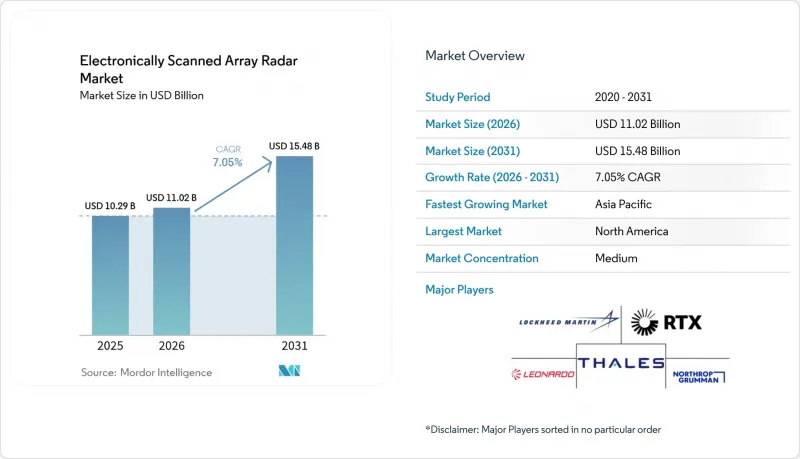
This report is Segmented by Type (AESA, and More), Platform (Land, Airborne, and More), Fit (Line Fit and Retrofit), Frequency Band (L and S Band, and More), Application (Surveillance/Early-warning, and More), End-User (Defense Forces, and More), Component (Digital Signal Processor, and More), and Geography (North America, and More). The Market Forecasts are Provided in Terms of Value (USD).
Global Electronically Scanned Array Radar Market Trends and Insights
Military Modernization Programs Accelerating AESA Procurement
AESA capability has shifted from desirable to mandatory for next-generation assets. The US Air Force fielded Northrop Grumman's AN/TPS-80 G/ATOR, combining five legacy functions into one platform. European states follow, with the UK integrating an advanced Typhoon radar and Estonia procuring Thales GM400a systems. Procurement velocity reflects recognition that legacy mechanically scanned radars cannot support multi-domain operations. AI-enabled modes further magnify mission value. Consequently, defense agencies now treat AESA as foundational infrastructure for network-centric warfare.
Demand for Multi-Function 4D Situational-Awareness Radars
Operators require instantaneous azimuth, elevation, range, and Doppler data. Thales' NS200 offers full digital beam-forming up to 400 km while supporting swarm defense and missile guidance. Lockheed Martin's Long-Range Discrimination Radar tracks targets beyond 2,000 km for ballistic-missile defense. Civil aviation's NextGen program similarly propels demand for advanced surveillance. Convergence of military and civilian needs lowers per-unit cost. The ability to cover multiple missions with one aperture transforms platform design economics.
High Program CAPEX Versus Legacy Systems
AESA upgrades carry steep upfront costs. The B-52 radar replacement has surpassed initial estimates and slowed schedules. Northrop Grumman's USD 121.5 million contract to refurbish B-1 antennas highlights the investment intensity. Complex integration work on power, cooling, and data buses inflates budgets. Smaller defense agencies defer adoption, sustaining a two-tier market.
Other drivers and restraints analyzed in the detailed report include:
- Geopolitical Tension-Fueled Defense Budget Expansion
- Transition to GaN T/R Modules Lowering Lifecycle Cost
- ITAR and Export-Control Constraints
For complete list of drivers and restraints, kindly check the Table Of Contents.
Segment Analysis
AESA technology accounted for 62.96% revenue in 2025 as distributed T/R modules eliminated single-point failure, while the segment promises a 9.32% CAGR through 2031. The electronically scanned array radar market benefits as each module scales independently, allowing graceful degradation under battle damage. Passive electronically scanned arrays (PESA) persist in cost-sensitive ground roles, yet falling GaN device pricing narrows the cost gap. AI-driven waveform agility further widens AESA's performance edge.
Growing demand for resilience against sophisticated jamming favours AESA configurations that can hop frequency and steer beams within microseconds. As volumes rise, manufacturing economies drive unit pricing closer to PESA equivalents, reshaping procurement calculus. Software-defined updates lengthen service life and accelerate capability upgrades. Consequently, the electronically scanned array radar market size for AESA platforms is forecast to reach USD 9.75 billion by 2031, reinforcing its position as the baseline architecture across airborne, maritime, and ground systems.
Land-based systems held a 45.12% share in 2025, yet naval installations are tracking an 10.62% CAGR, the highest across platforms. New-build destroyers, frigates, and amphibious vessels integrate SPY-6, CERETRON, and GhostEye systems, replacing mechanically scanned arrays. Raytheon's USD 1.18 billion SPY-6 series contract exemplifies volume potential.
The maritime up-cycle reflects Indo-Pacific fleet modernization and the need for distributed missile-defense coverage. Onshore, counter-UAS demand sustains ground segment sales, while airborne upgrades to F-15EX and Gripen E remain robust. Space and high-altitude pseudo-satellites add incremental demand, albeit from a small base. Altogether, the electronically scanned array radar market share for naval platforms is projected to rise four percentage points by 2031 as sea-based ballistic-missile defense becomes a top priority.
Line-fit deliveries represented 68.23% of 2025 revenue owing to F-35, Type 26, and Constellation-class procurement pipelines. Retrofit activity, however, grows faster at 10.21% CAGR as forces extend legacy fleet life. The APG-79 integration on F/A-18 and SPY-6 back-fit for Nimitz-class carriers illustrates scale.
Modular arrays and common back-end processors simplify insertion, curbing downtime. Digital-through-digital interfaces reduce cabling while embedded cooling plates lower structural modification needs. Retrofitting, therefore, offers near-new performance without the capital outlay of platform replacement, bolstering the electronically scanned array radar market through mid-decade.
Complete Report Scope:
- By Type
- Active Electronically Scanned Array (AESA)
- Passive electronically scanned array (PESA)
- By Platform
- Airborne
- Land
- Naval
- Space and High-Altitude Pseudo-Satellites (HAPS)
- By Fit
- Line-fit (new-build)
- Retrofit/Upgrade
- By Frequency Band
- L and S Band
- C and X Band
- Ku/Ka Band
- By Application
- Surveillance/Early-warning
- Fire-control and Weapon-Guidance
- Electronic Warfare and SIGINT
- Weather and Air-Traffic Control
- By End-User
- Defense Forces
- Homeland Security and Border Agencies
- Commercial Aviation and ATC
- By Component
- T/R Module
- Digital Signal Processor
- Antenna Aperture and Radome
- Other Components
- By Geography
- North America
- United States
- Canada
- Mexico
- Europe
- United Kingdom
- France
- Germany
- Russia
- Rest of Europe
- Asia-Pacific
- China
- India
- Japan
- South Korea
- Rest of Asia-Pacific
- South America
- Brazil
- Rest of South America
- Middle East and Africa
- Middle East
- Saudi Arabia
- United Arab Emirates
- Turkey
- Rest of Middle East
- Africa
- South Africa
- Rest of Africa
- Middle East
- North America
Geography Analysis
North America retained a 35.12% share in 2025, buoyed by the world's largest defense budget and a mature industrial base. Multi-year production of SPY-6 and TPY-4 systems underpins regional demand, while artificial-intelligence upgrades to legacy radars lock in aftermarket revenue. Canadian NORAD modernization and Mexican border-security programs provide supplemental orders. Continuous investment in GaN fab capacity positions the region to secure export competitiveness despite rising global rivalry.
Asia-Pacific posts the strongest 9.61% CAGR to 2031. China's KJ-3000 AEW platform and phased-array coverage on reclaimed South-China-Sea outposts spur neighbours to accelerate buys. Japan's transfer of FPS-3ME radars to the Philippines and Mongolia demonstrates deepening defense cooperation. India's indigenously developed Uttam radar showcases ambitions for sovereignty, while South Korea's Hanwha Systems equips FFX-III frigates with domestic GaN arrays. These combined initiatives elevate the electronically scanned array radar market across the region.
Europe continues to grow steadily as NATO's integrated-air-and-missile-defense strategy mandates the adoption of standardised AESA. HENSOLDT's EUR 6.929 billion (USD 8.06 billion) backlog exemplifies continental scale. The EISNET consortium integrates multi-sensor data for real-time command, emphasising software-defined interoperability. Influenced by the Ukraine conflict, Eastern European states prioritise ground-based air-defense radar, while the UK's Eurofighter upgrades anchor airborne spending. Collectively, European procurement sustains the electronically scanned array radar market share above 25% through the forecast window.
- Thales Group
- HENSOLDT AG
- Lockheed Martin Corporation
- RTX Corporation
- Saab AB
- BAE Systems plc
- ASELSAN A.S.
- Leonardo S.p.A
- Israel Aerospace Industries Ltd.
- Airbus SE
- L3Harris Technologies, Inc.
- Northrop Grumman Corporation
- Indra Sistemas, S.A.
- Bharat Electronics Ltd.
- Terma A/S
- NEC Corporation
- Teledyne Technologies Incorporated
- Mitsubishi Electric Corporation
- LIG Nex1
Additional Benefits:
- The market estimate (ME) sheet in Excel format
- 3 months of analyst support
TABLE OF CONTENTS
1 INTRODUCTION
- 1.1 Study Assumptions and Market Definition
- 1.2 Scope of the Study
2 RESEARCH METHODOLOGY
3 EXECUTIVE SUMMARY
4 MARKET LANDSCAPE
- 4.1 Market Overview
- 4.2 Market Drivers
- 4.2.1 Military modernization programs accelerating AESA procurement
- 4.2.2 Demand for multi-function 4D situational-awareness radars
- 4.2.3 Geopolitical tension-fueled defense budget expansion
- 4.2.4 Transition to GaN T/R modules lowering lifecycle cost
- 4.2.5 AI-enabled software-defined beam-forming capabilities
- 4.2.6 Lightweight ESA retrofits for UAVs and attritable platforms
- 4.3 Market Restraints
- 4.3.1 High program CAPEX versus legacy systems
- 4.3.2 ITAR and export-control constraints
- 4.3.3 Thermal-management limits of dense GaN arrays
- 4.3.4 Rare-earth supply-chain fragility for T/R modules
- 4.4 Value Chain Analysis
- 4.5 Regulatory Landscape
- 4.6 Technological Outlook
- 4.7 Porter's Five Forces Analysis
- 4.7.1 Bargaining Power of Buyers/Consumers
- 4.7.2 Bargaining Power of Suppliers
- 4.7.3 Threat of New Entrants
- 4.7.4 Threat of Substitute Products
- 4.7.5 Intensity of Competitive Rivalry
5 MARKET SIZE AND GROWTH FORECASTS (VALUE)
- 5.1 By Type
- 5.1.1 Active Electronically Scanned Array (AESA)
- 5.1.2 Passive electronically scanned array (PESA)
- 5.2 By Platform
- 5.2.1 Airborne
- 5.2.2 Land
- 5.2.3 Naval
- 5.2.4 Space and High-Altitude Pseudo-Satellites (HAPS)
- 5.3 By Fit
- 5.3.1 Line-fit (new-build)
- 5.3.2 Retrofit/Upgrade
- 5.4 By Frequency Band
- 5.4.1 L and S Band
- 5.4.2 C and X Band
- 5.4.3 Ku/Ka Band
- 5.5 By Application
- 5.5.1 Surveillance/Early-warning
- 5.5.2 Fire-control and Weapon-Guidance
- 5.5.3 Electronic Warfare and SIGINT
- 5.5.4 Weather and Air-Traffic Control
- 5.6 By End-User
- 5.6.1 Defense Forces
- 5.6.2 Homeland Security and Border Agencies
- 5.6.3 Commercial Aviation and ATC
- 5.7 By Component
- 5.7.1 T/R Module
- 5.7.2 Digital Signal Processor
- 5.7.3 Antenna Aperture and Radome
- 5.7.4 Other Components
- 5.8 By Geography
- 5.8.1 North America
- 5.8.1.1 United States
- 5.8.1.2 Canada
- 5.8.1.3 Mexico
- 5.8.2 Europe
- 5.8.2.1 United Kingdom
- 5.8.2.2 France
- 5.8.2.3 Germany
- 5.8.2.4 Russia
- 5.8.2.5 Rest of Europe
- 5.8.3 Asia-Pacific
- 5.8.3.1 China
- 5.8.3.2 India
- 5.8.3.3 Japan
- 5.8.3.4 South Korea
- 5.8.3.5 Rest of Asia-Pacific
- 5.8.4 South America
- 5.8.4.1 Brazil
- 5.8.4.2 Rest of South America
- 5.8.5 Middle East and Africa
- 5.8.5.1 Middle East
- 5.8.5.1.1 Saudi Arabia
- 5.8.5.1.2 United Arab Emirates
- 5.8.5.1.3 Turkey
- 5.8.5.1.4 Rest of Middle East
- 5.8.5.2 Africa
- 5.8.5.2.1 South Africa
- 5.8.5.2.2 Rest of Africa
- 5.8.5.1 Middle East
- 5.8.1 North America
6 COMPETITIVE LANDSCAPE
- 6.1 Market Concentration Analysis
- 6.2 Strategic Moves
- 6.3 Market Share Analysis
- 6.4 Company Profiles (includes Global level Overview, Market level overview, Core Segments, Financials as available, Strategic Information, Market Rank/Share for key companies, Products and Services, and Recent Developments)
- 6.4.1 Thales Group
- 6.4.2 HENSOLDT AG
- 6.4.3 Lockheed Martin Corporation
- 6.4.4 RTX Corporation
- 6.4.5 Saab AB
- 6.4.6 BAE Systems plc
- 6.4.7 ASELSAN A.S.
- 6.4.8 Leonardo S.p.A
- 6.4.9 Israel Aerospace Industries Ltd.
- 6.4.10 Airbus SE
- 6.4.11 L3Harris Technologies, Inc.
- 6.4.12 Northrop Grumman Corporation
- 6.4.13 Indra Sistemas, S.A.
- 6.4.14 Bharat Electronics Ltd.
- 6.4.15 Terma A/S
- 6.4.16 NEC Corporation
- 6.4.17 Teledyne Technologies Incorporated
- 6.4.18 Mitsubishi Electric Corporation
- 6.4.19 LIG Nex1
7 MARKET OPPORTUNITIES AND FUTURE OUTLOOK
- 7.1 White-space and Unmet-need Assessment

