PUBLISHER: Mordor Intelligence | PRODUCT CODE: 2114805

PUBLISHER: Mordor Intelligence | PRODUCT CODE: 2114805
Aerospace Floor Panels - Market Share Analysis, Industry Trends & Statistics, Growth Forecasts (2026 - 2031)
According to Mordor Intelligence, aerospace floor panels market size in 2026 is estimated at USD 507.6 million, growing from 2025 value of USD 488.26 million with 2031 projections showing USD 616.34 million, growing at 3.96% CAGR over 2026-2031.
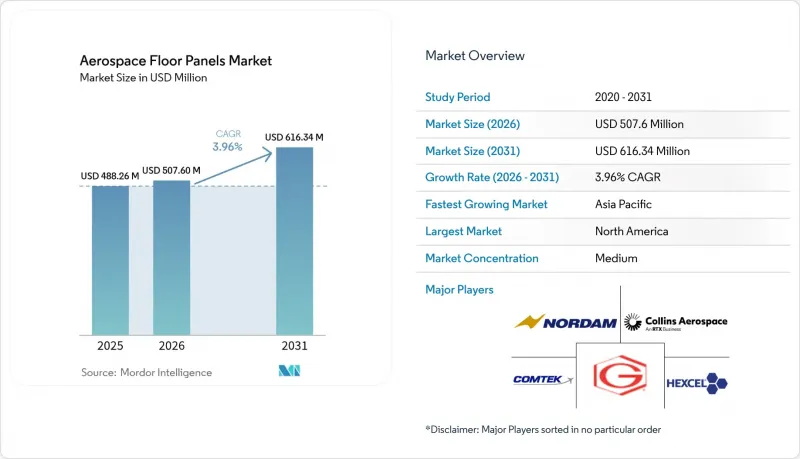
This report is Segmented by Core Material (Nomex Honeycomb, Aluminium Honeycomb, and More), Installation Area (Passenger Cabin Floor, Cargo Deck Floor, and More), End-User Channel (Commercial Aviation, Military Aircraft, Business Jets, and More), and Geography (Asia-Pacific, North America, Europe, South America, Middle East and Africa). The Market Forecasts are Provided in Terms of Value (USD).
Global Aerospace Floor Panels Market Trends and Insights
Growing Number of New-Build & Retrofit Aircraft Deliveries
Boeing forecasts just under 44,000 aircraft additions over the next two decades, with single-aisle models representing roughly three-quarters of the pipeline. Airlines increasingly schedule mid-life cabin overhauls that replace legacy aluminum boards with lighter honeycomb alternatives to secure immediate fuel savings. India anticipates 4,000 incremental airframes and 200 new airports within twenty years, amplifying retrofit prospects alongside new builds. China adds another growth vector: COMAC plans to lift C919 output to 75 units annually by 2029 to meet a domestic backlog topping 1,000 jets. Each incremental frame requires 30-50 m2 of primary cabin flooring, guaranteeing a persistent demand baseline. Retrofit work also benefits MRO centres, which can install certified thermoplastic panels during heavy-check windows without altering structural load paths.
Stringent Fuel-Burn & CO2 Regulations Accelerating Lightweighting
The European Fit-for-55 package and similar schemes worldwide obligate airlines to slash per-seat emissions, making cabin weight an actionable lever. Composite floor solutions cut panel mass by up to 30% versus aluminium, improving block fuel by roughly 0.5% on a narrow-body mission. Diehl Aviation's ECO Sidewall, combining carbon fibre skins and Kepler honeycomb, shows how interior programmes integrate weight and waste reduction; the concept trims 10% mass and 33% scrap. Airlines also link lightweighting to sustainable aviation fuel economics because every kilogram saved extends SAF burn efficiency. Consequently, composite panel upgrades feature prominently in decarbonisation roadmaps filed with regulators or used to negotiate airport carbon charges.
Raw-Material Price Volatility (Aramid Fibre, Aluminium, Titanium)
Global titanium output slid 12% between 2019 and 2024 as Ukrainian mining disruptions collided with export curbs, pressuring aerospace alloys. Aluminium costs remain sensitive to trade actions; U.S. tariffs of 25% on selected imports keep spot prices elevated relative to pre-trade-war averages. DuPont's Nomex supply chain has also faced intermittent capacity constraints, triggering double-digit quarterly price swings for aramid paper used in honeycomb cores. OEMs respond by multisourcing, forward-buying, and engineering substitution options, but margin compression persists when contracts lock in catalog prices.
Other drivers and restraints analyzed in the detailed report include:
- Rapid Adoption of Composite Honeycomb Floor Panels
- Additive-Manufactured Titanium Honeycomb Cores Speeding MRO Turnaround
- Geopolitical Supply-Chain Shocks for Aerospace Honeycomb Cores
For complete list of drivers and restraints, kindly check the Table Of Contents.
Segment Analysis
Nomex honeycomb retained 44.72% revenue in 2025, reflecting entrenched OEM specifications and a global supplier ecosystem tuned for high-volume output. Despite its lead, the aerospace floor panels market is tilting toward thermoplastic honeycomb, which is forecast to grow at 5.05% CAGR this decade. The performance uplift hinges on continuous-sheet technologies that marry mechanical strength with one-shot forming, thus cutting takt time and scrap. Thermoplastic boards also meet closed-loop recycling targets that regulators increasingly require. Aluminium honeycomb still finds favour in cargo decks where cost metrics trump every kilogram, while titanium cores remain vital for hot-zone floors on military transports. Additive-manufactured titanium promises future cost parity by eradicating machining waste and enabling lattice optimisation. Other experimental cores-ranging from basalt fibres to bio-resins-continue pilot testing with an eye on life-cycle carbon metrics.
Adoption trajectories vary by platform class. Narrow-body programmes lean toward PP and PEI thermoplastic variants because service temperatures rarely exceed 150 °C. Wide-body jets and long-range business aircraft prefer PEKK or PPS cores that withstand higher cabin floor loads and galley heat. Consequently, material suppliers pursue platform-specific qualification roadmaps rather than one-size strategies. Competition is intensifying as Asian compounders seek to undercut Western incumbents on cost while matching flame and smoke performance. Intellectual-property protection around core geometry remains a differentiator; patents on cell size gradients and edge-closure methods help vendors secure sole-source contracts. The aerospace floor panels industry therefore exhibits a dual dynamic: legacy Nomex supply chains deliver price stability at scale, whereas thermoplastic disruptors capture share through speed and sustainability credentials.
Complete Report Scope:
- By Core Material
- Nomex Honeycomb
- Aluminium Honeycomb
- Titanium Honeycomb
- Other Core Materials (Thermoplastic Honeycomb, etc.)
- By Installation Area
- Passenger Cabin Floor
- Cargo Deck Floor
- Cockpit Floor
- Galley and Lavatory Zones
- By End-User Channel
- Commercial Aviation
- Military Aircraft
- Business Jets
- Other End-user Channels (Helicopters, etc.)
- By Geography
- Asia-Pacific
- China
- Japan
- India
- South Korea
- ASEAN Countries
- Rest of Asia-Pacific
- North America
- United States
- Canada
- Mexico
- Europe
- Germany
- United Kingdom
- France
- Italy
- Spain
- Russia
- NORDIC Countries
- Rest of Europe
- South America
- Brazil
- Argentina
- Rest of South America
- Middle East and Africa
- Saudi Arabia
- South Africa
- Rest of Middle East and Africa
- Asia-Pacific
Geography Analysis
North America held 38.21% revenue share in 2025, thanks to an established manufacturing base stretching from Wichita through the Carolinas to Quebec. Collins Aerospace's USD 225 million footprint expansion across Fort Worth, Spokane, and Pueblo raised carbon brake and honeycomb capacity by more than 50% and secures long-term panel resin supply. Regional airline fleet renewal, including a 77-aircraft order from ANA Holdings for North American routes, reinforces order stability.
Asia-Pacific, however, is registering the quickest 4.72% CAGR. India's requirement for 2,500-plus aircraft and aggressive airport expansion is reshaping supply-chain geography, with local composite shops popping up around Hyderabad and Bengaluru. China's C919 advance, aided by annual rates of 75 units by 2029, accelerates domestic demand for compliant cabin components. Japan and South Korea are also incentivising locally sourced interiors under economic-security statutes, nudging global vendors to license technology or pursue JVs.
Europe leverages deep composites expertise clustered in Germany, France, and the UK. Programmes such as Diehl's ECO Sidewall feed into Airbus interior packages, keeping the region influential in design authority decisions. Latin America and the Middle East show mixed growth tied to tourism recovery and LCC proliferation; both regions import most panels but could cultivate assembly hubs to sidestep shipping lead times. Collectively, these geographic currents ensure the aerospace floor panels market remains globally diversified while tilting toward Asia-centric volume growth.
- AVIC Cabin Systems (UK)
- Collins Aerospace
- Comtek Advanced Structures Ltd.
- Corex Honeycomb
- DuPont
- Elbe Flugzeugwerke GmbH
- Encore Aerospace LLC
- Gurit Services AG, Zurich
- Hexcel Corporation
- Safran
- Showa Aircraft Industry Co., Ltd.
- Teledyne Aerospace & Defense
- The Gill Corporation
- The NORDAM Group LLC
- Toray Advanced Composites
Additional Benefits:
- The market estimate (ME) sheet in Excel format
- 3 months of analyst support
TABLE OF CONTENTS
1 Introduction
- 1.1 Study Assumptions and Market Definition
- 1.2 Scope of the Study
2 Research Methodology
3 Executive Summary
4 Market Landscape
- 4.1 Market Overview
- 4.2 Market Drivers
- 4.2.1 Growing number of new-build and retrofit aircraft deliveries
- 4.2.2 Stringent fuel-burn and CO2 regulations accelerating lightweighting
- 4.2.3 Rapid adoption of composite honeycomb floor panels
- 4.2.4 Low-cost carrier (LCC) expansion boosting narrow-body demand
- 4.2.5 Additive-manufactured titanium honeycomb cores speeding MRO turnaround
- 4.3 Market Restraints
- 4.3.1 Raw-material price volatility (aramid fibre, aluminium, titanium)
- 4.3.2 Geopolitical supply-chain shocks for aerospace honeycomb cores
- 4.3.3 Certification delays for next-gen thermoplastic floor systems
- 4.4 Value Chain Analysis
- 4.5 Porter's Five Forces
- 4.5.1 Bargaining Power of Suppliers
- 4.5.2 Bargaining Power of Buyers
- 4.5.3 Threat of New Entrants
- 4.5.4 Threat of Substitutes
- 4.5.5 Degree of Competition
5 Market Size and Growth Forecasts (Value and Volume)
- 5.1 By Core Material
- 5.1.1 Nomex Honeycomb
- 5.1.2 Aluminium Honeycomb
- 5.1.3 Titanium Honeycomb
- 5.1.4 Other Core Materials (Thermoplastic Honeycomb, etc.)
- 5.2 By Installation Area
- 5.2.1 Passenger Cabin Floor
- 5.2.2 Cargo Deck Floor
- 5.2.3 Cockpit Floor
- 5.2.4 Galley and Lavatory Zones
- 5.3 By End-User Channel
- 5.3.1 Commercial Aviation
- 5.3.2 Military Aircraft
- 5.3.3 Business Jets
- 5.3.4 Other End-user Channels (Helicopters, etc.)
- 5.4 By Geography
- 5.4.1 Asia-Pacific
- 5.4.1.1 China
- 5.4.1.2 Japan
- 5.4.1.3 India
- 5.4.1.4 South Korea
- 5.4.1.5 ASEAN Countries
- 5.4.1.6 Rest of Asia-Pacific
- 5.4.2 North America
- 5.4.2.1 United States
- 5.4.2.2 Canada
- 5.4.2.3 Mexico
- 5.4.3 Europe
- 5.4.3.1 Germany
- 5.4.3.2 United Kingdom
- 5.4.3.3 France
- 5.4.3.4 Italy
- 5.4.3.5 Spain
- 5.4.3.6 Russia
- 5.4.3.7 NORDIC Countries
- 5.4.3.8 Rest of Europe
- 5.4.4 South America
- 5.4.4.1 Brazil
- 5.4.4.2 Argentina
- 5.4.4.3 Rest of South America
- 5.4.5 Middle East and Africa
- 5.4.5.1 Saudi Arabia
- 5.4.5.2 South Africa
- 5.4.5.3 Rest of Middle East and Africa
- 5.4.1 Asia-Pacific
6 Competitive Landscape
- 6.1 Market Concentration
- 6.2 Strategic Moves
- 6.3 Market Share (%)/ Ranking Analysis
- 6.4 Company Profiles (includes Global level Overview, Market level overview, Core Segments, Financials as available, Strategic Information, Market Rank/Share for key companies, Products and Services, and Recent Developments)
- 6.4.1 AVIC Cabin Systems (UK)
- 6.4.2 Collins Aerospace
- 6.4.3 Comtek Advanced Structures Ltd.
- 6.4.4 Corex Honeycomb
- 6.4.5 DuPont
- 6.4.6 Elbe Flugzeugwerke GmbH
- 6.4.7 Encore Aerospace LLC
- 6.4.8 Gurit Services AG, Zurich
- 6.4.9 Hexcel Corporation
- 6.4.10 Safran
- 6.4.11 Showa Aircraft Industry Co., Ltd.
- 6.4.12 Teledyne Aerospace & Defense
- 6.4.13 The Gill Corporation
- 6.4.14 The NORDAM Group LLC
- 6.4.15 Toray Advanced Composites
7 Market Opportunities and Future Outlook
- 7.1 White-space and Unmet-Need Assessment

