PUBLISHER: Mordor Intelligence | PRODUCT CODE: 2114806

PUBLISHER: Mordor Intelligence | PRODUCT CODE: 2114806
Conductive Ink - Market Share Analysis, Industry Trends & Statistics, Growth Forecasts (2026 - 2031)
According to Mordor Intelligence, the conductive ink market size in 2026 is estimated at USD 3.39 billion, growing from 2025 value of USD 3.26 billion with 2031 projections showing USD 4.11 billion, growing at 3.92% CAGR over 2026-2031.
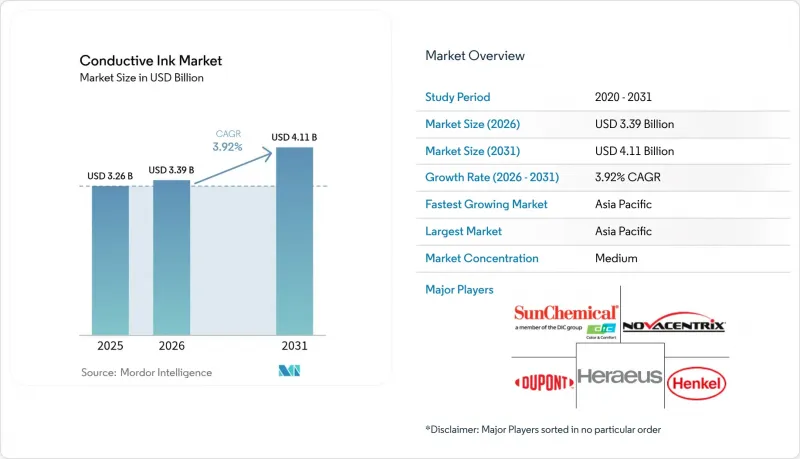
This report is Segmented by Type (Silver-Based, Copper-Based, Graphene-Based, Carbon-Nanotube, Conductive Polymers, Dielectric, Other Types), Application (Photovoltaics, RFID, Sensors, Touchscreens & Displays, Pcbs, Other Applications), and Geography (Asia-Pacific, North America, Europe, South America, Middle East and Africa). The Market Forecasts are Provided in Terms of Value (USD).
Global Conductive Ink Market Trends and Insights
Growing Installation of Solar Panels
Global solar build-outs keep silver paste consumption rising, with 700 million oz used in 2024, a 7% year-on-year jump. Higher-efficiency N-type cells rely on thicker silver fingers, lifting per-panel ink usage. Chinese and Indian policies that mandate large-scale solar arrays extend the demand pipeline through 2030. The International Energy Agency states that solar will add over 60% of renewable capacity this decade. Each incremental gigawatt, therefore, translates into heightened conductive inks market demand, reinforcing long-run growth.
Rising Demand for Printed Circuit Boards
High-density interconnect boards need fine-line printing that silver inks deliver, and North American PCB shipments were up 11.3% in February 2025 with a 1.33 book-to-bill ratio. Capacity re-shoring from China to Thailand and Vietnam broadens the Asia-Pacific manufacturing base. HDI expansion aligns with the conductive inks market goal of lowering resistive losses on smaller traces. Quick-turn production cycles also benefit from screen-printed circuits that cut etching steps. As demand keeps exceeding supply, ink suppliers secure multi-year contracts with board fabricators.
Oxidation & Reliability Issues in Copper-Based Inks
Copper nanoparticles oxidize quickly, adding resistive layers that undercut circuit performance. Polymer capping reduces oxidation but increases viscosity and print complexity. Advanced binders can hit 158 µΩ*cm resistivity yet require inert reflow ovens that raise capital cost. These processing burdens limit copper's penetration in high-reliability products such as medical sensors or aerospace circuits, keeping silver ahead despite its premium.
Other drivers and restraints analyzed in the detailed report include:
- Expansion of Flexible & Wearable Electronics
- Automaker Shift to Silver-Nanowire Transparent Heaters
- Throughput Limits of Roll-to-Roll Graphene Ink Processes
For complete list of drivers and restraints, kindly check the Table Of Contents.
Segment Analysis
Silver compositions supplied 77.10% of the conductive inks market in 2025, underscoring their unmatched conductivity for photovoltaics and circuit boards. Graphene-based inks, although smaller today, grow at a 4.88% CAGR by offering cost relief and flexibility benefits. Hybrid graphene-silver blends bridge the performance gap, easing the transition away from full-silver pastes. Copper tracks remain limited to low-cost electronics because oxidation needs protective chemistries that raise process steps. Carbon nanotubes and conductive polymer classes serve stretchable, chemical-resistant niches such as e-textiles and bio-patches.
The commercialization push elevates dielectric inks too, which enable multilayer architectures by insulating adjacent traces. Water-based graphene formulations nearing 1.5 X 10⁴ S/m conductivity threaten silver in sensors that can tolerate modest resistance. Precious-metal formulations using gold and platinum stay reserved for aerospace or implantable devices where cost recedes behind mission-critical reliability. Overall, performance, not price alone, dictates selections, securing silver's lead even as alternatives enlarge the broader conductive inks market.
Complete Report Scope:
- By Type
- Silver-based
- Copper-based
- Graphene-based
- Carbon-nanotube
- Conductive Polymers
- Dielectric
- Other Types (Precious-metal (Au, Pt), etc.)
- By Application
- Photovoltaics
- Radio Frequency Identification (RFID)
- Sensors
- Touchscreens and Displays
- Printed Circuit Boards
- Other Applications (Thermal Heaters and Automotive Electronics, etc.)
- By Geography
- Asia-Pacifc
- China
- Japan
- India
- South Korea
- Rest of Asia-Pacific
- North America
- United States
- Canada
- Mexico
- Europe
- Germany
- United Kingdom
- France
- Italy
- Rest of Europe
- South America
- Brazil
- Argentina
- Rest of South America
- Middle East and Africa
- Saudi Arabia
- South Africa
- Rest of Middle East and Africa
- Asia-Pacifc
Geography Analysis
Asia-Pacific commanded 45.20% of 2025 revenue and posts a 4.58% CAGR through 2031. China's renewable mandates, India's giga-factory buildout, and South Korea's chip packaging boom form a self-reinforcing ecosystem. Japan supplies specialty pastes and printer heads that tune performance. Thailand and Vietnam absorb capacity as brands mitigate geopolitical risk, yet remain within the regional value network. Such clustering compresses logistics costs and accelerates product iteration, advantages difficult for other regions to replicate.
North America follows, supported by policy incentives that favor domestic EV supply chains and defense electronics. The CHIPS Act allocates capital for new fabs, bringing printed interposer demand in-house. Automotive suppliers adopt transparent heaters and battery management circuits that rely on silver and graphene inks. Regulations emphasize critical material security, pushing ink firms to source regionally or recycle metals as Henkel now demonstrates. Europe prioritizes sustainability, valuing water-based chemistries that comply with REACH and RoHS. OEMs develop circular design guidelines that specify recyclable pastes. Electric vehicles lead adoption of advanced battery current collectors that need low-resistance printable materials. Meanwhile, South America and the Middle East & Africa see rising solar farm investments, but limited local converting means many inks still arrive from Asia-Pacific or Europe. These emerging markets extend the geographic footprint of the conductive inks market yet do not displace existing regional leaders.
- AdNano Technologies Pvt Ltd,
- Celanese Corporation
- Creative Materials
- Daicel Corporation
- DuPont
- Henkel AG & Co. KGaA
- Heraeus Holding
- IDTechEx Ltd
- InkTec Co. Ltd.
- Johnson Matthey
- Nano Dimension
- NovaCentrix
- Parker Hannifin Corp
- Sun Chemical
- TEKRA, LLC.
- Vorbeck Materials Corp
Additional Benefits:
- The market estimate (ME) sheet in Excel format
- 3 months of analyst support
TABLE OF CONTENTS
1 Introduction
- 1.1 Study Assumptions and Market Definition
- 1.2 Scope of the Study
2 Research Methodology
3 Executive Summary
4 Market Landscape
- 4.1 Market Overview
- 4.2 Market Drivers
- 4.2.1 Growing installation of solar panels
- 4.2.2 Rising demand for printed circuit boards
- 4.2.3 Expansion of flexible and wearable electronics
- 4.2.4 Automaker shift to silver-nanowire transparent heaters
- 4.2.5 Commercialisation of graphene/silver hybrid low-Ag inks
- 4.3 Market Restraints
- 4.3.1 Volatility in silver and copper prices
- 4.3.2 Oxidation and reliability issues in copper-based inks
- 4.3.3 Throughput limits of roll-to-roll graphene ink processes
- 4.4 Value Chain Analysis
- 4.5 Porter's Five Forces
- 4.5.1 Bargaining Power of Suppliers
- 4.5.2 Bargaining Power of Buyers
- 4.5.3 Threat of New Entrants
- 4.5.4 Threat of Substitute Products and Services
- 4.5.5 Degree of Competition
5 Market Size and Growth Forecasts (Value)
- 5.1 By Type
- 5.1.1 Silver-based
- 5.1.2 Copper-based
- 5.1.3 Graphene-based
- 5.1.4 Carbon-nanotube
- 5.1.5 Conductive Polymers
- 5.1.6 Dielectric
- 5.1.7 Other Types (Precious-metal (Au, Pt), etc.)
- 5.2 By Application
- 5.2.1 Photovoltaics
- 5.2.2 Radio Frequency Identification (RFID)
- 5.2.3 Sensors
- 5.2.4 Touchscreens and Displays
- 5.2.5 Printed Circuit Boards
- 5.2.6 Other Applications (Thermal Heaters and Automotive Electronics, etc.)
- 5.3 By Geography
- 5.3.1 Asia-Pacifc
- 5.3.1.1 China
- 5.3.1.2 Japan
- 5.3.1.3 India
- 5.3.1.4 South Korea
- 5.3.1.5 Rest of Asia-Pacific
- 5.3.2 North America
- 5.3.2.1 United States
- 5.3.2.2 Canada
- 5.3.2.3 Mexico
- 5.3.3 Europe
- 5.3.3.1 Germany
- 5.3.3.2 United Kingdom
- 5.3.3.3 France
- 5.3.3.4 Italy
- 5.3.3.5 Rest of Europe
- 5.3.4 South America
- 5.3.4.1 Brazil
- 5.3.4.2 Argentina
- 5.3.4.3 Rest of South America
- 5.3.5 Middle East and Africa
- 5.3.5.1 Saudi Arabia
- 5.3.5.2 South Africa
- 5.3.5.3 Rest of Middle East and Africa
- 5.3.1 Asia-Pacifc
6 Competitive Landscape
- 6.1 Market Concentration
- 6.2 Strategic Moves
- 6.3 Market Share(%)/Ranking Analysis
- 6.4 Company Profiles (includes Global level Overview, Market level overview, Core Segments, Financials as available, Strategic Information, Market Rank/Share for key companies, Products and Services, and Recent Developments)
- 6.4.1 AdNano Technologies Pvt Ltd,
- 6.4.2 Celanese Corporation
- 6.4.3 Creative Materials
- 6.4.4 Daicel Corporation
- 6.4.5 DuPont
- 6.4.6 Henkel AG & Co. KGaA
- 6.4.7 Heraeus Holding
- 6.4.8 IDTechEx Ltd
- 6.4.9 InkTec Co. Ltd.
- 6.4.10 Johnson Matthey
- 6.4.11 Nano Dimension
- 6.4.12 NovaCentrix
- 6.4.13 Parker Hannifin Corp
- 6.4.14 Sun Chemical
- 6.4.15 TEKRA, LLC.
- 6.4.16 Vorbeck Materials Corp
7 Market Opportunities and Future Outlook
- 7.1 White-space and Unmet-need Assessment

