PUBLISHER: Mordor Intelligence | PRODUCT CODE: 2114814

PUBLISHER: Mordor Intelligence | PRODUCT CODE: 2114814
Consumer Electronics Packaging - Market Share Analysis, Industry Trends & Statistics, Growth Forecasts (2026 - 2031)
According to Mordor Intelligence, the consumer electronic packaging market size in 2026 is estimated at USD 92.03 billion, growing from 2025 value of USD 86.39 billion with 2031 projections showing USD 126.23 billion, growing at 6.53% CAGR over 2026-2031.
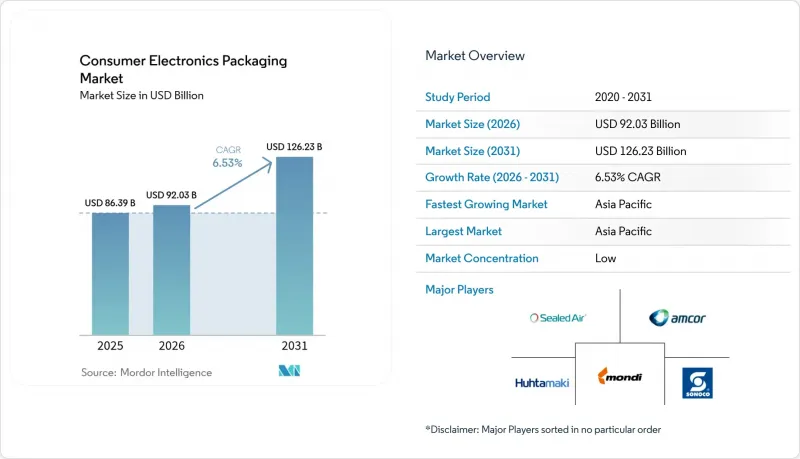
This report is Segmented by Material (Plastics, Paper), Packaging Format (Blister Packs, Clamshells, and More), Function (Primary Packaging, Secondary/Display Packaging, and More), Consumer Electronics (Smartphones, Computing Devices, TV and Set-Top Boxes, Wearables and Hearables, and More), and Geography. The Market Forecasts are Provided in Terms of Value (USD).
Global Consumer Electronics Packaging Market Trends and Insights
E-commerce boom driving protective and transit-ready formats
Holiday-season online sales of consumer electronics reached USD 55.3 billion in 2024, an 8.8% year-over-year increase. The shift from shelf-ready displays to transit-optimised packs raises the demand for engineered cushioning, tamper evidence, and right-size automation. Ranpak's Cut'it EVO Multi-Lid system reduces void space and freight costs while boosting sustainability metrics. Brand owners view packaging as an extension of the product experience, integrating quick-response codes for post-purchase engagement. As parcel networks grow denser and more fragmented, the consumer electronic packaging market expands with specifications tailored to multi-touch handling and variable climates.
Eco-friendly substrates mandated by EPR and plastics bans
The EU Packaging and Packaging Waste Regulation enforces a 65% recycling rate for all consumer packaging by 2025. Brands shift rapidly to recyclable fibre and bio-plastic blends to secure market access. Logitech eliminated 660 tons of plastic annually by converting mice packaging to paper-based formats, cutting carbon emissions by 6,000 tons. Paptic and Woodly commercialise barrier-coated papers delivering moisture protection once reserved for polymers. The consumer electronic packaging market gains incremental volume as converters retrofit lines for fibre substrates, though lead times for regulatory certification remain a bottleneck.
Volatile pulp, paper and polymer feedstock prices
Pulp prices fluctuated 25-40% from 2024 to 2025, reflecting climatic disruptions and logistics bottlenecks.Polymer pricing remains tied to crude oil swings, squeezing converter margins in the consumer electronic packaging market. Large players hedge inputs, but small and mid-sized firms often accept shorter quoting cycles, raising cost visibility concerns for OEMs.
Other drivers and restraints analyzed in the detailed report include:
- Anti-counterfeit and tamper-evident features for brand protection
- Rising smartphone and wearable shipments in emerging Asia
- Single-use-plastic restrictions tightening worldwide
For complete list of drivers and restraints, kindly check the Table Of Contents.
Segment Analysis
Plastic solutions retained 54.88% of total revenue in 2025 thanks to their moisture barrier and puncture resistance properties that safeguard complex electronics. Foam inserts and thermoformed trays remain the baseline for flagship smartphones and computing hardware. The consumer electronic packaging market size for paper substrates, however, is expanding at a 7.36% CAGR through 2031 as brands align with EPR thresholds and carbon targets. Folding cartons and molded fibre cushionings now integrate water-based coatings that provide antistatic and grease resistance previously achievable only with polymers.
Technological advances such as Stora Enso's Papira cellulose foam deliver comparable drop-test performance to expanded PE while offering fibre recyclability. Hybrid packs that combine paper exteriors with thin internal polymer films gain traction, balancing compliance with performance. Converters marketing life-cycle assessment data win bidding rounds, reinforcing paper momentum inside the consumer electronic packaging market.
Corrugated master cartons and pallets accounted for 30.31% of revenue in 2025 because they underpin every logistics move from factory to retailer. Growth accelerates most in protective mailers and bubble wraps, which post a 9.27% CAGR to 2031 on the back of direct-to-consumer fulfilment. The consumer electronic packaging market size for mailers rises as lightweight wearables and accessories ship individually.
Format innovation blends cushioning with brand storytelling. Textile-based pouches provide premium aesthetics and reusability, appealing to eco-centric consumers. Air-filled chambers formed in line reduce materials, and molded fibre clamshells extend retail display life while enabling curbside recycling. Multi-function formats that support both auto-packing and shelf visibility receive the highest RFP scores in OEM tenders.
Complete Report Scope:
- By Material
- Plastics
- Foam
- Thermoformed Trays
- Other Plastics
- Paper
- Folding Cartons
- Corrugated Boxes
- Other Papers
- Plastics
- By Packaging Format
- Blister Packs
- Clamshells
- Protective Mailers and Bubble Wrap
- Trays and Inserts
- Corrugated Boxes and Pallets
- By Function
- Primary Packaging
- Secondary/Display Packaging
- Tertiary and Logistics Packaging
- Anti-counterfeit and Security Packaging
- Smart/Connected Packaging
- By Consumer Electronics
- Smartphones
- Computing Devices
- TV and Set-Top Boxes
- Wearables and Hearables
- Smart Home / IoT Devices
- Other Consumer Electronics
- By Geography
- North America
- United States
- Canada
- Mexico
- Europe
- Germany
- United Kingdom
- France
- Italy
- Spain
- Russia
- Rest of Europe
- Asia-Pacific
- China
- India
- Japan
- South Korea
- Australia and New Zealand
- Rest of Asia-Pacific
- Middle East and Africa
- Middle East
- United Arab Emirates
- Saudi Arabia
- Turkey
- Rest of Middle East
- Africa
- South Africa
- Nigeria
- Egypt
- Rest of Africa
- Middle East
- South America
- Brazil
- Argentina
- Rest of South America
- North America
Geography Analysis
Asia-Pacific captured 39.74% of the consumer electronic packaging market in 2025, underpinned by its deep manufacturing bases and surging domestic consumption of smartphones and wearables. Regional CAGR stands at 9.75% through 2031, aided by policy incentives in Vietnam, India, and Malaysia that localise converter capacity and shorten lead times. Chinese converters leverage robotics to manage diverse SKU portfolios, while India's corrugated producers add digital presses for variable print.
North America retains strength in premium electronics and subscription models that favour recyclable fibre and smart pack integration. Brands place pilot programs for RFID-enabled circular frameworks in the US and Canada, driving early-adopter demand inside the consumer electronic packaging market. Regional logistics providers co-develop automation cells that seal on demand, aligning with parcel carrier dimension requirements.
Europe leads regulatory momentum, setting global precedents on recyclability and recycled-content thresholds. OEMs headquartered in Germany, Sweden, and France validate innovations such as cellulose foams and mono-material flexibles before global rollout. Middle East and Africa see rising smartphone penetration paired with infrastructure build-outs, generating incremental demand for moisture-resistant packs in hot climates. South America benefits from near-shoring of North American supply chains, especially as Mexican electronics production eclipses imports from China in certain categories.
- Sealed Air Corporation
- Smurfit WestRock
- International Paper Co.
- Pregis LLC
- Sonoco Products Co.
- Stora Enso Oyj
- Dordan Manufacturing
- Mondi Group
- Amcor plc
- Nefab AB
- UFP Technologies Inc.
- ProAmpac LLC
- Huhtamaki Oyj
- DunaPack Packaging Group
- Clondalkin Group
- Johns Byrne Co.
- Ball Corp. (Aerosol & Transit)
- Molded Fiber Glass Co.
Additional Benefits:
- The market estimate (ME) sheet in Excel format
- 3 months of analyst support
TABLE OF CONTENTS
1 INTRODUCTION
- 1.1 Study Assumptions and Market Definition
- 1.2 Scope of the Study
2 RESEARCH METHODOLOGY
3 EXECUTIVE SUMMARY
4 MARKET LANDSCAPE
- 4.1 Market Overview
- 4.2 Market Drivers
- 4.2.1 E-commerce boom driving protective and transit-ready formats
- 4.2.2 Eco-friendly substrates mandated by EPR and plastics bans
- 4.2.3 Anti-counterfeit and tamper-evident features for brand protection
- 4.2.4 Rising smartphone and wearable shipments in emerging Asia
- 4.2.5 RFID-enabled reverse-logistics packaging for circular economy
- 4.2.6 Miniaturized modular packs lowering freight cube and costs
- 4.3 Market Restraints
- 4.3.1 Volatile pulp, paper and polymer feedstock prices
- 4.3.2 Single-use-plastic restrictions tightening worldwide
- 4.3.3 Device-as-a-Service model curbing packaged unit volumes
- 4.3.4 Semiconductor supply shocks dampening electronics output
- 4.4 Supply-Chain Analysis
- 4.5 Regulatory Outlook
- 4.6 Technological Outlook
- 4.7 Porter's Five Forces Analysis
- 4.7.1 Threat of New Entrants
- 4.7.2 Bargaining Power of Buyers
- 4.7.3 Bargaining Power of Suppliers
- 4.7.4 Threat of Substitutes
- 4.7.5 Intensity of Competitive Rivalry
- 4.8 Investment Analysis
5 MARKET SIZE AND GROWTH FORECASTS (VALUE)
- 5.1 By Material
- 5.1.1 Plastics
- 5.1.1.1 Foam
- 5.1.1.2 Thermoformed Trays
- 5.1.1.3 Other Plastics
- 5.1.2 Paper
- 5.1.2.1 Folding Cartons
- 5.1.2.2 Corrugated Boxes
- 5.1.2.3 Other Papers
- 5.1.1 Plastics
- 5.2 By Packaging Format
- 5.2.1 Blister Packs
- 5.2.2 Clamshells
- 5.2.3 Protective Mailers and Bubble Wrap
- 5.2.4 Trays and Inserts
- 5.2.5 Corrugated Boxes and Pallets
- 5.3 By Function
- 5.3.1 Primary Packaging
- 5.3.2 Secondary/Display Packaging
- 5.3.3 Tertiary and Logistics Packaging
- 5.3.4 Anti-counterfeit and Security Packaging
- 5.3.5 Smart/Connected Packaging
- 5.4 By Consumer Electronics
- 5.4.1 Smartphones
- 5.4.2 Computing Devices
- 5.4.3 TV and Set-Top Boxes
- 5.4.4 Wearables and Hearables
- 5.4.5 Smart Home / IoT Devices
- 5.4.6 Other Consumer Electronics
- 5.5 By Geography
- 5.5.1 North America
- 5.5.1.1 United States
- 5.5.1.2 Canada
- 5.5.1.3 Mexico
- 5.5.2 Europe
- 5.5.2.1 Germany
- 5.5.2.2 United Kingdom
- 5.5.2.3 France
- 5.5.2.4 Italy
- 5.5.2.5 Spain
- 5.5.2.6 Russia
- 5.5.2.7 Rest of Europe
- 5.5.3 Asia-Pacific
- 5.5.3.1 China
- 5.5.3.2 India
- 5.5.3.3 Japan
- 5.5.3.4 South Korea
- 5.5.3.5 Australia and New Zealand
- 5.5.3.6 Rest of Asia-Pacific
- 5.5.4 Middle East and Africa
- 5.5.4.1 Middle East
- 5.5.4.1.1 United Arab Emirates
- 5.5.4.1.2 Saudi Arabia
- 5.5.4.1.3 Turkey
- 5.5.4.1.4 Rest of Middle East
- 5.5.4.2 Africa
- 5.5.4.2.1 South Africa
- 5.5.4.2.2 Nigeria
- 5.5.4.2.3 Egypt
- 5.5.4.2.4 Rest of Africa
- 5.5.4.1 Middle East
- 5.5.5 South America
- 5.5.5.1 Brazil
- 5.5.5.2 Argentina
- 5.5.5.3 Rest of South America
- 5.5.1 North America
6 COMPETITIVE LANDSCAPE
- 6.1 Market Concentration
- 6.2 Strategic Moves
- 6.3 Market Share Analysis
- 6.4 Company Profiles (Includes Global level Overview, Market level overview, Core Segments, Financials as available, Strategic Information, Market Rank/Share for key companies, Products and Services, and Recent Developments)
- 6.4.1 Sealed Air Corporation
- 6.4.2 Smurfit WestRock
- 6.4.3 International Paper Co.
- 6.4.4 Pregis LLC
- 6.4.5 Sonoco Products Co.
- 6.4.6 Stora Enso Oyj
- 6.4.7 Dordan Manufacturing
- 6.4.8 Mondi Group
- 6.4.9 Amcor plc
- 6.4.10 Nefab AB
- 6.4.11 UFP Technologies Inc.
- 6.4.12 ProAmpac LLC
- 6.4.13 Huhtamaki Oyj
- 6.4.14 DunaPack Packaging Group
- 6.4.15 Clondalkin Group
- 6.4.16 Johns Byrne Co.
- 6.4.17 Ball Corp. (Aerosol & Transit)
- 6.4.18 Molded Fiber Glass Co.
7 MARKET OPPORTUNITIES AND FUTURE OUTLOOK
- 7.1 White-space and Unmet-Need Assessment

