PUBLISHER: Mordor Intelligence | PRODUCT CODE: 2114817

PUBLISHER: Mordor Intelligence | PRODUCT CODE: 2114817
Banana Flour - Market Share Analysis, Industry Trends & Statistics, Growth Forecasts (2026 - 2031)
According to Mordor Intelligence, the banana flour market size in 2026 is estimated at USD 578.48 million, growing from 2025 value of USD 553.3 million with 2031 projections showing USD 721.72 million, growing at 4.55% CAGR over 2026-2031.
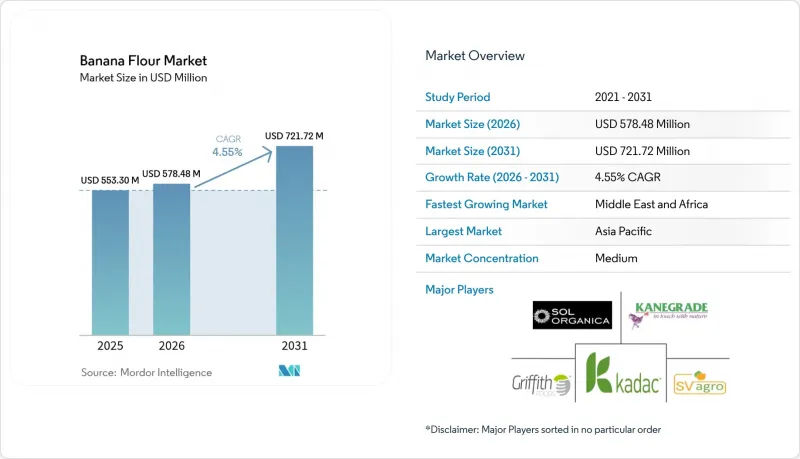
This report is Segmented by Nature (Conventional and Organic), Source (Green Banana and Ripe Banana), Application (Food and Beverage, Dietary Supplements, Animal Feed and Pet Food, and Others), and Geography (North America, Europe, Asia-Pacific, South America, and Middle East and Africa). The Market Forecasts are Provided in Terms of Value (USD).
Global Banana Flour Market Trends and Insights
Escalating demand for gluten-free products
The gluten-free food movement has transitioned from being solely focused on managing celiac disease to encompassing a broader emphasis on digestive health and wellness. This paradigm shift has driven a sustained and growing demand for innovative alternative flour solutions. Among these, banana flour has emerged as a premium option in bakery applications due to its naturally gluten-free composition and superior binding capabilities compared to traditional rice or corn-based alternatives. Additionally, banana flour offers significant functional benefits, such as enhanced moisture retention and improved structural integrity in gluten-free formulations. These attributes effectively address the longstanding technical challenges that have historically constrained the quality and appeal of gluten-free products. Furthermore, current dietary trends reveal that Australians consume only 3-9 grams of resistant starch daily, which is significantly below the recommended intake of 15-20 grams. This nutritional shortfall presents a substantial market opportunity for banana flour, as it can bridge this gap while aligning with clean-label requirements. For food manufacturers, incorporating banana flour into their product offerings not only enhances the nutritional value of gluten-free products but also strengthens their positioning in the health-conscious consumer segment.
Surging vegan and plant-based diet trends
The growing adoption of plant-based foods is significantly driving the demand for ingredients that combine high nutritional value with functional performance. Banana flour has emerged as a pivotal ingredient in the formulation of vegan products, offering a strategic advantage to manufacturers. Its inherent natural sweetness reduces the dependency on added sugars, while its prebiotic properties promote digestive health, addressing two critical consumer demands in the plant-based nutrition market. Reflecting the increasing institutional support for plant-based ingredients, the USDA has allocated a USD 500 million investment in 2024 to enhance local food sourcing for school meal programs. This initiative not only creates new market opportunities for banana flour suppliers but also strengthens connections between local farmers and producers. Furthermore, banana flour's versatility across both sweet and savory applications empowers manufacturers to develop comprehensive and diverse plant-based product portfolios using a single, multifunctional ingredient. The market's shift toward delivering complete plant-based nutritional profiles, rather than merely substituting animal-based products, positions banana flour as a key ingredient that simultaneously delivers multiple nutritional and functional benefits, aligning with evolving consumer preferences.
Price volatility of raw bananas limits the growth
Flour processors face significant margin pressures due to fluctuations in raw banana prices. These price variations are further intensified by climate change and plant diseases, such as Fusarium Tropical Race 4, which threaten production stability in key cultivation regions. According to the FAO, global banana production is increasingly exposed to risks from adverse weather conditions and escalating production costs. Major exporters, including Ecuador, the Philippines, and Costa Rica, are experiencing notable supply chain disruptions. Additionally, the production of banana flour relies on specific banana varieties and precise ripeness levels, limiting processors' ability to switch to lower-cost alternatives during price hikes. In 2023, global banana exports were highly concentrated, with Ecuador accounting for USD 3.79 billion, followed by the Philippines at USD 1.22 billion and Costa Rica at USD 1.19 billion. This concentration creates supply chain vulnerabilities, directly impacting flour pricing stability. To address these challenges, processors are increasingly adopting vertical integration strategies and entering long-term supply contracts. However, these approaches require substantial capital investment, making them less viable for smaller market participants.
Other drivers and restraints analyzed in the detailed report include:
- Rising preference for clean-label and natural food ingredients
- Expansion in functional food and beverage segment
- Intensifying competition from established alternative flours
For complete list of drivers and restraints, kindly check the Table Of Contents.
Segment Analysis
In 2025, conventional banana flour commands a dominant 82.74% market share, establishing itself as a cost-effective substitute for wheat flour in mainstream culinary applications. Its widespread adoption owes much to efficient supply chains and lower production costs, making it a go-to choice for large-scale food manufacturers attuned to price sensitivity. Bakery and snack producers, on the hunt for gluten-free ingredients that won't break the bank, consistently turn to conventional banana flour. Its versatility across a myriad of products cements its status as a staple in the industry. This affordability resonates with both mass-market consumers and manufacturers, ensuring the flour's continued prominence. In essence, the conventional segment stands as the cornerstone of the banana flour market, striking an optimal balance between price and performance.
While the organic banana flour segment holds a smaller market share, it boasts the title of the fastest-growing segment, with projections indicating a compound annual growth rate (CAGR) of 5.52% through 2031. This growth trajectory underscores a strategic shift towards premium positioning, fueled by consumers' readiness to invest more in certified organic ingredients. The momentum is especially strong in developed markets, where the demand for clean labels dovetails with sustainability ideals, allowing brands to set premium prices. Yet, the organic segment grapples with supply chain challenges, primarily due to the scarcity of certified organic bananas. This limitation poses a hurdle but simultaneously presents a golden opportunity for suppliers who can secure dependable sources. With backing from initiatives like the USDA's USD 300 million Organic Transition Initiative, which aims to assist farmers in transitioning to organic farming, there's potential for an expanded supply. This interplay of limited supply and surging demand not only accentuates competitive advantages but also paves the way for premiumization in the organic banana flour market throughout the forecast period.
Complete Report Scope:
- By Nature
- Conventional
- Organic
- By Source
- Green (Unripe) Banana
- Ripe Banana
- By Application
- Food and Beverage
- Bakery and Confectionery
- Snacks and Cereals
- Beverages
- Sauces, Soups and Dressings
- Others
- Dietary Supplements
- Animal Feed and Pet Food
- Others
- Food and Beverage
- By Geography
- North America
- United States
- Canada
- Mexico
- Rest of North America
- Europe
- Germany
- United Kingdom
- Italy
- France
- Spain
- Netherlands
- Poland
- Belgium
- Sweden
- Rest of Europe
- Asia-Pacific
- China
- India
- Japan
- Australia
- Indonesia
- South Korea
- Thailand
- Singapore
- Rest of Asia-Pacific
- South America
- Brazil
- Argentina
- Colombia
- Chile
- Peru
- Rest of South America
- Middle East and Africa
- South Africa
- Saudi Arabia
- United Arab Emirates
- Nigeria
- Egypt
- Morocco
- Turkey
- Rest of Middle East and Africa
- North America
Geography Analysis
In 2025, the Asia-Pacific region captured a dominant 38.27% share of the banana flour market. This leadership is attributed to abundant raw material availability, a rapidly growing processed-food industry, and cost-effective labor. The region leverages India's extensive banana production and the advanced food manufacturing infrastructure in countries like Japan and South Korea. In China, snack manufacturers are increasingly utilizing banana flour to enhance fiber content in product labeling. Furthermore, Japan's "Foods with Function Claims" system supports high-resistant-starch positioning, enabling products to secure premium pricing.
The Middle East and Africa is forecasted to achieve the highest growth, with a CAGR of 6.66% through 2031. In South Africa, retail chains are expanding their gluten-free product portfolios with banana-flour-based baked goods, while wellness cafes in Saudi Arabia are incorporating banana-flour pancakes into their menus. Regional growth is further driven by government initiatives aimed at enhancing food security and reducing import dependency, creating opportunities for local processing of imported raw materials.
North America and Europe are anticipated to witness steady but moderate growth. These mature markets demonstrate high penetration of gluten-free products and a consumer base that prioritizes supply chain transparency. The FDA has approved several resistant-starch ingredients under its Generally Recognized as Safe (GRAS) pathway. However, brands are differentiating themselves through organic and fair-trade certifications. In Europe, the EFSA's updated novel-food regulations mandate more transparent but cost-intensive dossiers, which are expected to benefit compliant exporters over time. South America, with its proximity to raw-banana production clusters, is positioning itself as an emerging processing hub. Ecuadorian cooperatives are piloting solar-assisted drying technologies to reduce energy costs, while Brazilian start-ups are targeting fitness centers with banana-flour smoothie bases. Although challenges such as infrastructure gaps and currency volatility persist, government-backed loan programs indicate a positive outlook for growth in the region.
- KADAC Pty Ltd
- Sol Organica, S.A.
- Kanegrade Ltd.
- Griffith Foods Worldwide Inc. (Terova)
- SV Agrofood
- Saipro Biotech Pvt Ltd
- TWF Flours
- Medikonda Nutrients
- Natural Evolution Foods
- Symrise AG (Diana Food)
- Hearthy Foods Inc
- Z-Company B.V.
- Xi'an Demeter Biotech Co., Ltd.
- Natural Evolution
- Urban Platter
- Sattvic Foods
- Phalada Agro Research Foundations Private Limited
- Blue Lily Organics
- Banamin Healthcare
- Vinayak Ingredients (INDIA) Pvt. Ltd.
Additional Benefits:
- The market estimate (ME) sheet in Excel format
- 3 months of analyst support
TABLE OF CONTENTS
1 INTRODUCTION
- 1.1 Study Assumptions and Market Definition
- 1.2 Scope of the Study
2 RESEARCH METHODOLOGY
3 EXECUTIVE SUMMARY
4 MARKET LANDSCAPE
- 4.1 Market Overview
- 4.2 Market Drivers
- 4.2.1 Increasing adoption of banana flour in the food processing industry
- 4.2.2 Escalating demand for gluten-free products
- 4.2.3 Growing adoption of resistant starch-rich flours in baking
- 4.2.4 Rising preference for clean-label and natural food ingredients
- 4.2.5 Surging vegan and plant-based diet trends
- 4.2.6 Expansion in functional food and beverage segment
- 4.3 Market Restraints
- 4.3.1 Price volatility of raw bananas limits the growth
- 4.3.2 Intensifying competition from established alternative flours
- 4.3.3 Higher production costs compared to traditional flours
- 4.3.4 Limited consumer awareness in developing regions
- 4.4 Supply-Chain Analysis
- 4.5 Regulatory Outlook
- 4.6 Porter's Five Forces
- 4.6.1 Threat of New Entrants
- 4.6.2 Bargaining Power of Buyers/Consumers
- 4.6.3 Bargaining Power of Suppliers
- 4.6.4 Threat of Substitute Products
- 4.6.5 Intensity of Competitive Rivalry
5 MARKET SIZE AND GROWTH FORECASTS (VALUE)
- 5.1 By Nature
- 5.1.1 Conventional
- 5.1.2 Organic
- 5.2 By Source
- 5.2.1 Green (Unripe) Banana
- 5.2.2 Ripe Banana
- 5.3 By Application
- 5.3.1 Food and Beverage
- 5.3.1.1 Bakery and Confectionery
- 5.3.1.2 Snacks and Cereals
- 5.3.1.3 Beverages
- 5.3.1.4 Sauces, Soups and Dressings
- 5.3.1.5 Others
- 5.3.2 Dietary Supplements
- 5.3.3 Animal Feed and Pet Food
- 5.3.4 Others
- 5.3.1 Food and Beverage
- 5.4 By Geography
- 5.4.1 North America
- 5.4.1.1 United States
- 5.4.1.2 Canada
- 5.4.1.3 Mexico
- 5.4.1.4 Rest of North America
- 5.4.2 Europe
- 5.4.2.1 Germany
- 5.4.2.2 United Kingdom
- 5.4.2.3 Italy
- 5.4.2.4 France
- 5.4.2.5 Spain
- 5.4.2.6 Netherlands
- 5.4.2.7 Poland
- 5.4.2.8 Belgium
- 5.4.2.9 Sweden
- 5.4.2.10 Rest of Europe
- 5.4.3 Asia-Pacific
- 5.4.3.1 China
- 5.4.3.2 India
- 5.4.3.3 Japan
- 5.4.3.4 Australia
- 5.4.3.5 Indonesia
- 5.4.3.6 South Korea
- 5.4.3.7 Thailand
- 5.4.3.8 Singapore
- 5.4.3.9 Rest of Asia-Pacific
- 5.4.4 South America
- 5.4.4.1 Brazil
- 5.4.4.2 Argentina
- 5.4.4.3 Colombia
- 5.4.4.4 Chile
- 5.4.4.5 Peru
- 5.4.4.6 Rest of South America
- 5.4.5 Middle East and Africa
- 5.4.5.1 South Africa
- 5.4.5.2 Saudi Arabia
- 5.4.5.3 United Arab Emirates
- 5.4.5.4 Nigeria
- 5.4.5.5 Egypt
- 5.4.5.6 Morocco
- 5.4.5.7 Turkey
- 5.4.5.8 Rest of Middle East and Africa
- 5.4.1 North America
6 COMPETITIVE LANDSCAPE
- 6.1 Market Concentration
- 6.2 Strategic Moves
- 6.3 Market Ranking Analysis
- 6.4 Company Profiles (includes Global-level Overview, Market-level Overview, Core Segments, Financials as available, Strategic Information, Market Rank/Share, Products and Services, Recent Developments)
- 6.4.1 KADAC Pty Ltd
- 6.4.2 Sol Organica, S.A.
- 6.4.3 Kanegrade Ltd.
- 6.4.4 Griffith Foods Worldwide Inc. (Terova)
- 6.4.5 SV Agrofood
- 6.4.6 Saipro Biotech Pvt Ltd
- 6.4.7 TWF Flours
- 6.4.8 Medikonda Nutrients
- 6.4.9 Natural Evolution Foods
- 6.4.10 Symrise AG (Diana Food)
- 6.4.11 Hearthy Foods Inc
- 6.4.12 Z-Company B.V.
- 6.4.13 Xi'an Demeter Biotech Co., Ltd.
- 6.4.14 Natural Evolution
- 6.4.15 Urban Platter
- 6.4.16 Sattvic Foods
- 6.4.17 Phalada Agro Research Foundations Private Limited
- 6.4.18 Blue Lily Organics
- 6.4.19 Banamin Healthcare
- 6.4.20 Vinayak Ingredients (INDIA) Pvt. Ltd.
7 MARKET OPPORTUNITIES AND FUTURE OUTLOOK

