PUBLISHER: Mordor Intelligence | PRODUCT CODE: 2114819

PUBLISHER: Mordor Intelligence | PRODUCT CODE: 2114819
Europe Light Commercial Vehicle Trailer - Market Share Analysis, Industry Trends & Statistics, Growth Forecasts (2026 - 2031)
According to Mordor Intelligence, Europe light commercial vehicle trailer market size in 2026 is estimated at USD 3.98 billion, growing from 2025 value of USD 3.84 billion with 2031 projections showing USD 4.73 billion, growing at 3.54% CAGR over 2026-2031.
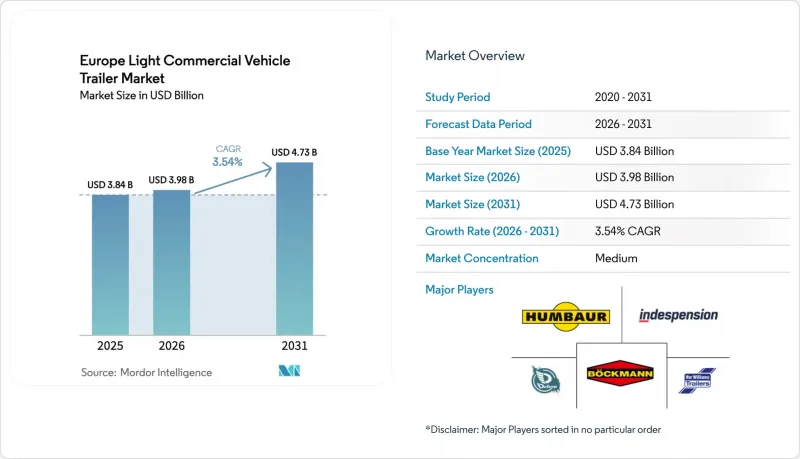
This report is Segmented by Application (Curtain, Refrigeration, and More), Trailer GVWR (Up To 3. 5t, and Above 7t), Axle Configuration (Single-Axle, and More), Ownership Model (Fleet-Owned, and More), End-User Industry (Parcel and Logistics, Construction and Building Materials, and More), and Country. The Market Forecasts are Provided in Terms of Value (USD).
Europe Light Commercial Vehicle Trailer Market Trends and Insights
E-Commerce Parcel-Volume Boom
Surging online sales radically reshape route density and shipment profiles across Europe. Parcel networks now value maneuverability and rapid load-unload capability more than bulk cubic capacity, so fleet managers shift toward curtain-sided and short dry-box formats that fit narrow urban corridors. Micro-fulfillment nodes inside metro areas drive demand for small trailers capable of multiple daily turns. Operators also favor telematics subscriptions that streamline route planning and location-based maintenance, reinforcing the need for digitally enabled trailer platforms.
Tightening CO2 standards driving lightweight materials
EU Regulation 2019/1242 obliges manufacturers to cut fleetwide CO2 emissions 15% by 2025 and 30% by 2030 against 2019 baselines. Compliance drives fast adoption of aluminum skins, high-tensile steels, and composite panels that shave 200-300 kg from typical curb weights. Aluminum producer price indices are increasing, sustaining cost pressure even as demand rises. Weight savings also cut toll charges under the revised Eurovignette directive, making lightweight trailers financially attractive despite higher material costs. Ongoing policy discussions to achieve a 90% emission reduction by 2040 further secure the long-run case for lightweight construction.
Soaring Aluminum and Steel Prices
Trailer manufacturers grapple with aluminum price swings, tightening margins, and complicating procurement. As raw material costs rise, producers have slightly hiked list prices. Yet, diminished purchasing power among smaller fleet operators curtails the extent of these price hikes, exerting pressure throughout the value chain. Geopolitical events, notably European sanctions on Russian aluminum, have heightened supply constraints. In response, manufacturers are pursuing long-term contracts and diversifying their sourcing, albeit at the cost of added logistical challenges.
Other drivers and restraints analyzed in the detailed report include:
- Urban Delivery-Access Regulations Favoring Small Trailers
- Electrification of LCV Fleets Requiring Lightweight Trailer Solutions
- Volatile Diesel Costs Reducing Fleet CAPEX
For complete list of drivers and restraints, kindly check the Table Of Contents.
Segment Analysis
Dry Box bodies retained their workhorse status, holding 36.78% of the Europe light commercial vehicle trailers market share in 2025 and serving general freight from parcel hubs to industrial intermediaries. Curtain-siders remain popular in multipurpose operations demanding side loading, whereas platform and car-carrier variants address niche needs tied to construction and automotive logistics. The premium pricing power of refrigerated trailers offsets higher production costs, making the sub-segment a profit pool for builders with cold-chain expertise.
Refrigeration units contributed the fastest expansion to the European light commercial vehicle trailers market, rising at a 7.68% CAGR through 2031 on the back of booming pharmaceutical and fresh-food demand. The segment benefits from direct-to-consumer grocery platforms and stricter Good Distribution Practice guidelines that specify temperature validation and real-time tracking. New designs such as Schmitz Cargobull's S.Ko COOL integrate battery-electric refrigeration and solar-assisted chargers, reflecting the convergence of cold-chain requirements with electrification imperatives.
Units up to 3.5 t commanded 51.85% of the Europe light commercial vehicle trailers market share in 2025 and are projected to grow at a 6.25% CAGR to 2031, reflecting the strong regulatory push for lighter combinations in congestion-charging zones. These trailers align perfectly with electric vans whose homologated towing limits rarely exceed 1.6 t, and they qualify for lower MAUT distance charges in Germany. Mid-weight trailers between 3.5-7 t maintain balanced payload and volume for regional deliveries, while heavy-duty models above 7 t serve construction and cross-border bulk freight.
Growing metropolitan zero-emission corridors intensify the business case for sub-3.5 t rigs. Fleets also appreciate lower insurance premiums and simpler driver licensing, since many EU states exempt lighter combinations from Class C qualification. Builders offer modular chassis that can be re-rated upward when used outside restricted zones, adding resale flexibility.
Complete Report Scope:
- By Application
- Curtain
- Refrigeration
- Dry Box
- Flat-bed / Platform
- Tippers
- Car Transporter
- Other Applications
- By Trailer GVWR
- Up to 3.5 t
- 3.5 - 7 t
- Above 7 t
- By Axle Configuration
- Single-axle
- Tandem-axle
- Multi-axle
- By Ownership Model
- Fleet-owned
- Leased / Rental
- Private / Owner-operator
- By End-user Industry
- Parcel and Logistics
- Construction and Building Materials
- Food and Beverage
- Retail and FMCG
- Agriculture and Livestock
- Others
- By Country
- United Kingdom
- Germany
- France
- Italy
- Spain
- Russia
- Sweden
- Denmark
- Estonia
- Rest of Europe
List of Companies Covered in this Report:
- Ifor Williams Trailers Ltd.
- Debon Trailers
- Trigano Remorques
- UNSINN Fahrzeugtechnik GmbH
- Eduards Trailer Factory
- Pongratz Trailer-Group GmbH
- Vezeko
- wm meyer Fahrzeugbau AG
- Gaupen-Henger AS
- Bockmann Fahrzeugwerke GmbH
- Indespension Ltd.
- Brian James Trailers
- Humbaur GmbH
- Anssems Trailers BV
- Erde SAS
- Brenderup Group
- Nugent Engineering
- Temared Sp. z o.o.
- Schmitz Cargobull (Light Division)
Additional Benefits:
- The market estimate (ME) sheet in Excel format
- 3 months of analyst support
TABLE OF CONTENTS
1 Introduction
- 1.1 Study Assumptions and Market Definition
- 1.2 Scope of the Study
2 Research Methodology
3 Executive Summary
4 Market Landscape
- 4.1 Market Overview
- 4.2 Market Drivers
- 4.2.1 E-Commerce Parcel-Volume Boom
- 4.2.2 Tightening CO2 Standards Driving Lightweight Materials
- 4.2.3 Urban Delivery-Access Regulations Favoring Small Trailers
- 4.2.4 Electrification of LCV Fleets Requiring Lightweight Trailer Solutions
- 4.2.5 Surge in Pan-EU "Micro-Fulfilment" Networks
- 4.2.6 OEM-Agnostic Telematics Subscriptions Bundling Trailers
- 4.3 Market Restraints
- 4.3.1 Soaring Aluminum and Steel Prices
- 4.3.2 Volatile Diesel Costs Reducing Fleet CAPEX
- 4.3.3 Supply-Chain Disruptions and Chassis Shortages
- 4.3.4 Rising Insurance Premiums for Articulated LCVs
- 4.4 Value / Supply-Chain Analysis
- 4.5 Regulatory Landscape
- 4.6 Technological Outlook
- 4.7 Porter's Five Forces Analysis
- 4.7.1 Threat of New Entrants
- 4.7.1.1 Bargaining Power of Buyers
- 4.7.1.2 Bargaining Power of Suppliers
- 4.7.1.3 Threat of Substitutes
- 4.7.1.4 Intensity of Competitive Rivalry
- 4.7.1 Threat of New Entrants
5 Market Size and Growth Forecasts (Value (USD))
- 5.1 By Application
- 5.1.1 Curtain
- 5.1.2 Refrigeration
- 5.1.3 Dry Box
- 5.1.4 Flat-bed / Platform
- 5.1.5 Tippers
- 5.1.6 Car Transporter
- 5.1.7 Other Applications
- 5.2 By Trailer GVWR
- 5.2.1 Up to 3.5 t
- 5.2.2 3.5 - 7 t
- 5.2.3 Above 7 t
- 5.3 By Axle Configuration
- 5.3.1 Single-axle
- 5.3.2 Tandem-axle
- 5.3.3 Multi-axle
- 5.4 By Ownership Model
- 5.4.1 Fleet-owned
- 5.4.2 Leased / Rental
- 5.4.3 Private / Owner-operator
- 5.5 By End-user Industry
- 5.5.1 Parcel and Logistics
- 5.5.2 Construction and Building Materials
- 5.5.3 Food and Beverage
- 5.5.4 Retail and FMCG
- 5.5.5 Agriculture and Livestock
- 5.5.6 Others
- 5.6 By Country
- 5.6.1 United Kingdom
- 5.6.2 Germany
- 5.6.3 France
- 5.6.4 Italy
- 5.6.5 Spain
- 5.6.6 Russia
- 5.6.7 Sweden
- 5.6.8 Denmark
- 5.6.9 Estonia
- 5.6.10 Rest of Europe
6 Competitive Landscape
- 6.1 Market Concentration
- 6.2 Strategic Moves
- 6.3 Market Share Analysis
- 6.4 Company Profiles (Includes Global level Overview, Market level overview, Core Segments, Financials as available, Strategic Information, Market Rank/Share for key companies, Products and Services, and Recent Developments)
- 6.4.1 Ifor Williams Trailers Ltd.
- 6.4.2 Debon Trailers
- 6.4.3 Trigano Remorques
- 6.4.4 UNSINN Fahrzeugtechnik GmbH
- 6.4.5 Eduards Trailer Factory
- 6.4.6 Pongratz Trailer-Group GmbH
- 6.4.7 Vezeko
- 6.4.8 wm meyer Fahrzeugbau AG
- 6.4.9 Gaupen-Henger AS
- 6.4.10 Bockmann Fahrzeugwerke GmbH
- 6.4.11 Indespension Ltd.
- 6.4.12 Brian James Trailers
- 6.4.13 Humbaur GmbH
- 6.4.14 Anssems Trailers BV
- 6.4.15 Erde SAS
- 6.4.16 Brenderup Group
- 6.4.17 Nugent Engineering
- 6.4.18 Temared Sp. z o.o.
- 6.4.19 Schmitz Cargobull (Light Division)
7 Market Opportunities and Future Outlook

