PUBLISHER: Mordor Intelligence | PRODUCT CODE: 2114836

PUBLISHER: Mordor Intelligence | PRODUCT CODE: 2114836
Indirect Calorimeter - Market Share Analysis, Industry Trends & Statistics, Growth Forecasts (2026 - 2031)
According to Mordor Intelligence, the indirect calorimeter market size was valued at USD 0.82 billion in 2025 and estimated to grow from USD 0.86 billion in 2026 to reach USD 1.09 billion by 2031, at a CAGR of 4.82% during the forecast period (2026-2031).
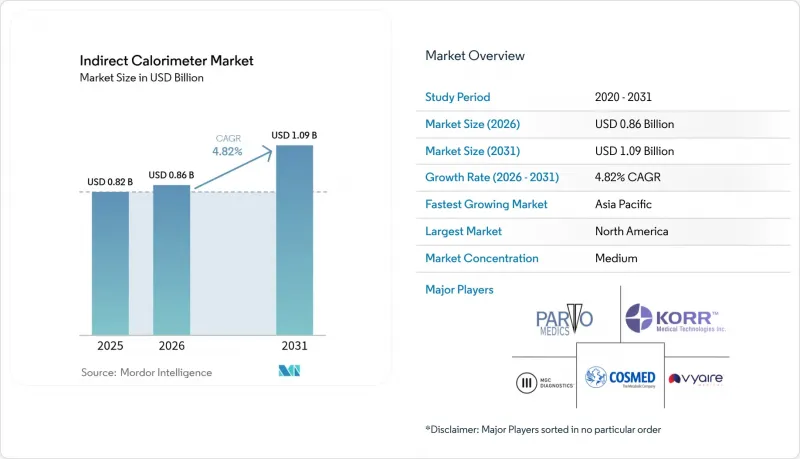
This report is Segmented by Product Type (Standalone, Portable), Application (Medical Care, Sports and Fitness, Others), End User (Hospitals, Diagnostic Centers, Sports Performance Labs, Others), and Geography (North America, Europe, Asia-Pacific, Middle East and Africa, South America). The Market Forecasts are Provided in Terms of Value (USD).
Global Indirect Calorimeter Market Trends and Insights
Technological Miniaturization & Sensor Cost Decline
MEMS-based oxygen and carbon-dioxide sensors now rival mass-spectrometry precision at a fraction of the cost, cutting measurement uncertainty to 3% and shrinking form-factors to pocket scale . Field-validated systems such as the COSMED K4b2 prove that mobile calorimetry can match laboratory reference methods in outdoor sports settings. Consumer prototypes achieve >0.99 correlation with Douglas-bag measurements, signaling a shift toward always-on metabolic monitoring. Lower per-test costs and shorter calibration cycles help hospitals justify routine bedside use, while sports labs gain flexibility to test athletes in real-play environments. Academic spin-offs such as the Breezing portable tracker underscore this democratization of metabolic analytics.
Rising Global Obesity & Metabolic Disorders
Prediction equations fail to estimate resting energy expenditure accurately in over 80% of hospitalized adults aged >=70, reinforcing the clinical need for direct measurement. As obesity-related metabolic dysfunction grows, precise calorimetry guides tailored macronutrient dosing, shortens ICU stays, and reduces complications. Governments and insurers increasingly reimburse indirect calorimetry because outcome data reveal cost offsets from fewer ventilator days. The indirect calorimeter market therefore scales with chronic-disease prevalence and policy shifts toward outcome-based care.
High Capital & Disposable Costs
Stand-alone ICU-grade systems exceed USD 25,000 and require calibration gases, flow sensors, and single-use valves, adding annual ownership burdens that smaller clinics struggle to absorb . The indirect calorimeter market therefore favors tertiary hospitals and integrated health networks. Portable MEMS devices cut entry prices, but reimbursement schedules must widen for broader penetration.
Other drivers and restraints analyzed in the detailed report include:
- Growing Awareness About the Advantages
- ICU Adoption for Precision Nutrition Therapy
- Stringent Regulatory & Validation Requirements
For complete list of drivers and restraints, kindly check the Table Of Contents.
Segment Analysis
Standalone calorimeters commanded 62.70% of the indirect calorimeter market share in 2025 on the strength of ICU protocols that prize absolute accuracy and deep analytic menus. Workflow-oriented designs integrate with electronic medical records, ensuring seamless data capture. The indirect calorimeter market size for portable units is projected to climb at 5.31% CAGR to 2031, reflecting their growing equivalence to laboratory benchmarks and their appeal for sports-science field work.
Portable systems now embed mini turbulence channels, micro-heaters, and advanced algorithms, matching +-5% precision thresholds once exclusive to benchtop instruments. Sports performance centers value this flexibility to test VO2 and VCO2 without tethering athletes to treadmills. Healthcare-at-home programs also piloted remote metabolic testing in 2025, signaling another future revenue pool within the indirect calorimeter market.
Complete Report Scope:
- By Product Type
- Standalone
- Portable
- By Application
- Medical Care
- Sports and Fitness
- Others
- By End User
- Hospitals
- Diagnostic Centers
- Sports Performance Labs
- Others
- By Geography
- North America
- United States
- Canada
- Mexico
- Europe
- Germany
- United Kingdom
- France
- Italy
- Spain
- Rest of Europe
- Asia-Pacific
- China
- Japan
- India
- Australia
- South Korea
- Rest of Asia-Pacific
- Middle East and Africa
- GCC
- South Africa
- Rest of Middle East and Africa
- South America
- Brazil
- Argentina
- Rest of South America
- North America
Geography Analysis
North America generated 40.70% of 2025 revenue for the indirect calorimeter market, leveraging Medicare code 94690 and strong clinical-society endorsements. Device vendors secure predictable sales funnels via group-purchasing contracts and bundled service agreements. Europe follows with entrenched ICU protocols and multicenter validation studies that maintain steady installations in Germany, France, and the Nordics.
Asia-Pacific is the fastest expanding geography at 5.26% CAGR to 2031, propelled by national obesity-control programs and rapid private-hospital growth in China and India. Local contract manufacturers are licensing Western sensor patents to produce cost-optimized units, aiding regional penetration of the indirect calorimeter market. Middle East and Africa lag in installed base but several teaching hospitals in the Gulf Cooperation Council funded Q-NRG fleets in 2025, hinting at latent demand once training hurdles ease.
South America observes moderate uptake; Brazil's cardiopulmonary rehab clinics favor lightweight calorimeters that couple with six-minute-walk tests, while Argentina's social-security hospitals budget for one device per ICU cluster. Collectively these dynamics diversify the regional revenue mix and insulate the indirect calorimeter market from single-region shocks.
- COSMED Srl
- MGC Diagnostics
- Vyaire Medical
- KORR Medical Technologies
- Maastricht Instruments
- Parvo Medics
- Microlife Medical (MedGem/BodyGem)
- Cortex Biophysik
- GE Healthcare
- Schiller
- CareFusion / BD
- iWorx Systems
- TSE Systems
- Room Calorimeters (UK)
- Geratherm Respiratory
- Omnical Netherlands
- Summit Healthcare (India)
- Sable Systems International
- CJD Technologies
- AEI Technologies
- Ultima Systems (USA)
Additional Benefits:
- The market estimate (ME) sheet in Excel format
- 3 months of analyst support
TABLE OF CONTENTS
1 Introduction
- 1.1 Study Assumptions & Market Definition
- 1.2 Scope of the Study
2 Research Methodology
3 Executive Summary
4 Market Landscape
- 4.1 Market Overview
- 4.2 Market Drivers
- 4.2.1 Technological miniaturization & sensor cost decline
- 4.2.2 Rising global obesity & metabolic disorders
- 4.2.3 Growing Awareness about the advantages
- 4.2.4 ICU adoption for precision nutrition therapy
- 4.2.5 Shift to at-home metabolic testing services
- 4.2.6 Insurance coding expansion for indirect calorimetry
- 4.3 Market Restraints
- 4.3.1 High capital & disposable costs
- 4.3.2 Stringent regulatory/validation requirements
- 4.3.3 Lack of trained metabolic technologists
- 4.3.4 \Accuracy drift in low-flow pediatric measurements
- 4.4 Regulatory Landscape
- 4.5 Technological Outlook
- 4.6 Porter's Five Forces Analysis
- 4.6.1 Threat of New Entrants
- 4.6.2 Bargaining Power of Buyers
- 4.6.3 Bargaining Power of Suppliers
- 4.6.4 Threat of Substitutes
- 4.6.5 Intensity of Competitive Rivalry
5 Market Size & Growth Forecasts (Value, USD)
- 5.1 By Product Type
- 5.1.1 Standalone
- 5.1.2 Portable
- 5.2 By Application
- 5.2.1 Medical Care
- 5.2.2 Sports and Fitness
- 5.2.3 Others
- 5.3 By End User
- 5.3.1 Hospitals
- 5.3.2 Diagnostic Centers
- 5.3.3 Sports Performance Labs
- 5.3.4 Others
- 5.4 By Geography
- 5.4.1 North America
- 5.4.1.1 United States
- 5.4.1.2 Canada
- 5.4.1.3 Mexico
- 5.4.2 Europe
- 5.4.2.1 Germany
- 5.4.2.2 United Kingdom
- 5.4.2.3 France
- 5.4.2.4 Italy
- 5.4.2.5 Spain
- 5.4.2.6 Rest of Europe
- 5.4.3 Asia-Pacific
- 5.4.3.1 China
- 5.4.3.2 Japan
- 5.4.3.3 India
- 5.4.3.4 Australia
- 5.4.3.5 South Korea
- 5.4.3.6 Rest of Asia-Pacific
- 5.4.4 Middle East and Africa
- 5.4.4.1 GCC
- 5.4.4.2 South Africa
- 5.4.4.3 Rest of Middle East and Africa
- 5.4.5 South America
- 5.4.5.1 Brazil
- 5.4.5.2 Argentina
- 5.4.5.3 Rest of South America
- 5.4.1 North America
6 Competitive Landscape
- 6.1 Market Concentration
- 6.2 Market Share Analysis
- 6.3 Company Profiles (includes Global level Overview, Market level overview, Core Segments, Financials as available, Strategic Information, Market Rank/Share for key companies, Products & Services, and Recent Developments)
- 6.3.1 COSMED Srl
- 6.3.2 MGC Diagnostics
- 6.3.3 Vyaire Medical
- 6.3.4 KORR Medical Technologies
- 6.3.5 Maastricht Instruments BV
- 6.3.6 Parvo Medics
- 6.3.7 Microlife Medical (MedGem/BodyGem)
- 6.3.8 Cortex Biophysik
- 6.3.9 GE Healthcare
- 6.3.10 Schiller AG
- 6.3.11 CareFusion / BD
- 6.3.12 iWorx Systems
- 6.3.13 TSE Systems
- 6.3.14 Room Calorimeters (UK)
- 6.3.15 Geratherm Respiratory
- 6.3.16 Omnical Netherlands
- 6.3.17 Summit Healthcare (India)
- 6.3.18 Sable Systems International
- 6.3.19 CJD Technologies
- 6.3.20 AEI Technologies
- 6.3.21 Ultima Systems (USA)
7 Market Opportunities & Future Outlook
- 7.1 White-space & Unmet-Need Assessment

