PUBLISHER: Mordor Intelligence | PRODUCT CODE: 2114842

PUBLISHER: Mordor Intelligence | PRODUCT CODE: 2114842
Infusion Management - Market Share Analysis, Industry Trends & Statistics, Growth Forecasts (2026 - 2031)
According to Mordor Intelligence, the infusion management market size is expected to grow from USD 47.61 billion in 2025 to USD 51.44 billion in 2026 and is forecast to reach USD 75.74 billion by 2031 at 8.05% CAGR over 2026-2031.
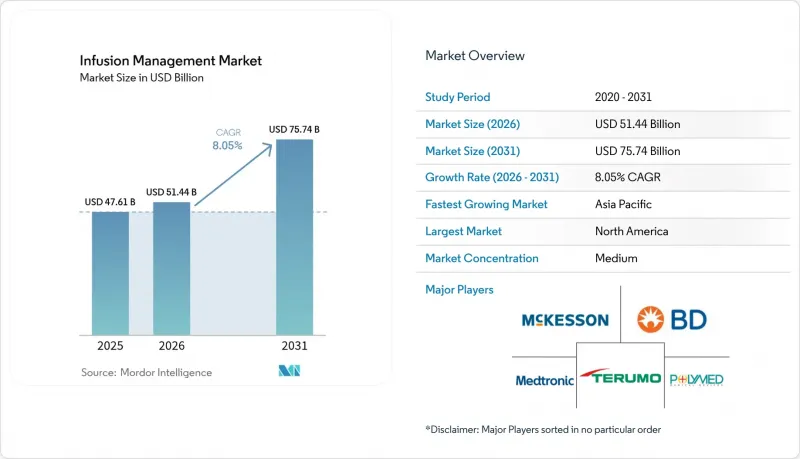
This report Segments the Industry Into by Product Type (Volumetric Infusion Pumps, Syringe Pumps, and More), Therapy Type (Antibiotics, Antimicrobial, and More), Application (Oncology, and More), End User (Hospital & Clinic, and More), and Geography (North America, Europe, Asia-Pacific, Middle East and Africa, and South America). The Report Offers the Value (in USD Million) for the Above Segments.
Global Infusion Management Market Trends and Insights
Rising Prevalence of Chronic Diseases
Chronic illnesses such as diabetes, cancer, and Parkinson's disease are expanding the candidate pool for continuous and programmable infusion therapy. Diabetes alone affects 537 million adults and necessitates precise insulin and GLP-1 biologic delivery. Smart infusion platforms integrate dose-error-reduction software, cutting high-risk medication errors from 45 to 25 per 100 infusions, a 44% improvement that meets tighter safety benchmarks.The FDA clearance of a wearable apomorphine pump for Parkinson's disease shows the appetite for patient-controlled devices that enable mobility and reduce clinic visits. Demand is especially strong in aging populations across the United States, Germany, and Japan, while lifestyle-related conditions spur uptake in India and Brazil. As a result, health systems are standardizing on enterprise-wide pump fleets that share drug libraries and analytics dashboards. Over the long term, chronic-disease dynamics are expected to add 1.8 percentage points to the Infusion management market CAGR.
Growing Demand for Ambulatory & Home-Based Infusion Therapy
Site-of-care migration is moving therapies from hospital outpatient departments to stand-alone centers and living rooms. Ambulatory infusion centers reported 48% year-on-year growth in rheumatology treatments, achieving per-episode savings of 30-50% versus inpatient administration. Technology is reshaping workflows: portable pumps with 12-hour batteries, LTE connectivity, and simplified touch screens reduce patient training to minutes. Baxter's elastomeric portfolio already delivers 4.5 million infusions per year outside hospitals, underscoring scale. Medicare's expanded home-infusion benefit further accelerates adoption, though payment updates lag specialty-drug price climbs. COVID-19 validated remote monitoring, with nurses shortening handling time by 4.06 minutes per infusion thanks to connected dashboards. Mid-term impact adds 2.1 percentage points to growth as payers intensify cost-reduction programs.
High Capital & Maintenance Cost of Next-Generation Pumps
Enterprise roll-outs can top USD 2.5 million, factoring in Wi-Fi upgrades, cybersecurity software, and staff accreditation. Annual maintenance contracts add 8-10% of capital cost, straining community hospitals and providers in middle-income economies. FDA cybersecurity rules compel secure software development life-cycles and vulnerability patching, embedding further cost. Leasing programs from InfuSystem and others reduce upfront spend but lift lifetime expenditure. The net effect subtracts 1.4% points from the CAGR as smaller buyers delay refresh cycles.
Other drivers and restraints analyzed in the detailed report include:
- Technological Shift Toward Smart-Connected Pumps
- Rapid Expansion of Outpatient Infusion Centers in Emerging Markets
- Regulatory Recalls & Cybersecurity Vulnerabilities
For complete list of drivers and restraints, kindly check the Table Of Contents.
Segment Analysis
Volumetric pumps represented 39.02% of the Infusion management market size in 2025, underpinned by universal compatibility with high-flow therapies in emergency and critical-care units. Hospitals favor these devices for integrated drug libraries, large LCD interfaces, and proven reliability. Syringe pumps remain indispensable in neonatal and oncology wards where milliliter-level precision is vital. Disposable sets, pressure sleeves, and filter accessories form a stable annuity stream, often bundled in multi-year service contracts.
Implantable pumps, though niche in unit terms, post a robust 10.12% CAGR and are reshaping pain management, oncolytic therapy, and spasticity treatment. Programmable reservoirs allow month-long dosing schedules, driving patient adherence and cutting clinic visits by 60%. Vendors co-design drug-device combos with pharma partners, embedding telemetry that reports reservoir levels to cloud dashboards. The shift toward fully internalized systems aligns with payer goals to curb readmissions and with patient preference for unobtrusive treatment. Collectively, these forces keep the Infusion management market deployment roadmap centered on modular, software-defined hardware that scales across acuity levels.
Antibiotics account for 22.12% of the Infusion management market share in 2025 as hospitals combat resistant organisms and sepsis cases. Smart pumps enforce extended-infusion protocols, optimizing pharmacodynamics and shortening length of stay. Dose-error-reduction software cut incorrect vancomycin rates by 38%, according to multi-center audits.
Looking ahead, oncology therapies claim the steepest value upside with a 13.24% CAGR. Biologic monoclonal antibodies require controlled flow and inline temperature conditioning, capabilities delivered by next-gen peristaltic modules. Oncology centers are standardizing closed-system transfer devices to guard staff from cytotoxic exposure, boosting accessory sales. Meanwhile, diabetes therapies blend insulin infusion with continuous glucose data streams and closed-loop algorithms, expanding the Infusion management market to the overlapping digital-health universe. Combined, these trends broaden the therapy mix, reduce idle pump time, and diversify revenue away from a single source.
Complete Report Scope:
- By Product Type
- Volumetric Infusion Pumps
- Syringe Pumps
- Ambulatory Infusion Pumps
- Insulin Pumps
- Enteral Infusion Pumps
- Implantable Infusion Pumps
- Patient-Controlled Analgesia Pumps
- Accessories & Disposables
- By Therapy Type
- Antibiotics
- Antimicrobial
- Pain Management
- Enteral Nutrition
- Chemotherapy / Oncology
- Parenteral Nutrition
- Diabetes Management
- Other Therapies
- By Application
- Oncology
- Diabetes
- Gastroenterology
- Pain Management
- Pediatrics & Neonatology
- Hematology
- Critical Care
- Others
- By End User
- Hospitals & Clinics
- Ambulatory Surgical Centers
- Homecare Settings
- Specialized Infusion Centers
- Others
- By Geography
- North America
- United States
- Canada
- Mexico
- Europe
- Germany
- United Kingdom
- France
- Italy
- Spain
- Rest of Europe
- Asia-Pacific
- China
- Japan
- India
- Australia
- South Korea
- Rest of Asia-Pacific
- Middle East & Africa
- GCC
- South Africa
- Rest of Middle East & Africa
- South America
- Brazil
- Argentina
- Rest of South America
- North America
Geography Analysis
North America generated the largest revenue slice in 2025, claiming 39.11% of the Infusion management market. Health systems benefit from commercial insurance that reimburses smart-pump premiums, while federal agencies push for cybersecurity compliance and EHR integration. Major integrated-delivery networks have already refreshed 70% of fleets to interoperable platforms, creating a replacement cycle every 7-8 years. The US also leads in AI algorithm validation, aided by FDA's pre-cert programs that expedite software updates.
Europe ranks second, supported by universal coverage and procurement frameworks that emphasize value and post-market surveillance. Germany, France, and the Nordics favor vendor-neutral interoperability, spurring open-API pump designs. EU regulations on DEHP and single-use plastics fast-track green product variants, influencing global design roadmaps. Brexit-related divergence in UK approvals introduces modest complexity yet does not slow overall adoption.
Asia-Pacific drives the fastest expansion at 9.42% CAGR. China's tier-2 cities, the Indian private hospital segment, and ASEAN medical hubs are modernizing infusion infrastructure, aided by government incentives for digital health. Domestic manufacturers in China and South Korea are entering mid-tier price bands, raising competitive stakes. Australia and Japan, classified as mature markets, pivot to home-care models that mirror US site-of-care shifts. Regional variance in reimbursement and cyber rules requires vendors to tailor SKUs and software modules, but the upside far exceeds these hurdles. Latin America and the Middle East trail yet offer pockets of double-digit growth in private oncology and transplant centers, rounding out the global footprint of the Infusion management market.
- Beckton Dickinson
- Baxter
- B. Braun
- ICU Medical
- Fresenius
- Terumo
- Medtronic
- Mindray
- Moog
- Insulet
- Tandem Diabetes Care
- Nipro
- Micrel Medical Devices
- Ypsomed
- Codan Medical
- WalkMed Infusion LLC
- Mckesson
- Roche
- Smiths Group
- Polymedicure Ltd.
Additional Benefits:
- The market estimate (ME) sheet in Excel format
- 3 months of analyst support
TABLE OF CONTENTS
1 Introduction
- 1.1 Study Assumptions & Market Definition
- 1.2 Scope of the Study
2 Research Methodology
3 Executive Summary
4 Market Landscape
- 4.1 Market Overview
- 4.2 Market Drivers
- 4.2.1 Rising Prevalence of Chronic Diseases
- 4.2.2 Growing Demand for Ambulatory & Home-Based Infusion Therapy
- 4.2.3 Technological Shift Toward Smart-Connected Pumps
- 4.2.4 Rapid Expansion of Outpatient Infusion Centers in Emerging Markets
- 4.2.5 Cloud-Based Pump-EMR Interoperability Mandates
- 4.2.6 Drug-Device Combination Kits for Biologics & Specialty Pharma
- 4.3 Market Restraints
- 4.3.1 High Capital & Maintenance Cost of Next-Gen Pumps
- 4.3.2 Regulatory Recalls & Cybersecurity Vulnerabilities
- 4.3.3 Semiconductor Shortages Delaying Smart-Pump Deliveries
- 4.3.4 Sustainability Pressure on Single-Use PVC Infusion Sets
- 4.4 Porter's Five Forces Analysis
- 4.4.1 Threat of New Entrants
- 4.4.2 Bargaining Power of Buyers
- 4.4.3 Bargaining Power of Suppliers
- 4.4.4 Threat of Substitutes
- 4.4.5 Intensity of Competitive Rivalry
5 Market Size & Growth Forecasts (Value in USD)
- 5.1 By Product Type
- 5.1.1 Volumetric Infusion Pumps
- 5.1.2 Syringe Pumps
- 5.1.3 Ambulatory Infusion Pumps
- 5.1.4 Insulin Pumps
- 5.1.5 Enteral Infusion Pumps
- 5.1.6 Implantable Infusion Pumps
- 5.1.7 Patient-Controlled Analgesia Pumps
- 5.1.8 Accessories & Disposables
- 5.2 By Therapy Type
- 5.2.1 Antibiotics
- 5.2.2 Antimicrobial
- 5.2.3 Pain Management
- 5.2.4 Enteral Nutrition
- 5.2.5 Chemotherapy / Oncology
- 5.2.6 Parenteral Nutrition
- 5.2.7 Diabetes Management
- 5.2.8 Other Therapies
- 5.3 By Application
- 5.3.1 Oncology
- 5.3.2 Diabetes
- 5.3.3 Gastroenterology
- 5.3.4 Pain Management
- 5.3.5 Pediatrics & Neonatology
- 5.3.6 Hematology
- 5.3.7 Critical Care
- 5.3.8 Others
- 5.4 By End User
- 5.4.1 Hospitals & Clinics
- 5.4.2 Ambulatory Surgical Centers
- 5.4.3 Homecare Settings
- 5.4.4 Specialized Infusion Centers
- 5.4.5 Others
- 5.5 By Geography
- 5.5.1 North America
- 5.5.1.1 United States
- 5.5.1.2 Canada
- 5.5.1.3 Mexico
- 5.5.2 Europe
- 5.5.2.1 Germany
- 5.5.2.2 United Kingdom
- 5.5.2.3 France
- 5.5.2.4 Italy
- 5.5.2.5 Spain
- 5.5.2.6 Rest of Europe
- 5.5.3 Asia-Pacific
- 5.5.3.1 China
- 5.5.3.2 Japan
- 5.5.3.3 India
- 5.5.3.4 Australia
- 5.5.3.5 South Korea
- 5.5.3.6 Rest of Asia-Pacific
- 5.5.4 Middle East & Africa
- 5.5.4.1 GCC
- 5.5.4.2 South Africa
- 5.5.4.3 Rest of Middle East & Africa
- 5.5.5 South America
- 5.5.5.1 Brazil
- 5.5.5.2 Argentina
- 5.5.5.3 Rest of South America
- 5.5.1 North America
6 Competitive Landscape
- 6.1 Market Concentration
- 6.2 Market Share Analysis
- 6.3 Company Profiles (includes Global level Overview, Market level overview, Core Segments, Financials as available, Strategic Information, Market Rank/Share for key companies, Products & Services, and Recent Developments)
- 6.3.1 Becton, Dickinson and Company
- 6.3.2 Baxter International Inc.
- 6.3.3 B. Braun SE
- 6.3.4 ICU Medical Inc.
- 6.3.5 Fresenius Kabi AG
- 6.3.6 Terumo Corporation
- 6.3.7 Medtronic
- 6.3.8 Mindray Medical International Ltd.
- 6.3.9 Moog Inc.
- 6.3.10 Insulet Corporation
- 6.3.11 Tandem Diabetes Care Inc.
- 6.3.12 Nipro Corporation
- 6.3.13 Micrel Medical Devices SA
- 6.3.14 Ypsomed AG
- 6.3.15 Codan Medical
- 6.3.16 WalkMed Infusion LLC
- 6.3.17 McKesson Corporation
- 6.3.18 Roche Diabetes Care
- 6.3.19 Smiths Medical
- 6.3.20 Polymedicure Ltd.
7 Market Opportunities & Future Outlook
- 7.1 White-Space & Unmet-Need Assessment

