PUBLISHER: Mordor Intelligence | PRODUCT CODE: 2114843

PUBLISHER: Mordor Intelligence | PRODUCT CODE: 2114843
Global Laboratory Centrifuge - Market Share Analysis, Industry Trends & Statistics, Growth Forecasts (2026 - 2031)
According to Mordor Intelligence, the laboratory centrifuge market size was valued at USD 1.71 billion in 2025 and estimated to grow from USD 1.81 billion in 2026 to reach USD 2.39 billion by 2031, at a CAGR of 5.73% during the forecast period (2026-2031).
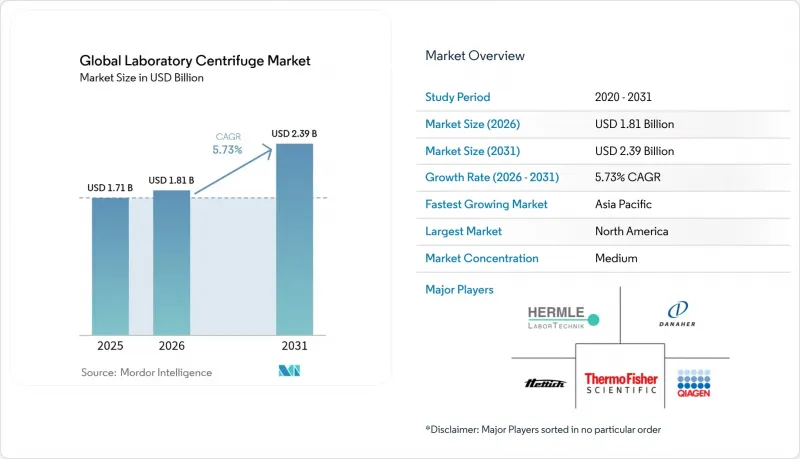
This report is Segmented by Product Type (Equipment [Microcentrifuges, Ultracentrifuges, and More], Accessories [Tubes & Bottles, and More]), by Model Type (Benchtop, Floor-Standing), by Application (Microbiology, Cellomics, and More), by End-User (Hospitals & Diagnostic Labs, and More), by Automation Level (Manual / Conventional, and More), by Geography (North America, Europe, Asia-Pacific, and More).
Global Laboratory Centrifuge Market Trends and Insights
High Prevalence of Chronic & Infectious Diseases
Diagnostic laboratories rely on centrifugation to separate plasma and isolate pathogens for biomarkers that guide diabetes, cardiovascular, and cancer management. Safety-bucket designs now meet WHO tuberculosis protocols that call for sealed operation to reduce aerosol risk. Aging populations in the United States and Western Europe keep specimen volumes high, while novel infection outbreaks spur health systems to deploy portable centrifuges in frontline clinics. These conditions collectively maintain baseline demand across the laboratory centrifuge market.
Rising R&D Spending in Biopharma & Life Sciences
Drug-discovery programs adopt advanced separation workflows for protein purification, extracellular-vesicle isolation, and viral-vector production. The EVics system shows how tandem tangential-flow filtration overcomes legacy ultracentrifuge bottlenecks by processing up to 1 L while preserving biomolecule integrity. Contract research organizations equip new automated platforms to keep pace with sponsor projects, further expanding the laboratory centrifuge market.
High Upfront Capital Cost of Advanced Systems
Fully-equipped ultracentrifuges often exceed USD 100,000, restricting adoption by small laboratories. A USD 2 billion global secondary-equipment channel now supplies refurbished units with vendor warranties, offering affordable entry points. Leasing and rental plans further spread out expenditure, yet budget constraints persist, especially in Latin America and parts of Southeast Asia.
Other drivers and restraints analyzed in the detailed report include:
- Technological Advances in High-Throughput & Refrigerated Systems
- Viral-Vector Demand for Cell & Gene Therapy Manufacturing
- Tightening Biosafety & Noise-Emission Regulations
For complete list of drivers and restraints, kindly check the Table Of Contents.
Segment Analysis
Equipment represented 76.12% of 2025 revenue, confirming users' primary focus on platform procurement within the laboratory centrifuge market. Ultracentrifuges reach speeds above 100,000 rpm, supporting protein and virus separation for biologics research. Microcentrifuges remain staples of routine assays, while multipurpose units cater to institutions needing rotor flexibility. The laboratory centrifuge market size for accessories is smaller but displays faster momentum as laboratories replace tubes, bottles, and rotor seals after repeated sterilization cycles. Carbon-fiber rotors, lighter yet corrosion-resistant, now enter service contracts that guarantee load balancing and fatigue inspection.
The accessories segment grows at 7.04% CAGR because consumables are replaced more frequently than hardware. Fixed-angle and swinging-bucket formats account for most aftermarket demand, backed by vendor programs that bundle rotor upgrades with calibration services. As high-throughput screens expand, laboratories secure bulk lots of single-use tubes to avoid cross-contamination. Manufacturers thus bank on recurring sales that complement initial hardware margins, reinforcing the resilience of the laboratory centrifuge market.
Benchtop units held 61.30% revenue in 2025, favored for daily diagnostic and academic protocols that handle volumes under 500 mL. Their compact footprint aligns with space-limited benches, and recent firmware updates add touch-screen controls plus QR-code maintenance logs. In contrast, floor-standing models realise a 6.49% CAGR by accommodating bags and bottles needed for upstream bioprocess harvests. Programmable ramps and vibration dampers meet GMP validation rules, which lifts their appeal for contract manufacturers.
The laboratory centrifuge market benefits as institutions deploy mixed fleets: benchtops for stat tests, floor units for batch purification. Integration with robotic arms enables unmanned loading, turning traditional floor systems into automated work cells. Vendors now offer hybrid service plans that remotely track rotor cycles across both model lines, minimising downtime while retaining operator familiarity.
Complete Report Scope:
- By Product Type
- Equipment
- Microcentrifuges
- Ultracentrifuges
- Multipurpose/General-purpose
- Accessories
- Tubes & Bottles
- Rotors (fixed-angle, swinging-bucket)
- Buckets/Plates/Consumables
- Equipment
- By Model Type
- Benchtop
- Floor-standing
- By Intended Use
- Clinical
- Pre-clinical/Research
- General Purpose
- By Application
- Microbiology
- Cellomics
- Proteomics
- Genomics
- Diagnostics
- By End-user
- Hospitals & Diagnostic Labs
- Academic & Research Institutes
- Biotech & Pharma Companies
- Contract Testing / CROs
- By Automation Level
- Manual / Conventional
- Semi-automated
- Fully-automated / Robotic
- By Geography
- North America
- United States
- Canada
- Mexico
- Europe
- Germany
- United Kingdom
- France
- Italy
- Spain
- Rest of Europe
- Asia-Pacific
- China
- Japan
- India
- Australia
- South Korea
- Rest of Asia-Pacific
- Middle East and Africa
- GCC
- South Africa
- Rest of Middle East and Africa
- South America
- Brazil
- Argentina
- Rest of South America
- North America
Geography Analysis
North America retained 36.10% of 2025 revenue, anchored by the United States' dense cluster of pharmaceutical headquarters, National Institutes of Health grants, and a robust contract manufacturing base. Canada complements with public health labs and a growing biologics ecosystem, while Mexico benefits from near-shoring of medical-device assembly. Federal incentives for advanced manufacturing further stimulate orders for GMP-graded centrifuges that feed into local cell-therapy plants. Laboratories also respond to OSHA and CDC safety directives, prompting upgrades to aerosol-tight lids and acoustic dampening, which sustains the laboratory centrifuge market.
Asia-Pacific posts the fastest 7.68% CAGR. China's medical-equipment sector reached USD 179 billion in 2024, featuring 138,000 device patents, and state policy favours domestic sourcing.India's National Medical Devices Policy targets USD 50 billion turnover by 2030 and simplifies regulatory pathways, encouraging multinational and local firms to invest in centrifuge assembly lines. Japan, South Korea, and Australia expand clinical-trial networks that demand high-throughput centrifugation, reinforcing the laboratory centrifuge market across the region.
Europe shows steady growth paced by Germany's export-oriented device makers, the United Kingdom's biotech clusters, and France's hospital modernisation programs. EU directives on eco-design and medical-device regulation encourage adoption of energy-efficient rotors and comprehensive validation records. Sustainability-focused hospitals favor models with 70% lower power draw, aligning procurement with green public-purchasing policies. Collectively, these initiatives keep European demand consistent while opening niches for circular-economy refurbishment services that extend the lifecycle of centrifuge fleets.
- Thermo Fisher Scientific
- Danaher Corp. (Beckman Coulter)
- Eppendorf
- Andreas Hettich
- Sigma Laborzentrifugen
- HERMLE Labortechnik
- Kubota Corp.
- NuAire Inc.
- Sartorius
- QIAGEN
- Labnics Equipment
- Esco Life Sciences
- KeraJet / Khera Instruments (Pvt Ltd)
- BT Lab Systems
- LabMedica (Scheuermann)
- Centrisys/CNP LLC
- Alfa Laval AB
- Becton, Dickinson & Co. (BD)
Additional Benefits:
- The market estimate (ME) sheet in Excel format
- 3 months of analyst support
TABLE OF CONTENTS
1 Introduction
- 1.1 Study Assumptions & Market Definition
- 1.2 Scope of the Study
2 Research Methodology
3 Executive Summary
4 Market Landscape
- 4.1 Market Overview
- 4.2 Market Drivers
- 4.2.1 High prevalence of chronic & infectious diseases
- 4.2.2 Rising R&D spending in biopharma & life sciences
- 4.2.3 Technological advances in high-throughput & refrigerated systems
- 4.2.4 Expansion of decentralised/near-patient diagnostic labs
- 4.2.5 Viral-vector demand for cell & gene therapy manufacturing
- 4.2.6 Rotor-refurbishment & circular-economy revenue streams
- 4.3 Market Restraints
- 4.3.1 High upfront capital cost of advanced systems
- 4.3.2 Long equipment lifespans slowing replacement sales
- 4.3.3 Growth of outsourced centrifugation services
- 4.3.4 Tightening biosafety & noise-emission regulations
- 4.4 Value / Supply-Chain Analysis
- 4.5 Regulatory Landscape
- 4.6 Technological Outlook
- 4.7 Porter's Five Forces Analysis
- 4.7.1 Threat of New Entrants
- 4.7.2 Bargaining Power of Buyers
- 4.7.3 Bargaining Power of Suppliers
- 4.7.4 Threat of Substitutes
- 4.7.5 Competitive Rivalry
5 Market Size & Growth Forecasts (Value)
- 5.1 By Product Type
- 5.1.1 Equipment
- 5.1.1.1 Microcentrifuges
- 5.1.1.2 Ultracentrifuges
- 5.1.1.3 Multipurpose/General-purpose
- 5.1.2 Accessories
- 5.1.2.1 Tubes & Bottles
- 5.1.2.2 Rotors (fixed-angle, swinging-bucket)
- 5.1.2.3 Buckets/Plates/Consumables
- 5.1.1 Equipment
- 5.2 By Model Type
- 5.2.1 Benchtop
- 5.2.2 Floor-standing
- 5.3 By Intended Use
- 5.3.1 Clinical
- 5.3.2 Pre-clinical/Research
- 5.3.3 General Purpose
- 5.4 By Application
- 5.4.1 Microbiology
- 5.4.2 Cellomics
- 5.4.3 Proteomics
- 5.4.4 Genomics
- 5.4.5 Diagnostics
- 5.5 By End-user
- 5.5.1 Hospitals & Diagnostic Labs
- 5.5.2 Academic & Research Institutes
- 5.5.3 Biotech & Pharma Companies
- 5.5.4 Contract Testing / CROs
- 5.6 By Automation Level
- 5.6.1 Manual / Conventional
- 5.6.2 Semi-automated
- 5.6.3 Fully-automated / Robotic
- 5.7 By Geography
- 5.7.1 North America
- 5.7.1.1 United States
- 5.7.1.2 Canada
- 5.7.1.3 Mexico
- 5.7.2 Europe
- 5.7.2.1 Germany
- 5.7.2.2 United Kingdom
- 5.7.2.3 France
- 5.7.2.4 Italy
- 5.7.2.5 Spain
- 5.7.2.6 Rest of Europe
- 5.7.3 Asia-Pacific
- 5.7.3.1 China
- 5.7.3.2 Japan
- 5.7.3.3 India
- 5.7.3.4 Australia
- 5.7.3.5 South Korea
- 5.7.3.6 Rest of Asia-Pacific
- 5.7.4 Middle East and Africa
- 5.7.4.1 GCC
- 5.7.4.2 South Africa
- 5.7.4.3 Rest of Middle East and Africa
- 5.7.5 South America
- 5.7.5.1 Brazil
- 5.7.5.2 Argentina
- 5.7.5.3 Rest of South America
- 5.7.1 North America
6 Competitive Landscape
- 6.1 Market Concentration
- 6.2 Market Share Analysis
- 6.3 Company Profiles (includes Global level Overview, Market level overview, Core Segments, Financials as available, Strategic Information, Market Rank/Share, Products & Services, Recent Developments)
- 6.3.1 Thermo Fisher Scientific Inc.
- 6.3.2 Danaher Corp. (Beckman Coulter)
- 6.3.3 Eppendorf AG
- 6.3.4 Andreas Hettich GmbH & Co. KG
- 6.3.5 Sigma Laborzentrifugen GmbH
- 6.3.6 HERMLE Labortechnik GmbH
- 6.3.7 Kubota Corp.
- 6.3.8 NuAire Inc.
- 6.3.9 Sartorius AG
- 6.3.10 Qiagen NV
- 6.3.11 Labnics Equipment
- 6.3.12 Esco Life Sciences
- 6.3.13 KeraJet / Khera Instruments (Pvt Ltd)
- 6.3.14 BT Lab Systems
- 6.3.15 LabMedica (Scheuermann)
- 6.3.16 Centrisys/CNP LLC
- 6.3.17 Alfa Laval AB
- 6.3.18 Becton, Dickinson & Co. (BD)
7 Market Opportunities & Future Outlook
- 7.1 White-space & Unmet-need Assessment

