PUBLISHER: Mordor Intelligence | PRODUCT CODE: 2114850

PUBLISHER: Mordor Intelligence | PRODUCT CODE: 2114850
Global Stethoscope - Market Share Analysis, Industry Trends & Statistics, Growth Forecasts (2026 - 2031)
According to Mordor Intelligence, the stethoscope market size was valued at USD 663.50 million in 2025 and estimated to grow from USD 692.16 million in 2026 to reach USD 855.33 million by 2031, at a CAGR of 4.32% during the forecast period (2026-2031).
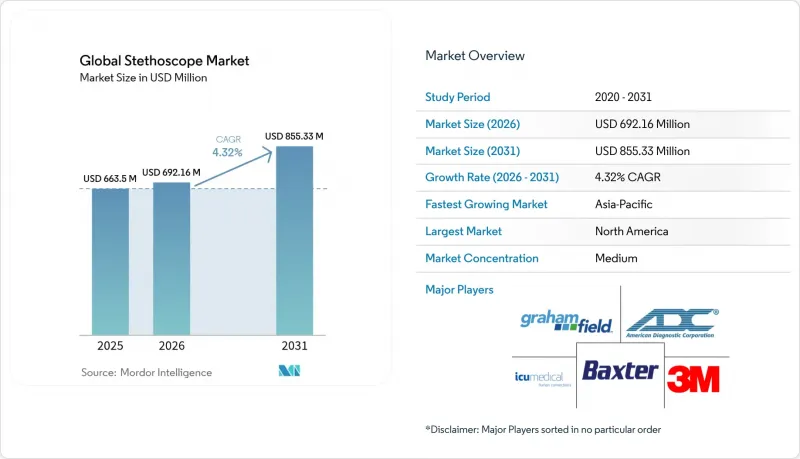
This report is Segmented by Type (Manual Stethoscope, Electronic Stethoscope, and More), End-Users (Hospitals and Clinics, Ambulatory Surgical Centers, and More), and Geography. The Market Sizes and Forecasts are Provided in Terms of Value (USD).
Global Stethoscope Market Trends and Insights
Rising Prevalence of Cardiovascular & Pulmonary Diseases
Ischemic heart disease maintained an age-standardized 108.8 deaths per 100,000 worldwide in 2023, and total CVD deaths climbed to 19.8 million in 2022. These data elevate continuous auscultation from episodic bedside practice into year-round monitoring in outpatient and community settings. A Mayo Clinic trial in Nigeria showed AI-ready scopes doubling peripartum cardiomyopathy detection versus legacy methods, underlining value in regions short on cardiologists. WHO non-communicable-disease strategies now encourage early-stage cardiopulmonary screening in primary care, further institutionalizing the stethoscope market within public-health budgets. In the United States, heart-failure management already drives more than USD 30 billion in annual spending, positioning algorithm-equipped devices as cost-avoidance tools for payers.
Accelerating Adoption of Digital & AI-Enabled Stethoscopes
FDA clearance in April 2024 for Eko Health's low-ejection-fraction algorithm validated that 15-second heart-failure screening can fit into routine vitals collection. The ruling coincided with Eko's USD 41 million Series D, expanding installed base to over 500,000 clinicians worldwide . Machine-learning models trained on decades of heart-sound libraries now surface structural murmurs at primary-care level, narrowing referral delays. Device connectivity via Bluetooth and Wi-Fi funnels raw phonocardiograms to cloud dashboards, letting remote cardiologists verify findings asynchronously. Regulatory momentum, including updated FDA cybersecurity guidance, lowers adoption friction yet raises the bar on software maintenance-favoring suppliers with dedicated MLOps capacity.
Hand-Held Ultrasound Reducing Reliance on Auscultation
A study of 250 patients showed pocket ultrasound spotting 82% of cardiac abnormalities versus 47% for standard examination and trimming downstream testing spend from USD 707.44 to USD 644.43 per patient. Emergency departments adopt probe-based workflows that bypass auscultation, especially for dyspnea triage. Research groups at the University of Cambridge advanced flexible-patch sensors that record heart sounds through clothing, pairing ultrasound imaging and machine-learning analytics for valve screening. Although device costs and training requirements still block wholesale replacement, they compress the upgrade cycle for traditional scopes and challenge growth in high-acuity settings.
Other drivers and restraints analyzed in the detailed report include:
- Expansion of Home-Care & Remote Monitoring Models
- Infection-Control Demand for Disposable Accessories
- Price Pressure & Commoditization of Manual Models
For complete list of drivers and restraints, kindly check the Table Of Contents.
Segment Analysis
In 2025 acoustic/manual devices controlled 63.58% of the stethoscope market, underscoring the category's heritage and cost edge. The segment still anchors first-year medical curricula and dominates humanitarian-aid kits, benefiting from batteries-free operation and repair simplicity. Electronic models supply amplified auscultation for ICU teams and pulmonologists who need clearer mid-frequency ranges. Niche teaching scopes integrate headsets that broadcast a single patient's sounds to multiple trainees simultaneously. Veterinary editions ride the pet-health boom as owners allocate larger budgets for canine cardiology check-ups.
Smart scopes, although a smaller base, compound at 5.27% CAGR to 2031. The stethoscope market size for smart devices is forecast to climb in tandem with hospital digitization grants and insurer telemonitoring pilots. Products such as CORE 500(TM) layer ECG visualization onto auscultation, accelerating decision-making during chest-pain triage. Regulatory clarity on connected devices plus falling MEMS-microphone costs trim bill-of-materials, letting suppliers position AI features at price points digestible for primary-care clinics. Cloud dashboards add subscription revenue, turning one-time hardware sales into annualized software contracts.
Complete Report Scope:
- By Type
- Acoustic / Manual Stethoscopes
- Electronic Stethoscopes
- Smart / AI-Enabled Stethoscopes
- Teaching & Training Stethoscopes
- Veterinary Stethoscopes
- By End User
- Hospitals & Clinics
- Ambulatory Surgical Centers
- Home Healthcare
- Tele-health Providers
- Veterinary Practices
- Academic & Training Institutions
- By Geography
- North America
- United States
- Canada
- Mexico
- Europe
- Germany
- United Kingdom
- France
- Italy
- Spain
- Rest of Europe
- Asia-Pacific
- China
- Japan
- India
- South Korea
- Australia
- Rest of Asia-Pacific
- Middle East
- GCC
- South Africa
- Rest of Middle East
- South America
- Brazil
- Argentina
- Rest of South America
- North America
Geography Analysis
North America retained 44.78% of the stethoscope market in 2025 aided by robust reimbursement for digital health tools, a mature cardiology workforce, and FDA fast-track pathways that shorten time-to-market for AI algorithms. United States buyers absorb premium SKUs, while Canada's provincial health systems standardize procurement through group purchasing organizations, keeping volume steady. Mexico's public-hospital expansion under INSABI reforms nudges acoustic scope demand upward, albeit at lower price tiers. Regional challenges come from handheld ultrasound diffusion inside emergency consortiums where grant funding offsets acquisition costs.
Europe presents a steady but price-sensitive landscape. Demographic aging pushes cardiac-screening volumes, yet austerity measures in Southern nations cap device budgets. Germany and the United Kingdom pilot AI-scope rollouts in primary care to meet early-diagnosis targets, whereas France and Italy lean on hybrid acoustic-electronic formats that fit existing training protocols. The European Union's postponed DEHP ban buys PVC-tube suppliers another five years but accelerates R&D in silicone-based alternatives Notified-body bottlenecks under MDR lengthen certification cycles, creating entry hurdles for smaller brands.
Asia-Pacific secures the fastest 5.49% CAGR through 2031, anchored by China, India, and Indonesia. Japan fosters early adoption through smart-hospital pilots that integrate auscultation data into nationwide EHRs, while South Korea couples local manufacturing capability with export subsidies, heightening competitive intensity. India's Ayushman Bharat program steers funds toward primary-care diagnostics in rural blocks, though extreme price sensitivity favors hybrid electronic-acoustic units. Southeast Asian governments, led by Indonesia, channel pandemic-era health-budget increases toward telemedicine infrastructure that aligns with remote-ready stethoscopes.
- 3M
- Baxter
- GF Health Products
- Medline Industries
- American Diagnostic
- Rudolf Riester
- Cardionics
- ICU Medical
- Heine Optotechnik
- Eko Health
- Meditech Equipment Co.
- Contec Medical Systems
- Thinklabs Medical
- MDF Instruments
- Welch Allyn
- OMRON
- Koninklijke Philips
- HD Medical Group
- A&D Medical
- Edan Instruments
Additional Benefits:
- The market estimate (ME) sheet in Excel format
- 3 months of analyst support
TABLE OF CONTENTS
1 Introduction
- 1.1 Study Assumptions & Market Definition
- 1.2 Scope of the Study
2 Research Methodology
3 Executive Summary
4 Market Landscape
- 4.1 Market Overview
- 4.2 Market Drivers
- 4.2.1 Rising prevalence of cardiovascular & pulmonary diseases
- 4.2.2 Increase in routine patient visits & physical exams
- 4.2.3 Accelerating adoption of digital & AI-enabled stethoscopes
- 4.2.4 Expansion of home-care & remote monitoring models
- 4.2.5 Infection-control demand for disposable accessories
- 4.2.6 Veterinary-care boom boosting specialty stethoscopes
- 4.3 Market Restraints
- 4.3.1 Hand-held ultrasound reducing reliance on auscultation
- 4.3.2 Price pressure & commoditization of manual models
- 4.3.3 PVC & elastomer shortages disrupting tubing supply
- 4.3.4 Data-privacy concerns around cloud-linked devices
- 4.4 Value / Supply-Chain Analysis
- 4.5 Regulatory Landscape
- 4.6 Technological Outlook
- 4.7 Porter's Five Forces
- 4.7.1 Threat of New Entrants
- 4.7.2 Bargaining Power of Buyers
- 4.7.3 Bargaining Power of Suppliers
- 4.7.4 Threat of Substitute Products
- 4.7.5 Intensity of Competitive Rivalry
5 Market Size & Growth Forecasts (Value, USD million)
- 5.1 By Type
- 5.1.1 Acoustic / Manual Stethoscopes
- 5.1.2 Electronic Stethoscopes
- 5.1.3 Smart / AI-Enabled Stethoscopes
- 5.1.4 Teaching & Training Stethoscopes
- 5.1.5 Veterinary Stethoscopes
- 5.2 By End User
- 5.2.1 Hospitals & Clinics
- 5.2.2 Ambulatory Surgical Centers
- 5.2.3 Home Healthcare
- 5.2.4 Tele-health Providers
- 5.2.5 Veterinary Practices
- 5.2.6 Academic & Training Institutions
- 5.3 By Geography
- 5.3.1 North America
- 5.3.1.1 United States
- 5.3.1.2 Canada
- 5.3.1.3 Mexico
- 5.3.2 Europe
- 5.3.2.1 Germany
- 5.3.2.2 United Kingdom
- 5.3.2.3 France
- 5.3.2.4 Italy
- 5.3.2.5 Spain
- 5.3.2.6 Rest of Europe
- 5.3.3 Asia-Pacific
- 5.3.3.1 China
- 5.3.3.2 Japan
- 5.3.3.3 India
- 5.3.3.4 South Korea
- 5.3.3.5 Australia
- 5.3.3.6 Rest of Asia-Pacific
- 5.3.4 Middle East
- 5.3.4.1 GCC
- 5.3.4.2 South Africa
- 5.3.4.3 Rest of Middle East
- 5.3.5 South America
- 5.3.5.1 Brazil
- 5.3.5.2 Argentina
- 5.3.5.3 Rest of South America
- 5.3.1 North America
6 Competitive Landscape
- 6.1 Market Concentration
- 6.2 Market Share Analysis
- 6.3 Company profiles (includes Global level Overview, Market level overview, Core Segments, Financials as available, Strategic Information, Market Rank/Share for key companies, Products & Services, and Recent Developments)
- 6.3.1 3M Company
- 6.3.2 Baxter International (Hillrom)
- 6.3.3 GF Health Products
- 6.3.4 Medline Industries
- 6.3.5 American Diagnostic Corporation
- 6.3.6 Rudolf Riester GmbH
- 6.3.7 Cardionics Inc.
- 6.3.8 ICU Medical
- 6.3.9 Heine Optotechnik
- 6.3.10 Eko Health
- 6.3.11 Meditech Equipment Co.
- 6.3.12 Contec Medical Systems
- 6.3.13 Thinklabs Medical
- 6.3.14 MDF Instruments
- 6.3.15 Welch Allyn
- 6.3.16 Omron Healthcare
- 6.3.17 Philips Healthcare
- 6.3.18 HD Medical Group
- 6.3.19 A&D Medical
- 6.3.20 Edan Instruments
7 Market Opportunities & Future Outlook
- 7.1 White-space & Unmet-Need Assessment

