PUBLISHER: Mordor Intelligence | PRODUCT CODE: 2114852

PUBLISHER: Mordor Intelligence | PRODUCT CODE: 2114852
Vaginal Rejuvenation - Market Share Analysis, Industry Trends & Statistics, Growth Forecasts (2026 - 2031)
According to Mordor Intelligence, the vaginal rejuvenation market size is expected to increase from USD 5.15 billion in 2025 to USD 5.76 billion in 2026 and reach USD 10.91 billion by 2031, growing at a CAGR of 13.61% over 2026-2031.
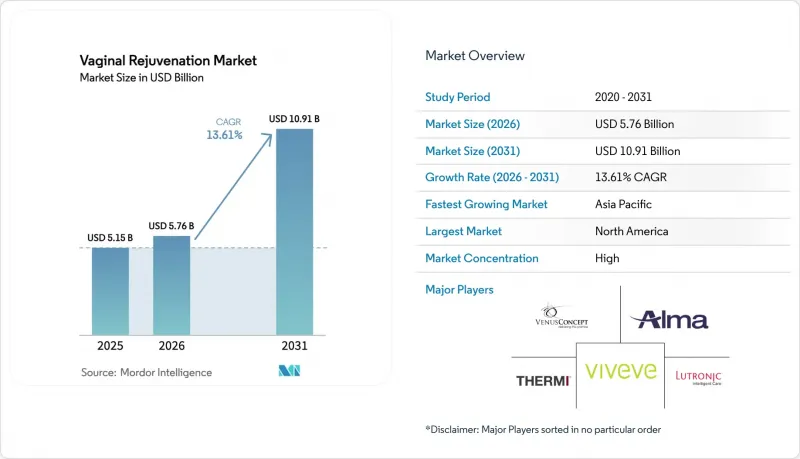
This report is Segmented by Treatment Purpose (Cosmetic, Reconstructive), Modality (Surgical, Energy-Based Devices[CO2 Laser Systems and More], Injectable/Biologic Therapies, OTC & Pelvic-Floor Devices), End User (Hospitals, Ambulatory Surgical Centers, Specialty Clinics, DTC/E-commerce), and Geography (North America, Europe, and More). Market Forecasts are Provided in Terms of Value (USD).
Global Vaginal Rejuvenation Market Trends and Insights
Surging Demand for Energy-Based Treatments
Energy-based platforms such as CO2 lasers, erbium:YAG systems, radiofrequency devices, and high-intensity focused ultrasound are displacing surgical vaginoplasty because they offer shorter recovery, minimal scarring, and same-day discharge. A 2025 study showed platelet-rich plasma with hyaluronic acid outperformed topical estrogen for vulvovaginal atrophy, highlighting the value of adjunct biologics. InMode's women's health portfolio grew 19% year over year in Q3 2024, validating commercial demand despite regulatory caution. Yet no energy-based device carries explicit FDA clearance for cosmetic vaginal indications, and an International Menopause Society white paper reported randomized trials that failed to prove laser superiority over sham, a gap that limits reimbursement.
Increasing Adoption of Non-Invasive Gynecological Procedures
Office-based treatments reshape patient expectations and clinic economics. The American Society of Plastic Surgeons logged 10,827 labiaplasties in 2024, a 2% rise from the prior year. Radiofrequency systems such as Hologic's TempSure Vitalia deliver controlled thermal energy without incisions, allowing quick turnaround sessions. A 2024 meta-analysis ranked high-intensity focused electromagnetic therapy among the top interventions for stress urinary incontinence, aligning muscle-stimulation chairs with vaginal rejuvenation packages.However, NICE guidance still favors vaginal estrogen and recommends lasers only in research protocols, so payer coverage remains limited.
Stringent Regulatory Scrutiny and Uncertain Approvals
The FDA issued 2018 warning letters to seven manufacturers and has not cleared any laser or radiofrequency system specifically for cosmetic vaginal use. Australia canceled all devices from its register in November 2024, citing safety concerns. China elevated radiofrequency beauty devices to Class III in 2024, creating a compliance bottleneck until April 2026. The European Union's Medical Device Regulation heightens post-market surveillance demands, raising cost and delaying launches.
Other drivers and restraints analyzed in the detailed report include:
- Rising Disposable Incomes and Aesthetic Awareness
- Integration of Pelvic-Floor Digital Therapeutics and EMS Chair Devices
- Social Stigma and Ethical Debate
For complete list of drivers and restraints, kindly check the Table Of Contents.
Segment Analysis
Cosmetic procedures captured 51.56% of revenue in 2025, reflecting strong interest in aesthetic genital care. That slice of vaginal rejuvenation market share expands as social acceptance widens and ASCs lower entry costs. Cosmetic sessions often utilize energy-based devices that shorten recovery, allowing clinics to schedule higher daily volumes. Reconstructive indications, including pelvic-organ prolapse repair and stress-urinary-incontinence management, draw reimbursement but grow slower because payers mandate stricter evidence. Breast-cancer survivors and post-menopausal patients drive reconstructive demand, creating overlap across care pathways. Manufacturers now design single consoles usable in both cohorts, protecting revenue against shifts in payer policy. Despite the momentum, NICE still advises estrogen first for urogenital atrophy, constraining reconstructive growth in the United Kingdom. Continued multicenter trials are required to unlock wider coverage and accelerate adoption.
The cosmetic segment continues to command premium pricing, enabling higher margins even when procedure volumes fluctuate. Word-of-mouth and influencer endorsements play a disproportionate role in patient acquisition, and clinics differentiate through bundled offerings that include topical products and at-home pelvic-floor devices. On the reconstructive side, surgeons emphasize durability and functional outcomes, favoring modalities with published long-term data. As evidence matures, especially around combined radiofrequency and platelet-rich plasma protocols, the reconstructive share of the vaginal rejuvenation market could rise, but near-term growth remains anchored in cosmetics.
Complete Report Scope:
- By Treatment Purpose
- Cosmetic Vaginal Rejuvenation
- Reconstructive Vaginal Rejuvenation
- By Modality
- Surgical Procedures
- Energy-Based Devices
- CO2 Laser Systems
- Er:YAG Laser Systems
- Radio-frequency Devices
- High-Intensity Focused Ultrasound (HIFU)
- Injectable / Biologic Therapies (PRP, Stem-cell, Fillers)
- OTC & Pelvic-Floor Devices
- By End User
- Hospitals
- Ambulatory Surgical Centers
- Specialty Aesthetic & Uro-gynecology Clinics
- Direct-to-Consumer / E-commerce
- By Geography
- North America
- United States
- Canada
- Mexico
- Europe
- Germany
- France
- United Kingdom
- Italy
- Spain
- Rest of Europe
- Asia-Pacific
- China
- Japan
- India
- South Korea
- Australia
- Rest of Asia-Pacific
- Middle East & Africa
- GCC
- South Africa
- Rest of Middle East & Africa
- South America
- Brazil
- Argentina
- Rest of South America
- North America
Geography Analysis
North America contributed 41.11% of 2025 revenue thanks to high disposable incomes, widespread aesthetic-clinic infrastructure, and relatively permissive regulation that stops short of outright bans. Median menopause age is 52, and surgical menopause adds to the candidate pool, sustaining demand for both cosmetic and functional care. InMode's women's health division booked USD 73.5 million in Q3 2024, signaling robust device utilization across U.S. and Canadian centers. FDA warning letters dampen marketing claims but have not halted procedure volume. Mexico benefits from cross-border medical tourism, offering cost-effective cosmetic packages to U.S. residents.
Asia-Pacific records the fastest regional CAGR at 15.21%, driven by rising incomes and urbanization. China's Class III reclassification delays new radiofrequency launches, giving early-certified firms an advantage. Indian metros and South Korean specialty clinics showcase rapid adoption, while Australia's November 2024 device cancellation shifts demand to neighboring countries with lighter oversight. Local distributors tailor marketing to cultural sensitivities, an essential strategy because stigma still suppresses uptake outside major cities.
Europe holds a mid-tier share, with Germany, the United Kingdom, France, Italy, and Spain as lead markets. The EU Medical Device Regulation tightens evidence and post-market surveillance, delaying some device renewals. The United Kingdom's NICE guidance recommends lasers only inside research protocols, tempering growth in reconstructive indications. Vendors seek CE certification for combination radiofrequency and electromagnetic field systems, such as Venus Fiore, to diversify revenue streams across European and Latin American markets. Middle East and Africa plus South America represent emerging markets where medical tourism and affluent local populations drive niche demand. Nevertheless, social conservatism and limited reimbursement slow broad expansion.
- Alma Lasers
- Almirall
- Apyx Medical
- BTL
- Caldera Medical
- Cynosure LLC
- Fotona
- Hologic
- InMode Ltd.
- Lumenis
- Lutronic
- Onda S.p.A.
- Rohrer Aesthetics
- Sciton
- Sinclair Pharma
- ThermiGen
- Venus Concept
- Viveve Medical
- Vuvatech
Additional Benefits:
- The market estimate (ME) sheet in Excel format
- 3 months of analyst support
TABLE OF CONTENTS
1 Introduction
- 1.1 Study Assumptions & Market Definition
- 1.2 Scope of the Study
2 Research Methodology
3 Executive Summary
4 Market Landscape
- 4.1 Market Overview
- 4.2 Market Drivers
- 4.2.1 Surging Demand for Energy-Based Treatments
- 4.2.2 Increasing Adoption of Non-Invasive Gynecological Procedures
- 4.2.3 Rising Disposable Incomes & Aesthetic Awareness
- 4.2.4 Integration of Pelvic-Floor Digital Therapeutics & EMS Chair Devices
- 4.2.5 Uro-Gynecologic Crossover (Stress-Urinary-Incontinence Synergy)
- 4.2.6 Menopause-Tech Platforms Bundling Laser Sessions
- 4.3 Market Restraints
- 4.3.1 Stringent Regulatory Scrutiny & Uncertain Approvals
- 4.3.2 Social Stigma & Ethical Debate
- 4.3.3 Escalating Litigation & Liability-Insurance Premiums
- 4.3.4 Digital-Advertising Restrictions on "Vaginal-Rejuvenation" Claims
- 4.4 Value / Supply-Chain Analysis
- 4.5 Regulatory Landscape
- 4.6 Technological Outlook
- 4.7 Porter's Five Forces Analysis
- 4.7.1 Threat of New Entrants
- 4.7.2 Bargaining Power of Buyers
- 4.7.3 Bargaining Power of Suppliers
- 4.7.4 Threat of Substitute Products
- 4.7.5 Intensity of Competitive Rivalry
5 Market Size & Growth Forecasts (Value in USD)
- 5.1 By Treatment Purpose
- 5.1.1 Cosmetic Vaginal Rejuvenation
- 5.1.2 Reconstructive Vaginal Rejuvenation
- 5.2 By Modality
- 5.2.1 Surgical Procedures
- 5.2.2 Energy-Based Devices
- 5.2.2.1 CO2 Laser Systems
- 5.2.2.2 Er:YAG Laser Systems
- 5.2.2.3 Radio-frequency Devices
- 5.2.2.4 High-Intensity Focused Ultrasound (HIFU)
- 5.2.3 Injectable / Biologic Therapies (PRP, Stem-cell, Fillers)
- 5.2.4 OTC & Pelvic-Floor Devices
- 5.3 By End User
- 5.3.1 Hospitals
- 5.3.2 Ambulatory Surgical Centers
- 5.3.3 Specialty Aesthetic & Uro-gynecology Clinics
- 5.3.4 Direct-to-Consumer / E-commerce
- 5.4 By Geography
- 5.4.1 North America
- 5.4.1.1 United States
- 5.4.1.2 Canada
- 5.4.1.3 Mexico
- 5.4.2 Europe
- 5.4.2.1 Germany
- 5.4.2.2 France
- 5.4.2.3 United Kingdom
- 5.4.2.4 Italy
- 5.4.2.5 Spain
- 5.4.2.6 Rest of Europe
- 5.4.3 Asia-Pacific
- 5.4.3.1 China
- 5.4.3.2 Japan
- 5.4.3.3 India
- 5.4.3.4 South Korea
- 5.4.3.5 Australia
- 5.4.3.6 Rest of Asia-Pacific
- 5.4.4 Middle East & Africa
- 5.4.4.1 GCC
- 5.4.4.2 South Africa
- 5.4.4.3 Rest of Middle East & Africa
- 5.4.5 South America
- 5.4.5.1 Brazil
- 5.4.5.2 Argentina
- 5.4.5.3 Rest of South America
- 5.4.1 North America
6 Competitive Landscape
- 6.1 Market Concentration
- 6.2 Market Share Analysis
- 6.3 Company Profiles (includes Global level Overview, Market level overview, Core Segments, Financials as available, Strategic Information, Market Rank/Share for key companies, Products and Services, and Recent Developments)
- 6.3.1 Alma Lasers
- 6.3.2 Almirall
- 6.3.3 Apyx Medical
- 6.3.4 BTL Industries
- 6.3.5 Caldera Medical
- 6.3.6 Cynosure LLC
- 6.3.7 Fotona
- 6.3.8 Hologic Inc.
- 6.3.9 InMode Ltd.
- 6.3.10 Lumenis
- 6.3.11 Lutronic
- 6.3.12 Onda S.p.A.
- 6.3.13 Rohrer Aesthetics
- 6.3.14 Sciton Inc.
- 6.3.15 Sinclair Pharma
- 6.3.16 ThermiGen LLC
- 6.3.17 Venus Concept
- 6.3.18 Viveve Medical
- 6.3.19 Vuvatech
7 Market Opportunities & Future Outlook
- 7.1 White-Space & Unmet-Need Assessment

