PUBLISHER: Mordor Intelligence | PRODUCT CODE: 2114858

PUBLISHER: Mordor Intelligence | PRODUCT CODE: 2114858
Intracardiac Echocardiography - Market Share Analysis, Industry Trends & Statistics, Growth Forecasts (2026 - 2031)
According to Mordor Intelligence, the intracardiac echocardiography market size is projected to expand from USD 728.44 million in 2025 and USD 765.44 million in 2026 to USD 981.13 million by 2031, registering a CAGR of 5.08% between 2026 to 2031.
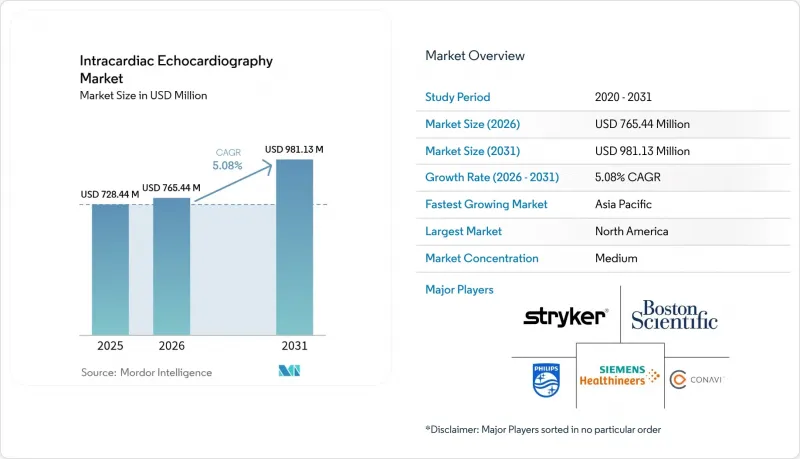
This report is Segmented by Product Type (Electronic Phased-Array Catheters, and More), Technology (2-D Imaging, 3-D Imaging, and More), Application (Electrophysiology, Left Atrial Appendage Closure, and More), End User (Hospitals, Cardiac Catheterisation Laboratories, and More), and Geography (North America, Europe, and More). The Market Forecasts are Provided in Terms of Value (USD).
Global Intracardiac Echocardiography Market Trends and Insights
Rising Prevalence of Atrial Fibrillation & Structural Heart Disorders
In 2024, 6.7 million adults in the U.S. were diagnosed with atrial fibrillation, a figure expected to exceed 8 million by 2030. This surge amplifies the demand for ablation procedures, which utilize ICE for transseptal guidance and lesion visualization. Structural heart diseases, like aortic stenosis and mitral regurgitation, currently impact 2.5% of adults over 75. With this age group projected to expand by 30% in Europe and Japan by 2030, the implications are significant. Electrophysiology labs, once content with a single catheter per case, have upgraded to stocking 4-D units for structural work, effectively doubling their annual ICE expenditure per site. As reimbursement frameworks evolve and interventional cardiology training extends into tier-2 cities, emerging markets such as India and Brazil offer untapped potential. The result? A steady baseline demand propelling the intracardiac echocardiography market on a consistent growth path, even amidst fluctuating capital budgets.
Technological Progress in 3-D / 4-D ICE Catheters
Siemens Healthineers' AcuNav Lumos 4-D catheter, cleared by the FDA in August 2024, delivers volumetric views plus AI-based chamber recognition that lighten operator workload. Multiplanar reconstruction and biplane modalities help operators locate transseptal targets swiftly, limiting fluoroscopy time. Philips followed with the VeriSight Pro launch in Europe during May 2025, underscoring a competitive pivot toward contrast-free workflows. These advances elevate image fidelity, shrink dose exposure, and preserve renal function attributes that appeal to hospital value-analysis committees weighing capital requests. As 4-D catheters enter mainstream procurement schedules, the intracardiac echocardiography market is expected to see a steady upgrade cycle.
High Disposable Catheter Cost & Inconsistent Reimbursement
ICE catheters priced between USD 2,000 and USD 4,000 incur significant overhead, yet Medicare's CPT 93662 payment varies by region and is under periodic review. In emerging economies, self-pay rates are dominant, making additional disposable income unaffordable for district hospitals. The discrepancy widens in ambulatory surgical centers, which still lack a dedicated ASC code for intracardiac ultrasound-guided ablation. Without aligned payer policies, care teams face budgetary constraints, prompting the use of alternative imaging or transesophageal echocardiography despite sedation drawbacks. These gaps collectively temper the diffusion of the intracardiac echocardiography market in cost-sensitive geographies.
Other drivers and restraints analyzed in the detailed report include:
- Shift Toward Minimally-Invasive, Radiation-Sparing Workflows
- Favorable Reimbursement in Key Developed Markets
- Steep Learning Curve & Limited Training Programs
For complete list of drivers and restraints, kindly check the Table Of Contents.
Segment Analysis
In 2025, electronic phased-array catheters are projected to generate 37.35% of the market's revenue. Priced between USD 800 and 1,200, these catheters seamlessly integrate with legacy CARTO and EnSite consoles, making them an appealing choice for budget-conscious labs. Meanwhile, mechanical rotating catheters, once favored for their 360-degree view, are losing ground due to their slower frame rates. The market for 4-D intracardiac echocardiography catheters is set to expand at a 7.05% CAGR, driven by their ability to provide real-time volumetric views. These views can shorten TAVR procedures by up to 18 minutes and lower the risk of paravalvular leaks. Additionally, AI-enhanced consoles promptly identify pericardial effusion, bolstering the confidence of structural-heart teams.
While phased arrays will continue to dominate high-volume electrophysiology centers, premium 4-D systems, despite being sold at one-third the volume, offer significantly higher profit margins. Consequently, manufacturers are diversifying their portfolios: they offer value-priced phased arrays for standard ablation procedures, while positioning high-spec 4-D catheters as cost-saving alternatives to traditional anesthesia methods like TEE. With the spread of reimbursement uplifts, the intracardiac echocardiography market is poised for a pivotal shift. It's anticipated that 4-D units will soon dominate revenue generation, even as phased arrays maintain their share in the installed base.
In 2025, 2-D imaging accounted for 47.86% of revenue, primarily because cross-sectional views meet the needs of most atrial fibrillation ablations. Additionally, transducer costs for 2-D models are 40% lower than their 4-D counterparts. However, as hospitals increasingly prioritize precision for structural cases, the market share of 2-D in intracardiac echocardiography is set to decline.
Real-time 4-D imaging is transitioning from a luxury to a necessity, especially for valve and appendage procedures, with a projected CAGR of 6.90% through 2031. When fused with mapping systems, 4-D imaging evolves from a mere navigation tool to a critical safety feature, justifying its 2-3X price premium. Furthermore, AI modules in modern consoles enhance efficiency by auto-segmenting chambers and providing proximity alerts, resulting in a 15% reduction in procedure time and fewer complications. In markets with favorable reimbursement policies, there's a trend toward bypassing 3-D upgrades altogether and opting for 4-D. This shift is poised to accelerate the technology refresh cycle in the broader intracardiac echocardiography landscape.
Complete Report Scope:
- By Product Type
- Electronic Phased-Array Catheters
- Mechanical Rotating Catheters
- 4-D Volume Catheters
- AI-Integrated Consoles & Software
- By Technology
- 2-D Imaging
- 3-D Imaging
- 4-D Imaging
- AI-assisted Navigation
- By Application
- Electrophysiology
- Left Atrial Appendage Closure
- Transcatheter Aortic Valve Implantation
- MitraClip & Mitral Valvuloplasty
- Congenital Heart Disease Interventions
- Other structural heart procedures
- By End User
- Hospitals
- Cardiac catheterisation laboratories
- Ambulatory surgical centres
- Diagnostic imaging centres
- By Geography
- North America
- United States
- Canada
- Mexico
- Europe
- Germany
- United Kingdom
- France
- Italy
- Spain
- Rest of Europe
- Asia-Pacific
- China
- Japan
- India
- Australia
- South Korea
- Rest of Asia-Pacific
- South America
- Brazil
- Argentina
- Rest of South America
- Middle East & Africa
- GCC
- South Africa
- Rest of Middle East & Africa
- North America
Geography Analysis
North America led the intracardiac echocardiography market with 38.96% of global revenue in 2025. U.S. academic hubs operate mature ablation programs and produce most peer-reviewed evidence that underpins FDA approvals, while Canada's provincial health authorities now reimburse ICE-guided left-atrial appendage closure to curb stroke-related costs. Mexico shows rising procedure counts at private hospitals catering to medical tourists seeking fixed-price ablation packages.
Asia Pacific posted the fastest trajectory at an 7.78% CAGR and is on course to rival European volumes by 2031. China's national volume-based procurement scheme has added ICE catheters to its device catalog, accelerating penetration in tertiary hospitals. Japan's super-aged demographic fuels structural heart interventions, and local manufacturers partner with global firms to co-develop imaging algorithms tuned to small stature anatomy. Korea and Australia maintain stable replacement demand as installed consoles approach refresh cycles.
Europe remains a methodical adopter, guided by cost-effectiveness appraisals led by agencies such as NICE. Germany is the region's largest buyer, with sickness funds funding ICE for PFA procedures after publication of real-world registries showing reduced hospital stay. France, Italy, and Spain channel EU recovery funds into cath-lab modernization, including radiation-saving imaging. Post-Brexit, the United Kingdom continues to honor many CE marks but is moving toward its UKCA regimen, potentially adding dual-testing costs that vendors must factor into pricing.
- Abbott Laboratories
- Acist Medical Systems
- Acutus Medical
- B. Braun
- Boston Scientific
- Conavi Medical
- Edward Lifesciences
- FUJIFILM
- GE Healthcare
- iCardio.ai
- Infraredx Inc.
- Johnson & Johnson Services, Inc. (Biosense Webster)
- Koninklijke Philips
- Medtronic
- MicroPort
- NuVera Medical (Shifamed)
- OMEGA Medical Imaging
- Mindray
- Siemens Healthineers
- Stereotaxis
- Stryker
Additional Benefits:
- The market estimate (ME) sheet in Excel format
- 3 months of analyst support
TABLE OF CONTENTS
1 Introduction
- 1.1 Study Assumptions & Market Definition
- 1.2 Scope of the Study
2 Research Methodology
3 Executive Summary
4 Market Landscape
- 4.1 Market Overview
- 4.2 Market Drivers
- 4.2.1 Rising Prevalence of Atrial Fibrillation & Structural Heart Disorders
- 4.2.2 Technological Progress in 3-D / 4-D ICE Catheters
- 4.2.3 Shift Toward Minimally-Invasive, Radiation-Sparing Workflows
- 4.2.4 Favourable Reimbursement in Key Developed Markets
- 4.2.5 Integration With Pulsed-Field Ablation Platforms
- 4.2.6 ASC Single-Operator Cost Models Accelerating Adoption
- 4.3 Market Restraints
- 4.3.1 High Disposable Catheter Cost & Inconsistent Reimbursement
- 4.3.2 Steep Learning Curve & Limited Training Programmes
- 4.3.3 Low Clinical Awareness in Developing Nations
- 4.3.4 Geopolitical-Driven Supply-Chain Price Volatility
- 4.4 Supply-Chain Analysis
- 4.5 Regulatory Landscape
- 4.6 Technological Outlook
- 4.7 Porter's Five Forces
- 4.7.1 Threat of New Entrants
- 4.7.2 Bargaining Power of Suppliers
- 4.7.3 Bargaining Power of Buyers
- 4.7.4 Threat of Substitutes
- 4.7.5 Competitive Rivalry
5 Market Size & Growth Forecasts (Value, USD)
- 5.1 By Product Type
- 5.1.1 Electronic Phased-Array Catheters
- 5.1.2 Mechanical Rotating Catheters
- 5.1.3 4-D Volume Catheters
- 5.1.4 AI-Integrated Consoles & Software
- 5.2 By Technology
- 5.2.1 2-D Imaging
- 5.2.2 3-D Imaging
- 5.2.3 4-D Imaging
- 5.2.4 AI-assisted Navigation
- 5.3 By Application
- 5.3.1 Electrophysiology
- 5.3.2 Left Atrial Appendage Closure
- 5.3.3 Transcatheter Aortic Valve Implantation
- 5.3.4 MitraClip & Mitral Valvuloplasty
- 5.3.5 Congenital Heart Disease Interventions
- 5.3.6 Other structural heart procedures
- 5.4 By End User
- 5.4.1 Hospitals
- 5.4.2 Cardiac catheterisation laboratories
- 5.4.3 Ambulatory surgical centres
- 5.4.4 Diagnostic imaging centres
- 5.5 By Geography
- 5.5.1 North America
- 5.5.1.1 United States
- 5.5.1.2 Canada
- 5.5.1.3 Mexico
- 5.5.2 Europe
- 5.5.2.1 Germany
- 5.5.2.2 United Kingdom
- 5.5.2.3 France
- 5.5.2.4 Italy
- 5.5.2.5 Spain
- 5.5.2.6 Rest of Europe
- 5.5.3 Asia-Pacific
- 5.5.3.1 China
- 5.5.3.2 Japan
- 5.5.3.3 India
- 5.5.3.4 Australia
- 5.5.3.5 South Korea
- 5.5.3.6 Rest of Asia-Pacific
- 5.5.4 South America
- 5.5.4.1 Brazil
- 5.5.4.2 Argentina
- 5.5.4.3 Rest of South America
- 5.5.5 Middle East & Africa
- 5.5.5.1 GCC
- 5.5.5.2 South Africa
- 5.5.5.3 Rest of Middle East & Africa
- 5.5.1 North America
6 Competitive Landscape
- 6.1 Market Concentration
- 6.2 Market Share Analysis
- 6.3 Company Profiles (includes Global level Overview, Market level overview, Core Segments, Financials as available, Strategic Information, Market Rank/Share for key companies, Products & Services, and Recent Developments)
- 6.3.1 Abbott Laboratories
- 6.3.2 Acist Medical Systems
- 6.3.3 Acutus Medical
- 6.3.4 B. Braun SE
- 6.3.5 Boston Scientific Corporation
- 6.3.6 Conavi Medical
- 6.3.7 Edwards Lifesciences
- 6.3.8 Fujifilm Healthcare
- 6.3.9 GE HealthCare
- 6.3.10 iCardio.ai
- 6.3.11 Infraredx Inc.
- 6.3.12 Johnson & Johnson Services, Inc. (Biosense Webster)
- 6.3.13 Koninklijke Philips N.V.
- 6.3.14 Medtronic plc
- 6.3.15 MicroPort Scientific
- 6.3.16 NuVera Medical (Shifamed)
- 6.3.17 OMEGA Medical Imaging
- 6.3.18 Shenzhen Mindray Bio-Medical Electronics
- 6.3.19 Siemens Healthineers AG
- 6.3.20 Stereotaxis Inc.
- 6.3.21 Stryker Corporation
7 Market Opportunities & Future Outlook
- 7.1 White-space & Unmet-need Assessment

