PUBLISHER: Mordor Intelligence | PRODUCT CODE: 2114863

PUBLISHER: Mordor Intelligence | PRODUCT CODE: 2114863
GCC Construction Machinery Rental - Market Share Analysis, Industry Trends & Statistics, Growth Forecasts (2026 - 2031)
According to Mordor Intelligence, the GCC construction machinery rental market size was valued at USD 5.30 billion in 2025 and estimated to grow from USD 5.63 billion in 2026 to reach USD 7.61 billion by 2031, at a CAGR of 6.22% during the forecast period (2026-2031).
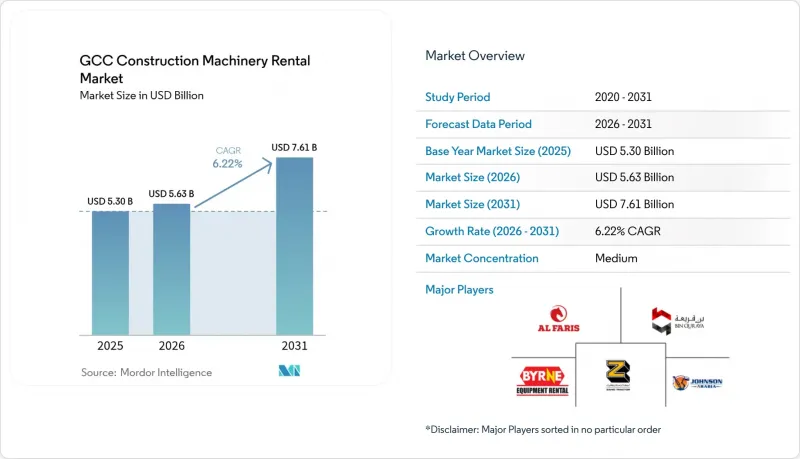
This report is Segmented by Vehicle Type (Earth-Moving Equipment, Material Handling Equipment, and More), Propulsion Type (IC Engine, Hybrid Drive, and More), End-User Industry (Commercial and Residential Construction, Oil and Gas/Petrochemicals, and More), and Country (Saudi Arabia, United Arab Emirates, and More). The Market Forecasts are Provided in Terms of Value (USD).
GCC Construction Machinery Rental Market Trends and Insights
Infrastructure Boom Under GCC Vision Programs
Megaprojects such as NEOM, the Red Sea Global tourism corridors, and Dubai 2040 drive unprecedented equipment demand, compressing traditional purchase cycles into rental-first decisions. Saudi Arabia's Public Investment Fund into NEOM, while a new Wolffkran-Zamil joint venture is building a 150-unit-per-year tower-crane plant to serve regional projects . UAE real-estate transactions growth in 2024, reinforcing steady vertical construction pipelines that rely on readily available cranes and concrete pumps. Qatar's Third National Development Strategy outlines investment in PPP schemes through 2030, further stretching contractor capital. Long project lists across Oman's Duqm SEZ and Bahrain's metro program underscore how Vision agendas escalate the need for flexible fleets. Consequently, the GCC construction machinery rental market gains a structural boost from megaproject scheduling volatility and capex discipline requirements.
Rapid Growth Of Data-Center And Renewable-Energy Build-Outs
Hyperscale data-center clusters in Dubai South and Saudi Arabia's King Salman Energy Park require precision foundation work, heavy lifts for prefabricated modules, and continuous onsite power generation. Concurrently, utility-scale photovoltaic plants such as UAE's 2 GW Al Dhafra project and Oman's green-hydrogen concessions demand specialty piling rigs, tracked cranes, and high-capacity telehandlers over multi-year periods . Rental providers tailor equipment packages with thermal-stress kits and dust-protection features suited to desert conditions, lowering upfront costs for developers. As renewables accelerate toward the region's clean-power target by 2050, specialist rental fleets become indispensable for meeting tight commissioning deadlines.
Intensifying Price Competition From Chinese OEM-Affiliated Lessors
Shandong-based crane makers bundle zero-interest financing with rental offers, undercutting regional incumbents while accelerating regional parts-storage hubs in Dammam and Jebel Ali. Their integrated model leverages scale procurement from domestic factories, squeezing margins for operators reliant on European-sourced fleets. Although stringent Saudi localization rules favor established players, price-sensitive second-tier contractors gravitate toward Chinese alternatives, prompting incumbents to emphasize telematics-backed uptime guarantees and value-added training.
Other drivers and restraints analyzed in the detailed report include:
- Contractor Shift To OPEX-Light Models Amid Tightening Project Margins
- Mandatory Tier-4-Final / EU Stage V Import Standards (UAE And KSA)
- Project Delays And Payment Backlogs In Public-Sector Megaprojects
For complete list of drivers and restraints, kindly check the Table Of Contents.
Segment Analysis
Earth-moving assets captured 44.68% of the GCC construction machinery rental market size in 2025 on the back of expansive earthworks for NEOM corridors, UAE freight rail extensions, and Qatar's gas-processing platforms. Digital blade-control on dozers and 3D-GPS guided graders underpin higher productivity against tight project timelines, reinforcing rental adoption as contractors seek the latest firmware without ownership risk. Material-handling cranes gain momentum in Oman's Duqm port expansion, while concrete pumps and placing booms post a 6.88% CAGR as high-rise clusters multiply along Riyadh Boulevard and Dubai Creek.
Rental firms integrate OEM telematics into dashboards that allocate equipment across multiple sites, improving utilization and supporting dynamic pricing models. The GCC construction machinery rental market benefits from bundled service packages that include certified operators, maintenance call-outs within four hours, and on-site parts storage. Contractors increasingly benchmark total project cost per cubic meter moved rather than hourly equipment rates, anchoring the shift toward rental contracts that embed performance metrics.
Complete Report Scope:
- By Vehicle Type
- Earth-moving Equipment
- Material Handling Equipment
- Road-building and Compaction Equipment
- Concrete and Hoisting Equipment
- Power and Utility Generators
- By Propulsion Type
- IC Engine
- Hybrid Drive
- Full Electric / Battery-Powered
- By End-user Industry
- Commercial and Residential Construction
- Oil and Gas / Petrochemicals
- Infrastructure and Transport (roads, metros, ports, airports)
- Power and Renewables
- Industrial and Manufacturing
- By Country
- Saudi Arabia
- United Arab Emirates
- Qatar
- Kuwait
- Oman
- Bahrain
List of Companies Covered in this Report:
- Al Faris Group
- Bin Quraya
- Arabian Machinery & Heavy Equipment Co. (AMHEC)
- Byrne Equipment Rental LLC
- Mohamed Abdulrahman Al-Bahar LLC
- Zahid Tractor & Heavy Machinery Co.
- Johnson Arabia LLC
- Rezayat Sparrow Arabian Crane Hire Co. Ltd.
- Abdullah H. Al Shuwayer Company
- Hertz Dayim Equipment Rental
- Wolffkran Arabia
- Al Mutawa Crane
- ACT Crane & Heavy Equipment
- Sarens Nass Middle East
- United Gulf Equipment Rentals
- Rapid Access LLC
- Kanoo Machinery Rental
Additional Benefits:
- The market estimate (ME) sheet in Excel format
- 3 months of analyst support
TABLE OF CONTENTS
1 Introduction
- 1.1 Study Assumptions & Market Definition
- 1.2 Scope of the Study
2 Research Methodology
3 Executive Summary
4 Market Landscape
- 4.1 Market Overview
- 4.2 Market Drivers
- 4.2.1 Infrastructure Boom Under GCC Vision Programs
- 4.2.2 Rapid Growth of Data-Center and Renewable-Energy Build-Outs
- 4.2.3 Contractor Shift to OPEX-Light Models Amid Tightening Project Margins
- 4.2.4 Mandatory Tier-4-Final / EU Stage V Import Standards (UAE and KSA)
- 4.2.5 Digital Fleet-Management and Telematics-Driven Uptime Guarantees
- 4.2.6 COP28-Linked Green Procurement Incentives for Hybrid/Electric Equipment
- 4.3 Market Restraints
- 4.3.1 Intensifying Price Competition from Chinese OEM-Affiliated Lessors
- 4.3.2 Project Delays and Payment Backlogs in Public-Sector Megaprojects
- 4.3.3 Scarcity of Certified Operators and Escalating Labor Costs
- 4.3.4 Climatic Stress Accelerating Depreciation Cycles in Rental Fleets
- 4.4 Value/Supply-Chain Analysis
- 4.5 Regulatory Landscape
- 4.6 Technological Outlook
- 4.7 Porter's Five Forces
- 4.7.1 Bargaining Power of Suppliers
- 4.7.2 Bargaining Power of Consumers
- 4.7.3 Threat of New Entrants
- 4.7.4 Intensity of Competitive Rivalry
- 4.7.5 Threat of Substitute Products
5 Market Size & Growth Forecasts (Value, USD)
- 5.1 By Vehicle Type
- 5.1.1 Earth-moving Equipment
- 5.1.2 Material Handling Equipment
- 5.1.3 Road-building and Compaction Equipment
- 5.1.4 Concrete and Hoisting Equipment
- 5.1.5 Power and Utility Generators
- 5.2 By Propulsion Type
- 5.2.1 IC Engine
- 5.2.2 Hybrid Drive
- 5.2.3 Full Electric / Battery-Powered
- 5.3 By End-user Industry
- 5.3.1 Commercial and Residential Construction
- 5.3.2 Oil and Gas / Petrochemicals
- 5.3.3 Infrastructure and Transport (roads, metros, ports, airports)
- 5.3.4 Power and Renewables
- 5.3.5 Industrial and Manufacturing
- 5.4 By Country
- 5.4.1 Saudi Arabia
- 5.4.2 United Arab Emirates
- 5.4.3 Qatar
- 5.4.4 Kuwait
- 5.4.5 Oman
- 5.4.6 Bahrain
6 Competitive Landscape
- 6.1 Market Concentration
- 6.2 Strategic Moves
- 6.3 Market Share Analysis
- 6.4 Company Profiles (includes Global Level Overview, Market Level Overview, Core Segments, Financials as Available, Strategic Information, Market Rank/Share for Key Companies, Products and Services, SWOT Analysis, and Recent Developments)
- 6.4.1 Al Faris Group
- 6.4.2 Bin Quraya
- 6.4.3 Arabian Machinery & Heavy Equipment Co. (AMHEC)
- 6.4.4 Byrne Equipment Rental LLC
- 6.4.5 Mohamed Abdulrahman Al-Bahar LLC
- 6.4.6 Zahid Tractor & Heavy Machinery Co.
- 6.4.7 Johnson Arabia LLC
- 6.4.8 Rezayat Sparrow Arabian Crane Hire Co. Ltd.
- 6.4.9 Abdullah H. Al Shuwayer Company
- 6.4.10 Hertz Dayim Equipment Rental
- 6.4.11 Wolffkran Arabia
- 6.4.12 Al Mutawa Crane
- 6.4.13 ACT Crane & Heavy Equipment
- 6.4.14 Sarens Nass Middle East
- 6.4.15 United Gulf Equipment Rentals
- 6.4.16 Rapid Access LLC
- 6.4.17 Kanoo Machinery Rental
7 Market Opportunities & Future Outlook
- 7.1 White-space & Unmet-Need Assessment

