PUBLISHER: Mordor Intelligence | PRODUCT CODE: 2114868

PUBLISHER: Mordor Intelligence | PRODUCT CODE: 2114868
Steel Rebar - Market Share Analysis, Industry Trends & Statistics, Growth Forecasts (2026 - 2031)
According to Mordor Intelligence, the steel rebar market size was valued at 144.75 Million tons in 2025 and estimated to grow from 152.96 Million tons in 2026 to reach 201.56 Million tons by 2031, at a CAGR of 5.67% during the forecast period (2026-2031).
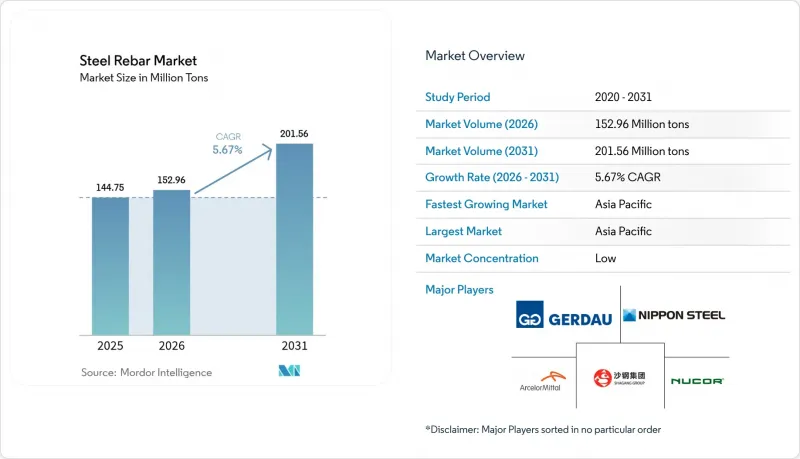
This report is Segmented by Type (Deformed, Mild), Diameter (Less Than Equal To 10 Mm, 10-20 Mm, 20-32 Mm, Greater Than 32 Mm), Production Process (Electric-Arc Furnace, Basic Oxygen Furnace, Induction Furnace), End-User Industry (Residential, Non-Residential), and Geography (Asia-Pacific, North America, Europe, South America, Middle East and Africa). The Market Forecasts are Provided in Terms of Volume (Tons).
Global Steel Rebar Market Trends and Insights
Rapid Demand from Residential Construction
Demographic pressure and pro-housing fiscal programs heighten rebar consumption across key economies. US residential spending rose 10.9% year-on-year in April 2024 as federal incentives linked to the CHIPS and Inflation Reduction Acts spurred single-family starts. Brazil's Minha Casa Minha Vida scheme lifted cement sales 5.9% in Q1 2025, signaling a parallel uptick in rebar-rich concrete pours. India's steel use reached 112.5 million tons in 2024 on the back of state-subsidized housing and urban metro construction. Seismic-zone building codes now request higher-strength bar, boosting tonnage per dwelling. Manufacturing plant construction-up 156% since 2019-adds indirect residential demand as new workforce housing clusters around industrial corridors.
Increasing Reconstruction in Retrofitting Activities
Europe and North America accelerate retrofits to meet net-zero and safety targets. The UK must triple retrofit rates to 3% annually to align with 2050 climate goals, locking in long-run rebar demand. California and Japan fund seismic upgrades that specify stainless or epoxy-coated bar for longevity, raising per-project tonnage. Post-Grenfell rules under the 2022 Building Safety Act fuel structural overhauls across the UK's mid-rise housing stock. Specialized alloys and customized diameters command premiums that cushion mills from volume volatility in mature markets.
Volatile Iron-Ore and Scrap Prices Squeezing Mills' Margins
Spot iron-ore fell from USD 144/ton in January 2024 to USD 91.28 by September as Chinese pig-iron output weakened, pressuring integrated producers. Long-range forecasts point to USD 78/ton by 2034 as Simandou ramps up 120 million tons annually. Scrap premiums vary by region; shortages of clean industrial scrap can spike EAF input costs and curb run rates. Chinese subsidies-ten times OECD averages-further distort global margins, challenging less-subsidized mills.
Other drivers and restraints analyzed in the detailed report include:
- Belt-and-Road Mega-Infrastructure Pipeline Revival
- Prevalence of Reinforced Concrete in Construction
- Accelerating Adoption of Fibre-Reinforced Polymer Bars in Coastal Projects
For complete list of drivers and restraints, kindly check the Table Of Contents.
Segment Analysis
Deformed bar held a commanding 70.10% of steel rebar market share in 2025 thanks to superior bond performance and seismic code mandates. Building codes in high-risk geographies stipulate deformed profiles for load-transfer efficiency, anchoring their role in primary structural elements. Mild-steel grades expand at a 5.96% CAGR as retrofit and marine contractors prize bendability and corrosion coatings that simplify congested reinforcement zones. Digital modeling tempers blanket deformed use, specifying mild grades where stresses allow, thus reallocating tonnage. JSW Steel's plan to lift long-product output to 35% by 2030 illustrates strategic alignment with specialized segment growth.
Demand for galvanized and epoxy-coated mild bar rises in piers, quays, and refurbishment of aging bridges. Surface treatments extend service life and offset initial cost gaps versus stainless options. Advances in micro-alloying elevate yield strength, closing mechanical gaps with deformed varieties. As a result, producers that master coating lines and small heat batches gain share in higher-margin retrofitting contracts.
Bar in the 10-20 mm range represented 45.30% of steel rebar market size in 2025, fueled by residential slabs and mid-rise commercial frames. Contractors favor this diameter for ready compatibility with standard stirrup cages and concrete cover guidelines. Projects exceeding 32 mm bar accelerate at 6.05% CAGR, propelled by offshore wind monopiles and extra-long span bridges where higher section modulus curbs assembly count. Mega-foundation pours on Belt-and-Road rail corridors likewise lift large-bar tonnage and optimize labor hours per unit steel.
Lower diameters <=10 mm cater to precast panels and architectural fascias; demand stays stable amid modular housing trials. The 20-32 mm bracket grows in civic infrastructure such as hospitals and airports where live-load criteria surpass residential norms. Mills that supply wider diameter mixes enhance mill scheduling flexibility and capture cross-segment orders.
Complete Report Scope:
- By Type
- Deformed
- Mild
- By Diameter
- Less than equal to10 mm
- 10-20 mm
- 20-32 mm
- Geater than 32 mm
- By Production Process
- Electric-Arc Furnace (EAF)
- Basic Oxygen Furnace (BOF)
- Induction Furnace
- By End-user Industry
- Residential
- Non-Residential
- Commercial
- Infrastructure
- Institutional
- By Geography
- Asia-Pacific
- China
- Japan
- India
- South Korea
- ASEAN Countries
- Rest of Asia-Pacific
- North America
- United States
- Canada
- Mexico
- Europe
- Germany
- United Kingdom
- France
- Italy
- Spain
- Russia
- NORDIC Countries
- Rest of Europe
- South America
- Brazil
- Argentina
- Rest of South America
- Middle East and Africa
- Saudi Arabia
- South Africa
- Rest of Middle East and Africa
- Asia-Pacific
Geography Analysis
Asia-Pacific retained 38.90% of global consumption in 2025 and is poised for a leading 5.86% CAGR through 2031. China's crude-steel pull of 911 million tons in 2023 centered on rail, machinery, and renewable capacity rather than residential high-rise, altering grade and diameter mix. India recorded 14.5% yearly demand growth and expects 8-10% gains in 2025 as metro, airport, and highway schemes mature. ASEAN hubs, led by Malaysia, channel FDI into data-center campuses that favor 20-32 mm bar cages.
North America benefits from reshored manufacturing, with the US construction sector accounting for more than half of domestic steel uptake. CHIPS-driven semiconductor plants, plus renewable component factories, sustain high-strength bar orders. Canada posted a 5.8% rise in non-residential starts during 2024, offsetting a slowdown in housing. Mexico's MXN 859 billion infrastructure program across energy and mobility widens continental steel corridors.
Europe faces tempered demand as energy costs and geopolitical risk curb fresh projects; apparent steel use slipped 2.3% in 2024. Yet retrofit mandates and offshore wind investments uphold specialty bar consumption. The Middle East surges, with Saudi Arabia projected to eclipse USD 181.5 billion in construction outlays by 2028, funneling long-product imports until local melt-shop expansions catch up. South America shows patchy growth; Brazil's real-estate stimulus lifted cement and by extension rebar volumes, while infrastructural deficits hint at future mega-project pipelines.
- ArcelorMittal
- CMC (Commercial Metals Company )
- Daido Steel Co., Ltd.
- EMSTEEL
- Gerdau S/A
- Hybar LLC
- Hyundai Steel
- JFE Steel Corporation
- Jiangsu Shagang Group Su
- JSW
- Kobe Steel, Ltd.
- NIPPON STEEL CORPORATION
- Nucor Corporation
- POSCO
- SAIL
- Sohar Steel LLC
- Stecol International Pvt. Ltd.
- Steel Dynamics
- Tata Steel
Additional Benefits:
- The market estimate (ME) sheet in Excel format
- 3 months of analyst support
TABLE OF CONTENTS
1 Introduction
- 1.1 Study Assumptions and Market Definition
- 1.2 Scope of the Study
2 Research Methodology
3 Executive Summary
4 Market Landscape
- 4.1 Market Overview
- 4.2 Market Drivers
- 4.2.1 Rapid demand from residentional construction
- 4.2.2 Increasing reconstruction in retrofitting activities
- 4.2.3 Belt-and-Road mega-infrastructure pipeline revival
- 4.2.4 Prevalence of Reinforced Concrete in Construction
- 4.2.5 Maritime wind-farm foundations demanding corrosion-resistant rebar
- 4.3 Market Restraints
- 4.3.1 Volatile iron-ore and scrap prices squeezing mills' margins
- 4.3.2 Accelerating adoption of fibre-reinforced polymer bars in coastal projects
- 4.3.3 Rising cement-concrete 3-D printing that bypasses traditional rebar
- 4.4 Value Chain Analysis
- 4.5 Porter's Five Forces
- 4.5.1 Bargaining Power of Suppliers
- 4.5.2 Bargaining Power of Buyers
- 4.5.3 Threat of New Entrants
- 4.5.4 Threat of Substitute Products and Services
- 4.5.5 Degree of Competition
5 Market Size and Growth Forecasts (Volume)
- 5.1 By Type
- 5.1.1 Deformed
- 5.1.2 Mild
- 5.2 By Diameter
- 5.2.1 Less than equal to10 mm
- 5.2.2 10-20 mm
- 5.2.3 20-32 mm
- 5.2.4 Geater than 32 mm
- 5.3 By Production Process
- 5.3.1 Electric-Arc Furnace (EAF)
- 5.3.2 Basic Oxygen Furnace (BOF)
- 5.3.3 Induction Furnace
- 5.4 By End-user Industry
- 5.4.1 Residential
- 5.4.2 Non-Residential
- 5.4.2.1 Commercial
- 5.4.2.2 Infrastructure
- 5.4.2.3 Institutional
- 5.5 By Geography
- 5.5.1 Asia-Pacific
- 5.5.1.1 China
- 5.5.1.2 Japan
- 5.5.1.3 India
- 5.5.1.4 South Korea
- 5.5.1.5 ASEAN Countries
- 5.5.1.6 Rest of Asia-Pacific
- 5.5.2 North America
- 5.5.2.1 United States
- 5.5.2.2 Canada
- 5.5.2.3 Mexico
- 5.5.3 Europe
- 5.5.3.1 Germany
- 5.5.3.2 United Kingdom
- 5.5.3.3 France
- 5.5.3.4 Italy
- 5.5.3.5 Spain
- 5.5.3.6 Russia
- 5.5.3.7 NORDIC Countries
- 5.5.3.8 Rest of Europe
- 5.5.4 South America
- 5.5.4.1 Brazil
- 5.5.4.2 Argentina
- 5.5.4.3 Rest of South America
- 5.5.5 Middle East and Africa
- 5.5.5.1 Saudi Arabia
- 5.5.5.2 South Africa
- 5.5.5.3 Rest of Middle East and Africa
- 5.5.1 Asia-Pacific
6 Competitive Landscape
- 6.1 Market Concentration
- 6.2 Strategic Moves
- 6.3 Market Share(%)/Ranking Analysis
- 6.4 Company Profiles (includes Global level overview, market level overview, core segments, financials, strategic information, market rank/share, products and services, recent developments)
- 6.4.1 ArcelorMittal
- 6.4.2 CMC (Commercial Metals Company )
- 6.4.3 Daido Steel Co., Ltd.
- 6.4.4 EMSTEEL
- 6.4.5 Gerdau S/A
- 6.4.6 Hybar LLC
- 6.4.7 Hyundai Steel
- 6.4.8 JFE Steel Corporation
- 6.4.9 Jiangsu Shagang Group Su
- 6.4.10 JSW
- 6.4.11 Kobe Steel, Ltd.
- 6.4.12 NIPPON STEEL CORPORATION
- 6.4.13 Nucor Corporation
- 6.4.14 POSCO
- 6.4.15 SAIL
- 6.4.16 Sohar Steel LLC
- 6.4.17 Stecol International Pvt. Ltd.
- 6.4.18 Steel Dynamics
- 6.4.19 Tata Steel
7 Market Opportunities and Future Outlook
- 7.1 White-space and Unmet-Need Assessment

