PUBLISHER: Mordor Intelligence | PRODUCT CODE: 2114873

PUBLISHER: Mordor Intelligence | PRODUCT CODE: 2114873
Paper Pigment - Market Share Analysis, Industry Trends & Statistics, Growth Forecasts (2026 - 2031)
According to Mordor Intelligence, the paper pigment market size was valued at USD 19.65 billion in 2025 and estimated to grow from USD 20.71 billion in 2026 to reach USD 26.96 billion by 2031, at a CAGR of 5.41% during the forecast period (2026-2031).
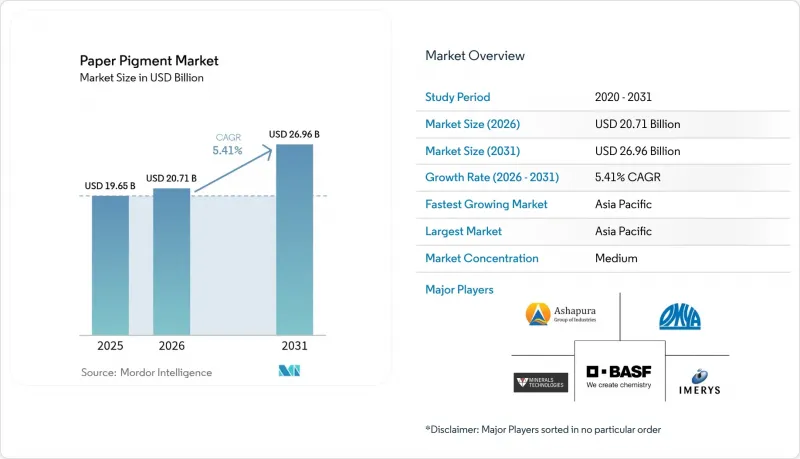
This report Segments the Industry by Pigment Type (Calcium Carbonate, Kaolin, and Other Pigment Types), Application (Uncoated Paper and Coated Paper), End-Use Industry (Packaging, Printing and Writing, Labels and Specialty Graphics and Tissue and Hygiene) and Geography (Asia-Pacific, North America, Europe, South America, and Middle-East and Africa). The Market Forecasts are Provided in Terms of Value (USD).
Global Paper Pigment Market Trends and Insights
Growing Demand for Paper from the Packaging Industry
Corrugated and folding carton producers now demand pigments that meet printability, brightness and food-contact requirements. Valmet's OptiConcept M line for Anhui Linping adds 1,808 tonnes per day of recycled linerboard capacity, underscoring the volume pull for pigments that ensure surface uniformity. Brand owners shifting from plastics to fiber packaging rely on highly opaque and migration-safe pigment systems, and BASF's new water-based dispersion plant in Heerenveen is designed specifically for these substrates. As a result, the paper pigments market is capturing increased tonnage and higher average selling prices in packaging-centric regions.
Rising Adoption of Calcium Carbonate Fillers to Cut Production Cost
Ground and precipitated calcium carbonate can replace titanium dioxide at up to 20 percentage points while preserving brightness, generating immediate margin relief for mills coping with volatile energy charges. Suppliers with captive limestone quarries, such as Imerys and Omya, offer on-site PCC satellite plants that lower logistics costs and help customers to optimize the paper pigments market supply chain. Emerging economies, where converter margins are slimmer, are rapidly pivoting toward GCC-rich formulations, reinforcing calcium carbonate's dominant share.
Digitalization Reducing Demand for Printing & Writing Paper
Digital transformation creates structural headwinds for traditional paper pigment applications, with the US printing industry experiencing 47.3% employment reduction from 2002-2021 as digitalization accelerated . Pigment suppliers built around high-volume offset stocks now face under-utilized plants and must realign toward packaging, tissue or functional papers.
Other drivers and restraints analyzed in the detailed report include:
- Expansion of E-commerce Boosting Corrugated Board Output
- Increasing Consumption of Coated & Specialty Graphic Papers
- Digitalization Reducing Demand for Printing & Writing Paper
For complete list of drivers and restraints, kindly check the Table Of Contents.
Segment Analysis
Calcium carbonate commanded 52.35% of the paper pigments market in 2025, a share built on its ability to displace high-priced TiO2 and to double as filler and coating pigment. GCC and PCC variants can cut formulation cost by up to 20%, a critical benefit when energy inflates overall mill expense. The paper pigments market size allocated to calcium carbonate grades is expected to grow in lock-step with new satellite PCC plants coming onstream near Asian board mills.
Meanwhile, the "Other Types" basket-titanium dioxide, kaolin-nano hybrids and emerging bio-based pigments-posts a 6.71% CAGR to 2031. Titanium dioxide remains indispensable in high-grade decor and label stock, yet suppliers add nanotechnology to boost opacity at lower dosages. Specialty players that master surface treatment and dispersion can charge premiums in the paper pigments industry as converters seek lightweight yet vivid sheets.
Complete Report Scope:
- By Pigment Type
- Calcium Carbonate
- Kaolin
- Other Pigment Types (Titanium Dioxide, etc.)
- By Application
- Uncoated Paper
- Coated Paper
- By End-use Industry
- Packaging
- Printing and Writing
- Labels and Specialty Graphics
- Tissue and Hygiene
- By Geography
- Asia-Pacific
- China
- India
- Japan
- South Korea
- Thailand
- Indonesia
- Vietnam
- Malaysia
- Philippines
- Rest of Asia-Pacific
- North America
- United States
- Canada
- Mexico
- Europe
- Germany
- United Kingdom
- France
- Italy
- Spain
- Russia
- NORDIC Countries
- Turkey
- Rest of Europe
- South America
- Brazil
- Argentina
- Colombia
- Rest of South America
- Middle East and Africa
- Saudi Arabia
- United Arab Emirates
- Qatar
- South Africa
- Nigeria
- Egypt
- Rest of Middle East and Africa
- Asia-Pacific
Geography Analysis
Asia-Pacific held 44.05% of the paper pigments market in 2025 and is expanding at a 6.14% CAGR as the region adds board machines and invests in e-commerce-oriented packaging. China's latest mill upgrades, together with India's capacity builds, secure long-run volume for PCC and specialty pigments. Suppliers benefit not only from proximity to limestone reserves but also from lower production costs that allow competitive export pricing.
North America remains anchored in packaging and tissue, offsetting graphic decline. Brand sustainability pledges have led converters to phase out plastics in favor of recyclable fiber, leading pigment producers to qualify PFAS-free, migration-safe systems at mills across the United States and Canada. Digital presses for short-run folding cartons and direct-to-corrugate printing require new surface chemistries, prompting collaborative development between pigment suppliers and OEMs.
Europe emphasizes eco-design and carbon-footprint cuts. Despite a 13% fall in paper production during 2023, investment continues in premium barrier coatings and CO2-optimized mills, such as Smurfit Kappa's Zulpich upgrade that trims 55,000 tonnes of annual emissions. South America and the Middle East & Africa register smaller bases but above-average growth, supported by mega-pulp projects like ANDRITZ's 2.55 million-ton Suzano line that boosts pigment demand for high-brightness pulp exports.
- Ashapura Group
- BASF
- Clariant
- FP-Pigments Oy
- Heubach GmbH
- Imerys
- LANXESS
- Minerals Technologies Inc.
- Nordkalk Corp.
- Omya AG
- PurpurLab
- Solenis
- Sun Chemical
- Thiele Kaolin Company
- Tronox Holdings plc
Additional Benefits:
- The market estimate (ME) sheet in Excel format
- 3 months of analyst support
TABLE OF CONTENTS
1 Introduction
- 1.1 Study Assumptions and Market Definition
- 1.2 Scope of the Study
2 Research Methodology
3 Executive Summary
4 Market Landscape
- 4.1 Market Overview
- 4.2 Market Drivers
- 4.2.1 Growing Demand for Paper from the Packaging Industry
- 4.2.2 Rising Adoption of Calcium Carbonate Fillers to cut Production Cost
- 4.2.3 Expansion of E-Commerce Boosting Corrugated Board Output
- 4.2.4 Increasing Consumption of Coated and Specialty Graphic Papers
- 4.2.5 Nano-Structured Pigments Enabling Lighter High-Opacity Paper
- 4.3 Market Restraints
- 4.3.1 Digitalization Reducing Demand for Printing and Writing Paper
- 4.3.2 Environmental Concerns and Inadequate Recycling Infrastructure
- 4.3.3 Direct-to-Package Digital Printing Lowering Coating Requirements
- 4.4 Value Chain Analysis
- 4.5 Porter's Five Forces
- 4.5.1 Bargaining Power of Suppliers
- 4.5.2 Bargaining Power of Buyers
- 4.5.3 Threat of New Entrants
- 4.5.4 Threat of Substitutes
- 4.5.5 Degree of Competition
5 Market Size and Growth Forecasts (Value)
- 5.1 By Pigment Type
- 5.1.1 Calcium Carbonate
- 5.1.2 Kaolin
- 5.1.3 Other Pigment Types (Titanium Dioxide, etc.)
- 5.2 By Application
- 5.2.1 Uncoated Paper
- 5.2.2 Coated Paper
- 5.3 By End-use Industry
- 5.3.1 Packaging
- 5.3.2 Printing and Writing
- 5.3.3 Labels and Specialty Graphics
- 5.3.4 Tissue and Hygiene
- 5.4 By Geography
- 5.4.1 Asia-Pacific
- 5.4.1.1 China
- 5.4.1.2 India
- 5.4.1.3 Japan
- 5.4.1.4 South Korea
- 5.4.1.5 Thailand
- 5.4.1.6 Indonesia
- 5.4.1.7 Vietnam
- 5.4.1.8 Malaysia
- 5.4.1.9 Philippines
- 5.4.1.10 Rest of Asia-Pacific
- 5.4.2 North America
- 5.4.2.1 United States
- 5.4.2.2 Canada
- 5.4.2.3 Mexico
- 5.4.3 Europe
- 5.4.3.1 Germany
- 5.4.3.2 United Kingdom
- 5.4.3.3 France
- 5.4.3.4 Italy
- 5.4.3.5 Spain
- 5.4.3.6 Russia
- 5.4.3.7 NORDIC Countries
- 5.4.3.8 Turkey
- 5.4.3.9 Rest of Europe
- 5.4.4 South America
- 5.4.4.1 Brazil
- 5.4.4.2 Argentina
- 5.4.4.3 Colombia
- 5.4.4.4 Rest of South America
- 5.4.5 Middle East and Africa
- 5.4.5.1 Saudi Arabia
- 5.4.5.2 United Arab Emirates
- 5.4.5.3 Qatar
- 5.4.5.4 South Africa
- 5.4.5.5 Nigeria
- 5.4.5.6 Egypt
- 5.4.5.7 Rest of Middle East and Africa
- 5.4.1 Asia-Pacific
6 Competitive Landscape
- 6.1 Market Concentration
- 6.2 Strategic Moves
- 6.3 Market Share(%)/Ranking Analysis
- 6.4 Company Profiles (includes Global level Overview, Market level overview, Core Segments, Financials as available, Strategic Information, Market Rank/Share for key companies, Products and Services, and Recent Developments)
- 6.4.1 Ashapura Group
- 6.4.2 BASF
- 6.4.3 Clariant
- 6.4.4 FP-Pigments Oy
- 6.4.5 Heubach GmbH
- 6.4.6 Imerys
- 6.4.7 LANXESS
- 6.4.8 Minerals Technologies Inc.
- 6.4.9 Nordkalk Corp.
- 6.4.10 Omya AG
- 6.4.11 PurpurLab
- 6.4.12 Solenis
- 6.4.13 Sun Chemical
- 6.4.14 Thiele Kaolin Company
- 6.4.15 Tronox Holdings plc
7 Market Opportunities and Future Outlook
- 7.1 White-space and Unmet-Need Assessment

