PUBLISHER: Mordor Intelligence | PRODUCT CODE: 2114877

PUBLISHER: Mordor Intelligence | PRODUCT CODE: 2114877
Fiberglass Pipes - Market Share Analysis, Industry Trends & Statistics, Growth Forecasts (2026 - 2031)
According to Mordor Intelligence, the fiberglass pipes market size is expected to grow from USD 3.45 billion in 2025 to USD 3.61 billion in 2026 and is forecast to reach USD 4.52 billion by 2031 at a 4.58% CAGR over 2026-2031.
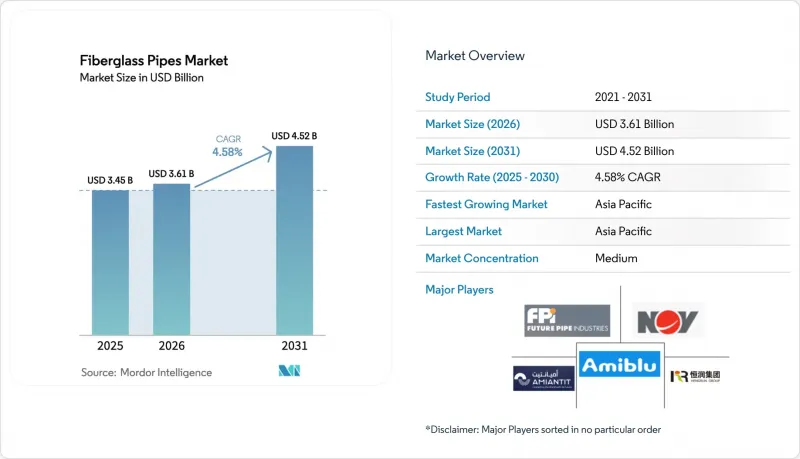
This report is Segmented by Type (Glass Fiber Reinforced Plastic (GRP) Pipes, Glass Reinforced Epoxy (GRE) Pipes, and Other Types), End-User Industry (Oil and Gas, Chemicals, Sewage, and More), and Geography (Asia-Pacific, North America, Europe, South America, and Middle-East and Africa). The Market Forecasts are Provided in Terms of Value (USD).
Global Fiberglass Pipes Market Trends and Insights
Increasing Installation of Oil and Gas Pipelines
National oil companies are scaling non-metallic pipe programs to cut sour-service downtime and cathodic-protection spend. Saudi Aramco's Master Gas System phase three adds 4,000 kilometers of composite flowlines, marking the world's largest single-country adoption of fiberglass standards. Colorado regulators require API 15S-compliant pipes on new gathering lines, triggering replacement of legacy steel assets. Strohm's 33-kilometer thermoplastic composite pipe order for Aramco's Fadhili gas expansion underscores material convergence across onshore and offshore fields. API and CSA codes provide the harmonized framework that de-risks operator qualification cycles and accelerates volume uptake. As new wells trend toward higher H2S and CO2 levels, fatigue-resistant GRE grades capture incremental share within the fiberglass pipes market.
Water- and Wastewater-Infrastructure Replacement Programs
Consent decrees and urban expansion fast-track composite adoption in municipal networks. San Antonio Water System awarded USD 26.5 million in 2024 to install six miles of fiberglass pipe under an Environmental Protection Agency order, signaling a shift from clay and concrete toward corrosion-immune systems. India's CPHEEO Manual codifies GRP across DN 200-3000 ranges, effectively embedding fiberglass in every state-funded water tender. China's trenchless jacking projects in Zhongxian, Linhai, and Guangzhou illustrate how GRP minimizes surface disruption in dense urban corridors. These programs expand the fiberglass pipes market by tying compliance deadlines to rapid installation metrics, a combination where light-weight composites excel.
Raw-material (resin and glass) Price Volatility
Epoxy and polyester resin prices track crude-derived feedstocks, and supply shocks can reverse cost deflation within a single quarter. Glass-fiber furnaces consume large volumes of natural gas, exposing European producers to TTF price swings that topped 40% volatility in early 2025. Specialty epoxy grades command 25-35% premiums over commodity polyester, curbing uptake in budget-constrained water projects. Smaller Southeast Asian fabricators lack hedging tools, so currency fluctuations amplify landed-cost uncertainty and squeeze margins. Persistent volatility leads EPC contractors to include price-adjustment clauses, slightly elongating bid cycles for fiberglass pipes market projects.
Other drivers and restraints analyzed in the detailed report include:
- Rising Demand in Chemical Processing Industry
- Surge in Large-Diameter Desalination Projects
- Limited Recyclability and Looming Regulation Risk
For complete list of drivers and restraints, kindly check the Table Of Contents.
Segment Analysis
GRP commanded 48.79% fiberglass pipes market share in 2025, reflecting its cost leadership in municipal, irrigation, and low-pressure oil gathering lines. GRE pipes, though smaller in absolute shipments, are advancing at a 4.82% CAGR through 2031 as offshore platforms and chemical plants require higher temperature and pressure ratings. Operators accept GRE's 25-35% price premium because epoxy matrices offer fatigue resistance under multi-axial stress and cyclic loading. HOBAS scaled capacity by 50% in 2024, launching a second U.S. line that produces 12- to 118-inch diameters with 150-year design-life warranties, an advantage that mitigates life-cycle cost discussions during municipal tenders. Deepwater fields in West Africa and the Gulf of Mexico specify epoxy grades to avoid hydrogen-induced blistering, thus lifting demand for GRE within the fiberglass pipes market.
New hybrid architectures combine carbon-fiber pressure armor with thermoplastic liners to handle ultra-deepwater tension loads that exceed 3,000 meters. Although still niche, these designs demonstrate the material innovation curve that keeps composites ahead of metallic counterparts suffering embrittlement in hydrogen service. API 15S and ISO 14692 revisions incorporate higher design factors for composite joints, reducing uncertainty allowances and trimming wall-thickness budgets. Continuous winding processes lower per-meter resin utilization and shorten cure cycles, allowing fabricators to pass efficiency gains to buyers without eroding margins. Consequently, volume growth in GRE and hybrids outpaces GRP, reshaping the product-mix outlook inside the fiberglass pipes market.
Complete Report Scope:
- By Type
- Glass Fiber Reinforced Plastic (GRP) Pipes
- Glass Reinforced Epoxy (GRE) Pipes
- Other Types (Hybrid, CFRP-liner, etc.)
- By End-user Industry
- Oil and Gas
- Chemicals
- Sewage
- Agriculture
- Other End-user Industry (Mining, Marine, Pulp and Paper, etc.)
- By Geography
- Asia-Pacific
- China
- India
- Japan
- South Korea
- ASEAN Countries
- Rest of Asia-Pacific
- North America
- United States
- Canada
- Mexico
- Europe
- Germany
- United Kingdom
- Italy
- France
- Spain
- NORDIC Countries
- Rest of Europe
- South America
- Brazil
- Argentina
- Rest of South America
- Middle East and Africa
- Saudi Arabia
- South Africa
- Rest of Middle-East and Africa
- Asia-Pacific
Geography Analysis
Asia-Pacific owns 44.42% revenue share in 2025 and is forecast to maintain a 4.65% CAGR through 2031 as China, India, and Saudi Arabia modernize fluid-transfer grids. China's trenchless jacking projects adopt DN 250-2000 GRP pipes to minimize urban disruption, while Zhejiang-based fabricators supply 50-year-rated pump stations that reinforce reliability narratives. India's CPHEEO guidelines anchor GRP specifications in every centrally funded water program, reinforcing pipeline bid uniformity. Saudi Arabia's USD 800 million Group Five Pipe contract and Strohm's composite flowline delivery integrate fiberglass across desalination and hydrocarbon systems. These concurrent capital programs cement Asia-Pacific as the growth engine for the fiberglass pipes market.
North America rides regulatory upgrades tied to API and CSA standards. San Antonio's consent-decree project and Colorado's flowline mandates demonstrate how legal compliance converts to immediate purchase orders. The U.S. Department of Energy's Hydrogen Shot pilots double-wall FRP pipes that blend hydrogen and CO2 transport, spotlighting composites as the default for distributed energy grids. HOBAS's new U.S. line and Amiblu's capacity in Spain funnel extra supply toward North American tenders, shortening lead times and edging out imports. Collectively these initiatives equip the region with a stable 4.2% CAGR, second only to Asia-Pacific in the fiberglass pipes market.
Europe focuses on water resilience and decarbonization. EIB financed EUR 500 million for SUEZ projects that evaluate trenchless GRP in historic urban centers. The United Kingdom earmarked GBP 8 billion for reservoirs, transfers, and desalination between 2025-2030, opening new demand for DN 3000 pipes rated at 32 bar. Amiblu's Tarragona plant achieves 72% CO2 reduction through onsite solar, aligning with procurement rules that favor low-embodied-carbon materials.
South America and Middle East and Africa trail in absolute spending but display pockets of high growth where donor agencies and national oil companies underwrite composite infrastructure, providing optional upside to the fiberglass pipes market.
- Abu Dhabi Pipe Factory (ADPF)
- Amiantit Company
- Amiblu Holding GmbH
- Chemical Process Piping Pvt. Ltd. (CPP)
- Farassan
- Fibrex
- Future Pipe Industries
- Graphite India Limited
- Gruppo Sarplast S.r.l.
- Hengrun Group Co., Ltd.
- HOBAS Pipe USA Inc.
- Lianyungang Zhongfu Lianzhong Composites Group Co., Ltd.
- NOV
- Western Fiberglass
Additional Benefits:
- The market estimate (ME) sheet in Excel format
- 3 months of analyst support
TABLE OF CONTENTS
1 Introduction
- 1.1 Study Assumptions and Market Definition
- 1.2 Scope of the Study
2 Research Methodology
3 Executive Summary
4 Market Landscape
- 4.1 Market Overview
- 4.2 Market Drivers
- 4.2.1 Increasing installation of oil and gas pipelines
- 4.2.2 Water- and wastewater-infrastructure replacement programs
- 4.2.3 Rising demand in chemical processing industry
- 4.2.4 Surge in large-diameter desalination projects
- 4.2.5 Hydrogen-transport and CCUS pilot networks supporting fiberglass pipes demand
- 4.3 Market Restraints
- 4.3.1 Raw-material (resin and glass) price volatility
- 4.3.2 Limited recyclability and looming regulation risk
- 4.3.3 Shortage of certified composite-pipe installers
- 4.4 Value Chain Analysis
- 4.5 Porter's Five Forces
- 4.5.1 Bargaining Power of Suppliers
- 4.5.2 Bargaining Power of Buyers
- 4.5.3 Threat of New Entrants
- 4.5.4 Threat of Substitutes
- 4.5.5 Degree of Competition
5 Market Size and Growth Forecasts (Value)
- 5.1 By Type
- 5.1.1 Glass Fiber Reinforced Plastic (GRP) Pipes
- 5.1.2 Glass Reinforced Epoxy (GRE) Pipes
- 5.1.3 Other Types (Hybrid, CFRP-liner, etc.)
- 5.2 By End-user Industry
- 5.2.1 Oil and Gas
- 5.2.2 Chemicals
- 5.2.3 Sewage
- 5.2.4 Agriculture
- 5.2.5 Other End-user Industry (Mining, Marine, Pulp and Paper, etc.)
- 5.3 By Geography
- 5.3.1 Asia-Pacific
- 5.3.1.1 China
- 5.3.1.2 India
- 5.3.1.3 Japan
- 5.3.1.4 South Korea
- 5.3.1.5 ASEAN Countries
- 5.3.1.6 Rest of Asia-Pacific
- 5.3.2 North America
- 5.3.2.1 United States
- 5.3.2.2 Canada
- 5.3.2.3 Mexico
- 5.3.3 Europe
- 5.3.3.1 Germany
- 5.3.3.2 United Kingdom
- 5.3.3.3 Italy
- 5.3.3.4 France
- 5.3.3.5 Spain
- 5.3.3.6 NORDIC Countries
- 5.3.3.7 Rest of Europe
- 5.3.4 South America
- 5.3.4.1 Brazil
- 5.3.4.2 Argentina
- 5.3.4.3 Rest of South America
- 5.3.5 Middle East and Africa
- 5.3.5.1 Saudi Arabia
- 5.3.5.2 South Africa
- 5.3.5.3 Rest of Middle-East and Africa
- 5.3.1 Asia-Pacific
6 Competitive Landscape
- 6.1 Market Concentration
- 6.2 Strategic Moves
- 6.3 Market Share (%)/Ranking Analysis
- 6.4 Company Profiles {(includes Global-level Overview, Market-level overview, Core Segments, Financials as available, Strategic Information, Market Rank/Share, Products and Services, Recent Developments)}
- 6.4.1 Abu Dhabi Pipe Factory (ADPF)
- 6.4.2 Amiantit Company
- 6.4.3 Amiblu Holding GmbH
- 6.4.4 Chemical Process Piping Pvt. Ltd. (CPP)
- 6.4.5 Farassan
- 6.4.6 Fibrex
- 6.4.7 Future Pipe Industries
- 6.4.8 Graphite India Limited
- 6.4.9 Gruppo Sarplast S.r.l.
- 6.4.10 Hengrun Group Co., Ltd.
- 6.4.11 HOBAS Pipe USA Inc.
- 6.4.12 Lianyungang Zhongfu Lianzhong Composites Group Co., Ltd.
- 6.4.13 NOV
- 6.4.14 Western Fiberglass
7 Market Opportunities and Future Outlook
- 7.1 White-space and Unmet-Need Assessment
- 7.2 Innovations on Smart-sensor embedded pipes enable predictive maintenance

