PUBLISHER: Mordor Intelligence | PRODUCT CODE: 2114878

PUBLISHER: Mordor Intelligence | PRODUCT CODE: 2114878
Foam Insulation - Market Share Analysis, Industry Trends & Statistics, Growth Forecasts (2026 - 2031)
According to Mordor Intelligence, the foam insulation market size is expected to grow from USD 30.33 billion in 2025 to USD 31.81 billion in 2026 and is forecast to reach USD 40.39 billion by 2031 at 4.89% CAGR over 2026-2031.
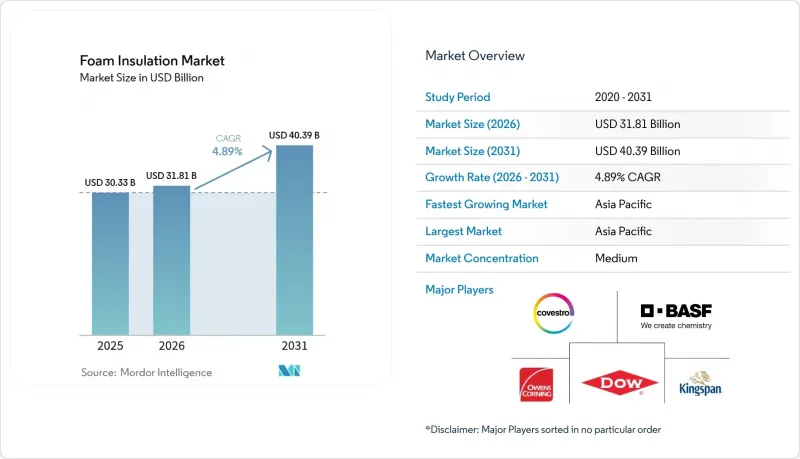
This report Segments the Industry by Type (Polystyrene, Polyurethane and Polyisocyanurate, Polyolefin, Elastomeric, Phenolic, and Others), End-User Industry (Building and Construction, Transportation, Consumer Appliances, and Others), and Geography (Asia-Pacific, North America, Europe, South America, and Middle East and Africa). The Market Forecasts are Provided in Terms of Value (USD).
Global Foam Insulation Market Trends and Insights
Tightening Building-Energy Codes & Green-Building Certifications
New codes such as the 2024 IECC raise mandatory R-values, continuous-insulation requirements, and air-leakage limits across climate zones. Builders are adopting high-density polyurethane, polyisocyanurate, and composite SIPs to comply with these stricter standards. Retrofit activity is also rising, driven by incentives that reward energy-efficiency upgrades to existing building stock. Foam solutions are favored because they deliver high thermal resistance in thinner profiles, freeing up interior space while meeting code-mandated performance thresholds. Manufacturers are responding with higher R-value spray formulations and panel systems certified for net-zero and LEED projects. Regulatory momentum is therefore embedding advanced foam products in both new construction and renovation pipelines.
Infrastructure Stimulus Reviving Non-Residential Construction
Large infrastructure packages in the United States, China, and the European Union are accelerating projects that have significant insulation intensity, including data centers, hospitals, and logistics hubs. Foam boards and spray systems are specified for their moisture resistance and installation speed, which shorten construction schedules. Public funding is cascading into regional supply chains, prompting capacity additions by leading producers to secure long-term contracts. The foam insulation market benefits directly from the volume of roofing, wall, and foundation area insulated in these public works. Suppliers are also leveraging specification momentum to introduce bio-based polyiso boards into federally funded projects, aligning with emission-reduction targets.
Volatile MDI/TDI & Styrene Prices
Price swings in MDI, TDI, and styrene reflect supply disruptions, geopolitical risks, and evolving trade rules. Sudden cost spikes squeeze margins and complicate long-term contracting with builders and OEMs. Large producers hedge through backward integration, alternate feedstocks, and inventory buffers, while smaller converters face thinner pricing power. Bio-based polyols and recycled styrene streams are being trialed to mitigate exposure, yet remain commercially limited. Persistent volatility therefore tempers near-term profitability and could delay capacity expansions in the foam insulation market.
Other drivers and restraints analyzed in the detailed report include:
- Rapid E-Commerce Cold-Chain Build-Out
- Growing Modular Off-Site Construction Using Foam-Insulated Panels
- Fire-Safety & Flame-Retardant Regulations Raising Compliance Cost
For complete list of drivers and restraints, kindly check the Table Of Contents.
Segment Analysis
Polyurethane and polyisocyanurate foams commanded 40.74% of the foam insulation market in 2025, a lead that stems from their superior R-values, chemical resistance, and ease of on-site application. Strong compatibility with both spray and board formats makes these foams the workhorse for exterior walls, low-slope roofs, and industrial tanks. Manufacturers are integrating bio-based polyols and CO2-derived feedstocks into mainstream grades, helping designers meet embodied-carbon benchmarks without compromising performance. Rapid code changes have further entrenched these foams, reinforcing their place at the core of project specifications across climate zones.
The Other Types"category, which groups phenolic, melamine, elastomeric, and vacuum panels, is on track to post a 5.03% CAGR through 2031. Performance attributes such as ultra-low thermal conductivity, fire resistance, and sound dampening attract niche demand in high-rise facades, petrochemical plants, and specialty HVAC equipment. Producers are innovating around aerogel-infused and nano-cellular structures that can achieve R-10 per inch. Although volume remains modest, sustained investments suggest these alternatives will influence value-added segments and gradually diversify the broader foam insulation market.
Complete Report Scope:
- By Type
- Polystyrene
- Polyurethane and Polyisocyanurate
- Polyolefin
- Elastomeric
- Phenolic
- Others (Melamine, Glass-blowing micro-cellular foams, etc.)
- By End-user Industry
- Building and Construction
- Transportation
- Consumer Appliances
- Others (Energy and Utilities, Industrial and OEM Equipment, etc.)
- By Geography
- Asia-Pacific
- China
- India
- Japan
- South Korea
- ASENA Countries
- Rest of Asia-Pacific
- North America
- United States
- Canada
- Mexico
- Europe
- Germany
- United Kingdom
- France
- Italy
- NORDIC Countries
- Rest of Europe
- South America
- Brazil
- Argentina
- Rest of South America
- Middle East and Africa
- Saudi Arabia
- South Africa
- Rest of Middle East and Africa
- Asia-Pacific
Geography Analysis
Asia-Pacific owns 41.30% of global revenue and is forecast to grow the fastest at a 5.78% CAGR through 2031. Rapid urban migration and programs such as China's 14th Five-Year Plan channel capital into green office towers, smart warehouses, and cold-chain facilities. National building codes now specify higher insulation values, aligning with China's dual-carbon goals and India's Energy Conservation Building Code. Suppliers are commissioning rigid-foam board lines and spray-foam blending plants close to demand centers, shortening lead times and cutting logistics emissions.
North America is benefitting from unprecedented federal infrastructure funding that prioritizes energy-efficient public buildings, bridges, and transit facilities. Insulation intensity is particularly high in data centers, where heat-management demands are critical and downtime is costly. The foam insulation market size for institutional retrofits in the United States is projected to expand steadily as school districts and hospitals tap tax incentives to upgrade aging envelopes. Close collaboration between builders and material suppliers speeds approvals for novel low-GWP formulations, broadening regional adoption.
Europe maintains a leadership role in sustainability, pushing manufacturers toward life-cycle assessments and recyclability roadmaps. The Fit-for-55 package and F-gas phase-out schedule encourage foam makers to introduce third-generation blowing agents and recycled-content formulations. Germany and France are implementing extended producer-responsibility schemes for construction materials, prompting joint ventures in chemical recycling to recover polyols. Southern Europe and emerging Eastern markets provide incremental growth as their building codes align with EU directives. Together, these factors sustain a diversified yet cohesive demand landscape across the foam insulation market.
- Armacell
- BASF
- Carlisle Spray Foam Insulation
- Covestro AG
- Dow
- HOLCIM
- Huntsman Corporation
- Icynene-Lapolla
- Johns Manville
- Kingspan Group
- Knauf Insulation
- NCFI Polyurethanes
- Owens Corning
- Carpenter Co.
- Saint-Gobain
- SEKISUI CHEMICAL CO., LTD.
Additional Benefits:
- The market estimate (ME) sheet in Excel format
- 3 months of analyst support
TABLE OF CONTENTS
1 Introduction
- 1.1 Study Assumptions and Market Definition
- 1.2 Scope of the Study
2 Research Methodology
3 Executive Summary
4 Market Landscape
- 4.1 Market Overview
- 4.2 Market Drivers
- 4.2.1 Tightening Building-Energy Codes and Green-Building certifications
- 4.2.2 Infrastructure Stimulus Reviving Non-Residential Construction
- 4.2.3 Rapid E-Commerce Cold-Chain Build-Out
- 4.2.4 Growing Modular Off-site Construction Using Foam Insulated Panels
- 4.2.5 Growing Emphasis on Sustainable Construction
- 4.3 Market Restraints
- 4.3.1 Volatile MDI/TDI and Styrene Prices
- 4.3.2 Fire-Safety and Flame-Retardant Regulations Raising Compliance Cost
- 4.3.3 Recyclability Mandates and Lack of Scalable Foam-Reclaim Programs
- 4.4 Value Chain Analysis
- 4.5 Porter's Five Forces
- 4.5.1 Bargaining Power of Suppliers
- 4.5.2 Bargaining Power of Buyers
- 4.5.3 Threat of New Entrants
- 4.5.4 Threat of Substitutes
- 4.5.5 Degree of Competition
5 Market Size and Growth Forecasts (Value)
- 5.1 By Type
- 5.1.1 Polystyrene
- 5.1.2 Polyurethane and Polyisocyanurate
- 5.1.3 Polyolefin
- 5.1.4 Elastomeric
- 5.1.5 Phenolic
- 5.1.6 Others (Melamine, Glass-blowing micro-cellular foams, etc.)
- 5.2 By End-user Industry
- 5.2.1 Building and Construction
- 5.2.2 Transportation
- 5.2.3 Consumer Appliances
- 5.2.4 Others (Energy and Utilities, Industrial and OEM Equipment, etc.)
- 5.3 By Geography
- 5.3.1 Asia-Pacific
- 5.3.1.1 China
- 5.3.1.2 India
- 5.3.1.3 Japan
- 5.3.1.4 South Korea
- 5.3.1.5 ASENA Countries
- 5.3.1.6 Rest of Asia-Pacific
- 5.3.2 North America
- 5.3.2.1 United States
- 5.3.2.2 Canada
- 5.3.2.3 Mexico
- 5.3.3 Europe
- 5.3.3.1 Germany
- 5.3.3.2 United Kingdom
- 5.3.3.3 France
- 5.3.3.4 Italy
- 5.3.3.5 NORDIC Countries
- 5.3.3.6 Rest of Europe
- 5.3.4 South America
- 5.3.4.1 Brazil
- 5.3.4.2 Argentina
- 5.3.4.3 Rest of South America
- 5.3.5 Middle East and Africa
- 5.3.5.1 Saudi Arabia
- 5.3.5.2 South Africa
- 5.3.5.3 Rest of Middle East and Africa
- 5.3.1 Asia-Pacific
6 Competitive Landscape
- 6.1 Market Concentration
- 6.2 Strategic Moves
- 6.3 Market Share (%)/Ranking Analysis
- 6.4 Company Profiles (includes Global level Overview, Market level overview, Core Segments, Financials, Strategic Info, Market Rank/Share, Products and Services, Recent Developments)
- 6.4.1 Armacell
- 6.4.2 BASF
- 6.4.3 Carlisle Spray Foam Insulation
- 6.4.4 Covestro AG
- 6.4.5 Dow
- 6.4.6 HOLCIM
- 6.4.7 Huntsman Corporation
- 6.4.8 Icynene-Lapolla
- 6.4.9 Johns Manville
- 6.4.10 Kingspan Group
- 6.4.11 Knauf Insulation
- 6.4.12 NCFI Polyurethanes
- 6.4.13 Owens Corning
- 6.4.14 Carpenter Co.
- 6.4.15 Saint-Gobain
- 6.4.16 SEKISUI CHEMICAL CO., LTD.
7 Market Opportunities and Future Outlook
- 7.1 White-space and Unmet-need Assessment

