PUBLISHER: Mordor Intelligence | PRODUCT CODE: 2114881

PUBLISHER: Mordor Intelligence | PRODUCT CODE: 2114881
Ceramic Substrate - Market Share Analysis, Industry Trends & Statistics, Growth Forecasts (2026 - 2031)
According to Mordor Intelligence, the ceramic substrate market size is projected to expand from USD 6.45 billion in 2025 and USD 6.88 billion in 2026 to USD 9.44 billion by 2031, registering a CAGR of 6.54% between 2026 to 2031.
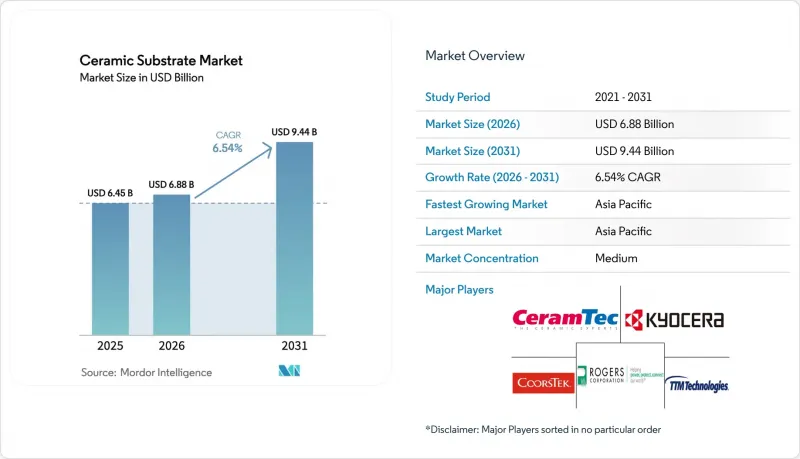
This report is Segmented by Type (Alumina, Aluminum Nitride, Silicon Nitride, Beryllium Oxide, and More), Manufacturing Process (HTCC, LTCC, DBC, and AMB), End-User Industry (Consumer Electronics, Automotive, Semiconductor, Telecommunications, and More), and Geography (Asia-Pacific, North America, Europe, South America, and Middle East and Africa). Market Forecasts are Provided in Terms of Value (USD).
Global Ceramic Substrate Market Trends and Insights
Superior Thermal Conductivity Enabling High-Power Electronics
Designers now treat thermal conductivity as a primary constraint rather than a secondary specification. Silicon-carbide MOSFETs and gallium-nitride HEMTs run at junction temperatures up to 225°C, generating local heat fluxes that top 300 W/cm2, well beyond the safe envelope for epoxy-based laminates. Aluminum-nitride substrates, offering 170-250 W/m*K, cut heat-sink volume by 35% and trim liquid-coolant flow rates, improving full-system efficiency by 2-3%. Direct-bonded-copper (DBC) variants eliminate adhesive layers, slicing thermal resistance by 0.1 K*cm2/W and allowing current densities of 200 A/cm2 in automotive traction inverters. Multi-company investments that will lift global SiC wafer output from 150-mm to 200-mm diameters further expand the ceramic substrate market.
Rapid EV Inverter and On-Board-Charger Build-Out Increasing Usage
Battery-electric vehicles are standardizing on 800-V architectures, which impose voltage transients above 1,200 V and thermal cycling from -40°C to 150°C over 200,000 cycles. To meet these conditions, automakers integrate DBC substrates that handle regenerative-braking reversals within milliseconds, loads that fracture FR-4 boards. Silicon-carbide diodes on aluminum-nitride bases lift on-board-charger efficiency to 98% and shave cooling-system mass by 20%, extending vehicle range. Kyocera's USD 454 million Nagasaki build-out will double automotive-grade substrate capacity by late 2026. As module costs fall, premium-segment penetration already exceeds 80%, and mainstream adoption is tracking downward cost curves, cementing demand for the ceramic substrate market.
High Price Premium Over Metal/Organic Boards
Unit prices range from USD 2 to USD 10 per square inch versus USD 0.10-0.50 for FR-4, a 5-to-20-fold spread that shuts entry into many consumer devices. Raw alumina powder and metallization account for 60% of the cost, while yield loss contributes another 15%, leaving scant room for markdowns without process innovation. Temporary shortages in 2024-2025 inflated prices by up to 20%, compelling some handset makers to revert to metal-core PCBs. Hybrid assemblies that place ceramic only under high-heat-flux components cut substrate spend by 30% while retaining most thermal benefit.
Other drivers and restraints analyzed in the detailed report include:
- 5G Base-Station and RF Module Densification
- SiC/GaN Migration Requiring AlN and DBC Substrates
- Fragility and Yield Losses During Assembly
For complete list of drivers and restraints, kindly check the Table Of Contents.
Segment Analysis
Alumina delivered 44.18% of the ceramic substrate market share in 2025, anchored by cost-sensitive consumer electronics and industrial drives. At the same time, silicon carbide substrates expanded 7.80% CAGR through 2031, propelled by aerospace radars and next-generation EV inverters that require coefficient-of-thermal-expansion mismatches below 0.5 ppm/K. Aluminum nitride, with 170-250 W/m*K conductivity, is gaining traction in 800-V EV platforms where operating junctions exceed 175°C.
Revenue momentum favors premium materials because average selling prices remain three to five times higher than alumina equivalents. As Coherent, DENSO, and Mitsubishi Electric pour USD 1 billion into 200-mm SiC wafer lines, downstream demand for compatible substrates will accelerate, reshaping the ceramic substrate market size profile. Alumina will keep its volume edge through 2031 in LEDs and smartphone power-management ICs, yet its revenue share will slip as telecom and data-center designers upgrade to AlN for lower dielectric loss.
Complete Report Scope:
- By Type
- Alumina
- Aluminum Nitride
- Silicon Nitride
- Beryllium Oxide
- Other Types (Cordierite andSilicon Carbide)
- By Manufacturing Process
- High-Temperature Co-Fired Ceramic (HTCC)
- Low-Temperature Co-Fired Ceramic (LTCC)
- Direct Bonded Copper (DBC)
- Active Metal Brazed (AMB)
- By End-User Industry
- Consumer Electronics
- Automotive
- Aerospace & Defense
- Semiconductor
- Telecommunications
- Other End-user Industries (Industrial Power & Renewable Energy, and Medical Devices)
- By Geography
- Asia-Pacific
- China
- India
- Japan
- South Korea
- Vietnam
- Malaysia
- Indonesia
- Thailand
- Rest of Asia-Pacific
- North America
- United States
- Canada
- Mexico
- Europe
- Germany
- United Kingdom
- France
- Italy
- Russia
- Turkey
- Spain
- NORDIC Countries
- Rest of Europe
- South America
- Brazil
- Argentina
- Colombia
- Rest of South America
- Middle East and Africa
- Saudi Arabia
- South Africa
- Qatar
- Nigeria
- United Arab Emirates
- Rest of Middle East and Africa
- Asia-Pacific
Geography Analysis
Asia-Pacific contributed 46.61% of revenue in 2025 and is expected to post a 7.09% CAGR through 2031, buoyed by Chinese EV output topping 9 million units in 2024 and Japanese initiatives to triple translucent-alumina wafer capacity by fiscal 2027. Kyocera's Nagasaki complex, slated for late 2026 completion, will co-locate SiC substrate and advanced packaging lines, cutting lead times by 30% and reinforcing regional self-sufficiency.
North America's 2025 share was driven by defense and space programs that specify AlN substrates for phased-array radars operating across -55°C to 125°C. The Inflation Reduction Act's clean-energy incentives underpin domestic inverter assembly, cushioning slower EV penetration relative to Asia.
In Europe, high energy prices inflate alumina sintering costs by 25% versus Asia-Pacific, but the EU Carbon Border Adjustment Mechanism, phasing in USD 90-equivalent tariffs per ton of CO2, nudges OEMs toward low-carbon alumina such as Hydro's HalZero, lifting regional demand for recyclable substrates. South America and the Middle East & Africa remain sub-10% contributors; projects in Brazil's solar belt and Saudi Arabia's NEOM smart-city keep niche demand alive, yet import reliance raises landed cost by up to 25%, limiting the ceramic substrate market's expansion there.
- CeramTec GmbH
- CoorsTek Inc.
- Corning Incorporated
- Denka Company Limited
- Heraeus Electronics
- KOA Speer Electronic, Inc.
- KYOCERA Corporation
- LEATEC
- MARUWA Co., Ltd.
- NEOTech
- NIPPON CARBIDE INDUSTRIES CO., INC.
- Niterra Materials Co., Ltd.
- Ortech, Inc.
- Rogers Corporation
- TTM Technologies Inc.
- Yokowo Co., Ltd.
Additional Benefits:
- The market estimate (ME) sheet in Excel format
- 3 months of analyst support
TABLE OF CONTENTS
1 Introduction
- 1.1 Study Assumptions & Market Definition
- 1.2 Scope of the Study
2 Research Methodology
3 Executive Summary
4 Market Landscape
- 4.1 Market Overview
- 4.2 Market Drivers
- 4.2.1 Superior thermal conductivity driving the demand for ceramic substrates in high-power electronics
- 4.2.2 Rapid EV inverter & on-board-charger build-out increasing ceramic substarte usage
- 4.2.3 5G base-station and RF module densification
- 4.2.4 SiC/GaN migration requiring AlN & DBC substrates
- 4.2.5 Aerospace CubeSat miniaturisation needs LTCC
- 4.3 Market Restraints
- 4.3.1 High price premium over metal/organic boards
- 4.3.2 Fragility & yield losses during assembly
- 4.3.3 Toxic-exposure limits on BeO
- 4.4 Value Chain Analysis
- 4.5 Porter's Five Forces
- 4.5.1 Threat of New Entrants
- 4.5.2 Bargaining Power of Suppliers
- 4.5.3 Bargaining Power of Buyers
- 4.5.4 Threat of Substitutes
- 4.5.5 Degree of Competition
5 Market Size & Growth Forecasts (Value)
- 5.1 By Type
- 5.1.1 Alumina
- 5.1.2 Aluminum Nitride
- 5.1.3 Silicon Nitride
- 5.1.4 Beryllium Oxide
- 5.1.5 Other Types (Cordierite andSilicon Carbide)
- 5.2 By Manufacturing Process
- 5.2.1 High-Temperature Co-Fired Ceramic (HTCC)
- 5.2.2 Low-Temperature Co-Fired Ceramic (LTCC)
- 5.2.3 Direct Bonded Copper (DBC)
- 5.2.4 Active Metal Brazed (AMB)
- 5.3 By End-User Industry
- 5.3.1 Consumer Electronics
- 5.3.2 Automotive
- 5.3.3 Aerospace & Defense
- 5.3.4 Semiconductor
- 5.3.5 Telecommunications
- 5.3.6 Other End-user Industries (Industrial Power & Renewable Energy, and Medical Devices)
- 5.4 By Geography
- 5.4.1 Asia-Pacific
- 5.4.1.1 China
- 5.4.1.2 India
- 5.4.1.3 Japan
- 5.4.1.4 South Korea
- 5.4.1.5 Vietnam
- 5.4.1.6 Malaysia
- 5.4.1.7 Indonesia
- 5.4.1.8 Thailand
- 5.4.1.9 Rest of Asia-Pacific
- 5.4.2 North America
- 5.4.2.1 United States
- 5.4.2.2 Canada
- 5.4.2.3 Mexico
- 5.4.3 Europe
- 5.4.3.1 Germany
- 5.4.3.2 United Kingdom
- 5.4.3.3 France
- 5.4.3.4 Italy
- 5.4.3.5 Russia
- 5.4.3.6 Turkey
- 5.4.3.7 Spain
- 5.4.3.8 NORDIC Countries
- 5.4.3.9 Rest of Europe
- 5.4.4 South America
- 5.4.4.1 Brazil
- 5.4.4.2 Argentina
- 5.4.4.3 Colombia
- 5.4.4.4 Rest of South America
- 5.4.5 Middle East and Africa
- 5.4.5.1 Saudi Arabia
- 5.4.5.2 South Africa
- 5.4.5.3 Qatar
- 5.4.5.4 Nigeria
- 5.4.5.5 United Arab Emirates
- 5.4.5.6 Rest of Middle East and Africa
- 5.4.1 Asia-Pacific
6 Competitive Landscape
- 6.1 Market Concentration
- 6.2 Strategic Moves
- 6.3 Market Share(%)/Ranking Analysis
- 6.4 Company Profiles (includes Global level Overview, Market level overview, Core Segments, Financials as available, Strategic Information, Market Rank/Share for key companies, Products & Services, and Recent Developments)
- 6.4.1 CeramTec GmbH
- 6.4.2 CoorsTek Inc.
- 6.4.3 Corning Incorporated
- 6.4.4 Denka Company Limited
- 6.4.5 Heraeus Electronics
- 6.4.6 KOA Speer Electronic, Inc.
- 6.4.7 KYOCERA Corporation
- 6.4.8 LEATEC
- 6.4.9 MARUWA Co., Ltd.
- 6.4.10 NEOTech
- 6.4.11 NIPPON CARBIDE INDUSTRIES CO., INC.
- 6.4.12 Niterra Materials Co., Ltd.
- 6.4.13 Ortech, Inc.
- 6.4.14 Rogers Corporation
- 6.4.15 TTM Technologies Inc.
- 6.4.16 Yokowo Co., Ltd.
7 Market Opportunities & Future Outlook
- 7.1 White-space & Unmet-Need Assessment
- 7.2 CBAM pushes EU OEMs to recyclable alumina

