PUBLISHER: Mordor Intelligence | PRODUCT CODE: 2114884

PUBLISHER: Mordor Intelligence | PRODUCT CODE: 2114884
Thermic Fluid - Market Share Analysis, Industry Trends & Statistics, Growth Forecasts (2026 - 2031)
According to Mordor Intelligence, the thermic fluid market size was valued at USD 11.76 billion in 2025 and estimated to grow from USD 12.21 billion in 2026 to reach USD 14.71 billion by 2031, at a CAGR of 3.79% during the forecast period (2026-2031).
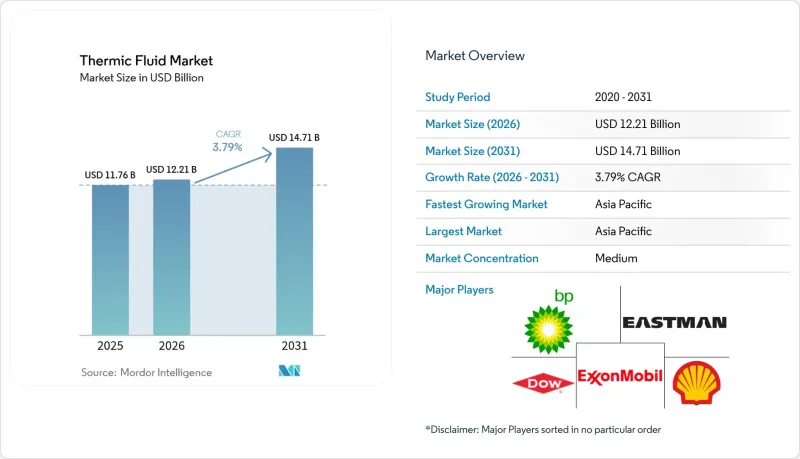
This report is Segmented by Product Type (Mineral Oils, Silicon and Aromatics, Glycols, and More), Temperature Range (Low Temperature, Medium Temperature, High Temperature), End-User Industry (Chemical, Oil and Gas, Food and Beverage, Pharmaceutical, and More), and Geography (Asia-Pacific, North America, Europe, South America, Middle East and Africa). The Market Forecasts are Provided in Terms of Value (USD).
Global Thermic Fluid Market Trends and Insights
Extensive demand from oil & gas
Heat-transfer duties in modern refineries have grown more complex as operators chase higher conversion rates and lower emissions. China's throughput of 14.8 million bpd in 2023 illustrates sustained appetite for high-temperature synthetic fluids capable of stable service beyond 380 °C. ExxonMobil's Singapore resid-upgrade project, due in 2025, will add 20,000 bpd of base stocks tuned for premium thermic fluids, targeting stringent Asian specifications. EPA Subpart OOOOb, enforced from May 2024, mandates zero-emission pneumatic equipment, nudging operators toward low-volatility, longer-life formulations that curb fugitive leaks. These shifts reinforce a two-tier market where synthetic blends command premium pricing while mineral oils retain price-sensitive niches.
Growing adoption in concentrated solar power
CSP plants see thermic fluids as a core storage medium enabling 24-hour renewable power. India's 500 GW non-fossil goal underlines this outlook, and long-duration storage via molten salt or advanced silicone fluids is now integral to project economics. Laboratory work shows platinum-nanoparticle silicone fluids boosting plant efficiency by 44% at 425 °C without the toxicity concerns linked to legacy aromatics. Algeria's CSP tower plants record levelized costs of USD 0.097/kWh, validating commercial feasibility and driving demand for high-temperature, low-degradation fluids. Thermal energy storage capacity is forecast to triple this decade, widening the downstream pull on innovative heat-transfer media.
Volatile raw material pricing
Rapid capacity additions outpaced demand after 2022, squeezing petrochemical margins and swinging base-oil prices. Clean-tech spending topping USD 2.8 trillion diverts naphtha feedstocks toward polymers for batteries and solar panels, tightening supply for thermic fluid producers. Caustic-soda shortages complicate de-acidification steps critical to fluid stability. Firms hedge exposure through vertical integration-Chevron's pursuit of Phillips 66's chemical stake exemplifies efforts to secure in-house feed-notwithstanding steep capital commitments.
Other drivers and restraints analyzed in the detailed report include:
- Expansion in chemical & petrochemical processing
- Food-grade formulations gain traction
- Safety & environmental concerns over aromatics
For complete list of drivers and restraints, kindly check the Table Of Contents.
Segment Analysis
Mineral oils remained the volume leader with 44.38% share in 2025, yet tightening VOC caps shrink their cost edge. Glycols, propelled by food-grade and server-farm demand, are growing 4.05% CAGR, narrowing the gap with hydrocarbons. Eastman's Therminol FF and Dow's SYLTHERM silicone line evidence a shift toward broad-temperature synthetics able to run from -40 °C to 400 °C, lengthening service life and boosting uptime. Nanoparticle-infused silicone prototypes raise conductivity by 24% at 200 °C, underscoring how R&D differentiates suppliers. As a result, the thermic fluids market sees larger customers specify synthetic alternatives during turnaround cycles, even when upfront prices rise.
Premium synthetics widen addressable niches in CSP, specialty chemicals and immersion cooling. Silicon and aromatic blends occupy high-temperature or narrow-boiling-range duties where mineral oils break down. New categories, such as platinum-doped silicone oils for 425 °C service, illustrate rapid progress.
Complete Report Scope:
- By Product Type
- Mineral Oils
- Silicon and Aromatics
- Glycols
- Other Product Types
- By Temperature Range
- Low Temperature (less than 150 °C)
- Medium Temperature (150-300 °C)
- High Temperature (greater than 300 °C)
- By End-user Industry
- Chemical
- Oil and Gas
- Food and Beverage
- Pharmaceutical
- Concentrated Solar Power
- Other End-user Industry
- By Geography
- Asia-Pacific
- China
- India
- Japan
- South Korea
- Rest of Asia-Pacific
- North America
- United States
- Canada
- Mexico
- Europe
- Germany
- United Kingdom
- France
- Italy
- Russia
- Rest of Europe
- South America
- Brazil
- Argentina
- Rest of South America
- Middle East and Africa
- Saudi Arabia
- South Africa
- Rest of Middle East and Africa
- Asia-Pacific
Geography Analysis
Asia-Pacific owned 37.40% thermic fluids market share in 2025 and is advancing at a 4.42% CAGR through 2031, underpinned by China's 14.8 million bpd crude runs, BASF's Zhanjiang megasite and India's CSP rollout. Policy incentives and local supply chains reinforce regional sales, although reshoring trends encourage multi-country diversification.
North America and Europe rely on technology leadership and tight regulations to pull in higher-margin synthetics. EPA methane rules and EU REACH updates accelerate substitution away from aromatic mineral oils. ExxonMobil's Singapore base-stock addition illustrates North American firms manufacturing in Asia yet retaining IP dominance.
South America, Middle East and Africa present emerging possibilities as energy infrastructure scales. Algeria's CSP economics validate demand for 400 °C fluids, while Gulf refiners invest in residue conversion that needs stable heat carriers. Political risk and logistics gaps temper uptake, but governmental supply-chain resilience programs, such as Australia's critical-minerals initiative, highlight a pivot toward diversified sourcing.
- BASF SE
- BP plc
- Caldera
- Chevron Corporation
- Clariant
- Dow
- Duratherm Extended Life Fluids
- Eastman Chemical Company
- Exxon Mobil Corporation
- Global Heat Transfer
- HP Lubricants
- MultiTherm LLC
- Paratherm
- Radco Industries, LLC
- Shell plc
Additional Benefits:
- The market estimate (ME) sheet in Excel format
- 3 months of analyst support
TABLE OF CONTENTS
1 Introduction
- 1.1 Study Assumptions and Market Definition
- 1.2 Scope of the Study
2 Research Methodology
3 Executive Summary
4 Market Landscape
- 4.1 Market Overview
- 4.2 Market Drivers
- 4.2.1 Extensive demand from oil and gas
- 4.2.2 Growing adoption in concentrated solar power
- 4.2.3 Expansion in chemical and petrochemical processing
- 4.2.4 Food-grade formulations gain traction
- 4.2.5 Data-center immersion cooling uptake
- 4.3 Market Restraints
- 4.3.1 Volatile raw material pricing
- 4.3.2 Safety and environmental concerns over aromatics
- 4.3.3 Strict VOC regulations on mineral oils
- 4.4 Value Chain Analysis
- 4.5 Porter's Five Forces
- 4.5.1 Bargaining Power of Suppliers
- 4.5.2 Bargaining Power of Buyers
- 4.5.3 Threat of New Entrants
- 4.5.4 Threat of Substitute Products
- 4.5.5 Degree of Competition
5 Market Size and Growth Forecasts (Value)
- 5.1 By Product Type
- 5.1.1 Mineral Oils
- 5.1.2 Silicon and Aromatics
- 5.1.3 Glycols
- 5.1.4 Other Product Types
- 5.2 By Temperature Range
- 5.2.1 Low Temperature (less than 150 °C)
- 5.2.2 Medium Temperature (150-300 °C)
- 5.2.3 High Temperature (greater than 300 °C)
- 5.3 By End-user Industry
- 5.3.1 Chemical
- 5.3.2 Oil and Gas
- 5.3.3 Food and Beverage
- 5.3.4 Pharmaceutical
- 5.3.5 Concentrated Solar Power
- 5.3.6 Other End-user Industry
- 5.4 By Geography
- 5.4.1 Asia-Pacific
- 5.4.1.1 China
- 5.4.1.2 India
- 5.4.1.3 Japan
- 5.4.1.4 South Korea
- 5.4.1.5 Rest of Asia-Pacific
- 5.4.2 North America
- 5.4.2.1 United States
- 5.4.2.2 Canada
- 5.4.2.3 Mexico
- 5.4.3 Europe
- 5.4.3.1 Germany
- 5.4.3.2 United Kingdom
- 5.4.3.3 France
- 5.4.3.4 Italy
- 5.4.3.5 Russia
- 5.4.3.6 Rest of Europe
- 5.4.4 South America
- 5.4.4.1 Brazil
- 5.4.4.2 Argentina
- 5.4.4.3 Rest of South America
- 5.4.5 Middle East and Africa
- 5.4.5.1 Saudi Arabia
- 5.4.5.2 South Africa
- 5.4.5.3 Rest of Middle East and Africa
- 5.4.1 Asia-Pacific
6 Competitive Landscape
- 6.1 Market Concentration
- 6.2 Strategic Moves
- 6.3 Market Share Analysis
- 6.4 Company Profiles (includes Global level Overview, Market level overview, Core Segments, Financials as available, Strategic Information, Market Rank/Share for key companies, Products and Services, and Recent Developments)
- 6.4.1 BASF SE
- 6.4.2 BP plc
- 6.4.3 Caldera
- 6.4.4 Chevron Corporation
- 6.4.5 Clariant
- 6.4.6 Dow
- 6.4.7 Duratherm Extended Life Fluids
- 6.4.8 Eastman Chemical Company
- 6.4.9 Exxon Mobil Corporation
- 6.4.10 Global Heat Transfer
- 6.4.11 HP Lubricants
- 6.4.12 MultiTherm LLC
- 6.4.13 Paratherm
- 6.4.14 Radco Industries, LLC
- 6.4.15 Shell plc
7 Market Opportunities and Future Outlook
- 7.1 White-space and Unmet-need Assessment

