PUBLISHER: Mordor Intelligence | PRODUCT CODE: 2114886

PUBLISHER: Mordor Intelligence | PRODUCT CODE: 2114886
Coalescing Agents - Market Share Analysis, Industry Trends & Statistics, Growth Forecasts (2026 - 2031)
According to Mordor Intelligence, the coalescing agent market size is expected to grow from USD 1.18 billion in 2025 to USD 1.24 billion in 2026 and is forecast to reach USD 1.57 billion by 2031 at 4.86% CAGR over 2026-2031.
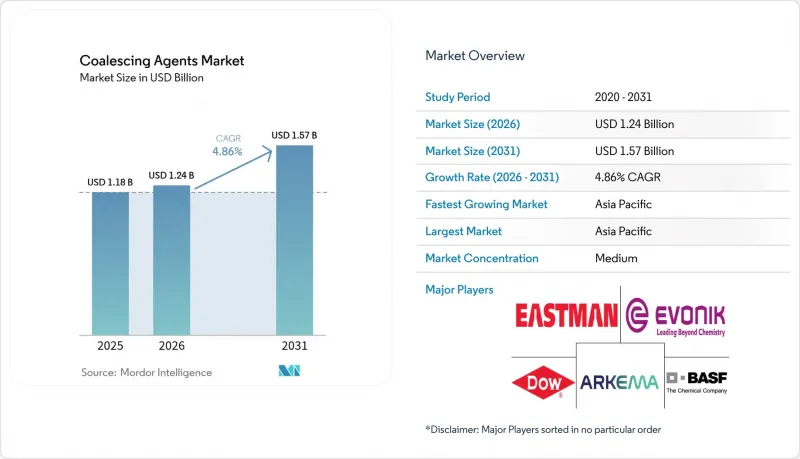
This report is Segmented by Type (Hydrophilic, Hydrophobic), Chemistry (Esters, Ketones, Alcohols, Diols and Glycol-Ethers, Other Chemistries), Application (Paints and Coatings, Adhesives and Sealants, Inks, Personal Care, Other Applications), and Geography (Asia-Pacific, North America, Europe, South America, Middle East and Africa). The Market Forecasts are Provided in Terms of Value (USD).
Global Coalescing Agents Market Trends and Insights
Expansion of Industrial Coating Lines in Developing Economies
Record infrastructure outlays across China, India, and Southeast Asia are lifting industrial coating throughput and creating a volume pull for the coalescing agents market. New ethylene and propylene crackers, such as SABIC's USD 6.4 billion Fujian project with 1.8 million t/y capacity, guarantee backward integration for acrylic esters and glycol-ether derivatives essential to additive production. As water-borne formulations become mandatory in factory-applied metal, plastic, and wood coatings, demand concentrates on hydrophobic grades that accelerate film formation at ambient humidity. Regional petrochemical self-sufficiency also curbs import dependency, enabling local suppliers to shorten lead times while tailoring products to divergent national VOC caps. Collectively, these factors improve supply security and strengthen APAC's positional advantage within the broader coalescing agents market.
Uptake of Low-Temperature Film-Formation Additives in Automotive Refinish
Electric-vehicle platforms and stringent air-district rules push refinish shops toward lower bake profiles to conserve energy and protect sensitive battery components. The South Coast Air Quality Management District's revised Rule 1151, effective May 2025, tightens VOC ceilings across primer, base-coat, and clear-coat systems, accelerating the switch to high-boiling, low-odor coalescing agents that deliver proper film coalescence below 60 °C. Large refinish paint makers are incorporating ester blends that remain in the film long enough to promote latex fusion yet volatilize before service, helping body shops meet cycle-time KPIs. Global uptake is rapid because identical low-temperature needs exist in plastics finishing, aerospace touch-ups, and composite repair. This cross-sector adoption enlarges the coalescing agents market and mitigates cyclical swings tied solely to automotive volumes.
REACH and EPA Restrictions on High-VOC Ester Alcohols
EU REACH dossiers and the U.S. National VOC Emission Standards are progressively blacklisting high-reactivity ester alcohols, obliging formulators to re-screen raw materials and re-qualify end-use coatings Compliance timelines consume R&D budgets and slow product launches, especially for SMEs. Because acceptable substitutes often cost more and may require additional surfactant packages to stabilize latex particles, overall formulation economics tighten. Regional rule deviations further limit economies of scale, fragmenting inventories and adding logistics complexity that restrains the coalescing agents market.
Other drivers and restraints analyzed in the detailed report include:
- Tightening Indoor-Air-Quality Norms in Building Codes
- Commercialization of Reactive (Zero-VOC) Coalescing Agents
- Volatility in Glycol-Ether Feedstock Pricing
For complete list of drivers and restraints, kindly check the Table Of Contents.
Segment Analysis
The hydrophobic category retained 60.10% of the coalescing agents market share in 2025, benefiting from proven adhesion and water-resistance properties in heavy-duty coatings. Construction equipment, offshore platforms, and marine topcoats all specify hydrophobic blends due to prolonged exposure to moisture and solvents. Yet formulators increasingly complement these agents with ancillary wetting aids to manage gloss uniformity at higher solid contents. Margins remain attractive because large-volume paint makers favor long-term contracts that guarantee steady off-take.
Hydrophilic grades, while smaller today, log a 5.51% CAGR through 2031 on the back of stringent indoor-air-quality targets. Their molecular affinity to water packages allows use levels 10-15% lower than hydrophobic counterparts, trimming total VOC grams per liter. Cosmetic emulsion producers leverage these agents to stabilize oil-in-water formulations, improving sensory attributes without synthetic surfactants. As R&D refines film-formation profiles, uptake will accelerate in interior latex paints and next-generation adhesives, further diversifying the coalescing agents market.
Complete Report Scope:
- By Type
- Hydrophilic
- Hydrophobic
- By Chemistry
- Esters
- Ketones
- Alcohols
- Diols and Glycol-ethers
- Other Chemistries (Lactates, Citrates, Siloxanes)
- By Application
- Paints and Coatings
- Adhesives and Sealants
- Inks
- Personal Care
- Other Applications (Plastics and Polymers, Oil-and-Gas Separators, etc.)
- By Geography
- Asia-Pacific
- China
- Japan
- India
- South Korea
- ASEAN Countries
- Rest of Asia-Pacific
- North America
- United States
- Canada
- Mexico
- Europe
- Germany
- United Kingdom
- France
- Italy
- Spain
- Russia
- NORDIC Countries
- Rest of Europe
- South America
- Brazil
- Argentina
- Rest of South America
- Middle East and Africa
- Saudi Arabia
- South Africa
- Rest of Middle East and Africa
- Asia-Pacific
Geography Analysis
Asia-Pacific commanded 38.40% of coalescing agents market size in 2025. New ethylene and acrylic ester capacity clusters in China's coastal provinces and in Vietnam's Long Son complex assure raw-material supply and reduce freight expense. Regional governments continue to harmonize VOC measures with OECD benchmarks, propelling water-borne coating adoption. This policy push, combined with consumer upgrading and e-commerce packaging growth, yields a 5.29% CAGR through 2031, the fastest worldwide.
North America accounts for roughly one-quarter of demand, underpinned by mature but innovation-rich coatings and personal-care sectors. The EPA's aerosol-coating deadline extension to January 2027 offers breathing room for formulation trials, stabilizing near-term offtake. Meanwhile, the shift to electric vehicle assembly lines raises consumption of low-temperature coalescing blends in refinish and plastic interior parts. Feedstock pricing volatility remains the primary regional headwind, prompting downstream users to negotiate shorter contracts.
Europe mirrors North American technology adoption yet grapples with elevated natural-gas costs that feed into acrylic-acid and glycol-ether production. Producers offset cost inflation by emphasizing zero-VOC innovations and bio-feedstock chain-of-custody certifications. Regulatory clarity on post-consumer plastic recycling targets stimulates R&D partnerships that position European firms at the vanguard of circular chemistry, maintaining steady contributions to the coalescing agents market.
Latin America, the Middle East, and Africa together represent a high-growth frontier. Petrochemical build-outs in Saudi Arabia and Abu Dhabi underpin resin-grade solvent availability, inviting downstream additive ventures. In Brazil and Mexico, housing rebound and export-oriented appliance manufacturing add diverse consumption points. Multinationals deploy technical service teams in these regions to tailor products to tropical climate performance norms, thereby expanding the addressable coalescing agents market over the long term.
- Arkema
- BASF
- Cargill, Incorporated.
- Cristol
- Dow
- Eastman Chemical Company
- Elementis PLC
- Evonik Industries AG
- Indorama Ventures
- Perstorp
- Runtai Chemical Co., Ltd.
- Shell Plc
- Stepan Company
- Synthomer plc
Additional Benefits:
- The market estimate (ME) sheet in Excel format
- 3 months of analyst support
TABLE OF CONTENTS
1 Introduction
- 1.1 Study Assumptions and Market Definition
- 1.2 Scope of the Study
2 Research Methodology
3 Executive Summary
4 Market Landscape
- 4.1 Market Overview
- 4.2 Market Drivers
- 4.2.1 Expansion of Industrial Coating Lines in Developing Economies
- 4.2.2 Uptake of Low-Temperature Film-Formation Additives in Automotive Refinish
- 4.2.3 Tightening Indoor-Air-Quality Norms in Building Codes
- 4.2.4 Commercialisation of Reactive (Zero-VOC) Coalescing Agents
- 4.2.5 Increasing Demand for Specialty and High Performance Inks and Coatings
- 4.3 Market Restraints
- 4.3.1 REACH And EPA Restrictions on High-VOC Ester Alcohols
- 4.3.2 Volatility in Glycol-Ether Feedstock Pricing
- 4.3.3 Self-Coalescing Polymer Dispersion Technologies
- 4.4 Value Chain Analysis
- 4.5 Porter's Five Forces
- 4.5.1 Bargaining Power of Suppliers
- 4.5.2 Bargaining Power of Buyers
- 4.5.3 Threat of New Entrants
- 4.5.4 Threat of Substitutes
- 4.5.5 Degree of Competition
5 Market Size and Growth Forecasts (Value)
- 5.1 By Type
- 5.1.1 Hydrophilic
- 5.1.2 Hydrophobic
- 5.2 By Chemistry
- 5.2.1 Esters
- 5.2.2 Ketones
- 5.2.3 Alcohols
- 5.2.4 Diols and Glycol-ethers
- 5.2.5 Other Chemistries (Lactates, Citrates, Siloxanes)
- 5.3 By Application
- 5.3.1 Paints and Coatings
- 5.3.2 Adhesives and Sealants
- 5.3.3 Inks
- 5.3.4 Personal Care
- 5.3.5 Other Applications (Plastics and Polymers, Oil-and-Gas Separators, etc.)
- 5.4 By Geography
- 5.4.1 Asia-Pacific
- 5.4.1.1 China
- 5.4.1.2 Japan
- 5.4.1.3 India
- 5.4.1.4 South Korea
- 5.4.1.5 ASEAN Countries
- 5.4.1.6 Rest of Asia-Pacific
- 5.4.2 North America
- 5.4.2.1 United States
- 5.4.2.2 Canada
- 5.4.2.3 Mexico
- 5.4.3 Europe
- 5.4.3.1 Germany
- 5.4.3.2 United Kingdom
- 5.4.3.3 France
- 5.4.3.4 Italy
- 5.4.3.5 Spain
- 5.4.3.6 Russia
- 5.4.3.7 NORDIC Countries
- 5.4.3.8 Rest of Europe
- 5.4.4 South America
- 5.4.4.1 Brazil
- 5.4.4.2 Argentina
- 5.4.4.3 Rest of South America
- 5.4.5 Middle East and Africa
- 5.4.5.1 Saudi Arabia
- 5.4.5.2 South Africa
- 5.4.5.3 Rest of Middle East and Africa
- 5.4.1 Asia-Pacific
6 Competitive Landscape
- 6.1 Market Concentration
- 6.2 Strategic Moves
- 6.3 Market Share(%)/Ranking Analysis
- 6.4 Company Profiles (includes Global-level Overview, Market-level Overview, Core Segments, Financials as available, Strategic Information, Market Rank/Share for key companies, Products and Services, and Recent Developments)
- 6.4.1 Arkema
- 6.4.2 BASF
- 6.4.3 Cargill, Incorporated.
- 6.4.4 Cristol
- 6.4.5 Dow
- 6.4.6 Eastman Chemical Company
- 6.4.7 Elementis PLC
- 6.4.8 Evonik Industries AG
- 6.4.9 Indorama Ventures
- 6.4.10 Perstorp
- 6.4.11 Runtai Chemical Co., Ltd.
- 6.4.12 Shell Plc
- 6.4.13 Stepan Company
- 6.4.14 Synthomer plc
7 Market Opportunities and Future Outlook
- 7.1 White-space and Unmet-Need Assessment
- 7.2 Rising Focus on Eco-friendly Products

