PUBLISHER: Mordor Intelligence | PRODUCT CODE: 2114889

PUBLISHER: Mordor Intelligence | PRODUCT CODE: 2114889
Global Gastroparesis Drug - Market Share Analysis, Industry Trends & Statistics, Growth Forecasts (2026 - 2031)
According to Mordor Intelligence, the gastroparesis drugs market size is expected to grow from USD 5.03 billion in 2025 to USD 5.25 billion in 2026 and is forecast to reach USD 6.51 billion by 2031 at 4.38% CAGR over 2026-2031.
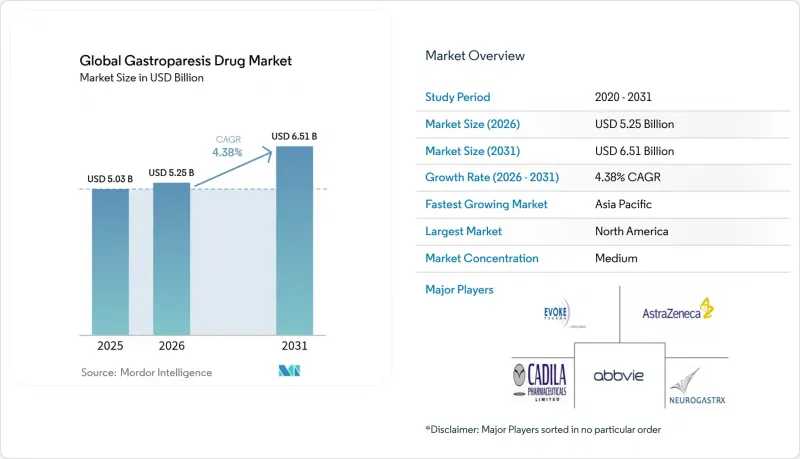
This report Segments the Industry Into by Drug Class (Antiemetic Agents, Prokinetic Agents, Botulinum Toxin Injections, and Others), by Disease Type (Diabetic Gastroparesis, Post-Surgical Gastroparesis, Idiopathic Gastroparesis, and More), by End User (Hospitals, Specialty Clinics, Pharmacies), and Geography. The Market Sizes and Forecasts are Provided in Terms of Value (USD).
Global Gastroparesis Drug Market Trends and Insights
Rising Incidence of Diabetes
Diabetes is the single largest demand catalyst for gastroparesis interventions, with diabetic cases making up 60.25% of all diagnoses in 2024 . Meta-analysis data place gastroparesis prevalence at 12.5% among adults with type 2 diabetes and 8.3% in type 1 diabetes cohorts. Epidemiological work from Pakistan and Palestine reports symptom rates of 11.5% and 14.5% respectively, underscoring under-recognition in emerging markets. Earlier disease onset means longer treatment duration, increasing lifetime value per patient for drug developers. In parallel, GLP-1 agonist prescriptions, although valuable for glycemic control, can aggravate gastric emptying and create incremental therapy needs.
Increase in Gastric & Bariatric Surgeries
The number of bariatric surgeries is climbing, and post-surgical gastroparesis represents the fastest growing disease sub-segment at 5.81% CAGR to 2030. Roux-en-Y procedures carry higher risk versus sleeve gastrectomy, sharpening the focus on prophylactic and early intervention regimens. Gastric peroral endoscopic myotomy (G-POEM) adds a minimally invasive option, shifting care models toward procedure-drug combinations that command premium pricing.
Lengthy Regulatory Approval Timelines
Gastroparesis trials face high placebo response and subjective endpoints, complicating proof-of-efficacy. The FDA's 2024 refusal of tradipitant after an extended review period demonstrates unpredictability in the approval path . The EMA imposes additional pediatric data demands, stretching development budgets and discouraging smaller biotech entrants.
Other drivers and restraints analyzed in the detailed report include:
- Growing Geriatric Population
- New Approvals of Novel Prokinetics
- Adverse Effects & Product Withdrawals
For complete list of drivers and restraints, kindly check the Table Of Contents.
Segment Analysis
Prokinetics captured 41.73% of the gastroparesis drugs market in 2025 and continue to anchor first-line therapy despite legacy safety warnings. GIMOTI's 126% prescription growth in 2024 shows that nasal delivery can revitalize established molecules. Deudomperidone and naronapride are positioned to lift the gastroparesis drugs market size for this class through safer receptor selectivity and improved absorption. Botulinum toxin injections, while holding a smaller base, are rising 5.05% per year as gastroenterologists refine endoscopic pyloric injection techniques, improving symptom relief durability.
Antiemetics such as ondansetron sustain demand for nausea control, while extended-release granisetron is gaining traction in peri-operative settings. The "Others" basket ranges from mirtazapine in refractory cases to ghrelin receptor agonists like TZP-102, which normalized gastric emptying in 52.6% of diabetic patients in a Phase 2 study. This pipeline diversification underscores a trend toward etiology-tailored regimens that combine motility agents with symptom modulators.
Complete Report Scope:
- By Drug Class
- Antiemetic Agents
- 5-HT3 Antagonists
- NK-1 Antagonists
- Dopamine Antagonists
- Prokinetic Agents
- Metoclopramide
- Domperidone
- Macrolide Antibiotics
- Ghrelin Receptor Agonists
- Botulinum Toxin Injections
- Others
- Antiemetic Agents
- By Disease Type
- Diabetic Gastroparesis
- Post-Surgical Gastroparesis
- Idiopathic Gastroparesis
- Viral & Neurological-Induced Gastroparesis
- Others
- By End User
- Hospitals
- Specialty Clinics
- Pharmacies
- By Geography
- North America
- United States
- Canada
- Mexico
- Europe
- Germany
- United Kingdom
- France
- Italy
- Spain
- Rest of Europe
- Asia-Pacific
- China
- Japan
- India
- Australia
- South Korea
- Rest of Asia-Pacific
- Middle East & Africa
- GCC
- South Africa
- Rest of Middle East & Africa
- South America
- Brazil
- Argentina
- Rest of South America
- North America
Geography Analysis
North America accounted for 43.22% of 2025 revenue, anchored by large academic medical centers and favorable reimbursement for procedure-drug combinations. FDA designation of gastroparesis as an unmet medical need supports accelerated review for new entrants. The Cleveland Clinic reported 82% clinical response when combining gastric electrical stimulation with pyloromyotomy, reinforcing the region's leadership in integrated care models. However, the tradipitant rejection shows that regulatory thresholds remain stringent.
Europe follows with a smaller but mature base. EMA guidelines and divergent national formularies lengthen rollout times, yet Germany showcases innovation through botanical combination therapy Iberogast Advance, supported by post-marketing data. Cross-border academic collaborations, such as Dr. Falk Pharma and Renexxion's clinical partnership on naronapride, sustain a flow of late-stage assets. Professional societies, including the European Society of Neurogastroenterology and Motility, issue prescribing recommendations that shape clinical adoption.
Asia-Pacific is the fastest-growing region at 6.18% CAGR, propelled by high diabetes incidence, rapid urbanization, and expanding diagnostic capacity. Prevalence studies from Pakistan and Palestine highlight sizable undiagnosed populations, pointing to latent demand Cureus. Regulators in markets such as South Korea now grant reimbursement for new acid-suppressive agents that can be co-administered with prokinetics, signaling greater openness to novel gastrointestinal therapies. Pharmaceutical alliances, including the Lupin-Takeda tie-up for vonoprazan in India, illustrate the value multinationals place on regional partnerships to navigate pricing and distribution complexities.
- Abbott Laboratories
- Abbvie
- Zydus Group
- Evoke Pharma
- AstraZeneca
- Neurogastrx
- Bausch Health
- Theravance Biopharma
- GlaxoSmithKline
- Takeda Pharmaceutical Co.
- CinDome Pharma
- RaQualia Pharma
- SEBELA Pharmaceuticals
- TEVA Pharmaceutical
- Johnson & Johnson
- Pfizer
- Sun Pharmaceuticals Industries
- Lupin
- Zeria Pharmaceutical
- ANI Pharmaceuticals
Additional Benefits:
- The market estimate (ME) sheet in Excel format
- 3 months of analyst support
TABLE OF CONTENTS
1 Introduction
- 1.1 Study Assumptions & Market Definition
- 1.2 Scope of the Study
2 Research Methodology
3 Executive Summary
4 Market Landscape
- 4.1 Market Overview
- 4.2 Market Drivers
- 4.2.1 Rising incidence of diabetes
- 4.2.2 Increase in gastric & bariatric surgeries
- 4.2.3 Growing geriatric population
- 4.2.4 New approvals of novel prokinetics
- 4.2.5 Adoption of gastric electrical stimulators boosting adjunct drug use
- 4.2.6 Expansion of home-based enteral nutrition programs
- 4.3 Market Restraints
- 4.3.1 Lengthy regulatory approval timelines
- 4.3.2 Adverse effects & product withdrawals
- 4.3.3 Shift toward cannabinoid & herbal alternatives
- 4.3.4 Limited reimbursement for idiopathic cases
- 4.4 Value / Supply-Chain Analysis
- 4.5 Regulatory Landscape
- 4.6 Technological Outlook
- 4.7 Porter's Five Forces Analysis
- 4.7.1 Threat of New Entrants
- 4.7.2 Bargaining Power of Buyers
- 4.7.3 Bargaining Power of Suppliers
- 4.7.4 Threat of Substitutes
- 4.7.5 Competitive Rivalry
5 Market Size & Growth Forecasts (Value)
- 5.1 By Drug Class
- 5.1.1 Antiemetic Agents
- 5.1.1.1 5-HT3 Antagonists
- 5.1.1.2 NK-1 Antagonists
- 5.1.1.3 Dopamine Antagonists
- 5.1.2 Prokinetic Agents
- 5.1.2.1 Metoclopramide
- 5.1.2.2 Domperidone
- 5.1.2.3 Macrolide Antibiotics
- 5.1.2.4 Ghrelin Receptor Agonists
- 5.1.3 Botulinum Toxin Injections
- 5.1.4 Others
- 5.1.1 Antiemetic Agents
- 5.2 By Disease Type
- 5.2.1 Diabetic Gastroparesis
- 5.2.2 Post-Surgical Gastroparesis
- 5.2.3 Idiopathic Gastroparesis
- 5.2.4 Viral & Neurological-Induced Gastroparesis
- 5.2.5 Others
- 5.3 By End User
- 5.3.1 Hospitals
- 5.3.2 Specialty Clinics
- 5.3.3 Pharmacies
- 5.4 By Geography
- 5.4.1 North America
- 5.4.1.1 United States
- 5.4.1.2 Canada
- 5.4.1.3 Mexico
- 5.4.2 Europe
- 5.4.2.1 Germany
- 5.4.2.2 United Kingdom
- 5.4.2.3 France
- 5.4.2.4 Italy
- 5.4.2.5 Spain
- 5.4.2.6 Rest of Europe
- 5.4.3 Asia-Pacific
- 5.4.3.1 China
- 5.4.3.2 Japan
- 5.4.3.3 India
- 5.4.3.4 Australia
- 5.4.3.5 South Korea
- 5.4.3.6 Rest of Asia-Pacific
- 5.4.4 Middle East & Africa
- 5.4.4.1 GCC
- 5.4.4.2 South Africa
- 5.4.4.3 Rest of Middle East & Africa
- 5.4.5 South America
- 5.4.5.1 Brazil
- 5.4.5.2 Argentina
- 5.4.5.3 Rest of South America
- 5.4.1 North America
6 Competitive Landscape
- 6.1 Market Concentration
- 6.2 Market Share Analysis
- 6.3 Company Profiles (includes Global-level Overview, Market-level Overview, Core Segments, Financials as available, Strategic Information, Market Rank/Share, Products & Services, Recent Developments)
- 6.3.1 Abbott Laboratories
- 6.3.2 AbbVie Inc.
- 6.3.3 Cadila Pharmaceuticals
- 6.3.4 Evoke Pharma
- 6.3.5 AstraZeneca plc
- 6.3.6 Neurogastrx Inc.
- 6.3.7 Bausch Health
- 6.3.8 Theravance Biopharma
- 6.3.9 GlaxoSmithKline plc
- 6.3.10 Takeda Pharmaceutical Co.
- 6.3.11 CinDome Pharma
- 6.3.12 RaQualia Pharma
- 6.3.13 SEBELA Pharmaceuticals
- 6.3.14 TEVA Pharmaceutical
- 6.3.15 Johnson & Johnson (Janssen)
- 6.3.16 Pfizer Inc.
- 6.3.17 Sun Pharma
- 6.3.18 Lupin Ltd.
- 6.3.19 Zeria Pharmaceutical
- 6.3.20 ANI Pharmaceuticals
7 Market Opportunities & Future Outlook
- 7.1 White-space & Unmet-need Assessment

