PUBLISHER: Mordor Intelligence | PRODUCT CODE: 2114894

PUBLISHER: Mordor Intelligence | PRODUCT CODE: 2114894
Prosthetic Liners - Market Share Analysis, Industry Trends & Statistics, Growth Forecasts (2026 - 2031)
According to Mordor Intelligence, the prosthetic liners market size was valued at USD 278.88 million in 2025 and estimated to grow from USD 296.62 million in 2026 to reach USD 403.72 million by 2031, at a CAGR of 6.36% during the forecast period (2026-2031).
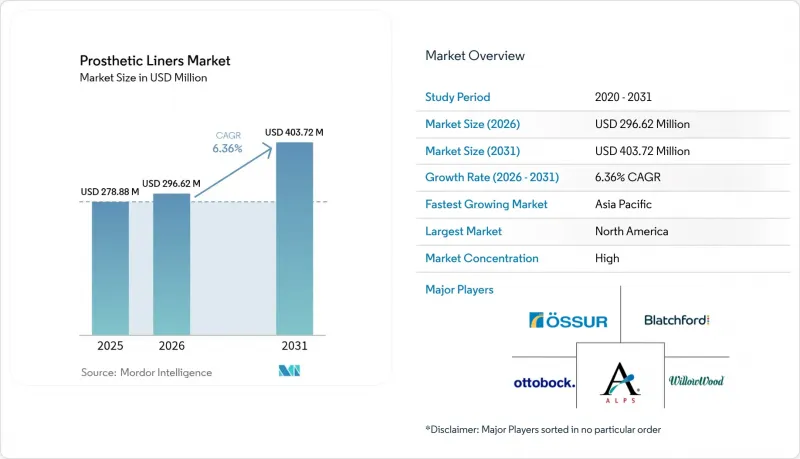
This report is Segmented by Product Type (Upper-Extremity Liners and Lower-Extremity Liners), Material (Silicone and More), Suspension Mechanism (Pin-Lock Liners, Cushion Liners, and More), Thickness Profile (6mm, and More), End User(Hospitals and Clinics and More) and Geography (North America, Europe, Asia-Pacific, and More). The Market and Forecasts are Provided in Terms of Value (USD).
Global Prosthetic Liners Market Trends and Insights
Rising incidence of diabetes-related amputations
Diabetes is reshaping global limb-loss epidemiology by pushing vascular disease ahead of trauma as the leading cause of lower-limb amputation. Peer-reviewed projections indicate limb-loss prevalence could jump 145% by 2060 if metabolic trends hold. The shift swells the addressable base for premium liners because diabetic amputees present fluctuating limb volumes and elevated infection risk, prompting prosthetists to specify breathable silicones with embedded antimicrobials. Payers now view such upgrades as cost-avoidance tools that lower readmission rates and ulcer-care outlays. Device makers that bundle diabetes-specific clinical education with liners gain a competitive foothold among hospital purchasing teams and value-based insurance networks.
Growing number of road-traffic & industrial accidents
Trauma remains a sizeable, demographically younger cohort that demands rugged liners capable of supporting high-activity lifestyles. A global prevalence study recorded 57.7 million traumatic amputees in 2017, with road injuries making up 15.7% and mechanical forces 10.4% of cases. Asia-Pacific registers the heaviest burden as urbanization and industrialization progress faster than occupational-safety frameworks. These patients seek durable liners with sensor-ready interfaces for activity tracking, which in turn nudges OEMs toward multi-material composites that can dissipate shear without adding bulk. Economic analyses tie fast return-to-work rates to higher-grade liner adoption, reinforcing payer willingness to reimburse performance-oriented models in trauma centers.
High average selling price of premium liners
Price remains the primary adoption hurdle when payer caps lag behind material-cost inflation. Advanced liners can retail at triple the price of entry models, and amputees typically need multiple replacements during the socket-life cycle. Economists note that a transtibial patient fitted at age 40 could face liner expenses across a 30-year horizon that rival household income levels in emerging economies. Multinational vendors have responded with tiered catalogues yet still confront sticker shock in self-pay markets, slowing penetration despite clear clinical benefits. Until reimbursement catch-up or cost-down innovation closes the gap, value offerings will dominate rural and low-income geographies.
Other drivers and restraints analyzed in the detailed report include:
- Expanding reimbursement coverage for advanced liners
- Rapid material innovation in medical-grade silicones
- Dermatological complications & heat-rash issues
For complete list of drivers and restraints, kindly check the Table Of Contents.
Segment Analysis
Lower-extremity devices generated 64.68% of prosthetic liners market revenue in 2025 on the back of high diabetes-linked transtibial and transfemoral caseloads. Hospitals value the stability that premium lower-limb liners bring to gait rehabilitation, and the category benefits from proven reimbursement codes that shorten the claim cycle. The prosthetic liners market size attributable to lower limbs is forecast to widen steadily through 2031 as vascular-disease prevalence rises. In contrast, upper-extremity liners are gaining momentum with a 7.12% CAGR tied to myoelectric hand adoption and growing clinical interest in partial-hand reconstruction.
Upper-extremity amputees skew younger and prioritize dexterity, which allows suppliers to position smart liners with embedded electrodes despite higher unit prices. Developers are also leveraging 3-D silicone printing to create anatomically contoured finger sheaths that marry cosmetic appearance with reliable suspension. As these niche breakthroughs scale, upper-limb penetration will expand overall prosthetic liners market addressability, reducing dependence on lower-limb volumes for topline growth.
Silicone maintained 55.67% dominance in 2025, benefitting from decades of clinical data proving hypoallergenic performance and long-wear durability. The material's cross-link density preserves elasticity across temperature swings, a feature valued in both temperate and tropical regions. Despite this commanding position, thermoplastic elastomers are advancing at 6.97% CAGR to become the most disruptive rival. The prosthetic liners market size tied to TPE products remains modest but gains disproportionate mindshare because extrusion and injection-molding lines already installed for consumer goods can transition to medical output with minimal re-tooling.
TPE also supports rapid-cycle color matching and is compatible with fused-deposition 3-D printers, allowing localized production near clinics that lack silicone-curing ovens. Hybrid composite formulas that layer silicone interior surfaces with TPE exteriors are emerging to bridge comfort and cost norms. As payers in developing economies push for price-aligned outcomes, mid-tier TPE offerings will absorb volume from entry silicones, moving market dynamics toward a dual-material equilibrium.
Complete Report Scope:
- By Product Type
- Upper-Extremity Liners
- Lower-Extremity Liners
- By Material
- Silicone
- Thermoplastic Elastomer (TPE)
- Others
- By Suspension Mechanism
- Pin-Lock Liners
- Cushion Liners
- Others
- By Thickness Profile
- Less than or Equal to 3mm
- 6mm
- Greater than or equal to 9mm
- By End User
- Hospitals and Clinics
- Ambulatory Surgical Centers
- Others
- By Geography
- North America
- United States
- Canada
- Mexico
- Europe
- Germany
- United Kingdom
- France
- Italy
- Spain
- Rest of Europe
- Asia-Pacific
- China
- Japan
- India
- Australia
- South Korea
- Rest of Asia-Pacific
- Middle East and Africa
- GCC
- South Africa
- Rest of Middle East and Africa
- South America
- Brazil
- Argentina
- Rest of South America
- North America
Geography Analysis
North America accounted for 42.02% of 2025 global revenue, supported by Medicare Part B rules that reimburse 80% of medically necessary prosthetic supplies once deductibles clear. The region's dense prosthetist network and extensive diabetes-management programs ensure a steady inflow of candidates, while private insurers mirror federal coding, further smoothing advanced-liner uptake . FDA guidance updates that accept chemical-equivalency data in lieu of full animal testing have shortened time-to-market for incremental material tweaks, encouraging continuous portfolio refresh.
Asia-Pacific stands out as the fastest-growing territory with a 7.15% CAGR thanks to rising household incomes, stimulative public-insurance pilots, and domestic manufacturing clusters that whittle logistics cost. China and India together recorded a sizable increase in amputation procedures, reflecting both urban trauma incidence and expanding chronic-disease screening. Regulators are harmonizing device rules with global ISO standards, enabling regional OEMs to submit single dossier sets for multiple ASEAN markets. That convergence will help the prosthetic liners market capture latent demand among the estimated tens of thousands of amputees who still rely on outdated suction socks.
Europe posts stable yet slower growth, supported by public health systems that guarantee prosthetic access but impose rigorous post-market surveillance under the Medical Device Regulation framework. Germany, France, and the United Kingdom remain procurement strongholds where tender boards weigh real-world performance data heavily, pushing suppliers to generate multi-center outcome studies . Southern and Eastern European states show incremental volume expansion as EU structural funds improve rehabilitation infrastructure. Elsewhere, selected Middle Eastern and Latin American nations demonstrate nascent demand, although lower reimbursement ceilings and clinician shortages moderate adoption of premium liners.
- Alps South LLC
- Blatchford
- Fillauer Europe
- Knite Rite
- Ortho Europe
- Ossur
- Ottobock
- Silipos Holding LLC
- Streifeneder ortho.production
- Willow Wood Global
- College Park Industries Inc.
- Proteor SAS
- Medi USA Inc.
- Steeper Group Ltd.
- Beckton Dickinson
- Engineered Silicone Products (ESP)
- Adaptive Prosthetics LLC
- Anatomic Concepts Inc.
- Ability Dynamics Inc.
- Capstone Medical Products
Additional Benefits:
- The market estimate (ME) sheet in Excel format
- 3 months of analyst support
TABLE OF CONTENTS
1 Introduction
- 1.1 Study Assumptions & Market Definition
- 1.2 Scope of the Study
2 Research Methodology
3 Executive Summary
4 Market Landscape
- 4.1 Market Overview
- 4.2 Market Drivers
- 4.2.1 Rising incidence of diabetes-related amputations
- 4.2.2 Growing number of road-traffic & industrial accidents
- 4.2.3 Expanding reimbursement coverage for advanced liners
- 4.2.4 Rapid material innovation in medical-grade silicones
- 4.2.5 Mass-customized 3-D-scanned liners lowering refit rates
- 4.2.6 Multi-patient sterilizable compression liners for clinics
- 4.3 Market Restraints
- 4.3.1 High average selling price of premium liners
- 4.3.2 Dermatological complications & heat-rash issues
- 4.3.3 Lack of liner-specific biocompatibility test standards
- 4.3.4 Volatile medical-grade silicone supply chain
- 4.4 Regulatory Landscape
- 4.5 Technological Outlook
- 4.6 Porters Five Forces Analysis
- 4.6.1 Threat of New Entrants
- 4.6.2 Bargaining Power of Buyers/Consumers
- 4.6.3 Bargaining Power of Suppliers
- 4.6.4 Threat of Substitute Products
- 4.6.5 Intensity of Competitive Rivalry
5 Market Size & Growth Forecasts (Value, USD)
- 5.1 By Product Type
- 5.1.1 Upper-Extremity Liners
- 5.1.2 Lower-Extremity Liners
- 5.2 By Material
- 5.2.1 Silicone
- 5.2.2 Thermoplastic Elastomer (TPE)
- 5.2.3 Others
- 5.3 By Suspension Mechanism
- 5.3.1 Pin-Lock Liners
- 5.3.2 Cushion Liners
- 5.3.3 Others
- 5.4 By Thickness Profile
- 5.4.1 Less than or Equal to 3mm
- 5.4.2 6mm
- 5.4.3 Greater than or equal to 9mm
- 5.5 By End User
- 5.5.1 Hospitals and Clinics
- 5.5.2 Ambulatory Surgical Centers
- 5.5.3 Others
- 5.6 By Geography
- 5.6.1 North America
- 5.6.1.1 United States
- 5.6.1.2 Canada
- 5.6.1.3 Mexico
- 5.6.2 Europe
- 5.6.2.1 Germany
- 5.6.2.2 United Kingdom
- 5.6.2.3 France
- 5.6.2.4 Italy
- 5.6.2.5 Spain
- 5.6.2.6 Rest of Europe
- 5.6.3 Asia-Pacific
- 5.6.3.1 China
- 5.6.3.2 Japan
- 5.6.3.3 India
- 5.6.3.4 Australia
- 5.6.3.5 South Korea
- 5.6.3.6 Rest of Asia-Pacific
- 5.6.4 Middle East and Africa
- 5.6.4.1 GCC
- 5.6.4.2 South Africa
- 5.6.4.3 Rest of Middle East and Africa
- 5.6.5 South America
- 5.6.5.1 Brazil
- 5.6.5.2 Argentina
- 5.6.5.3 Rest of South America
- 5.6.1 North America
6 Competitive Landscape
- 6.1 Market Concentration
- 6.2 Market Share Analysis
- 6.3 Company Profiles (includes Global-level Overview, Market-level Overview, Core Segments, Financials as available, Strategic Information, Market Rank/Share for key companies, Products & Services, and Recent Developments)
- 6.3.1 Alps South LLC
- 6.3.2 Blatchford Limited
- 6.3.3 Fillauer Europe AB
- 6.3.4 Knite Rite Inc.
- 6.3.5 Ortho Europe
- 6.3.6 Ossur hf
- 6.3.7 Ottobock SE & Co. KGaA
- 6.3.8 Silipos Holding LLC
- 6.3.9 Streifeneder ortho.production GmbH
- 6.3.10 WillowWood Global LLC
- 6.3.11 College Park Industries Inc.
- 6.3.12 Proteor SAS
- 6.3.13 Medi USA Inc.
- 6.3.14 Steeper Group Ltd.
- 6.3.15 Becker Orthopedic
- 6.3.16 Engineered Silicone Products (ESP)
- 6.3.17 Adaptive Prosthetics LLC
- 6.3.18 Anatomic Concepts Inc.
- 6.3.19 Ability Dynamics Inc.
- 6.3.20 Capstone Medical Products
7 Market Opportunities & Future Outlook
- 7.1 White-space & Unmet-Need Assessment

