PUBLISHER: Mordor Intelligence | PRODUCT CODE: 2114897

PUBLISHER: Mordor Intelligence | PRODUCT CODE: 2114897
Amniotic Membrane - Market Share Analysis, Industry Trends & Statistics, Growth Forecasts (2026 - 2031)
According to Mordor Intelligence, amniotic membrane market size in 2026 is estimated at USD 3.75 billion, growing from 2025 value of USD 3.35 billion with 2031 projections showing USD 6.58 billion, growing at 11.92% CAGR over 2026-2031.
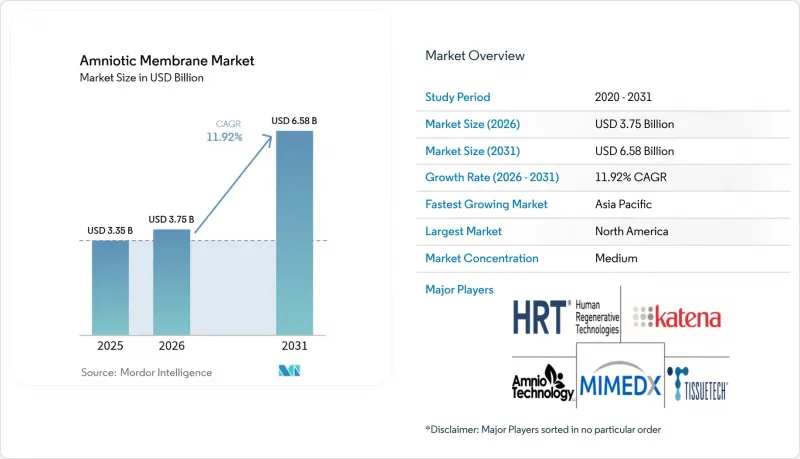
This report is Segmented by Preservation Method (Cryopreserved, Dehydrated), Thickness (Single-Layer, Multi-Layer), Application (Ophthalmology, Surgical and Chronic Wounds, Orthopedics & Sports Medicine, Burn Management, Others), End-User (Hospitals, Ambulatory Surgical Centers, and More), and Geography (North America, Europe, and More). The Market Forecasts are Provided in Terms of Value (USD).
Global Amniotic Membrane Market Trends and Insights
Rise in road-traffic accident & trauma burden
Emergency departments worldwide treat a growing number of complex wounds that benefit from biological dressings able to shorten healing time. Cryopreserved amniotic membranes have shown a 95.5% median wound-size reduction after 12 weeks in burn patients . National trauma guidelines increasingly reference these grafts for rapid epithelialization, and the World Health Organization prioritizes affordable trauma care protocols in developing regions. The resulting pull from both high-income and low-income markets underpins steady unit expansion during the medium term.
Escalating ophthalmic surgery volumes in ageing populations
Longer life expectancy drives higher rates of corneal repair, pterygium excision and severe dry-eye interventions. A sutureless dehydrated amniotic application reduced Ocular Surface Disease Index scores by 65% at six months in a recent randomized study. Medicare's HCPCS code V2790 now allows separate billing for human amniotic membrane when used with select ocular CPT codes, cementing routine use in U.S. ambulatory surgery centers . Comparable reimbursement pathways are emerging in Western Europe and Japan, making ophthalmology the anchor segment of the amniotic membrane market.
Shortage of standardized processing guidelines & skilled tissue-bank staff
Amniotic membrane processing demands rigorous donor screening and aseptic technique, yet regulatory guidance still varies widely. The American Association of Tissue Banks reports that many facilities struggle to align with evolving FDA expectations, slowing scale-up in resource-constrained settings. Training bottlenecks hinder capacity growth even when raw tissue supply is available.
Other drivers and restraints analyzed in the detailed report include:
- Growing clinical evidence & awareness of amniotic-derived biologics
- Government incentives for advanced wound-care adoption
- High cost of cryopreservation logistics
For complete list of drivers and restraints, kindly check the Table Of Contents.
Segment Analysis
Dehydrated grafts commanded 58.62% amniotic membrane market share in 2025 thanks to shelf-stable logistics that fit lean hospital inventories. Nonetheless, cryopreserved products are growing at a 12.41% CAGR because they keep cellular components intact, boosting growth-factor delivery for recalcitrant wounds. One multicenter burn study showed cryopreserved allografts outperformed dehydrated peers in time-to-closure, underpinning the segment's expansion.
Developers are closing the logistics gap via next-gen lyophilization that retains cell viability while allowing ambient storage-a hybrid model projected to widen total amniotic membrane market size for advanced preservation platforms by 2031. Suppliers able to scale both dehydration and cryopreservation lines stay best positioned to capture mixed provider preferences.
Single-layer sheets still own 68.10% of revenue; yet multi-layer formats are accelerating at 12.55% CAGR because they withstand mechanical stress and release bioactive signals over longer intervals. Ultra-thick constructs enabled orbit socket reconstructions impossible with earlier patches, expanding the overall amniotic membrane market. However, extra lamination steps raise quality-control complexity, providing a moat for firms with automated stacking technologies.
As freeze-dried multi-layer lines reach parity in handling time with single-layer sheets, clinicians increasingly deploy them for orthopedic or large-area burns. That premium adoption trajectory lifts total amniotic membrane market size even in mature regions.
Complete Report Scope:
- By Preservation Method
- Cryopreserved
- Dehydrated
- By Thickness
- Single-layer
- Multi-layer
- By Application
- Ophthalmology
- Surgical and Chronic Wounds
- Orthopedics & Sports Medicine
- Burn Management
- Others
- By End-User
- Hospitals
- Ambulatory Surgical Centers
- Specialty Clinics
- Others
- By Geography
- North America
- United States
- Canada
- Mexico
- Europe
- Germany
- United Kingdom
- France
- Italy
- Spain
- Rest of Europe
- Asia-Pacific
- China
- Japan
- India
- Australia
- South Korea
- Rest of Asia-Pacific
- Middle East and Africa
- GCC
- South Africa
- Rest of Middle East and Africa
- South America
- Brazil
- Argentina
- Rest of South America
- North America
Geography Analysis
North America held 41.85% of global revenue in 2025, driven by Medicare's national payment rate and a clear regulatory path for tissue allografts. The amniotic membrane market size in the United States grows steadily as clinics shift chronic-ulcer care toward regenerative protocols. Canada's provincial payers are adding coverage, and Mexico gears policy pilots around diabetic-foot management, securing region-wide momentum.
Asia-Pacific is the growth engine, slated for a 12.67% CAGR through 2031. China's RMB 205 trillion health-spending plan subsidizes hospitals that adopt innovative biologics, propelling volume uptake. Japan and South Korea fast-track approvals under regenerative-medicine frameworks, while India's expanding private hospital network pursues cost-effective wound solutions, enlarging the amniotic membrane market across diverse payer models.
Europe shows mid-single-digit revenue expansion backed by mature reimbursement but tempered by stringent tissue directives that slow new-product launches. Germany and the United Kingdom drive procedure counts, whereas Southern Europe advances gradually amid fiscal constraints.
Middle East & Africa and South America grow from a smaller base. Gulf states fund premium grafts in burn centers, yet donor-tissue logistics remain hurdles elsewhere. Brazil's SUS system pilots outpatient amniotic therapy for diabetic ulcers, signaling longer-term lift for regional amniotic membrane market adoption.
- MiMedx Group
- Integra LifeSciences
- Organogenesis Holdings
- TissueTech (BioTissue)
- Katena / Corza Ophthalmology
- Amnio Technology
- Surgenex
- VIVEX Biologics
- Human Regenerative Technologies
- Merakris Therapeutics
- Integra OrthoBiologics (AmnioExcel)
- NuVision Biotherapies
- Celularity
- Smith & Nephew (Apligraf)
- Skye Biologics
- Amniox Medical
- Laboratoire CCD
- Sentrex Bio
- Alliqua BioMedical
- Applied Biologics
Additional Benefits:
- The market estimate (ME) sheet in Excel format
- 3 months of analyst support
TABLE OF CONTENTS
1 Introduction
- 1.1 Study Assumptions & Market Definition
- 1.2 Scope of the Study
2 Research Methodology
3 Executive Summary
4 Market Landscape
- 4.1 Market Overview
- 4.2 Market Drivers
- 4.2.1 Rise In Road-Traffic Accident & Trauma Burden
- 4.2.2 Escalating Ophthalmic Surgery Volumes in Ageing Populations
- 4.2.3 Growing Clinical Evidence & Awareness of Amniotic-Derived Biologics
- 4.2.4 Government Incentives for Advanced Wound-Care Adoption
- 4.2.5 Rapid Uptake of Composite Amnion-ECM Combination Grafts
- 4.2.6 Emerging Veterinary Ophthalmology Use-Cases
- 4.3 Market Restraints
- 4.3.1 Shortage Of Standardized Processing Guidelines & Skilled Tissue-Bank Staff
- 4.3.2 High Cost of Cryopreservation Logistics
- 4.3.3 Ethical / Procurement Controversies Around Placental Tissue
- 4.3.4 Donor-Dependent Supply?Chain Fragility
- 4.4 Regulatory Landscape
- 4.5 Technological Outlook
- 4.6 Porters Five Forces Analysis
- 4.6.1 Threat of New Entrants
- 4.6.2 Bargaining Power of Buyers
- 4.6.3 Bargaining Power of Suppliers
- 4.6.4 Threat of Substitutes
- 4.6.5 Competitive Rivalry
5 Market Size & Growth Forecasts (Value, USD)
- 5.1 By Preservation Method
- 5.1.1 Cryopreserved
- 5.1.2 Dehydrated
- 5.2 By Thickness
- 5.2.1 Single-layer
- 5.2.2 Multi-layer
- 5.3 By Application
- 5.3.1 Ophthalmology
- 5.3.2 Surgical and Chronic Wounds
- 5.3.3 Orthopedics & Sports Medicine
- 5.3.4 Burn Management
- 5.3.5 Others
- 5.4 By End-User
- 5.4.1 Hospitals
- 5.4.2 Ambulatory Surgical Centers
- 5.4.3 Specialty Clinics
- 5.4.4 Others
- 5.5 By Geography
- 5.5.1 North America
- 5.5.1.1 United States
- 5.5.1.2 Canada
- 5.5.1.3 Mexico
- 5.5.2 Europe
- 5.5.2.1 Germany
- 5.5.2.2 United Kingdom
- 5.5.2.3 France
- 5.5.2.4 Italy
- 5.5.2.5 Spain
- 5.5.2.6 Rest of Europe
- 5.5.3 Asia-Pacific
- 5.5.3.1 China
- 5.5.3.2 Japan
- 5.5.3.3 India
- 5.5.3.4 Australia
- 5.5.3.5 South Korea
- 5.5.3.6 Rest of Asia-Pacific
- 5.5.4 Middle East and Africa
- 5.5.4.1 GCC
- 5.5.4.2 South Africa
- 5.5.4.3 Rest of Middle East and Africa
- 5.5.5 South America
- 5.5.5.1 Brazil
- 5.5.5.2 Argentina
- 5.5.5.3 Rest of South America
- 5.5.1 North America
6 Competitive Landscape
- 6.1 Market Concentration
- 6.2 Market Share Analysis
- 6.3 Company Profiles (includes Global level Overview, Market level overview, Core Segments, Financials as available, Strategic Information, Market Rank/Share for key companies, Products & Services, and Recent Developments)
- 6.3.1 MiMedx Group
- 6.3.2 Integra LifeSciences
- 6.3.3 Organogenesis Holdings
- 6.3.4 TissueTech (BioTissue)
- 6.3.5 Katena / Corza Ophthalmology
- 6.3.6 Amnio Technology
- 6.3.7 Surgenex
- 6.3.8 VIVEX Biologics
- 6.3.9 Human Regenerative Technologies
- 6.3.10 Merakris Therapeutics
- 6.3.11 Integra OrthoBiologics (AmnioExcel)
- 6.3.12 NuVision Biotherapies
- 6.3.13 Celularity
- 6.3.14 Smith & Nephew (Apligraf)
- 6.3.15 Skye Biologics
- 6.3.16 Amniox Medical
- 6.3.17 Laboratoire CCD
- 6.3.18 Sentrex Bio
- 6.3.19 Alliqua BioMedical
- 6.3.20 Applied Biologics
7 Market Opportunities & Future Outlook
- 7.1 White-space & Unmet-need Assessment

