PUBLISHER: Mordor Intelligence | PRODUCT CODE: 2114901

PUBLISHER: Mordor Intelligence | PRODUCT CODE: 2114901
Companion Animal Diagnostic - Market Share Analysis, Industry Trends & Statistics, Growth Forecasts (2026 - 2031)
According to Mordor Intelligence, the companion animal diagnostic market size is projected to expand from USD 3.42 billion in 2025 and USD 3.77 billion in 2026 to USD 6.10 billion by 2031, registering a CAGR of 10.20% between 2026 to 2031.
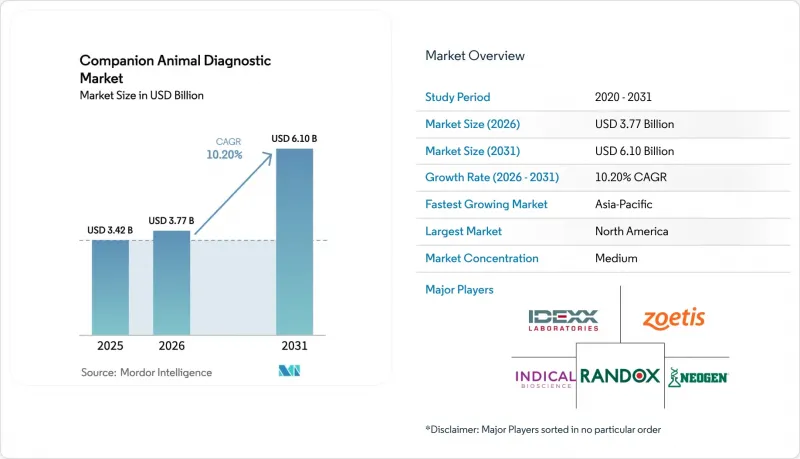
This report Segments the Industry Into by Animals (Cats, Dogs, Other Companion Animals), Application (Bacteriology, Parasitology, and More), Technology (Immunodiagnostic Tests, Molecular Diagnostics, Diagnostic Imaging, Other Diagnostics), and Geography (North America, Europe, Asia-Pacific, Middle East and Africa, South America). The Market Forecasts are Provided in Terms of Value (USD).
Global Companion Animal Diagnostic Market Trends and Insights
Rising Demand for Pet Insurance
North America closed 2023 with 5.36 million insured pets, a 6.8% year-on-year rise that still covered just 5.7% of the eligible population . Each percentage-point gain unlocks roughly USD 150 million in incremental test spending because insured owners are more than three times as likely to authorize advanced imaging and molecular panels. Mature European markets continue to expand more slowly, yet Australia doubled penetration to 21% by 2024, illustrating room for late-stage acceleration. Insurers increasingly bundle annual blood and urine panels into wellness policies, smoothing demand across economic cycles. Manufacturers that secure formulary inclusion can ride these prepaid volumes and protect pricing integrity.
Growth in Companion Animal Population
Urban Asia-Pacific now drives household pet acquisition: Japan's dog-and-cat population reached 18.4 million in 2024, while China surpassed 120 million across tier-1 and tier-2 cities. Demography alone, however, does not ensure revenue; India's ratio of one veterinarian for every 10,000 pets suppresses clinical test uptake despite a 30 million-dog population. The inflection occurs once middle-class households consistently allocate USD 300-500 per year to preventive care, a threshold now visible in Beijing, Shanghai, and Bengaluru. Global suppliers that pair lower-cost panels with remote-reading apps are best positioned to convert latent demand into billable volume.
Limited Reimbursement Outside North America & Europe
Latin America has fewer than 400,000 insured pets despite an 80 million-animal base, while Southeast Asia has fewer than 250,000 insured pets, leaving molecular assays priced at USD 80-150 beyond reach for most clinics. Cash-pay markets gravitate toward USD 25-40 chemistry panels, limiting diagnostic depth. Vendors must choose between discounted emerging-market SKUs or delayed entry until insurance platforms mature.
Other drivers and restraints analyzed in the detailed report include:
- Increasing Number of Veterinary Practitioners in Developed Economies
- AI-Enabled Point-of-Care Analytics Lowering Diagnostic Turnaround
- Escalating Overall Pet-Care Costs
For complete list of drivers and restraints, kindly check the Table Of Contents.
Segment Analysis
Dogs generated 41.5% of the companion animal diagnostic market revenue in 2025, supported by 65.1 million dog households in the United States and higher per-animal spend on breed-specific screening. Exotic pets, including birds and rabbits, will outpace all categories at an 11.23% CAGR, fueled by new multiplex PCR panels able to detect twelve psittacine pathogens from a single swab.
The segment's momentum reflects a 14% rise in board-certified avian and exotic practitioners in 2024, creating professional demand for specialized assays. Economies of scope allow one USD 15 multiplex test to replace three separate USD 60 single-pathogen assays, expanding routine screening. This tailwind positions the exotic category as a pivotal contributor to companion animal diagnostic market growth between 2026 and 2031.
Clinical pathology held 33.4% of application revenue in 2025, anchoring wellness exams and pre-anesthetic workups. Parasitology is projected to lead growth at an 11.78% CAGR, driven by at-home fecal kits mailed to reference labs, a workflow pioneered by Labrador's USD 79 subscription.
Mail-in convenience appeals to time-constrained pet owners and removes clinic visit barriers, a model that processed 12,000 samples in Q3 2024 alone. Clinics counter by bundling parasite screens into puppy and kitten packages, preserving some in-house volume. Nevertheless, remote fecal testing will inject new recurring revenue into the companion animal diagnostic market while challenging clinic-centric sales channels.
Complete Report Scope:
- By Animal
- Cats
- Dogs
- Other Companion Animals (birds, rabbits, etc.)
- By Application
- Bacteriology
- Parasitology
- Clinical Pathology
- Other Applications
- By Technology
- Immunodiagnostic Tests
- Molecular Diagnostics
- Diagnostic Imaging
- Other Diagnostics (biosensors, microfluidics)
- By End-User
- Veterinary Hospitals & Clinics
- Diagnostic Laboratories
- Others (Point-of-Care/In-house Testing and Research & Academic Institutes)
- Geography
- North America
- United States
- Canada
- Mexico
- Europe
- Germany
- United Kingdom
- France
- Italy
- Spain
- Rest of Europe
- Asia-Pacific
- China
- Japan
- India
- Australia
- South Korea
- Rest of APAC
- Middle East & Africa
- GCC
- South Africa
- Rest of Middle East & Africa
- South America
- Brazil
- Argentina
- Rest of South America
- North America
Geography Analysis
North America represented 47.1% of 2025 revenue, buoyed by 5.36 million insured pets and a veterinary workforce exceeding 127,000 practitioners. Average annual spend per dog topped USD 1,200 in 2024, a level that supports early adoption of AI-driven analyzers and multiplex PCR panels. Canada contributes incremental growth, whereas Mexico remains under-penetrated, creating white-space for mid-tier reagent bundles. IDEXX booked 9% organic growth in Q3 2024, largely from North American clinics adding reference instruments.
Europe ranked second by value, propelled by pet insurance penetration above 25% in the United Kingdom and mandatory bacteriology testing under Regulation 2024/1973, a directive expected to lift culture volume by up to 30% within two years . Scandinavia's 40% penetration sustains premium diagnostics, while Southern and Eastern Europe lag due to lower discretionary income. Reference labs in Germany and France are adopting automated microbiology systems that shrink time-to-result to 24 hours, aligning with stewardship timelines.
Asia-Pacific is forecast to deliver an 11.41% CAGR through 2031, led by China's 120 million-plus pet population and Japan's mature clinic infrastructure. Insurance coverage remains below 1% in China, so suppliers courting the region emphasize lower-cost antigen tests and bundled wellness plans. Australia stands out with penetration doubling to 21% by 2024, enabling rapid analyzer installations. India's undersupply of veterinarians caps near-term revenue, yet telemedicine platforms are starting to bridge access gaps in tier-one cities.
- Agrolabo
- bioMerieux
- Mars Veterinary Health
- Creative Diagnostics
- FUJIFILM
- GE Healthcare
- Heska
- IDEXX
- IDvet (Innovative Diagnostics)
- Indical Bioscience
- Neogen
- QIAGEN
- Randox Laboratories
- Thermo Fisher Scientific
- Virbac
- VMRD Inc.
- Zoetis
- Zomedica Corp.
Additional Benefits:
- The market estimate (ME) sheet in Excel format
- 3 months of analyst support
TABLE OF CONTENTS
1 Introduction
- 1.1 Study Assumptions & Market Definition
- 1.2 Scope of the Study
2 Research Methodology
3 Executive Summary
4 Market Landscape
- 4.1 Market Overview
- 4.2 Market Drivers
- 4.2.1 Rising Demand for Pet Insurance
- 4.2.2 Growth In Companion Animal Population
- 4.2.3 Increasing Number of Veterinary Practitioners in Developed Economies
- 4.2.4 AI-Enabled Point-Of-Care Analytics Lowering Diagnostic Turnaround
- 4.2.5 Growing Adoption of Multiplex Panels for Exotic Pets
- 4.2.6 Tele-Veterinary Platforms Integrating At-Home Sample Collection
- 4.3 Market Restraints
- 4.3.1 Escalating Overall Pet-Care Costs
- 4.3.2 Limited Reimbursement Outside North America & Europe
- 4.3.3 Shortage of Cold-Chain Logistics for Advanced Reagents in Emerging Markets
- 4.3.4 Rising Antimicrobial-Resistance Regulations Slowing Bacteriology Test Approvals
- 4.4 Supply-Chain Analysis
- 4.5 Regulatory Landscape
- 4.6 Technological Outlook
- 4.7 Porter's Five Forces Analysis
- 4.7.1 Bargaining Power of Buyers/Consumers
- 4.7.2 Bargaining Power of Suppliers
- 4.7.3 Threat of New Entrants
- 4.7.4 Threat of Substitute Products
- 4.7.5 Intensity of Competitive Rivalry
5 Market Size & Growth Forecasts (Value, USD)
- 5.1 By Animal
- 5.1.1 Cats
- 5.1.2 Dogs
- 5.1.3 Other Companion Animals (birds, rabbits, etc.)
- 5.2 By Application
- 5.2.1 Bacteriology
- 5.2.2 Parasitology
- 5.2.3 Clinical Pathology
- 5.2.4 Other Applications
- 5.3 By Technology
- 5.3.1 Immunodiagnostic Tests
- 5.3.2 Molecular Diagnostics
- 5.3.3 Diagnostic Imaging
- 5.3.4 Other Diagnostics (biosensors, microfluidics)
- 5.4 By End-User
- 5.4.1 Veterinary Hospitals & Clinics
- 5.4.2 Diagnostic Laboratories
- 5.4.3 Others (Point-of-Care/In-house Testing and Research & Academic Institutes)
- 5.5 Geography
- 5.5.1 North America
- 5.5.1.1 United States
- 5.5.1.2 Canada
- 5.5.1.3 Mexico
- 5.5.2 Europe
- 5.5.2.1 Germany
- 5.5.2.2 United Kingdom
- 5.5.2.3 France
- 5.5.2.4 Italy
- 5.5.2.5 Spain
- 5.5.2.6 Rest of Europe
- 5.5.3 Asia-Pacific
- 5.5.3.1 China
- 5.5.3.2 Japan
- 5.5.3.3 India
- 5.5.3.4 Australia
- 5.5.3.5 South Korea
- 5.5.3.6 Rest of APAC
- 5.5.4 Middle East & Africa
- 5.5.4.1 GCC
- 5.5.4.2 South Africa
- 5.5.4.3 Rest of Middle East & Africa
- 5.5.5 South America
- 5.5.5.1 Brazil
- 5.5.5.2 Argentina
- 5.5.5.3 Rest of South America
- 5.5.1 North America
6 Competitive Landscape
- 6.1 Market Concentration
- 6.2 Market Share Analysis
- 6.3 Company Profiles (includes Global level Overview, Market level overview, Core Segments, Financials as available, Strategic Information, Market Rank/Share for key companies, Products & Services, and Recent Developments)
- 6.3.1 Agrolabo SpA
- 6.3.2 BioMerieux SA
- 6.3.3 Mars Veterinary Health
- 6.3.4 Creative Diagnostics
- 6.3.5 FUJIFILM SonoSite Inc.
- 6.3.6 GE HealthCare
- 6.3.7 Heska Corporation
- 6.3.8 IDEXX Laboratories Inc.
- 6.3.9 IDvet (Innovative Diagnostics)
- 6.3.10 INDICAL Bioscience GmbH
- 6.3.11 Neogen Corporation
- 6.3.12 QIAGEN N.V.
- 6.3.13 Randox Laboratories Ltd.
- 6.3.14 Thermo Fisher Scientific Inc.
- 6.3.15 Virbac
- 6.3.16 VMRD Inc.
- 6.3.17 Zoetis Inc.
- 6.3.18 Zomedica Corp.
7 Market Opportunities & Future Outlook
- 7.1 White-Space & Unmet-Need Assessment

