PUBLISHER: Mordor Intelligence | PRODUCT CODE: 2114907

PUBLISHER: Mordor Intelligence | PRODUCT CODE: 2114907
Body Contouring Devices - Market Share Analysis, Industry Trends & Statistics, Growth Forecasts (2026 - 2031)
According to Mordor Intelligence, the body contouring devices market size was valued at USD 1.60 billion in 2025 and estimated to grow from USD 1.82 billion in 2026 to reach USD 3.45 billion by 2031, at a CAGR of 13.68% during the forecast period (2026-2031).
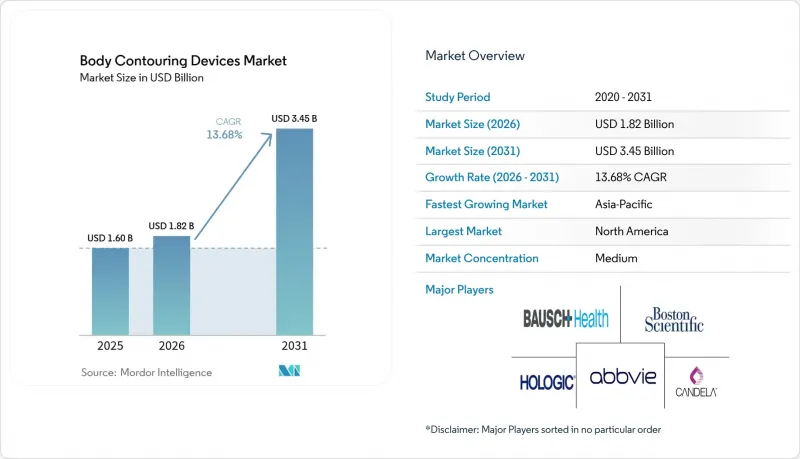
This report is Segmented by Product Type (Non-Invasive & Minimally Invasive Devices [Cryolipolysis Systems, and More] and Invasive Devices [Laser-Assisted Liposuction, and More]), Application (Fat Reduction, Skin Tightening and More), End-User (Hospitals, Medical Spas, and More), and Geography (North America, Europe, Asia-Pacific, and More). The Market Forecasts are Provided in Terms of Value (USD).
Global Body Contouring Devices Market Trends and Insights
Growing Adoption of Minimally Invasive & Non-Invasive Procedures
Patient preference has pivoted firmly toward less disruptive approaches that reduce downtime and visible bruising. Cryolipolysis devices, for example, can trim 20-25% of subcutaneous fat after a single session, while patient-reported pain scores remain low. Post-pandemic self-scrutiny amplified demand, and a 2024 survey showed that 63% of facial-aesthetic clients were first-time entrants to medical aesthetics. Multi-modality workstations now fuse HIFEM with radiofrequency, letting clinicians offer simultaneous muscle toning and fat lysis in under 30 minutes. Medical spas scale these offerings through loyalty memberships, and early trials of at-home suction-RF-EMS gadgets demonstrate measurable circumference loss, suggesting a future omnichannel ecosystem.
Technological Advancements in RF, Cryolipolysis & HIFEM
Engineering improvements focus on deeper, more uniform energy delivery and broader patient suitability. A next-generation HIFEM platform recently secured two additional FDA clearances covering darker Fitzpatrick skin types and lateral-thigh lipolysis, with MRI studies confirming 1.4 cm average fat-layer reduction. Fractionated RF handpieces now penetrate variable tissue depths, enabling precise collagen remodelling. Laboratory work on cerium-doped calcium carbonate particles paired with low-intensity ultrasound hints at a non-thermal pathway for adipocyte apoptosis. These breakthroughs underpin the body contouring devices market as manufacturers race to patent differentiated heat, cold or electromagnetic algorithms that promise consistent outcomes.
High Capital Cost of Advanced Devices & Procedures
Premium multi-modality systems can exceed USD 100,000, a figure that rises once training, disposables and annual maintenance contracts are included. Public filings from a leading manufacturer revealed that supply-chain expenses now equate to 20% of revenue, forcing aggressive cost-optimisation programmes. Smaller clinics in emerging economies struggle to attain payback within the typical 18-month horizon, hindering penetration into price-sensitive segments.
Other drivers and restraints analyzed in the detailed report include:
- Rising Prevalence of Obesity & Aesthetic Consciousness
- Expanding Medical Tourism in Emerging Economies
- Stringent Regulatory & Safety Compliance Requirements
For complete list of drivers and restraints, kindly check the Table Of Contents.
Segment Analysis
Non-invasive platforms owned 58.23% of 2025 revenue, and this share is forecast to widen as the category propels an 17.95% CAGR through 2031 in the body contouring devices market. Cryolipolysis heads the field, with real-world studies confirming 20-25% single-session fat volume reduction. HIFEM-RF hybrids further expand use-cases by delivering concurrent adipocyte apoptosis and myofibril hypertrophy. Invasive devices such as power-assisted liposuction remain vital for substantial debulking but grow at a slower clip as patients increasingly favour lunchtime procedures.
The competitive edge within non-invasive systems now lies in applicator ergonomics, cooling efficiency and electromagnetic field homogeneity. Vendors file rapid-fire patents around sensor-based temperature cut-offs and closed-loop impedance monitoring. Meanwhile, ultrasound-assisted lipoplasty evolves to address dense fibrous fat with lower ecchymosis, keeping an important albeit niche foothold in the body contouring devices industry.
Complete Report Scope:
- By Product Type
- Non-Invasive & Minimally Invasive Devices
- Cryolipolysis Systems
- Radiofrequency Devices
- Laser-Assisted Lipolysis Devices
- HIFEM Devices
- Ultrasound Cavitation Devices
- Other Emerging Modalities
- Invasive Devices
- Power-Assisted Liposuction Systems
- Ultrasound-Assisted Liposuction
- Laser-Assisted Liposuction
- Tumescent Liposuction Systems
- Other Invasive Systems
- Non-Invasive & Minimally Invasive Devices
- By Application
- Fat Reduction
- Skin Tightening & Cellulite Reduction
- Muscle Toning & Definition
- Post-Bariatric Body Contouring
- Other Niche Applications
- By End-User
- Hospitals
- Specialty Clinics & Dermatology Centers
- Medical Spas
- Ambulatory Surgical Centers
- Home-Use / At-Home Users
- Geography
- North America
- United States
- Canada
- Mexico
- Europe
- Germany
- United Kingdom
- France
- Italy
- Spain
- Rest of Europe
- Asia-Pacific
- China
- Japan
- India
- South Korea
- Australia
- Rest of Asia-Pacific
- Middle East and Africa
- GCC
- South Africa
- Rest of Middle East and Africa
- South America
- Brazil
- Argentina
- Rest of South America
- North America
Geography Analysis
North America accounted for 39.42% of 2025 revenue, underpinned by sophisticated aesthetic-medicine infrastructure and robust discretionary spending. United States physicians increasingly embed body contouring into multidisciplinary obesity-care pathways, aided by the surge in weight-loss drug prescriptions. Canada smooths device adoption through technology-specific regulatory fast-tracks, while cross-border clients from Mexico bolster procedure volumes.
Europe offers a deeply regulated yet opportunity-rich landscape. Uniform MDR rules elevate safety standards and filter sub-par devices, fostering practitioner trust. Germany, France and the United Kingdom anchor demand, and rising retirement-age populations with higher disposable savings pursue combined tightening and fat-reduction packages. Clinics leverage pan-European distributor networks to secure service cover and parts supply, safeguarding uptime amid supply-chain uncertainties.
Asia-Pacific delivers the fastest trajectory at a projected 17.05% CAGR to 2031 in the body contouring devices market. Rapid urbanisation and social-media-driven beauty ideals propel procedure counts in China, South Korea and Japan. India's speciality hospitals capture international clients seeking competitively priced liposuction and sculpting bundles, while Thailand positions itself as a recovery-tourism haven. Domestic manufacturers in China pilot cost-competitive RF machines that could challenge incumbents if international certifications are achieved.
- Abbvie
- Hologic
- Candela Medical
- Boston Scientific Corp. (Lumenis)
- Bausch Health
- Alma Lasers
- BTL Industries (BTL Aesthetics)
- Cutera
- InMode Ltd.
- Candela Medical
- Apyx Medical Corp.
- Lutronic Corp.
- Merz Pharma
- MicroAire
- Sculpting Technologies Inc.
- Venus Concept Inc.
- Sciton
- Fotona d.o.o.
- Sisram Medical Ltd.
Additional Benefits:
- The market estimate (ME) sheet in Excel format
- 3 months of analyst support
TABLE OF CONTENTS
1 Introduction
- 1.1 Study Assumptions & Market Definition
- 1.2 Scope of the Study
2 Research Methodology
3 Executive Summary
4 Market Landscape
- 4.1 Market Overview
- 4.2 Market Drivers
- 4.2.1 Growing Adoption of Minimally Invasive & Non-Invasive Procedures
- 4.2.2 Technological Advancements in RF, Cryolipolysis & HIFEM
- 4.2.3 Rising Prevalence of Obesity & Aesthetic Consciousness
- 4.2.4 Expanding Medical Tourism in Emerging Economies
- 4.2.5 AI-Enabled Personalised Treatment Protocols
- 4.2.6 Subscription-Based Med-Spa Business Models
- 4.3 Market Restraints
- 4.3.1 High Capital Cost of Advanced Devices & Procedures
- 4.3.2 Stringent Regulatory & Safety Compliance Requirements
- 4.3.3 Shortage of Qualified Aesthetic Practitioners
- 4.3.4 Semiconductor Supply-Chain Volatility
- 4.4 Technological Outlook
- 4.5 Porter's Five Forces Analysis
- 4.5.1 Threat of New Entrants
- 4.5.2 Bargaining Power of Buyers
- 4.5.3 Bargaining Power of Suppliers
- 4.5.4 Threat of Substitute Products
- 4.5.5 Intensity of Competitive Rivalry
5 Market Size & Growth Forecasts (Value, USD)
- 5.1 By Product Type
- 5.1.1 Non-Invasive & Minimally Invasive Devices
- 5.1.1.1 Cryolipolysis Systems
- 5.1.1.2 Radiofrequency Devices
- 5.1.1.3 Laser-Assisted Lipolysis Devices
- 5.1.1.4 HIFEM Devices
- 5.1.1.5 Ultrasound Cavitation Devices
- 5.1.1.6 Other Emerging Modalities
- 5.1.2 Invasive Devices
- 5.1.2.1 Power-Assisted Liposuction Systems
- 5.1.2.2 Ultrasound-Assisted Liposuction
- 5.1.2.3 Laser-Assisted Liposuction
- 5.1.2.4 Tumescent Liposuction Systems
- 5.1.2.5 Other Invasive Systems
- 5.1.1 Non-Invasive & Minimally Invasive Devices
- 5.2 By Application
- 5.2.1 Fat Reduction
- 5.2.2 Skin Tightening & Cellulite Reduction
- 5.2.3 Muscle Toning & Definition
- 5.2.4 Post-Bariatric Body Contouring
- 5.2.5 Other Niche Applications
- 5.3 By End-User
- 5.3.1 Hospitals
- 5.3.2 Specialty Clinics & Dermatology Centers
- 5.3.3 Medical Spas
- 5.3.4 Ambulatory Surgical Centers
- 5.3.5 Home-Use / At-Home Users
- 5.4 Geography
- 5.4.1 North America
- 5.4.1.1 United States
- 5.4.1.2 Canada
- 5.4.1.3 Mexico
- 5.4.2 Europe
- 5.4.2.1 Germany
- 5.4.2.2 United Kingdom
- 5.4.2.3 France
- 5.4.2.4 Italy
- 5.4.2.5 Spain
- 5.4.2.6 Rest of Europe
- 5.4.3 Asia-Pacific
- 5.4.3.1 China
- 5.4.3.2 Japan
- 5.4.3.3 India
- 5.4.3.4 South Korea
- 5.4.3.5 Australia
- 5.4.3.6 Rest of Asia-Pacific
- 5.4.4 Middle East and Africa
- 5.4.4.1 GCC
- 5.4.4.2 South Africa
- 5.4.4.3 Rest of Middle East and Africa
- 5.4.5 South America
- 5.4.5.1 Brazil
- 5.4.5.2 Argentina
- 5.4.5.3 Rest of South America
- 5.4.1 North America
6 Competitive Landscape
- 6.1 Market Concentration
- 6.2 Market Share Analysis
- 6.3 Company Profiles (includes Global level Overview, Market level overview, Core Segments, Financials as available, Strategic Information, Market Rank/Share for key companies, Products & Services, and Recent Developments)
- 6.3.1 AbbVie Inc. (Allergan Aesthetics)
- 6.3.2 Hologic Inc. (Cynosure)
- 6.3.3 Candela Medical
- 6.3.4 Boston Scientific Corp. (Lumenis)
- 6.3.5 Bausch Health Companies Inc.
- 6.3.6 Alma Lasers Ltd.
- 6.3.7 BTL Industries (BTL Aesthetics)
- 6.3.8 Cutera Inc.
- 6.3.9 InMode Ltd.
- 6.3.10 Syneron Medical Ltd.
- 6.3.11 Apyx Medical Corp.
- 6.3.12 Lutronic Corp.
- 6.3.13 Merz Pharma GmbH & Co. KGaA
- 6.3.14 MicroAire Surgical Instruments LLC
- 6.3.15 Sculpting Technologies Inc.
- 6.3.16 Venus Concept Inc.
- 6.3.17 Sciton Inc.
- 6.3.18 Fotona d.o.o.
- 6.3.19 Sisram Medical Ltd.
7 Market Opportunities & Future Outlook
- 7.1 White-Space & Unmet-Need Assessment

