PUBLISHER: Mordor Intelligence | PRODUCT CODE: 2114913

PUBLISHER: Mordor Intelligence | PRODUCT CODE: 2114913
Carbon Fiber Tape - Market Share Analysis, Industry Trends & Statistics, Growth Forecasts (2026 - 2031)
According to Mordor Intelligence, the carbon fiber tape market size is expected to grow from USD 2.67 billion in 2025 to USD 2.83 billion in 2026 and is forecast to reach USD 3.81 billion by 2031 at 6.08% CAGR over 2026-2031.
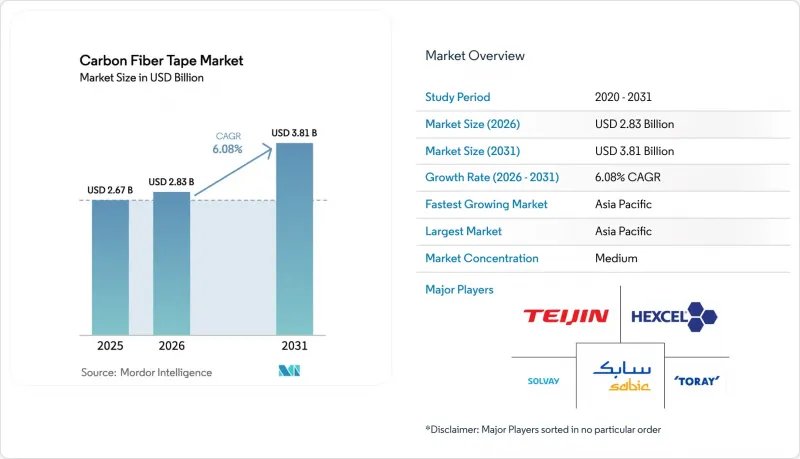
This report is Segmented by Type (Prepreg Tape, Dry Tape), Resin Type (Epoxy, Polyamide, and More), Manufacturing Process (Hot-Melt Prepreg, Solvent Dip, and More), End-User Industry (Aerospace and Defense, Automotive, and More), and Geography (Asia-Pacific, North America, Europe, South America, Middle East and Africa). The Market Forecasts are Provided in Terms of Value (USD).
Global Carbon Fiber Tape Market Trends and Insights
Surging Aerospace Demand for Lightweight Primary Structures
Commercial and defense airframers are replacing metallic wing spars, fuselage skins, and floor beams with carbon fiber tape lay-ups that deliver durability alongside 20% weight savings, a metric validated by the Boeing 787 and Airbus A350 programs. Automated fiber placement cells amplify demand because they require uniform tape widths and consistent tack to achieve high deposition rates without defects. NASA's HiCAM initiative, which pairs Toray's carbon fiber with rapid-cure prepregs, exemplifies how public-private research is compressing cycle times for wide-body and single-aisle structures. As qualification datasets mature, more primary structures migrate to tape-based designs, securing long-run growth for certified suppliers.
Ramp-up of Next-Gen Single-Aisle Aircraft Production
Airbus and Boeing have committed to double-digit monthly build-rates for the A320neo and 737 MAX families. These narrow-body programs consume large volumes of secondary and interior composite parts that are increasingly manufactured from tape because of its predictable fiber orientation and minimal material wastage. Equipment provider MTorres has introduced dry-fiber tape formats that enable producers to infuse resin in-house, cutting raw material costs by up to 50% while safeguarding mechanical performance. With total carbon fiber consumption in commercial aerospace projected to climb from 16,500 t in 2021 to 29,100 t by 2026, tape is positioned as the dominant intermediate form feeding the supply chains of tier-1 and tier-2 suppliers.
High Precursor and Processing Costs
Polyacrylonitrile accounts for half to three-quarters of finished fiber price, and the multi-stage oxidation/carbonization route is power intensive, leaving producers exposed to energy spikes. Market prices average USD 15 kg for industrial grades and exceed USD 85,000 t for aerospace classes, levels that restrain penetration into cost-sensitive sectors such as standard-range passenger cars. Research at the University of Limerick demonstrated microwave carbonization that could cut energy use by 70%, but commercialization remains distant. Until lignin-based or other low-cost precursors reach scale, tape producers must pursue incremental process yields and vertical integration to manage margin compression.
Other drivers and restraints analyzed in the detailed report include:
- Automotive Shift to Carbon Fiber Reinforced Plastics for EV Range Extension
- Wind-Turbine Blade Lengthening Needs High-Modulus Tapes
- Feedstock Price and Energy-Cost Volatility
For complete list of drivers and restraints, kindly check the Table Of Contents.
Segment Analysis
Prepreg variants held 63.45% carbon fiber tape market share in 2025 because they deliver uniform resin content, stable tack, and predictable cure profiles that aerospace primes specify for primary structures. Dry tape, in contrast, posted a leading 6.72% CAGR and is gaining acceptance as automated fiber placement systems mature and as tier-1 suppliers appreciate the logistics benefits of ambient storage. The cost differential widens as high-volume programs exploit in-line resin infusion, positioning dry tape as the economical alternative for secondary parts.
Prepreg's foothold is defended by refinements such as extended out-time and tougher resin chemistries that raise damage tolerance in thicker laminates. However, dry tape vendors answer with proprietary sizing agents that enhance resin wet-out and with slit-tape formats down to 3 mm that allow precise steering around tight radii. Tape lines that can switch between prepreg and dry, depending on order mix, provide supply flexibility coveted by vertically integrated producers serving both aerospace and wind customers.
Epoxy systems constituted 48.75% of global volume in 2025, reflecting decades of certification data and proven performance at service temperatures up to 120 °C. Their dominance also mirrors well-developed supply networks that support just-in-time deliveries to both tier-1 and tier-2 aerospace fabricators. The "other resins" basket, which includes thermoplastic families such as PEEK and PPS, is expanding at 6.85% CAGR as automotive and hydrogen tank applications require fast processing and recyclability.
Epoxy suppliers continue to engineer fracture-toughened grades and snap-cure formulations that can be out-of-autoclave processed. Thermoplastic innovators respond with lower-melt-viscosity matrices that facilitate consolidation at sub-400 °C and with carbon-fiber-reinforced unidirectional tapes suitable for over-molding into hybrid structures. Polyamide and vinyl ester occupy niche marine and chemical containment roles, while bio-based options remain pre-commercial but are attracting automotive OEM pilots that seek end-of-life circularity.
Complete Report Scope:
- By Type
- Prepreg Tape
- Dry Tape
- By Resin Type
- Epoxy
- Polyamide
- Vinyl Ester
- Polyurethane
- Other Resin Types (Thermoplastic (PEEK, PPS), etc.)
- By Manufacturing Process
- Hot-Melt Prepreg
- Solvent Dip
- Automated Fiber Placement (AFP)
- Resin Transfer Infusion
- By End-user Industry
- Aerospace and Defense
- Automotive
- Building and Construction
- Marine
- Energy
- Other End-User Industries (Sporting Goods, etc.)
- By Geography
- Asia-Pacific
- China
- Japan
- India
- South Korea
- ASEAN Countries
- Rest of Asia-Pacific
- North America
- United States
- Canada
- Mexico
- Europe
- Germany
- United Kingdom
- France
- Italy
- Spain
- Russia
- NORDIC Countries
- Rest of Europe
- South America
- Brazil
- Argentina
- Rest of South America
- Middle East and Africa
- Saudi Arabia
- South Africa
- Rest of Middle East and Africa
- Asia-Pacific
Geography Analysis
Asia-Pacific held 36.40% carbon fiber tape market size in 2025 thanks to the intersection of large-scale fiber production in China, robust wind-turbine build-out, and growing domestic aerospace programs. The region's 6.57% CAGR reflects government incentives for renewable capacity and state-sponsored aircraft such as COMAC's C919, which adopt significant composite content. Japanese players Toray and Mitsubishi anchor high-performance fiber output, while South Korean and Indian firms scale mid-grade capacities to service regional mobility and energy demand.
North America follows closely, underpinned by Boeing's assembly lines, a resilient defense budget, and federal funding into hydrogen-powered flight demonstrators. The United States also hosts many automated fiber placement technology suppliers, giving regional converters first access to next-generation deposition heads. Canada leverages a cluster of tier-2 aerospace fabricators, and Mexico emerges as a cost-competitive site for automotive composite parts shipped into U.S. OEMs. Europe commands balanced demand across aerospace, premium automotive, and wind energy. The EU's supportive stance on carbon composites, reaffirmed after the shelved restriction proposal, sustains adoption in both road and aviation segments. Germany's OEMs lead vehicle integration projects; the United Kingdom and France anchor wide-body airframe expertise; and Spain's coastal corridor benefits from large offshore wind deployments. Nordic nations inject momentum through aggressive renewable targets that mandate ever-larger blades, while Eastern Europe offers competitive labor for composite component assembly.
- Axiom Materials
- Cevotec
- Chomarat
- Evonik Industries AG
- Gurit Services AG, Zurich
- Hexcel Corporation
- ITECMA
- McLAREN
- MITSUBISHI GAS CHEMICAL COMPANY, INC.
- NTPT (North Thin Ply Technology)
- Owens Corning
- Porsche
- SABIC
- SGL Carbon
- Solvay
- TCR Composites, Inc.
- Teijin Limited
- TORAY INDUSTRIES, INC.
- Victrex plc
Additional Benefits:
- The market estimate (ME) sheet in Excel format
- 3 months of analyst support
TABLE OF CONTENTS
1 Introduction
- 1.1 Study Assumptions and Market Definition
- 1.2 Scope of the Study
2 Research Methodology
3 Executive Summary
4 Market Landscape
- 4.1 Market Overview
- 4.2 Market Drivers
- 4.2.1 Surging aerospace demand for lightweight primary structures
- 4.2.2 Ramp-up of next-gen single-aisle aircraft production
- 4.2.3 Automotive shift to carbon fiber reinforced plastics (CFRP) for EV range extension
- 4.2.4 Wind-turbine blade lengthening needs high-modulus tapes
- 4.2.5 Cryogenic hydrogen tank winding for zero-carbon aviation
- 4.3 Market Restraints
- 4.3.1 High precursor and processing costs
- 4.3.2 Feedstock price and energy-cost volatility
- 4.3.3 Regulatory qualification bottlenecks for thick laminates
- 4.4 Value Chain Analysis
- 4.5 Porter's Five Forces
- 4.5.1 Bargaining Power of Suppliers
- 4.5.2 Bargaining Power of Buyers
- 4.5.3 Threat of New Entrants
- 4.5.4 Threat of Substitutes
- 4.5.5 Degree of Competition
5 Market Size and Growth Forecasts (Value)
- 5.1 By Type
- 5.1.1 Prepreg Tape
- 5.1.2 Dry Tape
- 5.2 By Resin Type
- 5.2.1 Epoxy
- 5.2.2 Polyamide
- 5.2.3 Vinyl Ester
- 5.2.4 Polyurethane
- 5.2.5 Other Resin Types (Thermoplastic (PEEK, PPS), etc.)
- 5.3 By Manufacturing Process
- 5.3.1 Hot-Melt Prepreg
- 5.3.2 Solvent Dip
- 5.3.3 Automated Fiber Placement (AFP)
- 5.3.4 Resin Transfer Infusion
- 5.4 By End-user Industry
- 5.4.1 Aerospace and Defense
- 5.4.2 Automotive
- 5.4.3 Building and Construction
- 5.4.4 Marine
- 5.4.5 Energy
- 5.4.6 Other End-User Industries (Sporting Goods, etc.)
- 5.5 By Geography
- 5.5.1 Asia-Pacific
- 5.5.1.1 China
- 5.5.1.2 Japan
- 5.5.1.3 India
- 5.5.1.4 South Korea
- 5.5.1.5 ASEAN Countries
- 5.5.1.6 Rest of Asia-Pacific
- 5.5.2 North America
- 5.5.2.1 United States
- 5.5.2.2 Canada
- 5.5.2.3 Mexico
- 5.5.3 Europe
- 5.5.3.1 Germany
- 5.5.3.2 United Kingdom
- 5.5.3.3 France
- 5.5.3.4 Italy
- 5.5.3.5 Spain
- 5.5.3.6 Russia
- 5.5.3.7 NORDIC Countries
- 5.5.3.8 Rest of Europe
- 5.5.4 South America
- 5.5.4.1 Brazil
- 5.5.4.2 Argentina
- 5.5.4.3 Rest of South America
- 5.5.5 Middle East and Africa
- 5.5.5.1 Saudi Arabia
- 5.5.5.2 South Africa
- 5.5.5.3 Rest of Middle East and Africa
- 5.5.1 Asia-Pacific
6 Competitive Landscape
- 6.1 Market Concentration
- 6.2 Strategic Moves
- 6.3 Market Share(%)/Ranking Analysis
- 6.4 Company Profiles (includes Global level Overview, Market level overview, Core Segments, Financials as available, Strategic Information, Market Rank/Share, Products and Services, Recent Developments)
- 6.4.1 Axiom Materials
- 6.4.2 Cevotec
- 6.4.3 Chomarat
- 6.4.4 Evonik Industries AG
- 6.4.5 Gurit Services AG, Zurich
- 6.4.6 Hexcel Corporation
- 6.4.7 ITECMA
- 6.4.8 McLAREN
- 6.4.9 MITSUBISHI GAS CHEMICAL COMPANY, INC.
- 6.4.10 NTPT (North Thin Ply Technology)
- 6.4.11 Owens Corning
- 6.4.12 Porsche
- 6.4.13 SABIC
- 6.4.14 SGL Carbon
- 6.4.15 Solvay
- 6.4.16 TCR Composites, Inc.
- 6.4.17 Teijin Limited
- 6.4.18 TORAY INDUSTRIES, INC.
- 6.4.19 Victrex plc
7 Market Opportunities and Future Outlook
- 7.1 White-space & Unmet-need Assessment

