PUBLISHER: Mordor Intelligence | PRODUCT CODE: 2114919

PUBLISHER: Mordor Intelligence | PRODUCT CODE: 2114919
Naphthalene Derivatives - Market Share Analysis, Industry Trends & Statistics, Growth Forecasts (2026 - 2031)
According to Mordor Intelligence, the naphthalene derivatives market size is expected to grow from USD 1.92 billion in 2025 to USD 1.98 billion in 2026 and is forecast to reach USD 2.31 billion by 2031 at 3.11% CAGR over 2026-2031.
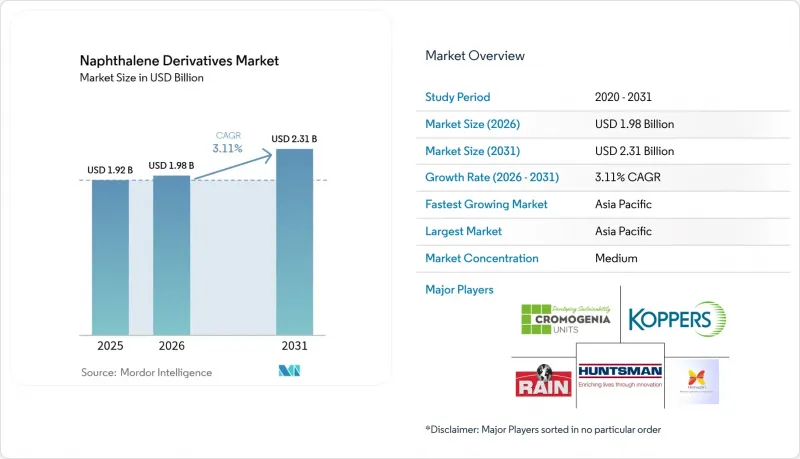
This report Segments the Industry by Form (Powder and Liquid), Source (Coal-Tar, Petroleum-Based, and More), Derivative (Sulphonated Naphthalene Formaldehyde (SNF), Phthalic Anhydride, and More), End-User Industry (Construction, Paints and Coatings, and More), and Geography (Asia-Pacific, North America, and More). The Market Forecasts are Provided in Terms of Value (USD).
Global Naphthalene Derivatives Market Trends and Insights
Expanding Construction Demand for Naphthalene-Based Superplasticizers
Global infrastructure upgrades extend the life of the naphthalene derivatives market by underpinning steady SNF throughput. Field trials show SNF dosing near 0.9% combined with 20% silica fume improves compressive strength and workability in ultra-high-performance concrete. China's stimulus packages worth more than USD 1.3 trillion steer a large share toward rail, bridge, and public-housing programs, keeping regional demand buoyant. Developers prefer SNF because its performance is robust under extreme temperature swings, a requirement in megaprojects across Asia and the Middle East. Stable pricing for SNF helps contractors contain budget overruns, sustaining order volumes even when other derivative categories fluctuate. Consequently, construction remains the demand floor for the naphthalene derivatives market through the decade.
Rising Consumption in Textile Dye Intermediates
Textile production rebound across South and Southeast Asia has restored the purchasing of naphthol and naphthalene sulphonic acid. India's specialty-chemicals revenue path to USD 50 billion by 2025 feeds a growing base of high-performance dye plants that favor naphthalene-based intermediates for superior colorfastness. Despite margin pressure, consolidation among Chinese dye makers funnels output into fewer, larger facilities that value consistent supply security. Regional free-trade pacts also incentivize local sourcing, reducing exposure to ocean freight volatility. This textile-dye pull supports incremental volume on top of construction base demand, ensuring diversified growth for the naphthalene derivatives market.
Carcinogenic-Toxicity Regulations
The EU's Revision of Annex XVII to REACH now caps polycyclic-aromatic-hydrocarbon emissions from clay targets and similar articles by April 2026, effectively mandating 99% reductions for naphthalene content. In the United States, the EPA began a formal risk evaluation of naphthalene in December 2024, broadening data-collection obligations and foreshadowing stricter workplace-exposure limits. The CDC updated its toxicological profile, spotlighting hemolytic-anemia risk for populations with G6PD deficiency. Producers now budget for higher monitoring costs, engineering controls, and possible reformulations, expenses that weigh on profitability in the naphthalene derivatives market. Larger, diversified firms can absorb these costs, but smaller regional players may exit or seek mergers.
Other drivers and restraints analyzed in the detailed report include:
- Surging Demand for Phthalic Anhydride Plasticizers
- Growth of Agrochemical Wetting-Agent Applications
- Coal-Tar Supply & Price Volatility
For complete list of drivers and restraints, kindly check the Table Of Contents.
Segment Analysis
Powder products generated 61.71% of 2025 revenue, underscoring their logistics friendliness in high-volume applications such as concrete admixtures. Powder's lower bulk density and moisture tolerance allow long-distance shipping without caking, an advantage for construction megaprojects that draw on imported material. Cement producers also favor dry dosing because it simplifies automated batching and reduces on-site cleanup. This entrenched preference lends stability to the naphthalene derivatives market.
Liquid derivatives, expanding at a 3.66% CAGR, satisfy niche needs in pharmaceuticals, micro-electronics and specialty coatings where exact dosing and immediate dissolution matter. Their contamination risk is lower because sealed drums prevent dust ingress that can interfere with high-purity applications. Growth in battery-electrolyte additives likewise tilts toward liquid formats, supporting gradual share gain while powder remains dominant.
Coal tar retained a 57.02% share of the feedstock supply in 2025, enabling economical aromatics extraction via established distillation units with coke plants. The resulting price edge sustains competitiveness for bulk SNF and phthalic-anhydride chains. However, vulnerability arises as global steel production plateaus and environmental mandates target coke ovens. Diversification into petroleum-derived streams and renewable naphtha thus ranks high on executive agendas within the naphthalene derivatives market.
Alternative sources show a 3.92% CAGR, buoyed by pilot plants converting waste cooking oil into renewable naphtha and by FCC refineries that integrate aromatic recovery. Technology vendors like Topsoe report commercial interest in circular-aromatics units co-producing benzene, toluene, xylenes, and naphthalene. Although absolute volume is low, the trajectory points to a more balanced supply mix by 2031.
Complete Report Scope:
- By Form
- Powder
- Liquid
- By Source
- Coal-Tar
- Petroleum-based
- Other Source (Bio-refinery, etc.)
- By Derivative
- Sulphonated Naphthalene Formaldehyde (SNF)
- Phthalic Anhydride
- Naphthalene Sulphonic Acid
- Naphthols (a, B)
- Alkyl Naphthalene Sulphonate Salts
- Others (1,6- & 1,8-Dihydroxynaphthalene, NDCA etc.)
- By End-User Industry
- Construction
- Paints and Coatings
- Textile
- Pulp and Paper
- Oil and Gas
- Pharmaceuticals
- Others End-User Industries (Electronics, Batteries, etc.)
- By Geography
- Asia-Pacific
- China
- India
- Japan
- South Korea
- Rest of Asia-Pacific
- North America
- United States
- Canada
- Mexico
- Europe
- Germany
- United Kingdom
- France
- Italy
- Rest of Europe
- South America
- Brazil
- Argentina
- Rest of South America
- Middle East and Africa
- Saudi Arabia
- South Africa
- Rest of Middle East and Africa
- Asia-Pacific
Geography Analysis
Asia-Pacific generated 53.35% of global volume in 2025 and is projected to log the fastest 4.06% CAGR to 2031. Government-backed megaprojects anchor construction demand in China, India, and Indonesia, while regional consumer-electronics clusters drive specialty-grade uptake. China's refining sector processed 14.8 million barrels daily of crude in 2024, ensuring ample aromatics feedstock. The region's aromatics build-out, adding 11.8 million t of capacity, intensifies competition and secures raw-material availability, strengthening the naphthalene derivatives market.
North America shows a mature demand profile, with steady replacement of aging bridges and highways underpinning SNF volumes. The EPA's ongoing risk evaluation injects compliance uncertainty, encouraging producers to invest early in emission-control technologies to safeguard access. Canada's petrochemical corridor in Alberta explores renewable-naphtha integration that could eventually supply naphthalene cuts, while Mexico's proximity to US construction markets sustains cross-border trade in powder SNF.
Europe faces structural headwinds from high energy prices and stringent carbon regulations, yet it remains at the forefront of sustainable-chemistry innovation. BioBTX's plan to commission a waste-to-aromatics unit by 2026 exemplifies circular-economy alignment. Germany's R&D leadership in automotive coatings keeps specialty naphthalene derivatives on procurement lists, although suppliers must certify lower residual PAH levels to comply with REACH. Southern European infrastructure upgrades tied to EU recovery funds provide a modest uplift for SNF demand.
- Biosynth Carbosynth
- CARBON TECH Group
- Chemanol
- Clariant AG
- Cromogenia Units
- Enaspol a.s.
- GCP Applied Technologies
- Himadri Specialty Chemical Ltd.
- Huntsman International LLC
- JFE Chemical Corporation
- King Industries Inc.
- Koppers Inc.
- MITSUBISHI GAS CHEMICAL COMPANY, INC.
- Nippon Steel Chemical & Material Co.
- Rain Carbon Inc.
Additional Benefits:
- The market estimate (ME) sheet in Excel format
- 3 months of analyst support
TABLE OF CONTENTS
1 Introduction
- 1.1 Study Assumptions & Market Definition
- 1.2 Scope of the Study
2 Research Methodology
3 Executive Summary
4 Market Landscape
- 4.1 Market Overview
- 4.2 Market Drivers
- 4.2.1 Expanding construction demand for naphthalene-based super-plasticizers
- 4.2.2 Rising consumption in textile dye intermediates
- 4.2.3 Surging demand for phthalic anhydride plasticizers
- 4.2.4 Growth of agrochemical wetting-agent applications
- 4.2.5 Adoption in graphene & advanced composite dispersants
- 4.3 Market Restraints
- 4.3.1 Carcinogenic-toxicity regulations
- 4.3.2 Coal-tar supply & price volatility
- 4.3.3 Substitution by bio-based/polycarboxylate super-plasticizers (under-reported)
- 4.4 Value Chain Analysis
- 4.5 Porter's Five Forces
- 4.5.1 Bargaining Power of Suppliers
- 4.5.2 Bargaining Power of Buyers
- 4.5.3 Threat of New Entrants
- 4.5.4 Threat of Substitutes
- 4.5.5 Degree of Competition
5 Market Size & Growth Forecasts
- 5.1 By Form
- 5.1.1 Powder
- 5.1.2 Liquid
- 5.2 By Source
- 5.2.1 Coal-Tar
- 5.2.2 Petroleum-based
- 5.2.3 Other Source (Bio-refinery, etc.)
- 5.3 By Derivative
- 5.3.1 Sulphonated Naphthalene Formaldehyde (SNF)
- 5.3.2 Phthalic Anhydride
- 5.3.3 Naphthalene Sulphonic Acid
- 5.3.4 Naphthols (a, B)
- 5.3.5 Alkyl Naphthalene Sulphonate Salts
- 5.3.6 Others (1,6- & 1,8-Dihydroxynaphthalene, NDCA etc.)
- 5.4 By End-User Industry
- 5.4.1 Construction
- 5.4.2 Paints and Coatings
- 5.4.3 Textile
- 5.4.4 Pulp and Paper
- 5.4.5 Oil and Gas
- 5.4.6 Pharmaceuticals
- 5.4.7 Others End-User Industries (Electronics, Batteries, etc.)
- 5.5 By Geography
- 5.5.1 Asia-Pacific
- 5.5.1.1 China
- 5.5.1.2 India
- 5.5.1.3 Japan
- 5.5.1.4 South Korea
- 5.5.1.5 Rest of Asia-Pacific
- 5.5.2 North America
- 5.5.2.1 United States
- 5.5.2.2 Canada
- 5.5.2.3 Mexico
- 5.5.3 Europe
- 5.5.3.1 Germany
- 5.5.3.2 United Kingdom
- 5.5.3.3 France
- 5.5.3.4 Italy
- 5.5.3.5 Rest of Europe
- 5.5.4 South America
- 5.5.4.1 Brazil
- 5.5.4.2 Argentina
- 5.5.4.3 Rest of South America
- 5.5.5 Middle East and Africa
- 5.5.5.1 Saudi Arabia
- 5.5.5.2 South Africa
- 5.5.5.3 Rest of Middle East and Africa
- 5.5.1 Asia-Pacific
6 Competitive Landscape
- 6.1 Market Concentration
- 6.2 Strategic Moves
- 6.3 Market Share(%)/Ranking Analysis
- 6.4 Company Profiles (includes Global level Overview, Market level overview, Core Segments, Financials as available, Strategic Information, Market Rank/Share for key companies, Products & Services, and Recent Developments)
- 6.4.1 Biosynth Carbosynth
- 6.4.2 CARBON TECH Group
- 6.4.3 Chemanol
- 6.4.4 Clariant AG
- 6.4.5 Cromogenia Units
- 6.4.6 Enaspol a.s.
- 6.4.7 GCP Applied Technologies
- 6.4.8 Himadri Specialty Chemical Ltd.
- 6.4.9 Huntsman International LLC
- 6.4.10 JFE Chemical Corporation
- 6.4.11 King Industries Inc.
- 6.4.12 Koppers Inc.
- 6.4.13 MITSUBISHI GAS CHEMICAL COMPANY, INC.
- 6.4.14 Nippon Steel Chemical & Material Co.
- 6.4.15 Rain Carbon Inc.
7 Market Opportunities & Future Outlook
- 7.1 White-space & Unmet-need Assessment

