PUBLISHER: Mordor Intelligence | PRODUCT CODE: 2114923

PUBLISHER: Mordor Intelligence | PRODUCT CODE: 2114923
Zinc Citrate - Market Share Analysis, Industry Trends & Statistics, Growth Forecasts (2026 - 2031)
According to Mordor Intelligence, the zinc citrate market size was valued at USD 2.14 billion in 2025 and estimated to grow from USD 2.23 billion in 2026 to reach USD 2.73 billion by 2031, at a CAGR of 4.12% during the forecast period (2026-2031).
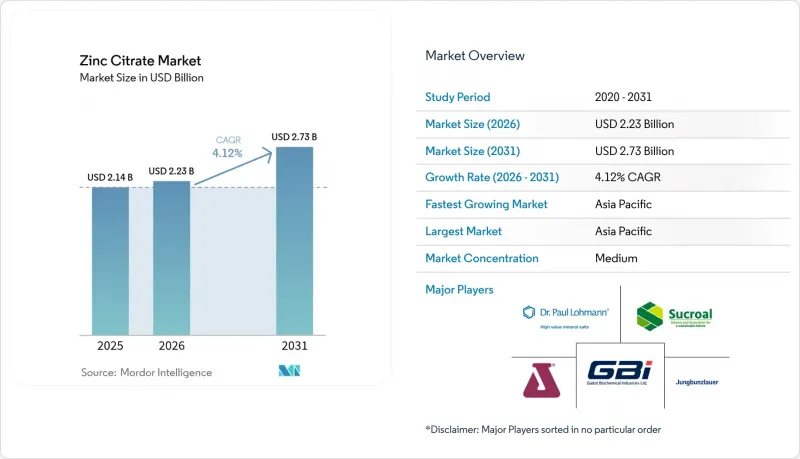
This report is Segmented by Form (Dihydrate, Trihydrate), Purity Grade (Pharma Grade, Food & Beverage Grade, Technical Grade), Application (Personal Care, Healthcare, Food & Beverage, Agriculture, Other Applications), and Geography (Asia-Pacific, North America, Europe, South America, Middle East and Africa). The Market Forecasts are Provided in Terms of Value (USD).
Global Zinc Citrate Market Trends and Insights
Demand Surge for Immune-Health Supplements
Heightened post-pandemic awareness of micronutrient gaps has pushed zinc citrate into center stage for immune formulations, supported by EFSA recognition of zinc's role in normal immune function. Clinical work shows supplementation improves neutrophil chemotaxis and NK-cell activity, outcomes that matter for older adults who experience declining absorption efficiency. Superior uptake over inorganic salts enables premium positioning, and pairing zinc citrate with probiotic strains such as Alkalihalobacillus clausii enhances gut-immune crosstalk, adding perceived value for formulators. Pharmaceutical-grade demand benefits most because consistent bioavailability underpins therapeutic claims. Ageing populations in North America and Europe therefore ensure a stable demand floor for the zinc citrate market.
Accelerating Uptake in Oral-Care Formulations
Clinical trials document 13.4% gingivitis and 55.3% gingival-bleeding reductions when zinc citrate is used in toothpaste, validating its antimicrobial activity against common periodontal pathogens. Unlike zinc chloride or sulfate, the chelate gives comparable efficacy without bitter or metallic notes, key for consumer acceptance. In 2024, the Expert Panel for Cosmetic Ingredient Safety reaffirmed zinc citrate's safety, removing a regulatory block that had slowed adoption. Co-formulation with arginine offers synergistic biofilm disruption, permitting lower zinc loads and better cost economics. The broader consumer shift toward aluminum-free personal-care items accelerates zinc citrate demand in deodorants and antiperspirants, strengthening the zinc citrate market outlook.
Low-Cost Substitutes (Oxide, Gluconate, Sulfate)
Zinc oxide sells at a steep discount to zinc citrate, making it the default choice in price-sensitive crop nutrition and bulk-technical formulations. Gluconate reaches similar absorption levels (60.9%) for less money, eroding zinc citrate's premium proposition in mass-market supplements. Industrial users keep favoring zinc sulfate because supply chains and regulatory templates are well established. With commodity zinc markets entering cyclical oversupply, price gaps widen, forcing formulators to justify added cost through stronger efficacy claims-a hurdle in the near term for the zinc citrate market.
Other drivers and restraints analyzed in the detailed report include:
- Growth of Zinc-Fortified Food and Beverage Products
- Growing Demand for Gummy/Chelated Delivery Formats
- Citric-Acid Feedstock Price Volatility
For complete list of drivers and restraints, kindly check the Table Of Contents.
Segment Analysis
Trihydrate took 61.87% of the zinc citrate market share in 2025, reflecting balanced zinc content and superior processing attributes. The form is forecast to clock a 4.62% CAGR through 2031 as supplement makers favor its low hygroscopicity for stable tablets and capsules. Trihydrate also opens agronomic possibilities: nanoparticulate trihydrate achieves faster leaf uptake, an advantage as biofortification programs scale. Dihydrate remains in niche pharmaceutical use where specific dissolution profiles matter, but handling complexity restrains growth. As beverage companies and personal-care formulators require resilient ingredients across pH ranges, trihydrate's broad compatibility should elongate its lead in the zinc citrate market.
A manufacturing base already optimized for trihydrate crystallization furthers economies of scale, enabling competitive pricing despite higher raw material costs. Its stability under both acidic beverage conditions and alkaline dentifrice environments underscores why the zinc citrate market size for trihydrate-based products is projected to expand steadily through the forecast.
Complete Report Scope:
- By Form
- Dihydrate
- Trihydrate
- By Purity Grade
- Pharma Grade
- Food and Beverage Grade
- Technical Grade
- By Application
- Personal Care
- Healthcare
- Food and Beverage
- Agriculture
- Other Applications (Industrial, etc.)
- By Geography
- Asia-Pacific
- China
- Japan
- India
- South Korea
- ASEAN Countries
- Rest of Asia-Pacific
- North America
- United States
- Canada
- Mexico
- Europe
- Germany
- United Kingdom
- France
- Italy
- Spain
- Russia
- NORDIC Countries
- Rest of Europe
- South America
- Brazil
- Argentina
- Rest of South America
- Middle East and Africa
- Saudi Arabia
- South Africa
- Rest of Middle East and Africa
- Asia-Pacific
Geography Analysis
Asia-Pacific retained 39.05% of the zinc citrate market size in 2025 and is on track for a 4.65% CAGR to 2031. China's dominance in citric-acid manufacturing delivers feedstock security, while India's fortification and biofortification policies keep agricultural demand buoyant. Urban middle-class expansion boosts supplement and personal-care sales, and regional sustainability initiatives such as Hindustan Zinc's low-carbon EcoZen brand align well with multinational buyers seeking greener minerals.
North America follows, buoyed by an established supplement culture and robust gummy-vitamin sales. FDA's GRAS status streamlines product launches, but high import reliance for refined zinc (76%) leaves supply chains sensitive to external shocks. Advanced personalization platforms push chelated minerals, supporting premium pricing, though overall regional growth trails emerging economies.
Europe shows steady demand underpinned by pharmaceutical and oral-care production hubs. EFSA's positive stance toward chelated zinc eases regulatory hurdles, and clean-label trends amplify interest. Geopolitical trade friction and Brexit add costs, yet diversified suppliers mitigate disruption risk. Biofortification projects in Eastern Europe could inject new agricultural demand if pilot trials prove cost-effective versus sulfate agronomy. Environmental regulation favoring lower-dose bioavailable forms reinforces zinc citrate's ecological proposition.
- Ava Chemicals.
- Dr. Paul Lohmann GmbH & Co. KGaA
- Gadot Biochemical Industries Ltd.
- Global Calcium
- Henan Alfa Chemical Co., Ltd.
- Jost Chemical Co.
- Jungbunzlauer Suisse AG
- Kronox Lab Sciences Ltd.
- NINGXIANG Xinyang Chemical Co., Ltd.
- Noah Chemicals
- Salvi Chemical Industries Ltd.
- Sisco Research Laboratories Pvt. Ltd.
- Sucroal
- Thermo Fisher Scientific Inc.
Additional Benefits:
- The market estimate (ME) sheet in Excel format
- 3 months of analyst support
TABLE OF CONTENTS
1 Introduction
- 1.1 Study Assumptions & Market Definition
- 1.2 Scope of the Study
2 Research Methodology
3 Executive Summary
4 Market Landscape
- 4.1 Market Overview
- 4.2 Market Drivers
- 4.2.1 Demand surge for immune-health supplements
- 4.2.2 Accelerating uptake in oral-care formulations
- 4.2.3 Growth of zinc-fortified food and beverage products
- 4.2.4 Growing demand for Gummy/chelated delivery formats
- 4.2.5 Bio-fortification programs in agri-micronutrients
- 4.3 Market Restraints
- 4.3.1 Low-cost substitutes (oxide, gluconate, sulfate)
- 4.3.2 Citric-acid feedstock price volatility
- 4.3.3 Clinical debates on relative antibacterial efficacy
- 4.4 Value Chain Analysis
- 4.5 Porter's Five Forces
- 4.5.1 Bargaining Power of Suppliers
- 4.5.2 Bargaining Power of Buyers
- 4.5.3 Threat of New Entrants
- 4.5.4 Threat of Substitutes
- 4.5.5 Degree of Competition
5 Market Size & Growth Forecasts (Value)
- 5.1 By Form
- 5.1.1 Dihydrate
- 5.1.2 Trihydrate
- 5.2 By Purity Grade
- 5.2.1 Pharma Grade
- 5.2.2 Food and Beverage Grade
- 5.2.3 Technical Grade
- 5.3 By Application
- 5.3.1 Personal Care
- 5.3.2 Healthcare
- 5.3.3 Food and Beverage
- 5.3.4 Agriculture
- 5.3.5 Other Applications (Industrial, etc.)
- 5.4 By Geography
- 5.4.1 Asia-Pacific
- 5.4.1.1 China
- 5.4.1.2 Japan
- 5.4.1.3 India
- 5.4.1.4 South Korea
- 5.4.1.5 ASEAN Countries
- 5.4.1.6 Rest of Asia-Pacific
- 5.4.2 North America
- 5.4.2.1 United States
- 5.4.2.2 Canada
- 5.4.2.3 Mexico
- 5.4.3 Europe
- 5.4.3.1 Germany
- 5.4.3.2 United Kingdom
- 5.4.3.3 France
- 5.4.3.4 Italy
- 5.4.3.5 Spain
- 5.4.3.6 Russia
- 5.4.3.7 NORDIC Countries
- 5.4.3.8 Rest of Europe
- 5.4.4 South America
- 5.4.4.1 Brazil
- 5.4.4.2 Argentina
- 5.4.4.3 Rest of South America
- 5.4.5 Middle East and Africa
- 5.4.5.1 Saudi Arabia
- 5.4.5.2 South Africa
- 5.4.5.3 Rest of Middle East and Africa
- 5.4.1 Asia-Pacific
6 Competitive Landscape
- 6.1 Market Concentration
- 6.2 Strategic Moves
- 6.3 Market Share(%)/Ranking Analysis
- 6.4 Company Profiles (includes Global level Overview, Market level overview, Core Segments, Financials as available, Strategic Information, Market Rank/Share for key companies, Products & Services, and Recent Developments)
- 6.4.1 Ava Chemicals.
- 6.4.2 Dr. Paul Lohmann GmbH & Co. KGaA
- 6.4.3 Gadot Biochemical Industries Ltd.
- 6.4.4 Global Calcium
- 6.4.5 Henan Alfa Chemical Co., Ltd.
- 6.4.6 Jost Chemical Co.
- 6.4.7 Jungbunzlauer Suisse AG
- 6.4.8 Kronox Lab Sciences Ltd.
- 6.4.9 NINGXIANG Xinyang Chemical Co., Ltd.
- 6.4.10 Noah Chemicals
- 6.4.11 Salvi Chemical Industries Ltd.
- 6.4.12 Sisco Research Laboratories Pvt. Ltd.
- 6.4.13 Sucroal
- 6.4.14 Thermo Fisher Scientific Inc.
7 Market Opportunities & Future Outlook
- 7.1 White-space & Unmet-need Assessment

